· AtlasPCB Engineering · Engineering · 21 min read
How to Compare PCB Quotes: A Manufacturer's Guide to Reading Between the Line Items
A PCB manufacturer explains what every line item on a fabrication quote actually means, why identical specifications produce wildly different prices, and how to compare quotes on an equal footing. Includes specific cost multipliers from production, a line-item normalization checklist, red flags that signal unreliable pricing, and a total-cost-of-ownership framework that goes beyond unit price.

Quick Answer
Comparing PCB quotes requires normalizing every line item to an equal basis because manufacturers structure pricing differently — some bundle testing and tooling into the unit price while others list them separately, and some absorb NRE costs into recurring charges while others call them out explicitly. The most reliable comparison method is to calculate the total landed cost per board including all fees (tooling, testing, packaging, documentation, shipping, and customs) divided by the order quantity, then evaluate that number against each manufacturer's engineering capability, quality track record, and communication responsiveness. Prices for identical specifications routinely vary by 200 to 300 percent across manufacturers, and the cheapest quote is often not the lowest total cost when factoring in quality failures, delays, and design re-spins.
Reviewed by AtlasPCB Engineering Team
An engineer sends the same Gerber files, the same stackup drawing, and the same specification sheet to five PCB manufacturers. The quotes come back: $12.40 per board, $18.90, $24.50, $31.00, and $47.80. Same board, same quantity, same stated requirements. The spread from lowest to highest is nearly four to one, and every manufacturer claims to meet the specification.
This scenario plays out thousands of times per day across the global electronics industry, and it leaves procurement teams and design engineers with a fundamental problem: these numbers are not directly comparable, because they do not all include the same things. One quote bundles electrical testing into the unit price. Another lists it as a separate line item. A third does not mention testing at all — not because they skip it, but because they add the charge after the order is placed. One manufacturer includes tooling amortized across the order quantity. Another charges tooling separately and quotes only the marginal cost per board. A third absorbs tooling for orders above a certain quantity threshold but does not mention where that threshold falls.
The result is that comparing PCB quotes on unit price alone is roughly as useful as comparing apartment rents without checking whether utilities are included. You need a systematic approach that normalizes every quote to the same basis before the numbers become meaningful.
At AtlasPCB, we review competitor quotes regularly — engineers send them to us when negotiating, and we see the full range of how pricing is structured across the industry. What follows is our perspective on what PCB pricing actually represents, how to decode what each line item covers, and how to make comparisons that reflect real cost rather than quoted cost.
What Every Line Item on a PCB Quote Actually Represents
A PCB fabrication quote, regardless of how it is formatted, covers costs from five fundamental categories: materials, processing, quality assurance, engineering overhead, and logistics. Understanding what falls into each category makes it much easier to see where manufacturers are shifting costs between line items rather than actually offering different pricing.
Materials encompass the base laminate, copper foil, prepreg, solder mask ink, silkscreen ink, and surface finish chemistry. For a standard four-layer board on FR-4 laminate with one-ounce copper and HASL surface finish, materials typically represent 25 to 35 percent of the total fabrication cost. When the specification calls for high-performance materials like Rogers or Megtron, the material share can climb to 50 percent or more because specialty laminates cost three to ten times more per square meter than standard FR-4.
Processing covers every step from laminate cutting through final routing: inner layer imaging, etching, oxide treatment, lamination, drilling, desmear, copper plating, outer layer imaging, solder mask application, silkscreen printing, surface finish, and profiling. Processing costs are driven primarily by the number of process steps (which correlates with layer count and feature complexity), the equipment time per panel, and the yield rate. A simple two-layer board passes through roughly twelve major process steps. A ten-layer board with blind and buried vias passes through twenty-five or more, with multiple lamination cycles that each require press time, alignment, and inspection.
Quality assurance includes automated optical inspection of every layer, electrical testing of the finished board (either flying probe or fixture-based), impedance verification via test coupons when impedance control is specified, microsection analysis for process qualification, and final visual inspection. In a well-run factory, quality assurance represents 10 to 15 percent of the total cost. Some manufacturers absorb this into the unit price. Others break it out — and a few leave it off the quote entirely, which should raise immediate concern.
Engineering overhead covers the CAM (computer-aided manufacturing) processing of your design files, panelization layout, drill program generation, impedance modeling, and any DFM review or engineering questions that arise during pre-production. This work typically takes one to four hours per new design, depending on complexity. Manufacturers handle this cost in three ways: some include it in the unit price and never mention it; some charge an explicit NRE (non-recurring engineering) fee on the first order but waive it on repeat orders; and some list it as a “tooling” charge that may or may not recur.
Logistics includes packaging (boards may be individually separated, vacuum-sealed with desiccant for moisture-sensitive applications, or bulk-packed), any required documentation (certificates of conformance, test reports, material certifications), and shipping. International orders add customs duties, brokerage fees, and potentially import VAT depending on the destination country.
The critical insight is that every manufacturer pays all five categories of cost. The question is not whether they incur these costs — they do — but where each cost appears on the quote. A manufacturer quoting $12.40 per board is not necessarily cheaper than one quoting $18.90 if the first quote excludes electrical testing, charges tooling separately, and adds packaging fees that the second quote has already bundled in.
The Seven Specification Drivers That Move Pricing Most
Certain specification choices have outsized effects on fabrication cost. Understanding these multipliers helps you anticipate pricing before quotes arrive, identify which specifications are driving cost in a received quote, and make informed design trade-offs when budget constraints are tight.
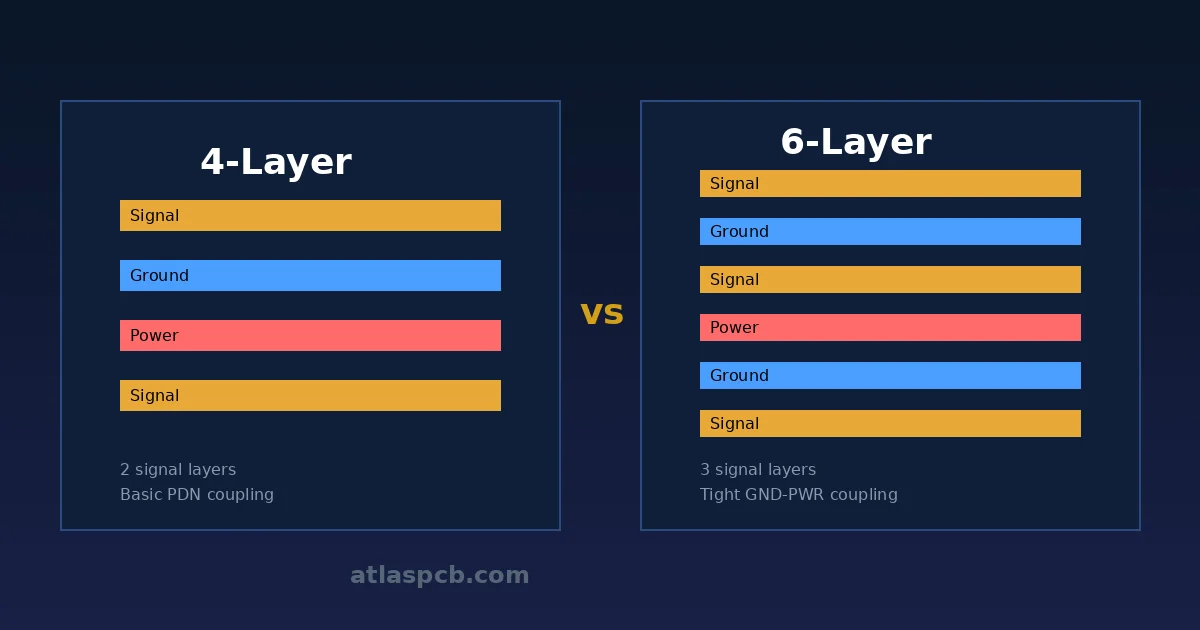
Layer count is the single largest cost driver. Each additional pair of layers requires additional laminate, additional imaging and etching cycles, additional lamination press cycles, and additional drilling operations. As a rough benchmark from our production data: going from two layers to four layers multiplies the base fabrication cost by 1.6 to 1.8 times. Going from four to six layers adds another 1.4 to 1.6 multiplier. Eight layers run approximately 2.0 to 2.5 times the four-layer cost, and ten or more layers typically run 3.0 times or more. These multipliers vary by manufacturer depending on their equipment utilization and press capacity, which is one reason quotes differ significantly on multilayer boards.
Minimum trace width and spacing affects yield and may trigger different imaging technology. Standard processing at 100 to 150 micrometer (4 to 6 mil) trace and space uses well-established parameters with high yield. Pushing to 75 micrometers (3 mil) typically adds a 10 to 20 percent premium. Below 75 micrometers, you enter the territory of advanced direct imaging and tighter process controls, adding 30 to 50 percent. And below 50 micrometers, you may require mSAP or semi-additive processing, which carries a 60 to 100 percent premium.
Minimum hole size determines whether mechanical drilling alone is sufficient or whether laser drilling is required. Standard mechanical drilling handles holes down to approximately 0.2 millimeters (8 mil) economically. Holes between 0.15 and 0.2 millimeters require premium drill bits and slower feed rates, adding 15 to 25 percent to drilling costs. Below 0.15 millimeters, laser drilling becomes necessary, and the cost structure shifts significantly because laser drilling equipment has different throughput characteristics than mechanical drilling.
Surface finish produces a predictable cost ladder. HASL (hot air solder leveling) is the baseline. Lead-free HASL adds roughly 5 to 10 percent. OSP (organic solderability preservative) is comparable to HASL in cost but has a shorter shelf life. Immersion tin adds 15 to 20 percent. Immersion silver adds 20 to 30 percent. ENIG (electroless nickel immersion gold) adds 30 to 50 percent depending on gold thickness. ENEPIG adds 50 to 70 percent. Hard gold plating for edge connectors adds localized cost depending on the plated area.
Board thickness and copper weight affect material cost and processing difficulty. Non-standard thicknesses below 0.8 millimeters or above 2.4 millimeters require special handling and may limit panel utilization. Heavy copper above two ounces requires modified etching parameters, wider trace compensation, and sometimes multiple plating passes, typically adding 15 to 30 percent per additional ounce of copper.
Impedance control adds cost through tighter process controls, impedance test coupon fabrication and measurement, and the documentation to prove compliance. A standard impedance-controlled board with +/-10 percent tolerance adds roughly 10 to 15 percent to the fabrication cost. Tightening to +/-7 percent adds 20 to 30 percent, and +/-5 percent can add 40 percent or more because the yield impact of tighter tolerances is non-linear.
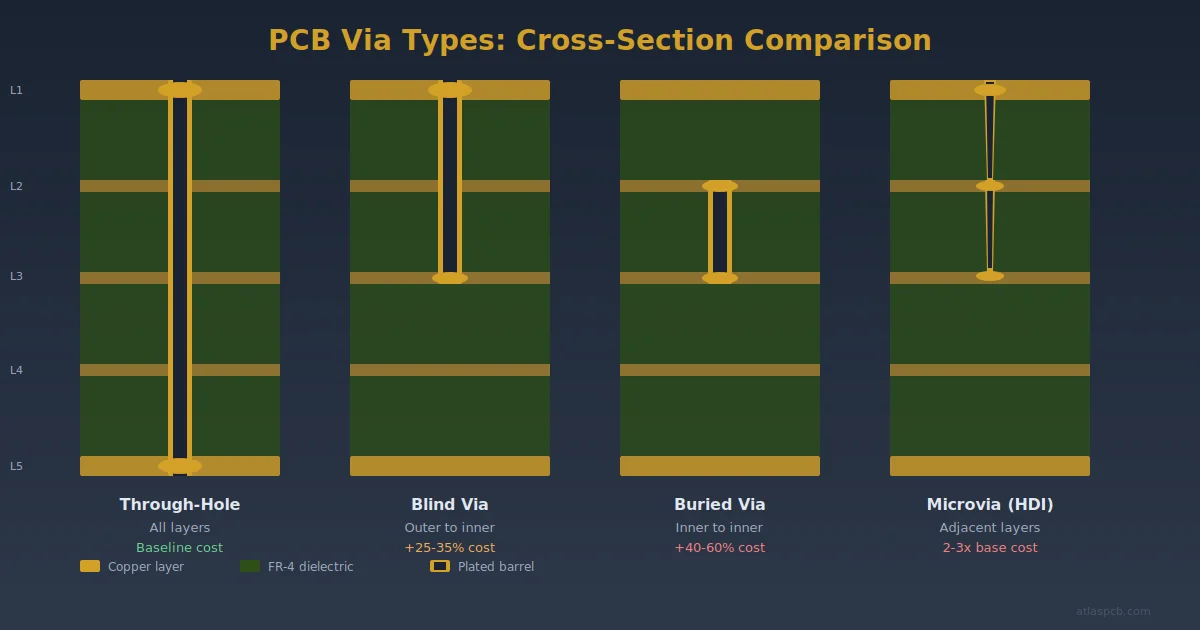
Special features such as blind and buried vias, via-in-pad with planarization, backdrilling, edge plating, controlled-depth routing, and selective surface finish all add specific cost increments. These features require additional process steps, specialized equipment, and often sequential lamination cycles that reduce panel throughput.

How to Normalize Quotes for Apples-to-Apples Comparison
The fundamental problem with comparing PCB quotes is that there is no industry-standard format. Every manufacturer structures their quote differently. Some provide a single unit price with everything bundled. Others break out ten or fifteen line items. Some list per-panel costs that you need to convert to per-board costs yourself. And some provide “estimated” figures that change once your files are reviewed in CAM.
The solution is to normalize every quote to a single metric: total landed cost per delivered board. Here is how to calculate it.
Start by listing every charge from the quote, categorized into one-time costs and recurring costs. One-time costs include tooling, NRE, stencil fabrication (if PCBA is included), and first-article inspection fees. Recurring costs include the unit fabrication price, electrical testing (if listed separately), packaging, documentation, and shipping. If any of these items are not mentioned in the quote, contact the manufacturer and ask explicitly whether they are included in the unit price or whether they will appear as additional charges.
Calculate the total order cost as: (one-time costs) + (unit price x quantity) + (all separate recurring line items x quantity where applicable) + shipping + customs duties. Then divide by the delivered quantity to get the total landed cost per board.
This normalization reveals the true comparison. A quote listing $14.50 per board with $300 tooling, $150 testing setup, and $85 shipping on a 100-board order works out to $14.50 + ($535 / 100) = $19.85 per delivered board. A competing quote listing $19.00 per board with tooling, testing, and standard shipping included works out to $19.00 per delivered board — which is actually cheaper despite the higher unit price.
When you are evaluating quotes, use this checklist of items to verify are either included or explicitly quoted:
Electrical testing (flying probe or fixture) — every board should be 100-percent tested. If a manufacturer does not mention testing, ask. If they say they do not test every board, that is a disqualifying red flag for anything beyond the simplest consumer applications.
Impedance testing — if your design specifies controlled impedance, verify that the quote includes fabrication and measurement of impedance test coupons. Some manufacturers include this automatically; others charge $50 to $200 per impedance requirement.
Panelization — verify whether the manufacturer optimizes panel utilization or uses your specified panelization. Poor panel utilization can increase the effective material cost per board by 20 to 40 percent.
Documentation — if you need certificates of conformance, material traceability certificates, or IPC test reports, verify these are quoted. Some manufacturers include them; others charge $50 to $150 per document set.
Packaging — verify the packaging method meets your requirements. Vacuum-sealed packaging with desiccant for boards with ENIG or immersion silver finish prevents tarnishing during transit and storage. If the manufacturer quotes bulk packaging and your finish requires moisture protection, you may face surface finish issues on arrival.
Red Flags That Signal an Unreliable Quote
Experience reviewing thousands of competitive quotes has taught us that certain patterns reliably predict problems downstream. Recognizing these red flags before placing an order saves far more money than any price negotiation.
A unit price dramatically below the market range is the clearest warning sign. If four manufacturers quote between $15 and $25 for a particular board and one quotes $8, the low-cost manufacturer is either cutting corners on materials or process controls, planning to recover margin through hidden fees and change orders, or misreading the specification and quoting a simpler board than what was specified. In any scenario, the $8 quote leads to problems.
No mention of electrical testing means either the manufacturer does not test (unacceptable for anything beyond hobbyist prototypes) or they plan to charge for it later. Electrical testing catches opens, shorts, and isolation failures that visual inspection cannot detect. A board that ships without electrical testing is a board that may fail in your assembly line or, worse, in the field.
Vague material specifications like “high-quality FR-4” without naming the laminate manufacturer and grade should prompt questions. There is a measurable difference between a Shengyi S1000-2 and a generic FR-4 from an unbranded supplier, particularly in dielectric constant consistency, moisture absorption, and thermal reliability. If material properties matter for your application — and they matter for more applications than most engineers realize — the quote should specify the material.
Unrealistic lead times relative to the board’s complexity are a concern. A standard four-layer FR-4 board can legitimately ship in five to seven working days. A ten-layer impedance-controlled board with blind vias and ENIG finish cannot, regardless of what a manufacturer promises. Compressing lead times on complex boards means skipping or shortening process controls, which directly impacts quality. A manufacturer promising a five-day turn on a board that realistically requires twelve days is either lying about the lead time or cutting corners on quality controls.
No DFM feedback after file submission suggests the manufacturer ran your files through an automated system without engineering review. A competent fabricator encountering a design for the first time will almost always have questions or suggestions — a trace-to-edge clearance that could cause reliability issues, a via size that pushes the aspect ratio limit, an annular ring that falls below IPC minimums under worst-case registration. If a manufacturer accepts every set of files without comment, they are either not reviewing them or not telling you about the issues they find.
Total Cost of Ownership — When the Cheapest Quote Costs the Most
Unit price is one number in a much larger equation. The total cost of ownership for a PCB order encompasses quality-related costs, schedule-related costs, and engineering support value, all of which affect the final economics far more than most procurement analyses acknowledge.
Quality failures are the most expensive hidden cost in PCB procurement. A board that arrives with impedance values outside tolerance may pass incoming inspection if you do not verify impedance, then cause functional failures at board-level test or, worse, in the field after assembly. The cost of a single field failure — including diagnosis, rework or replacement, customer communication, and reputation damage — typically exceeds the entire cost of the PCB order by a factor of ten or more. Even catching quality issues during incoming inspection or assembly means scrapped boards, delayed production, and emergency reorders at expedited pricing.
The mathematics are straightforward. Suppose you order 500 boards at $15 each from a low-cost manufacturer versus $20 each from a manufacturer with a stronger quality track record. The savings on the order are $2,500. If the low-cost manufacturer delivers boards with a 3 percent defect rate that you catch during assembly — a rate that would be considered unacceptably high by any quality-focused manufacturer but is not uncommon among the cheapest suppliers — you scrap 15 boards ($225 in PCB cost, but potentially $1,500 or more in assembled board value if components have already been placed), delay your production schedule while waiting for replacements, and spend engineering time diagnosing whether the failures are design-related or fabrication-related. The $2,500 “savings” evaporates immediately.
Schedule delays compound the problem. A manufacturer who quotes an aggressive lead time to win the order and then delivers late forces your entire production schedule to shift. If your product launch depends on that delivery — and in the fast-moving electronics industry, it usually does — the cost of a one-week delay can dwarf the entire PCB budget.
Engineering support represents real value that does not appear as a line item but directly affects outcomes. A manufacturer who identifies a DFM issue during pre-production review saves you a design re-spin. A manufacturer who recommends a stackup optimization that improves signal integrity saves you a round of prototype iterations. A manufacturer who flags a material selection that will not survive your reflow profile prevents an assembly failure. These interventions have tangible dollar value that the lowest-price manufacturer, who processes your files without review, simply does not provide.
The right way to evaluate total cost of ownership is to weight each component according to your application’s sensitivity. For a disposable consumer product with a two-year life and no safety implications, unit price legitimately deserves the heaviest weighting. For medical, aerospace, automotive, or industrial equipment where reliability is critical, quality track record and engineering support capability should carry more weight than the per-board price difference.
Timing Your Orders for Better Pricing
PCB pricing is not static. Manufacturers experience capacity fluctuations throughout the year, and timing your orders to align with available capacity can yield meaningful cost reductions without any compromise on quality or specification.
Industry-wide, Q1 (January through March) tends to be a lower-demand period in East Asia due to the Lunar New Year holiday cycle. Manufacturers returning from the holiday period often have available capacity and may offer more competitive pricing on orders placed for production in February and March. Conversely, Q3 and Q4 (July through December) typically see capacity tightening as consumer electronics manufacturers ramp production for holiday-season products. During peak periods, lead times extend and pricing tends to be less flexible.
For prototype quantities, the pricing dynamic is different. Most manufacturers run prototype orders on dedicated quick-turn lines with fixed overhead, so the unit pricing varies less with seasonal demand. However, prototype lines can reach capacity constraints during major trade show seasons when engineering teams rush to produce demo units.
Volume orders benefit most from timing optimization. If your production schedule allows flexibility of two to three weeks in either direction, communicating that flexibility to your manufacturer during the quoting process often results in better pricing because they can schedule your order during a gap in their production calendar rather than squeezing it into an already-loaded schedule.
Building a Manufacturer Shortlist That Serves Your Long-Term Interests
The ideal approach to PCB procurement is not to chase the lowest quote on every order but to develop relationships with two to three qualified manufacturers whose capabilities match your product requirements. This approach provides competitive pricing through informed negotiation, supply chain resilience through multiple qualified sources, and quality consistency through ongoing process familiarity with your designs.
When evaluating manufacturers for your shortlist, look beyond pricing to assess their core capabilities. A manufacturer whose standard capability envelope — not their stretch capability, but their everyday production — comfortably covers your design requirements will produce your boards more consistently and with fewer issues than one for whom your design represents the upper limit of what their equipment can handle. A factory that routinely produces six-layer impedance-controlled boards will treat your six-layer impedance-controlled design as routine work. A factory that occasionally produces them will treat it as a special order requiring extra attention, and that extra attention may or may not materialize during a busy production period.
Request sample boards or pay for a first-article run before committing to production quantities with a new manufacturer. The cost of evaluating a manufacturer with a small paid order is trivial compared to the cost of discovering quality issues after committing thousands of units to production. Examine the sample boards for solder mask registration, drill accuracy, copper plating uniformity, surface finish appearance and thickness (measurable with XRF), and dimensional accuracy. Compare these against the stated specifications to verify the manufacturer delivers what they promise.
The Questions That Matter More Than Price
When you receive a batch of quotes and begin your evaluation, the most valuable information often comes not from the numbers on the page but from the questions you ask and the responses you receive. Here are the questions that reveal the most about a manufacturer’s actual capability and reliability.
“What material will you use, specifically?” A manufacturer who names the laminate brand, grade, and Tg rating has actually reviewed your specification and knows what they plan to build. A manufacturer who says “FR-4” without further detail has not committed to a specific material.
“What is your standard flying probe test coverage?” The answer should be 100 percent net testing — every net on every board. If a manufacturer tests only a statistical sample, or tests only continuity without isolation, they are not providing adequate quality assurance for professional applications.
“Can you share your process capability data for my critical features?” A manufacturer who can provide Cpk data for their drilling accuracy, trace width control, and impedance tolerance demonstrates that they monitor and control their processes statistically. A manufacturer who cannot provide this data may not be monitoring their processes at the level required for consistent quality.
“What happens if the delivered boards do not meet specification?” The answer tells you about the manufacturer’s quality commitment. A strong manufacturer will offer replacement at no charge with expedited delivery. A manufacturer who hedges or refers you to their terms and conditions is signaling that they expect quality issues and have structured their agreements to limit their liability.
“How do you handle design changes after the order is placed?” The answer reveals the manufacturer’s flexibility and engineering capability. Design changes during production are costly, but they happen. A manufacturer with a responsive engineering team can evaluate the impact and provide options. A manufacturer with a rigid process may require you to cancel and reorder, adding cost and delay.
These questions serve a dual purpose. They provide genuinely useful information for your evaluation, and the quality of the answers tells you something important about the manufacturer’s engineering depth and customer communication. A manufacturer who responds thoughtfully and specifically to technical questions is one who will communicate effectively when issues arise during production — and issues inevitably arise during production.
Conclusion
Comparing PCB quotes effectively requires looking past the unit price to understand the total cost of doing business with each manufacturer. Normalize every quote to a total landed cost per board. Verify that all essential services — electrical testing, engineering review, appropriate packaging — are either included or explicitly quoted. Evaluate the manufacturer’s capability relative to your design requirements. And factor in the quality track record, engineering support, and communication responsiveness that determine whether the quoted price translates into a successful delivered product.
The manufacturers worth working with are the ones whose quotes you can read clearly, whose pricing reflects genuine capability rather than hidden cost recovery, and whose engineering teams engage with your design before the first panel hits the production line. Price matters — it always matters — but it is one variable in an equation where quality, reliability, and partnership carry equal weight.
About AtlasPCB — We specialize in complex PCB manufacturing for HDI, RF, and high-reliability applications. Explore our free engineering DFM review . Every order includes free engineering review. Get your quote.
Reviewed by AtlasPCB Engineering Team — IPC-certified manufacturing specialists with 15+ years of production experience in HDI, RF, and high-reliability PCB fabrication. Content based on factory floor data and real customer design reviews.
Frequently Asked Questions
Why do PCB quotes vary so much for the same specification?
What hidden fees should I watch for in a PCB quote?
How do I calculate the true cost per board?
Should I always choose the cheapest PCB manufacturer?
- PCB pricing
- PCB quote
- PCB cost
- manufacturer comparison
- DFM
- procurement
- PCB ordering