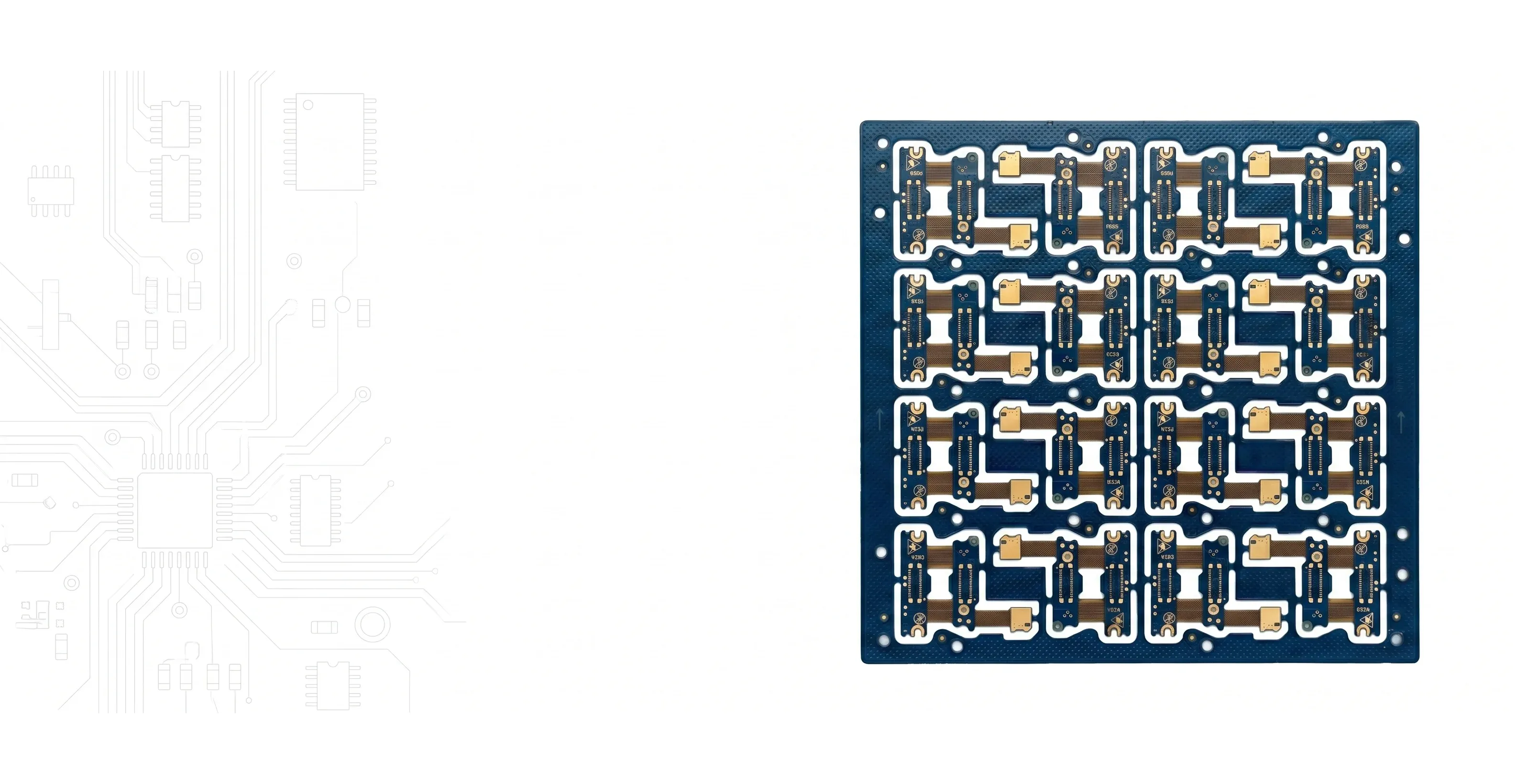
Rigid-Flex PCB Manufacturing
Rigid-Flex PCB Manufacturer Eliminate Connectors. Gain Reliability.
Integrated rigid and flex in one assembly. Up to 22 layers. Dynamic bend rated for 500K+ cycles. No more FPC connectors to fail.
Rigid-Flex Capabilities
Engineered for Flex Reliability
Rigid-flex is our most engineering-intensive product. Every order receives a dedicated stackup review for bend feasibility and long-term reliability — from 2 to 22 layers.
Bend Radius Verification
We calculate minimum bend radius from your layer count, copper thickness, and flex zone width — 6x flex thickness for static, 12x for dynamic. Verified before production, not guessed.
Layer Transition Design
Critical rigid-to-flex transitions engineered for stress relief: tapered thickness, proper anchoring, stiffener placement, and coverlay termination into the rigid section.
Material Selection
Polyimide substrate (25μm/50μm) with polyimide coverlay. Adhesiveless options for high-reliability dynamic flex. FR-4 TG170 for the rigid sections.
Dynamic vs Static Optimization
Different design rules for flex that bends once (static) versus repeatedly (dynamic). Trace routing, copper annulus, and via keep-out zones are all adapted to the use case.
Minimal Flex-Zone Layers
We keep 1–2 copper layers in the bend zone and drop internal layers before the rigid-to-flex boundary. Fewer layers means thinner flex and a tighter achievable bend radius.
Adhesiveless Construction
Copper cast directly onto polyimide with no adhesive layer to delaminate — a thinner flex section, better Z-axis stability, and 200°C+ tolerance for demanding dynamic designs.
The Case for Rigid-Flex
Why Integrate Instead of Connect
Every connector you eliminate is a failure point removed and an assembly step saved. Rigid-flex fuses FR-4 rigid islands with polyimide flex arms so one part both mounts components and folds into the enclosure.
Zero Connector Failures
FPC connectors are the #1 field failure point in portable electronics. Integrated flex connections have no mating cycle wear, no contact resistance drift, no latch fatigue.
3D Folding Architecture
Fold your board into the product enclosure. Rigid sections carry components, flex sections bridge between them — dramatically reducing assembly volume.
Dynamic Motion Applications
Laptop hinges, folding phones, robotic joints, print heads. Polyimide flex rated for 500K+ bend cycles with proper design rules.
Signal Integrity Through Flex
Controlled impedance maintained through the flex zone. No connector impedance discontinuities, no stub effects, no additional signal path length.

Rigid-Flex Boards We Build
Flex arms, folded assemblies, and panel arrays — in the wild


Manufacturing & Design Process
Built and Verified for Bend Life
The flex zone is where rigid-flex boards fail — not the rigid sections, not the vias. Here is how we build and verify each stage so the bend zone survives, with the real design rules behind every step.
Stackup & Bend-Radius Engineering
Every order starts with dedicated stackup review. Minimum bend radius is set at 6x flex thickness (static) or 12x (dynamic) — a 0.2mm flex section needs 1.2mm static, 2.4mm dynamic. Flex-zone copper is minimized to 1–2 layers, arranged symmetrically about the neutral bend axis.
Material Selection
Polyimide base film (25μm/50μm) with polyimide coverlay, FR-4 TG170 rigid sections. Rolled-annealed (RA) copper for dynamic flex — its elongated grain resists fatigue cracking; electrodeposited (ED) copper is used only for static-cost-driven zones.
Flex Circuit & Coverlay Lamination
Traces route perpendicular to the bend axis so cracks must cross grain boundaries. Polyimide coverlay is laminated over every bend zone — it flexes with the copper without cracking. LPI flex solder mask is reserved for non-bend SMD pad openings only.
Rigid Section Lamination
FR-4 rigid islands are laminated to the polyimide flex arms, forming the component-carrying sections. Adhesiveless (cast-copper) construction is used for dynamic designs and any bend radius below 3mm to eliminate an adhesive delamination path.
Rigid-to-Flex Transition Formation
The second most common failure point. Rigid tapers to flex thickness over 2–3mm, copper anchor pads pin the flex layers, no vias sit within 1.0mm (preferably 1.5mm) of the boundary, coverlay overlaps 1.0–1.5mm into the rigid, and traces are staggered across the transition line.
Stiffener Bonding
Local rigidity where flex meets connectors or ZIF sockets: FR-4 stiffeners (0.2–1.6mm) for general support, polyimide (0.05–0.2mm) where Z-height is critical, and stainless steel (0.1–0.3mm) under high-insertion-force connectors like USB-C.
Depanel & Surface Finish
Laser or routed depaneling protects the flex arms from stress, followed by ENIG or OSP surface finish. Flex sections are handled to avoid creasing or delamination before final inspection.
Flex-Cycle & Microsection Verification
Dynamic designs are validated to their rated bend life — 500K+ cycles — by folding coupons to the specified radius until failure. Microsection analysis confirms plating integrity across the rigid-to-flex transition before the board ships.

Materials & Construction
Polyimide flex, FR-4 rigid, matched to bend life
The flex zone uses a polyimide substrate (25μm/50μm) with polyimide coverlay, while the rigid sections use FR-4 TG170. For dynamic designs and any bend radius below 3mm we recommend adhesiveless construction — copper cast directly onto the polyimide, eliminating the adhesive layer that delaminates under cycling, for roughly a 15–20% material premium that the reliability gain easily justifies. Stiffeners add local rigidity where needed: FR-4 (0.2–1.6mm), polyimide (0.05–0.2mm), or stainless steel (0.1–0.3mm) under high-insertion-force connectors.
Rigid-flex vs flex PCB: the deciding factor is whether the assembly needs rigid, component-carrying islands. A plain flex circuit is an all-polyimide interconnect that bends but cannot rigidly support dense component clusters; rigid-flex fuses FR-4 rigid sections with polyimide flex arms so one part both mounts components and folds into the enclosure. Choose flex for simple dynamic jumpers, and rigid-flex when you need to eliminate the connectors between multiple rigid boards.
Applications
Where Rigid-Flex Excels
Rigid-flex earns its place wherever eliminating connectors, saving weight, or folding into a tight enclosure is worth more than the per-board premium.

Consumer & Wearables
Smartphones, smartwatches, AR/VR headsets, folding devices, action cameras — anywhere space is measured in fractions of a millimeter.

Medical Devices
Hearing aids, pacemaker leads, endoscope tips, surgical robots. Biocompatible materials available for implantable applications.

Aerospace & Defense
Missile guidance, satellite payloads, avionics — vibration immunity and weight savings in mission-critical systems.

Industrial & Automotive
Robotic arm joints, steering column electronics, engine bay sensors — harsh environment reliability with zero connector maintenance.
The Difference
Why Rigid-Flex at AtlasPCB
The challenge with rigid-flex isn't whether it can be made — it's whether the flex zone survives its rated bend life. Our engineering review and testing are built around that.
Dedicated Flex Engineering
Rigid-flex is our most engineering-intensive product. Every order receives a dedicated stackup review for bend feasibility and long-term reliability before it enters production.
Flex-Cycle Validation
Dynamic designs are tested against their rated bend life. We fold coupons to the specified radius until failure to confirm 500K+ cycles — some designs exceed 1 million.
Transition-Zone Reliability
The flex zone and its rigid-to-flex transition are where these boards fail. Microsection analysis confirms plating integrity across the transition on every build.
IPC Class 3 Build
Aerospace avionics, wearable health monitors, and implantable-class devices where a single flex-zone fracture ends the mission — built and inspected to IPC Class 3.
FAQ
Rigid-Flex Questions
Per-board cost is higher. Total system cost is often lower when you factor in eliminated connectors, reduced assembly labor, smaller enclosures, and improved field reliability. ROI is strongest in volume production or high-reliability applications.
Static flex bends once during assembly and stays fixed (most common). Dynamic flex bends repeatedly in use — requires thinner PI, perpendicular trace routing, no plating in bend zone, and larger bend radius.
11 days for 2-layer. Approximately 1 day per 2 additional layers. Most designs (4-8L) ship in 12-14 days.
The rule of thumb: 6x the flex section thickness for static applications (installed once, never moved again). 12x flex thickness for dynamic applications (repeated bending over the product lifetime). For a typical 0.2mm flex section, that means 1.2mm minimum bend radius for static and 2.4mm for dynamic. These numbers assume single-layer flex with 1/2oz RA copper — add thickness for each additional copper layer and recalculate. We verify bend radius feasibility for every order and will flag designs that violate minimum radius before production.
With rolled annealed (RA) copper, proper grain orientation (traces perpendicular to bend axis), and adhesiveless construction: 500,000+ cycles for dynamic applications at the rated bend radius. Some designs exceed 1 million cycles in testing. Static flex — installed once during assembly and never moved again — has effectively infinite life. The critical factors are copper type (RA, not ED), grain direction, layer count in the flex zone, and whether you respect the minimum bend radius. Violate any of these and fatigue life drops dramatically.
For dynamic flex (repeated bending): not recommended. Component solder joints create stress concentration points at the boundary between the rigid component and the flexing substrate. Every bend cycle fatigues those joints. For static flex (bends once during installation): yes, with a polyimide or FR-4 stiffener bonded to the back side of the flex beneath the components. The stiffener prevents the flex from bending under the component area during assembly and provides mechanical support for soldering. Keep components at least 2.5mm away from any bend transition line.
Considering Rigid-Flex?
Upload your design or contact engineering for a stackup consultation. We'll confirm bend feasibility before you commit.
Resources
Rigid-Flex Engineering Guides
Design rules, material selection, and cost considerations for rigid-flex PCBs.
Flex and Rigid-Flex PCB Design Guidelines
Bend radius rules, conductor routing, stiffener placement, and material selection.
Dynamic Flex PCB Design: Bend Radius, Materials, and Reliability
Design rules for flex sections that bend repeatedly in use.
Flex PCB Coverlay vs Solder Mask Selection
Material selection and bend reliability comparison for flex protection layers.
Rigid vs Flexible PCB: Materials, Applications, and How to Choose
Decision framework for choosing between rigid, flex, and rigid-flex constructions.
PCB Copper Foil: ED vs RA for Flex Applications
Why rolled-annealed copper is critical for dynamic flex reliability.
Castellated Holes in PCBs: Design Rules and Module Applications
Plating requirements for board-to-board connections in modular rigid-flex assemblies.