· David Okafor · Engineering · 12 min read
Military & Aerospace PCB Manufacturer
How to evaluate PCB manufacturers for military, aerospace, and defense applications. Covers IPC Class 3, MIL-PRF-31032, AS9100, ITAR considerations, traceability requirements, and supplier qualification for defense and aerospace electronics.
Quick Answer
Military grade PCBs require IPC-6012 Class 3 or MIL-PRF-31032 compliance, full material traceability from laminate lot to finished board, thermal stress testing per lot, microsection verification of plating quality, and ionic cleanliness testing. For U.S. defense programs, ITAR compliance may restrict manufacturing to domestic facilities, though many allied-nation and commercial military programs allow qualified international manufacturers with proper export controls.
Military and defense electronics operate where failure is not an option — where a PCB must function after years of storage, survive extreme environments, and perform on demand in conditions that would destroy commercial electronics.
Manufacturing PCBs for defense applications requires more than checking a box marked “military grade.” It requires specific process controls, documentation, testing, and traceability that most commercial PCB shops do not maintain.
This guide covers what military grade actually means in PCB manufacturing, which standards apply, and how to evaluate manufacturers for defense programs.
What “Military Grade” Actually Means
“Military grade” is a marketing term. The engineering terms are:
- IPC-6012 Class 3 — The highest commercial acceptability class for rigid PCBs, covering all the manufacturing requirements described in our [IPC Class 3 requirements guide]/blog/ipc-class-3-requirements/)
- MIL-PRF-31032 — The U.S. Department of Defense performance specification for printed circuit boards, which references IPC-6012 Class 3 as the baseline and adds military-specific requirements
- AS9100 — Aerospace quality management system (relevant for defense aerospace applications)
Most “military grade” PCBs in practice are built to IPC-6012 Class 3. MIL-PRF-31032 adds requirements around qualification testing, government source inspection, and specific documentation formats — but the manufacturing process requirements are largely equivalent to IPC Class 3.
Standards Hierarchy
MIL-PRF-31032 (U.S. military performance spec)
  └── References IPC-6012 Class 3 (manufacturing requirements)
        └── References IPC-6012 (general rigid PCB spec)
              └── References IPC-A-600 (acceptability visual standard)
              └── References IPC-TM-650 (test methods)
For most defense programs outside the U.S. DoD procurement chain, specifying IPC-6012 Class 3 with full documentation is sufficient. MIL-PRF-31032 adds value primarily when the program requires QPL (Qualified Products List) manufacturers or government source inspection.
Key Requirements Beyond Standard Class 3
While [IPC Class 3]/blog/ipc-class-3-requirements/) covers the manufacturing baseline, military applications add several additional considerations:
Full Material Traceability
Every material in the board must be traceable to its manufacturer, lot number, and date of manufacture:
| Material | Traceability Data Required |
|---|---|
| Copper-clad laminate | Manufacturer, grade, lot number, Tg, Dk |
| Prepreg | Manufacturer, style, lot number, resin content |
| Copper foil | Manufacturer, weight, type (ED/RA), lot number |
| Solder mask | Manufacturer, type, lot number |
| Surface finish chemistry | Manufacturer, lot number |
| Drill consumables | Not typically required but good practice |
Why this matters: If a field failure occurs 5 years after delivery, traceability allows root cause analysis back to specific material lots. Without traceability, failure analysis is guesswork.
Implementation: The manufacturer must maintain a material tracking system that links every production lot to specific material lots. This is typically a database or ERP system — not a notebook.
Environmental Qualification
Military electronics operate in environments far beyond commercial specifications:
| Parameter | Commercial | Military (MIL-STD-810) |
|---|---|---|
| Temperature range | 0°C to +70°C | -55°C to +125°C |
| Thermal shock | 5 cycles | 100+ cycles |
| Vibration | Light random | Severe random + sine |
| Humidity | 85% RH, 85°C | 95% RH, 71°C, 240 hours |
| Altitude | Sea level to 3km | Up to 21km (70,000 ft) |
| Salt fog | Not required | 48+ hours |
The PCB itself must survive these conditions. This means:
- High-Tg material (≥170°C) to survive thermal extremes
- Low-CTE construction to prevent via fatigue during thermal cycling
- Conformal coating compatibility — the board surface must accept and retain conformal coating
- No moisture absorption — boards must be baked before assembly in humid environments
- CAF resistance — Conductive Anodic Filament growth between vias must be characterized for closely-spaced via patterns
Extended Thermal Cycling Requirements
Standard Class 3 thermal stress testing is a single solder float at 288°C for 10 seconds. Military applications often require additional testing:
- IST (Interconnect Stress Testing) — 500-1000 cycles of internal resistive heating, monitoring resistance change
- Thermal cycling — 500-1000 cycles from -55°C to +125°C per MIL-STD-202 Method 107
- Humidity with bias — 240 hours at 85°C/85% RH with voltage applied (detecting CAF and electrochemical migration)
These tests are typically performed during design qualification, not on every production lot. However, the manufacturer’s process must be capable of consistently producing boards that pass these tests.
Lot Acceptance Testing
Every production lot (defined as boards made from the same material lot, on the same panel, in the same press cycle) requires:
- Microsection — minimum 1 coupon, measuring barrel plating, annular ring, dielectric thickness
- Thermal stress — solder float at 288°C for 10 seconds, no delamination or blistering
- Electrical test — 100% of boards, continuity and isolation
- Visual inspection — 100% per IPC-A-600 Class 3
- Dimensional verification — board outline, hole locations, feature positions
Results must be documented and retained for the specified record retention period (typically 7-15 years for defense programs).
ITAR and Export Control Considerations
When ITAR Applies
ITAR (International Traffic in Arms Regulations) restricts the export of defense articles, technical data, and defense services listed on the United States Munitions List (USML).
ITAR applies when:
- The PCB design is specifically for a USML-listed defense article
- Technical data (Gerber files, specifications) for a USML item is shared with a foreign manufacturer
- The PCB is a component of a classified system
ITAR may NOT apply when:
- The PCB uses commercial components and is for dual-use equipment
- The item is controlled under EAR (Export Administration Regulations) rather than ITAR
- The design does not contain classified or export-restricted technical data
- The program is for a U.S. ally under an approved export agreement
Practical Impact
If ITAR applies to your PCB, you need either:
- A U.S.-based manufacturer (the restrictive interpretation)
- A manufacturer in an approved country with a proper export license (the practical approach for many programs)
Important: ITAR determination is a legal and compliance question, not an engineering question. Consult your program’s export control officer. The manufacturer cannot make this determination for you.
For Non-ITAR Military Programs
Many military PCBs are not ITAR-restricted. International defense programs, commercial military equipment, and dual-use electronics frequently allow manufacturing in any qualified facility. In these cases, the selection criteria are purely capability-based: Can the manufacturer meet Class 3 requirements with full documentation and traceability?
Manufacturer Evaluation for Military Programs
Capability Assessment
| Requirement | How to Verify |
|---|---|
| IPC-6012 Class 3 qualified | Request qualification test results, audit reports |
| ISO 9001 certified | Verify certificate number with issuing body |
| AS9100 certified (if aerospace) | Verify certificate with registrar |
| Material traceability system | Request sample traceability report for a recent lot |
| Microsection capability | Request sample microsection report |
| Thermal stress testing | Request sample test report |
| Ionic cleanliness testing | Request recent ROSE or SIR test data |
| Controlled impedance | Request TDR test reports from recent production |
| Record retention | Confirm retention period meets program requirements |
Process Qualification
Beyond certifications, evaluate the manufacturer’s actual process capability:
- What percentage of their production is Class 3? A manufacturer whose Class 3 production is <10% of total volume may not have the process discipline of one running 30-50% Class 3.
- What is their Class 3 first-pass yield? This reveals process capability. A manufacturer with 95% FPY on Class 3 has better process control than one at 80% (who compensates with rework and screening).
- Do they have dedicated Class 3 lines? Some manufacturers process Class 3 orders on the same lines as commodity boards, relying on inspection rather than process control to achieve Class 3 quality. Dedicated lines with tighter process windows are preferable.
First Article Process
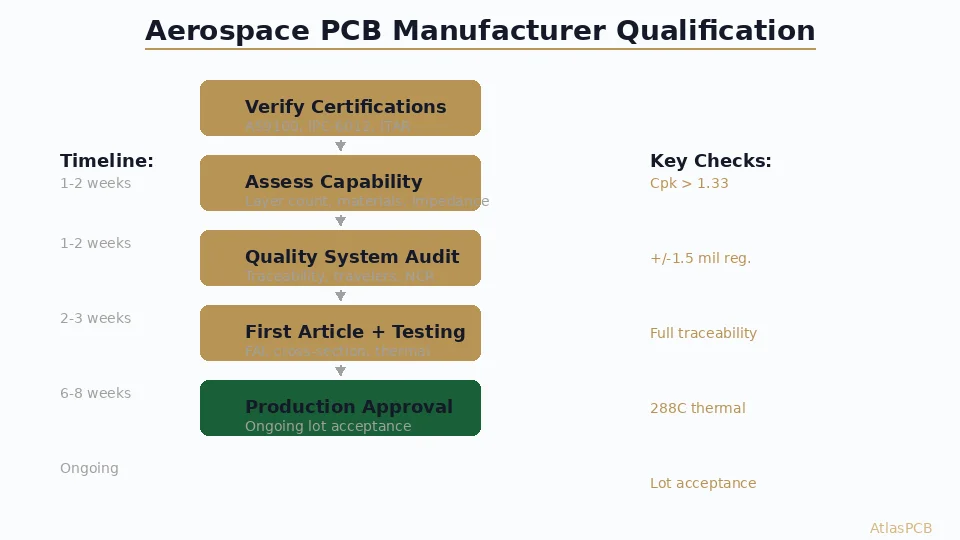
For military programs, first article inspection (FAI) is typically required before production release:
- Manufacturer produces 3-5 boards from the production tooling and process
- Full dimensional inspection against the drawing
- Microsection, thermal stress, impedance testing, cleanliness testing
- FAI report submitted to the customer for approval
- Production release only after FAI approval
This adds 1-2 weeks to the schedule but prevents production of non-conforming boards.
Design Considerations for Military PCBs
Material Selection
| Application | Recommended Material | Why |
|---|---|---|
| Ground electronics (-40 to +85°C) | High-Tg FR4 (≥170°C) | Adequate thermal margin, cost-effective |
| Airborne electronics (-55 to +125°C) | High-Tg FR4 or polyimide | Extended temperature range |
| Space electronics (-65 to +150°C) | Polyimide | Lowest CTE, widest temperature range |
| High-frequency military (radar, EW) | Rogers/Taconic + FR4 hybrid | RF performance + structural integrity |
| High-vibration (vehicles, ordnance) | High-Tg FR4, thick copper | Mechanical robustness |
Via Design for Reliability
Military thermal cycling requirements are much more demanding than commercial. Via design must account for 1000+ thermal cycles:
- Avoid high aspect ratios — Keep through-hole via aspect ratio ≤8:1 for maximum reliability
- Use copper-filled vias when stacking microvias — unfilled stacked vias fail thermal cycling
- Increase barrel plating — Design for 30μm+ (exceeding the 25μm Class 3 minimum) for additional margin
- Minimize via stub length — Back-drill or use blind vias to eliminate stubs that can crack under thermal stress
Copper Weight
Military boards often specify 2oz copper on outer layers for:
- Better thermal dissipation
- Higher current capacity
- Improved mechanical strength of plated through-holes
- Better ground plane performance for EMI shielding
However, heavy copper constrains minimum trace width and spacing. Design rules for 2oz copper are typically 6/6 mil (150/150μm) minimum, vs 4/4 mil for 1oz.
How Atlas PCB Handles Military PCB Orders
Atlas PCB’s manufacturing partners include facilities with demonstrated Class 3 capability and defense electronics experience:
- IPC-6012 Class 3 — qualified process with documented lot acceptance testing
- Material traceability — every laminate, prepreg, and chemistry lot tracked from receiving to shipment
- Full documentation — microsection, thermal stress, ionic cleanliness, impedance, electrical test, and material CoCs with every shipment
- Record retention — documentation archived per program requirements
- Environmental testing support — IST and thermal cycling qualification testing available
- High-Tg and specialty materials — Tg 170°C+ FR4, polyimide, and Rogers laminates in stock
Every military-grade order includes 12-hour human engineering pre-audit. Our engineer verifies Class 3 design compliance, material selection for the intended environment, via reliability for thermal cycling, and documentation requirements — before production begins.
Important note on ITAR: Atlas PCB does not accept ITAR-restricted work. For non-ITAR military and defense programs, we provide full Class 3 manufacturing capability with documentation to meet program requirements.
Frequently Asked Questions
What standards apply to military PCBs?
The primary standards are IPC-6012 Class 3 (the manufacturing baseline for high-reliability rigid PCBs) and MIL-PRF-31032 (the U.S. DoD performance specification that references IPC-6012 Class 3 and adds military-specific requirements). International military programs commonly reference IPC-6012 Class 3 directly. Supporting standards include IPC-A-600 (visual acceptability), IPC-TM-650 (test methods), and MIL-STD-810 (environmental testing).
Do military PCBs have to be manufactured in the USA?
Not necessarily. ITAR restricts export of defense articles on the U.S. Munitions List, which may require domestic manufacturing for classified or USML-listed items. However, many military PCBs are controlled under EAR rather than ITAR, and international defense programs routinely use qualified manufacturers outside the U.S. The determination depends on the specific program, item classification, and export control regulations. Consult your program’s export control officer for a definitive answer.
What documentation is required for military PCBs?
A complete military PCB documentation package includes: material Certificates of Conformance with full lot traceability (laminate, prepreg, copper foil, chemistry), microsection reports verifying plating thickness and via quality, thermal stress test results (288°C solder float), ionic cleanliness test results, 100% electrical test reports, impedance test data (TDR) for controlled impedance boards, first article inspection report, and an overall Certificate of Conformance to the applicable specification. This documentation must be retained for the period specified by the program (typically 7-15 years).
Aerospace PCB Manufacturing: Additional Requirements
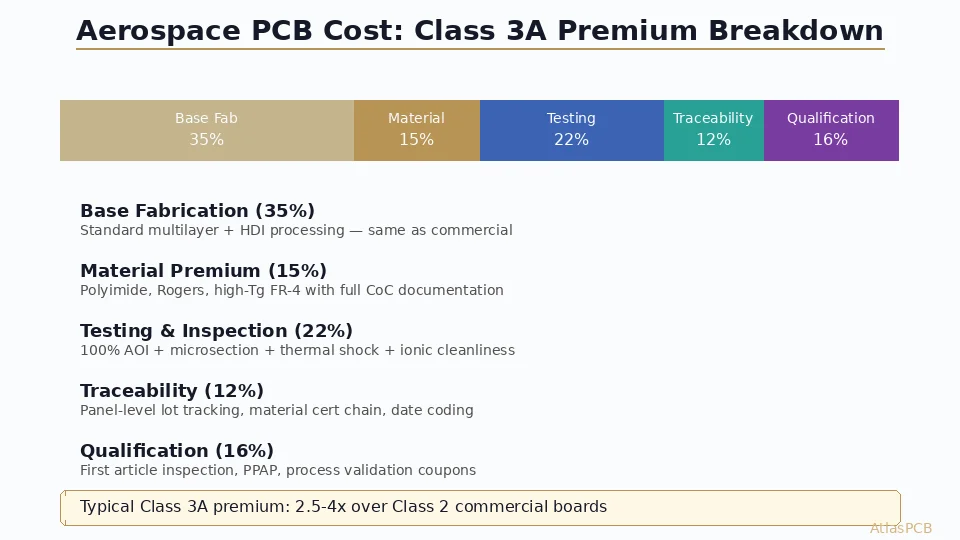
Aerospace PCBs share most requirements with military-grade boards but add specific challenges related to altitude, radiation, thermal cycling, and outgassing. Whether building PCBs for satellites, launch vehicles, avionics, or commercial aircraft systems, the following aerospace-specific considerations apply:
Outgassing compliance (ASTM E595). Materials used in space and vacuum applications must meet NASA’s outgassing requirements: TML (Total Mass Loss) below 1.0% and CVCM (Collected Volatile Condensable Materials) below 0.1%. This restricts adhesive choices, solder mask formulations, and conformal coating options. Standard FR4 passes ASTM E595 when properly cured, but some low-cost laminates do not.
Radiation tolerance. PCBs for satellite and deep-space applications face radiation that degrades organic materials over time. High-radiation environments may require polyimide substrates (more radiation-resistant than epoxy-based FR4) or ceramic substrates for extreme doses. The copper-to-laminate bond strength after radiation exposure becomes a critical reliability parameter.
Thermal cycling extremes. Aerospace PCBs experience thermal cycles far beyond commercial specifications. Low Earth orbit (LEO) satellites cycle between -65°C and +125°C every 90 minutes for years. These boards need high-Tg materials (Tg 260°C+ polyimide), controlled CTE matching between layers, and via structures proven to withstand 1000+ thermal cycles through interconnect stress testing (IST).
Vibration and mechanical shock. Launch vehicles subject PCBs to random vibration levels of 10-40 G RMS and shock events exceeding 2000 G. Board design must account for resonant frequency, mounting method, and copper adhesion under sustained vibration. Thicker copper (2 oz minimum for power planes) and reinforced mounting areas are standard practice.
Qualification and traceability. AS9100 quality management system certification is the baseline for aerospace PCB manufacturing. Programs often require lot acceptance testing, destructive physical analysis (DPA) on sample boards, and documentation retention periods of 20+ years. First article inspection per AS9102 is mandatory for new designs.
AtlasPCB fabricates PCBs for non-ITAR aerospace applications including commercial satellite systems, UAV avionics, and space-qualified sensor modules. We provide IST qualification testing, full material traceability, and documentation packages compliant with AS9100-derived requirements.
AEROSPACE PCB MANUFACTURER
Building for Aerospace or Defense?
IPC Class 3 fabrication with full traceability, IST testing, and engineering review included on every order.
Get Engineering Review ›
Summary
- “Military grade” means IPC-6012 Class 3 at minimum, with additional requirements for traceability, testing, and documentation
- MIL-PRF-31032 adds U.S. DoD-specific requirements on top of Class 3 — many international military programs use Class 3 directly
- Full material traceability, lot acceptance testing, and extended documentation retention are mandatory
- ITAR applies to some military PCBs but not all — the determination is program-specific
- Evaluate manufacturers on Class 3 production volume percentage, first-pass yield, and ability to provide complete documentation packages
- Design for reliability: high-Tg materials, conservative via aspect ratios, and adequate copper weight for the intended environment
Need PCBs for a defense or high-reliability program? Upload your Gerbers for a free engineering review — we verify Class 3 compliance and documentation requirements before production. Or talk to an engineer about your program specifications.
Related guides: [IPC Class 3 Requirements]/blog/ipc-class-3-requirements/) | [IPC Standards and PCB Classes]/blog/ipc-standards-pcb-classes/) | [PCB Reliability Testing]/blog/pcb-reliability-testing/)
Further Reading
[HDI PCB Technology: Microvias, Laser Drilling, and High-Density Design]/blog/hdi-pcb-technology/)
[Blind Via vs Buried Via: Design Rules, Cost Impact & When to Use Each]/blog/blind-via-vs-buried-via/)
[Controlled Impedance PCB: Design, Stackup & Testing Explained]/blog/controlled-impedance-pcb/)
[Impedance Controlled PCB Manufacturer: ±5% Guaranteed with TDR Testing]/blog/impedance-controlled-pcb-manufacturer/)
[Rogers 4350B vs FR4: When to Upgrade Your PCB Material]/blog/rogers-4350b-vs-fr4/)
[HDI PCB Design Guide: Stackup Rules, Via Structures & DFM Checklist]/blog/hdi-pcb-design-guide/)
[High-Multilayer FR4 vs Standard FR4: When to Upgrade Material Grade]/blog/high-multilayer-fr4-vs-standard-fr4/)
[PCB Manufacturer with Engineering Review: Why Human DFM Audit Matters]/blog/pcb-manufacturer-engineering-review/)
[PCB Manufacturing Process: 15 Steps from Gerber to Finished Board]/blog/pcb-manufacturing-process-15-steps/)
[PCB Gerber Files: What They Are and How to Generate Them]/blog/pcb-gerber-files-guide/)
About AtlasPCB — We specialize in complex PCB manufacturing for HDI, RF, and high-reliability applications. Explore our full PCB manufacturing capabilities . Every order includes free engineering review. Get your quote.
Reviewed by AtlasPCB Engineering Team — IPC-certified manufacturing specialists with 15+ years of production experience in HDI, RF, and high-reliability PCB fabrication. Content based on factory floor data and real customer design reviews.
Frequently Asked Questions
What standards apply to military PCBs?
Do military PCBs have to be manufactured in the USA?
What documentation is required for military PCBs?
- military pcb
- defense electronics
- IPC Class 3
- high reliability
- pcb manufacturer
- aerospace pcb
- pcb manufacturer for aerospace