· Thomas Webb · Engineering · 8 min read
High-Multilayer FR4 vs Standard FR4
When your PCB needs high-Tg FR4 instead of standard. Covers Tg ratings, thermal performance, sequential lamination requirements, material grades, and cost impact for multilayer boards.
Quick Answer
High-multilayer FR4 (Tg ≥170°C, Td ≥340°C) is required for PCBs with 8+ layers undergoing sequential lamination, lead-free assembly processes, and applications operating above 130°C. Standard FR4 (Tg 130-140°C) is adequate for 2-6 layer boards with standard assembly. The key difference is thermal stability: high-Tg FR4 maintains dimensional stability during multiple lamination cycles and lead-free reflow, while standard FR4 can soften, shift, and delaminate under repeated thermal exposure.
“FR4” appears on nearly every PCB fab drawing. But FR4 is not a single material — it is a family of glass-reinforced epoxy laminates with properties that vary significantly between grades.
The choice between standard FR4 and high-Tg FR4 is not academic. It determines whether your multilayer board survives manufacturing, whether it endures lead-free assembly, and whether it lasts in the field. This guide explains when you need to upgrade and what specific material grades to consider.
Bottom Line Up Front
Standard FR4 (Tg 130-140°C): Adequate for 2-6 layer boards with leaded solder assembly, operating below 100°C, in non-critical applications.
Mid-Tg FR4 (Tg 150-155°C): Suitable for 6-10 layer boards, lead-free assembly, operating up to 120°C.
High-Tg FR4 (Tg 170-180°C): Required for 8+ layer boards with sequential lamination, lead-free assembly in high-reliability applications, operating up to 150°C, and IPC Class 3 requirements.
Quick Comparison
| Property | Standard FR4 | Mid-Tg FR4 | High-Tg FR4 |
|---|---|---|---|
| Tg (°C) | 130-140 | 150-155 | 170-180 |
| Td (°C) | 290-310 | 320-330 | 340-350 |
| CTE z-axis below Tg (ppm/°C) | 55-70 | 45-55 | 40-50 |
| CTE z-axis above Tg (ppm/°C) | 250-300 | 200-250 | 180-220 |
| Moisture absorption (%) | 0.12-0.18 | 0.10-0.15 | 0.08-0.12 |
| T-260 (min) | 5-10 | 15-20 | >30 |
| T-288 (min) | 2-5 | 8-12 | >15 |
| Dk @ 1GHz | 4.2-4.6 | 4.1-4.5 | 4.0-4.4 |
| UL 94 rating | V-0 | V-0 | V-0 |
| Relative material cost | 1x | 1.1-1.2x | 1.2-1.3x |
T-260 and T-288 are time-to-delamination measurements at 260°C and 288°C respectively. These directly indicate how long the material survives at soldering temperatures. Standard FR4 with T-260 of 5 minutes means delamination begins after 5 minutes at 260°C — dangerously close to the margin for lead-free reflow profiles.
Why Tg Matters: The Physics
Below Tg: Stable
Below its glass transition temperature, FR4 behaves as a rigid material with predictable, low CTE. Through-hole vias experience manageable stress during thermal cycling.
Above Tg: Trouble
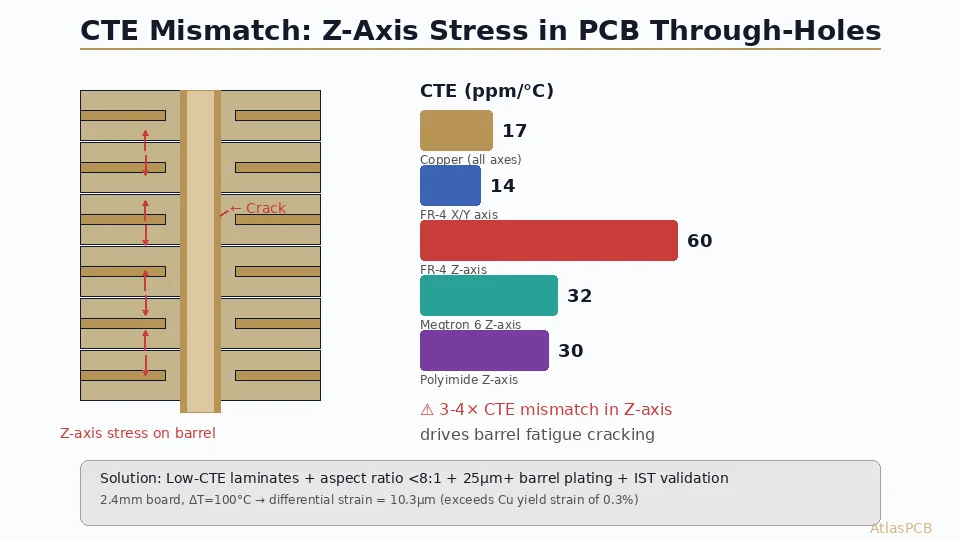
Above Tg, the resin softens. The z-axis CTE increases 3-5x (from 50 ppm/°C to 200+ ppm/°C). This causes:
Via barrel stress — The board expands in thickness, stretching copper via barrels. The copper cannot accommodate the expansion, leading to barrel cracks or pad lift.
Dimensional instability — The board changes dimensions, shifting layer registration. On a multilayer board in a sequential lamination press, this shifts inner layers relative to outer layers.
Delamination risk — The softened resin-glass interface weakens. If moisture is present (absorbed before processing), steam pressure at the weakened interface causes delamination — visible as white spots or blisters.
The Manufacturing Connection
Standard FR4 with Tg 135°C enters its transition zone at approximately 125°C. During:
- Lead-free reflow: Peak temperature 245-260°C — 110-125°C above Tg. The board is deep into the transition zone for 30-60 seconds.
- Wave soldering: 250-260°C — similar exposure.
- Sequential lamination: 170-190°C press temperature for 60-90 minutes per cycle. Each additional press cycle subjects inner layers to another excursion above Tg.
High-Tg FR4 at 175°C does not eliminate the problem (reflow still exceeds Tg), but it reduces the time spent above Tg and the magnitude of CTE increase — significantly improving reliability.
When Standard FR4 Fails
Failure 1: Sequential Lamination Degradation
A 12-layer board requires 2-3 sequential lamination cycles. Each cycle exposes inner layers to 170-190°C for 60-90 minutes.
With standard FR4 (Tg 135°C): Inner layers are above Tg for 60-90 minutes per press cycle, multiplied by 2-3 cycles. Z-axis expansion during each cycle causes:
- Cumulative registration shift
- Resin flow that changes dielectric thickness
- Progressive weakening of resin-glass bond
With high-Tg FR4 (Tg 175°C): The press temperature (170-190°C) barely reaches or slightly exceeds Tg. The material remains dimensionally stable, registration holds, and dielectric thickness remains controlled.
Failure 2: Lead-Free Reflow Damage
Lead-free solder requires higher reflow temperatures (245-260°C peak) than leaded solder (210-225°C peak). The additional 35-50°C extends the time above Tg and pushes deeper into the CTE expansion zone.
Common lead-free failure on standard FR4:
- Board delamination visible as blisters after reflow
- Barrel cracking on high-aspect-ratio vias
- Pad lift on fine-pitch components
- Measles (white spots from resin-glass separation)
Why double-sided assembly is worse: The second reflow cycle subjects the board to a second full thermal excursion. Standard FR4 that survived the first reflow may fail on the second due to cumulative damage.
Failure 3: Field Reliability
Standard FR4 in an application that cycles between -40°C and +85°C repeatedly crosses the Tg threshold. Each thermal cycle accumulates stress in via barrels.
Failure timeline: Standard FR4 in automotive underhood application: via failures appearing at 500-2000 thermal cycles. High-Tg FR4 in the same application: via failures above 3000 cycles — well beyond the typical design life.
Common High-Tg FR4 Materials
| Material | Manufacturer | Tg (°C) | Td (°C) | Key Feature |
|---|---|---|---|---|
| S1000-2 | Shengyi | 170 | 340 | Most widely available, cost-effective |
| S1000-2M | Shengyi | 175 | 350 | Enhanced S1000-2, better thermal |
| IT-180A | ITEQ | 175 | 350 | Low CTE, good for HDI |
| 370HR | Isola | 180 | 340 | Halogen-free, 180°C Tg |
| EM-370(D) | EMC | 175 | 340 | Chinese domestic, competitive pricing |
| TU-862 HF | TUC | 175 | 350 | Low Dk/Df version for high-speed |
| N4000-13 | Nelco/Park | 175 | 340 | Established in US/EU supply chains |
Recommendation for most applications: Shengyi S1000-2 or S1000-2M. These are the highest-volume high-Tg FR4 laminates in China and globally, meaning consistent availability, competitive pricing, and well-characterized process parameters at most manufacturers.
Design Implications of Material Upgrade
Impedance
High-Tg FR4 has slightly different Dk than standard FR4 (typically 4.0-4.4 vs 4.2-4.6 at 1GHz). If you are upgrading from standard to high-Tg on a controlled impedance board, you must recalculate trace widths.
Example: A 50Ω microstrip designed for Dk 4.4 (standard FR4) on high-Tg FR4 with Dk 4.1 will measure approximately 48Ω — within ±5% tolerance but using up margin.
Drill Quality
High-Tg FR4 is harder and more abrasive than standard grades (due to higher filler content in the resin). This affects drilling:
- Drill bit wear is faster — may need more frequent drill changes
- Hole wall quality can be rougher — ensure adequate desmear
- Very small drills (<0.2mm) may require adjusted parameters
Prepreg Flow
High-Tg prepregs have different flow characteristics than standard prepregs. The manufacturer must adjust press parameters (temperature ramp, pressure, and time) for the specific material.
Why this matters: If the manufacturer typically runs standard FR4 and switches to high-Tg without adjusting press parameters, dielectric thickness control will degrade — directly affecting impedance.
Decision Framework
| Your Board | Recommended Material | Why |
|---|---|---|
| 2-4 layers, leaded solder, consumer | Standard FR4 | No benefit from upgrade |
| 4-6 layers, lead-free, commercial | Mid-Tg FR4 (150°C) | Adequate for single reflow |
| 6-8 layers, lead-free, industrial | High-Tg FR4 (170°C) | Multiple reflow + thermal reliability |
| 8-16 layers, sequential lamination | High-Tg FR4 (170°C+) | Mandatory for dimensional stability |
| 16+ layers | High-Tg FR4 (175°C+) | Non-negotiable |
| Any layers, IPC Class 3 | High-Tg FR4 (170°C+) | Reliability requirement |
| Any layers, automotive | High-Tg FR4 (170°C+) | IATF 16949 / AEC qualification |
| HDI (any layer count) | High-Tg FR4 (175°C+) | Sequential buildup demands stability |
How to Specify Material on Your Fab Drawing
Do not write just “FR4.” Specify at minimum:
Material: FR4, Tg ≥170°C per IPC-4101/126 or equivalent
Preferred: Shengyi S1000-2M or ITEQ IT-180A
Td: ≥340°C
UL 94: V-0
This gives the manufacturer clear requirements while allowing equivalent substitution if the exact grade is not in stock.
If you specify nothing beyond “FR4,” the manufacturer will use the cheapest available material — typically standard Tg 130-140°C. This is a cost optimization, not a quality failing. The manufacturer is building what you specified.
How Atlas PCB Handles Material Selection
Atlas PCB stocks high-Tg FR4 as the default material for multilayer boards:
- Standard stock: Shengyi S1000-2 (Tg 170°C) and S1000-2M (Tg 175°C)
- Available on request: ITEQ IT-180A, Isola 370HR, and other specialty grades
- Automatic upgrade: For boards ≥8 layers, our engineering review will flag standard Tg material and recommend high-Tg if not specified
- Impedance recalculation: When upgrading material grade, impedance is recalculated using the actual Dk of the new material
Every order includes 12-hour engineering pre-audit that verifies material grade is appropriate for the board’s layer count, assembly process, and application requirements.
Frequently Asked Questions
What does Tg mean for PCB materials?
Tg (Glass Transition Temperature) is the temperature where FR4 transitions from rigid to rubbery. Above Tg, z-axis CTE increases 3-5x, causing via stress, dimensional instability, and delamination risk. Standard FR4 Tg is 130-140°C; high-Tg is 170-180°C. The higher Tg provides a wider thermal margin during manufacturing (lamination, soldering) and in-field thermal cycling.
When must I specify high-Tg FR4?
Specify high-Tg (≥170°C) for boards with 8+ layers, lead-free assembly, operating temperatures above 130°C, IPC Class 3 applications, HDI sequential buildup, and any board that undergoes double-sided reflow assembly. The material cost premium is 10-30% on the laminate, which translates to approximately 2-8% on the total board price.
How much more does high-Tg FR4 cost compared to standard?
High-Tg laminate is 10-30% more expensive per sheet. Since material is 15-25% of total board cost, the net price increase is approximately 2-8%. For a $10 standard FR4 board, expect to pay $10.20-$10.80 with high-Tg material. This is trivial compared to the cost of field failures, warranty returns, or qualification retest due to delamination.
Summary
- FR4 is a material family — specify Tg, Td, and preferred grade, not just “FR4”
- Standard Tg (130-140°C) is adequate only for simple boards with leaded solder in benign environments
- High-Tg (170-180°C) is required for 8+ layer boards, lead-free assembly, and high-reliability applications
- The material cost premium is small (2-8% on board price) but prevents expensive reliability failures
- Shengyi S1000-2/S1000-2M is the most available and cost-effective high-Tg option globally
- Always recalculate impedance when changing material grade — Dk differs between standard and high-Tg
Not sure which FR4 grade your board needs? Upload your Gerbers for a free engineering review — we verify material selection is appropriate for your layer count, assembly process, and reliability requirements.
Related guides: [PCB Materials Guide]/blog/pcb-materials-guide/) | [Multilayer FR4 PCB Manufacturer]/blog/multilayer-fr4-pcb-manufacturer/) | [PCB Stackup Design Guide]/blog/pcb-stackup-design-guide/)
Further Reading
[HDI PCB Design Guide: Stackup Rules, Via Structures & DFM Checklist]/blog/hdi-pcb-design-guide/)
[PCB Sequential Lamination: Process, Design Rules, and When You Need It]/blog/pcb-sequential-lamination/)
[Controlled Impedance PCB: Design, Stackup & Testing Explained]/blog/controlled-impedance-pcb/)
[Multilayer PCB Stackup Design Guide: 8 to 30+ Layers Step by Step]/blog/multilayer-pcb-stackup-design-guide/)
[PCB Manufacturer with Engineering Review: Why Human DFM Audit Matters]/blog/pcb-manufacturer-engineering-review/)
[PCB DFM Checklist: 50 Points to Review Before Sending Gerbers]/blog/pcb-dfm-checklist/)
[IPC Class 3 Requirements: The Complete Guide for Designers]/blog/ipc-class-3-requirements/)
[EMC/EMI Design for PCBs: Passing Compliance on the First Try]/blog/emc-emi-pcb-design/)
[PCB Cost Optimization: 15 Practical Ways to Reduce Board Cost]/blog/pcb-cost-optimization/)
About AtlasPCB — We specialize in complex PCB manufacturing for HDI, RF, and high-reliability applications. Explore our multilayer PCB fabrication up to 30 layers, or get an Isola 370HR high-Tg PCB manufacturing . Every order includes free engineering review. Get your quote.
Reviewed by AtlasPCB Engineering Team — IPC-certified manufacturing specialists with 15+ years of production experience in HDI, RF, and high-reliability PCB fabrication. Content based on factory floor data and real customer design reviews.
Frequently Asked Questions
What does Tg mean for PCB materials?
When must I specify high-Tg FR4?
How much more does high-Tg FR4 cost compared to standard?
- FR4
- high Tg
- pcb material
- multilayer pcb
- material selection