· David Okafor · Engineering · 12 min read
Blind Via vs Buried Via
A practical comparison of blind vias and buried vias for PCB design. Covers construction methods, aspect ratio limits, cost implications, reliability, and design decision criteria.
Quick Answer
Blind vias connect an outer layer to one or more inner layers without penetrating the entire board, while buried vias connect inner layers only and are invisible from the surface. Blind vias are formed by controlled-depth drilling or laser drilling, while buried vias are drilled in sub-lamination cores before final lamination. Both add cost through additional drill cycles and lamination steps, but enable higher routing density by freeing space on layers that do not need the connection.
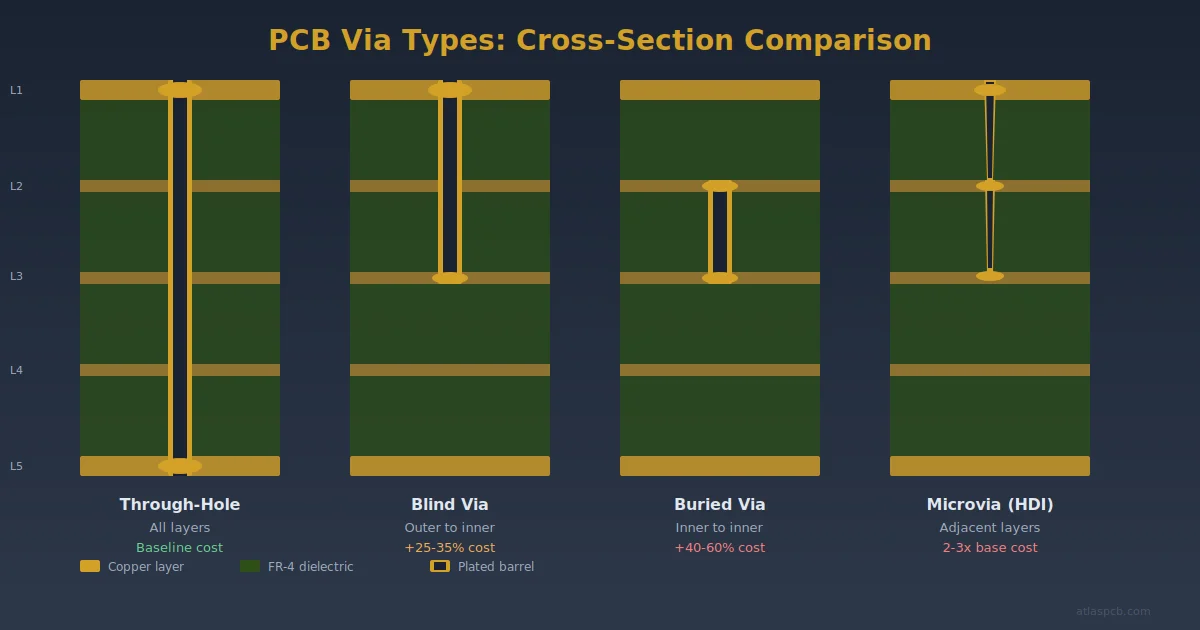
Through-hole vias are simple: drill a hole from top to bottom, plate it with copper, done. They work for most designs. But they consume routing space on every layer of the board — whether that layer needs the connection or not.
When routing density increases, board thickness is constrained, or signal integrity demands shorter via stubs, you need blind vias, buried vias, or both. This guide explains the differences, design rules, cost impact, and decision criteria.
Definitions and Construction
Through-Hole Via (For Reference)
A through-hole via is drilled from the top surface to the bottom surface of the finished board. It passes through every layer and is plated in a single process step.
- Advantages: Simple, cheap, one drill cycle, one plating cycle
- Disadvantages: Consumes routing space on every layer, creates via stubs that cause signal reflections at high frequencies
Blind Via
A blind via connects an outer layer (top or bottom) to one or more inner layers. It is visible from one side of the board but does not extend to the other side.
Construction methods:
Controlled-depth mechanical drilling — A standard drill bit is plunged to a precise depth. Requires depth control accuracy of ±2-4 mil. Limited to aspect ratios of 1:1 or less. Works for connecting L1 to L2 or L1 to L3 on standard multilayer boards.
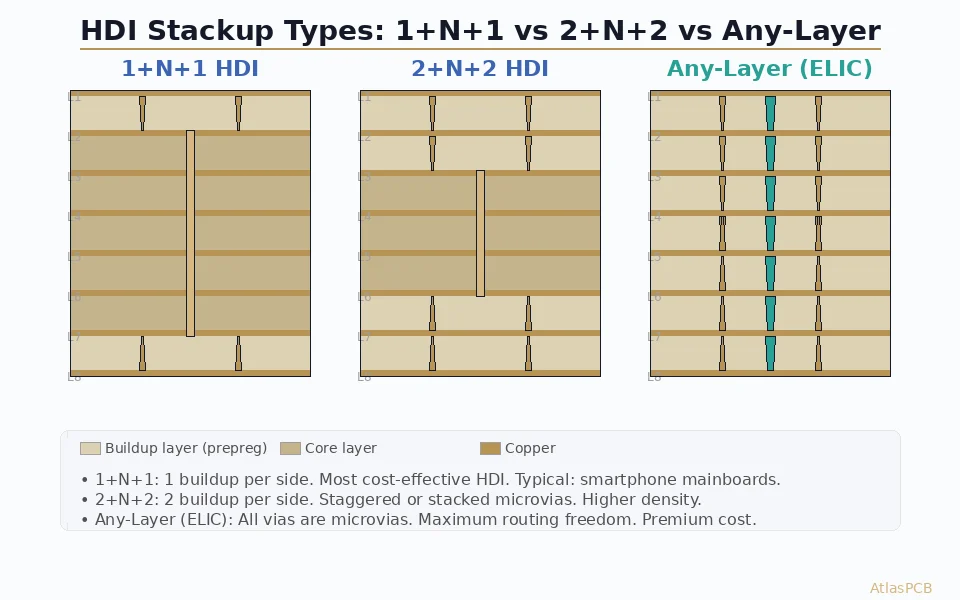
Laser drilling (microvia) — A UV or CO2 laser ablates a small hole through one dielectric layer, typically 75-150μm diameter. This is the standard method for HDI boards. Microvias connect only one layer pair (e.g., L1 to L2) per drill operation.
Sequential lamination — Inner layers are drilled and plated as separate sub-laminations, then assembled and pressed together. The “blind” via exists because it was a through-hole in the sub-lamination that becomes blind after the outer layers are added.
Buried Via
A buried via connects two or more inner layers only. It is completely invisible from the board surface.
Construction method: Buried vias are created during sub-lamination. The inner layer core is drilled and plated as a standalone board, then laminated into the final stackup. The via exists only within that inner core.
Example: In an 8-layer board, a buried via might connect L3 to L6. Layers 1-2 and 7-8 have no hole, no lost routing space, and no via pad consuming valuable real estate.
Visual Comparison
Through-Hole:          Blind:               Buried:
L1 ═══●═══            L1 ═══●═══           L1 ═════════
L2 ═══●═══            L2 ═══●═══           L2 ═════════
L3 ═══●═══            L3 ═════════         L3 ═══●═══
L4 ═══●═══            L4 ═════════         L4 ═══●═══
L5 ═══●═══            L5 ═════════         L5 ═══●═══
L6 ═══●═══            L6 ═════════         L6 ═══●═══
L7 ═══●═══            L7 ═════════         L7 ═════════
L8 ═══●═══            L8 ═════════         L8 ═════════

● = via passes through this layer
The through-hole via consumes routing space on all 8 layers. The blind via (L1-L2) affects only 2 layers. The buried via (L3-L6) affects only 4 layers and leaves both outer surfaces clear.
Design Rules and Constraints
Blind Via Design Rules
| Parameter | Mechanical Blind | Laser Microvia |
|---|---|---|
| Min diameter | 0.15mm (6 mil) | 0.075mm (3 mil) |
| Max aspect ratio | 1:1 | 0.8:1 to 1:1 |
| Typical span | 1-2 layers | 1 layer only |
| Registration | ±3 mil | ±1.5 mil |
| Pad size | Drill + 8 mil annular ring | Drill + 4-6 mil capture pad |
| Fill requirement | Optional | Required if stacking |
Aspect ratio is the primary constraint for blind vias. A 0.2mm mechanical blind via can reliably span a dielectric thickness of up to 0.2mm (1:1 ratio). For a 0.2mm via spanning L1 to L3 (typically 0.4-0.5mm), the aspect ratio exceeds 2:1 — unreliable with mechanical drilling.
Solution: Use laser microvias for single-layer spans (L1→L2, L2→L3) with stacked or staggered structures for multi-layer connections. Or use sequential lamination to create controlled-depth blind vias with acceptable aspect ratios.
Buried Via Design Rules
| Parameter | Specification |
|---|---|
| Min diameter | 0.15mm (6 mil) mechanical, 0.10mm (4 mil) laser |
| Max aspect ratio | 8:1 to 10:1 (within sub-lamination) |
| Span | Must be within a single sub-lamination core |
| Registration | Depends on lamination method (±2-3 mil typical) |
| Pad size | Standard annular ring rules apply within sub-lam |
The critical constraint for buried vias: They must be completely contained within a sub-lamination unit. You cannot drill a buried via that spans across a lamination boundary — the bonding prepreg layer between sub-laminations would not be drilled.
Stackup planning is essential. Before designing with buried vias, confirm with your manufacturer which layer pairs form sub-lamination units. A common 8-layer structure:
Sub-lam 1: L1-L2 (drilled, plated, then laminated on top)
Core:       L3-L6 (drilled, plated as standalone 4-layer)
Sub-lam 2: L7-L8 (drilled, plated, then laminated on bottom)
In this structure, buried vias can connect L3-L4, L4-L5, L5-L6, or any combination within L3-L6. But a buried via from L2 to L3 is impossible — L2 is in a different sub-lamination.
When to Use Blind Vias
1. BGA Fan-Out Routing
Fine-pitch BGAs (≤0.8mm pitch) require fan-out routing through the pad field. Through-hole vias consume too much space — their 0.3mm drill plus 0.5mm pad blocks routing channels on every layer.
Blind microvias (0.1mm drill, 0.25mm pad) on L1→L2 allow direct via-in-pad connection, with routing channels open on all inner layers.
2. High-Frequency Signal Integrity
Through-hole via stubs act as resonant stubs at high frequencies. A 1.2mm stub (typical on an 8-layer board using a via from L1 to L2 as a through-hole) creates a quarter-wave resonance at approximately 30GHz — but causes measurable insertion loss degradation starting around 5-8GHz.
Blind vias eliminate the stub entirely. For high-speed serial links (10Gbps+, 25Gbps+), blind vias or back-drilled through-hole vias are often mandatory.
3. Board Thickness Reduction
By routing connections that only need L1-L2 as blind vias, you avoid drilling through the entire board — which means you can use a thinner board without violating aspect ratio limits on your through-hole vias.
When to Use Buried Vias
1. Inner Layer Routing Density
When inner signal layers need connections that do not involve the outer layers, buried vias free up routing space on L1 and the bottom layer. This is common in:
- Power distribution networks connecting inner power/ground planes
- Bus routing between inner signal layers
- Clock distribution on inner layers
2. Layer Count Reduction
Buried vias can enable more efficient routing on fewer layers. If your 10-layer design with only through-hole vias could be routed on 8 layers with buried vias connecting L3-L6, the reduction in layers may offset the buried via cost premium.
3. Mixed-Signal Isolation
In mixed-signal designs, buried vias can route analog signals on inner layers without creating plated-through connections that couple noise from digital layers on the outer surfaces.
Cost Impact Analysis
Understanding the cost structure helps you decide whether blind or buried vias are justified for your design.
Why Blind and Buried Vias Cost More
Each additional drill-and-plate cycle adds cost:
- Additional drilling time — A separate drill setup for each via type/span
- Additional plating cycle — Electroless copper + electrolytic copper for each sub-lamination
- Sequential lamination — Multiple press cycles instead of one
- Registration complexity — Aligning sub-laminations introduces registration error
- Lower yield — More process steps = more opportunities for defects
Typical Cost Impact
| Via Configuration | Additional Cost vs Through-Hole Only |
|---|---|
| Blind vias only (L1-L2 mechanical) | +20-40% |
| Blind microvias (L1-L2 laser) | +30-60% |
| Buried vias only (inner core) | +30-50% |
| Blind + buried | +50-80% |
| 2-N-2 HDI (stacked microvias) | +60-100% |
Important: These percentages are additive to base fabrication cost. If your board already requires sequential lamination for other reasons (e.g., high layer count), adding blind or buried vias to the existing lamination plan has lower incremental cost than adding them to a single-press design.
Cost Optimization Tips
Minimize the number of different drill spans. Every unique blind or buried via span requires a separate drill program. A design with blind vias L1-L2, L1-L3, and L1-L4 needs three drill programs. Consolidating to L1-L2 only saves two drill cycles.
Use the same buried via span consistently. If you need buried vias, keep them all within the same sub-lamination core. Buried vias in multiple different cores multiply the sub-lamination count.
Evaluate layer count trade-off. If buried vias let you drop from 10 to 8 layers, calculate the cost both ways. The 8-layer board with buried vias may be cheaper than the 10-layer board with only through-holes.
Communicate with your manufacturer early. Send your preliminary stackup with via requirements before finalizing the design. The manufacturer can suggest a sub-lamination plan that minimizes press cycles.
Reliability Considerations
Blind Via Reliability
Mechanical blind vias are generally reliable at aspect ratios below 1:1. The primary risk is incomplete plating at the via bottom — the drill tip creates a conical bottom that is harder to plate uniformly than a cylindrical through-hole.
Laser microvias are highly reliable when properly processed — the clean, consistent hole shape from laser ablation produces uniform plating. The primary risk for microvias is barrel cracking during thermal cycling, which is managed by:
- Maintaining copper plating thickness ≥20μm in the via barrel
- Copper-filling stacked microvias (mandatory — unfilled stacked vias are a known reliability risk)
- IST (Interconnect Stress Testing) qualification for new stackup configurations
Buried Via Reliability
Buried vias are typically the most reliable via type because they are drilled and plated in a thin sub-lamination (low aspect ratio), and the surrounding lamination press applies hydrostatic pressure that closes any micro-voids.
The primary reliability risk for buried vias is registration shift during final lamination — if the sub-lamination shifts relative to the outer layers, alignment between buried vias and connecting through-hole vias is compromised. This is managed by tight lamination registration (±2-3 mil) and adequate pad-to-via clearance.
Design Checklist
Before committing to blind or buried vias:
- Confirm that through-hole vias cannot achieve the required routing density
- Identify the minimum number of unique drill spans needed
- Verify via spans with your manufacturer’s sub-lamination plan
- Check aspect ratios for all blind vias (mechanical ≤1:1, laser ≤1:1)
- Specify copper fill for any stacked microvias
- Add adequate capture pad size for registration tolerance
- Calculate cost impact (get quotes with and without blind/buried vias)
- Evaluate whether layer count reduction offsets the via premium
How Atlas PCB Handles Blind and Buried Vias
Atlas PCB works with manufacturers equipped for multi-cycle sub-lamination and sequential build-up processes.
- Blind vias: Mechanical controlled-depth (0.15mm min) and laser microvia (0.075mm min)
- Buried vias: Standard mechanical drill within sub-laminations, laser for thin cores
- Sequential lamination: Up to 5 lamination cycles for complex via structures
- Via fill: Copper-filled microvias with ≤15μm planarity per IPC-4761 Type VII
- Registration: ±2 mil layer-to-layer across lamination cycles
- Minimum order: 1 piece with full engineering review
Every order with blind or buried vias includes a 12-hour engineering pre-audit. Our CAM engineer verifies via spans against the sub-lamination plan, checks aspect ratios, confirms pad sizes accommodate registration tolerance, and flags any structures that create reliability risk — before production begins.
Frequently Asked Questions
What is the difference between a blind via and a buried via?
A blind via starts on an outer layer (top or bottom) and connects to one or more inner layers — you can see it from one side of the board. A buried via connects two or more inner layers only — it is completely hidden inside the finished board. Both free up routing space on layers they do not pass through, enabling higher routing density than through-hole vias. Blind vias are formed by controlled-depth drilling or laser ablation; buried vias are drilled in inner layer sub-laminations before final board assembly.
How much do blind and buried vias add to PCB cost?
Mechanical blind vias add approximately 20-40% to fabrication cost. Laser microvias add 30-60%. Buried vias add 30-50%. Combining blind and buried vias typically adds 50-80%. The cost comes from additional drill-and-plate cycles, sequential lamination steps, and lower yield due to increased process complexity. However, if blind or buried vias enable a layer count reduction (e.g., 10 layers down to 8), the net cost may be lower than the higher-layer-count all-through-hole alternative.
When should I use blind or buried vias instead of through-hole vias?
Consider blind vias when BGA fan-out cannot be achieved with through-hole vias (pitch ≤0.8mm), when via stubs degrade signal integrity at frequencies above 3-5GHz, or when board thickness must be minimized. Consider buried vias when inner layer routing density is the bottleneck, when you need connections between inner layers without consuming outer layer space, or when a layer count reduction justifies the cost. Always evaluate the cost trade-off — sometimes adding 2 layers with through-hole vias is cheaper than using blind or buried vias on fewer layers.
Summary
- Blind vias connect outer to inner layers; buried vias connect inner layers only
- Both free routing space on unused layers, enabling higher density or fewer layers
- Aspect ratio limits constrain blind via depth — laser microvias span one layer, mechanical blind vias span 1-2 layers
- Buried vias must be planned around the sub-lamination structure — coordinate with your manufacturer early
- Cost premium ranges from 20-80% depending on via types and complexity
- Layer count reduction can offset the via cost premium — always calculate both options
Need blind or buried vias in your design? Upload your Gerbers for a free engineering review — our team will verify your via structure, suggest an optimal sub-lamination plan, and flag any reliability risks before production.
Related guides: [HDI PCB Technology]/blog/hdi-pcb-technology/) | [PCB Via Types Guide]/blog/pcb-via-types-guide/) | [PCB Stackup Design Guide]/blog/pcb-stackup-design-guide/)
Further Reading
[HDI PCB Design Guide: Stackup Rules, Via Structures & DFM Checklist]/blog/hdi-pcb-design-guide/)
[PCB Sequential Lamination: Process, Design Rules, and When You Need It]/blog/pcb-sequential-lamination/)
[Via-in-Pad Design: Filled, Capped, and Plated Over — Complete Guide]/blog/via-in-pad-design/)
[High-Speed PCB Design: Signal Integrity Essentials for Modern Electronics]/blog/high-speed-pcb-design/)
[Multilayer PCB Stackup Design Guide: 8 to 30+ Layers Step by Step]/blog/multilayer-pcb-stackup-design-guide/)
[PCB Manufacturer with Engineering Review: Why Human DFM Audit Matters]/blog/pcb-manufacturer-engineering-review/)
[BGA Escape Routing: Strategies for 0.4mm, 0.5mm, and 0.8mm Pitch]/blog/bga-escape-routing/)
[PCB Cost Optimization: 15 Practical Ways to Reduce Board Cost]/blog/pcb-cost-optimization/)
About AtlasPCB — We specialize in complex PCB manufacturing for HDI, RF, and high-reliability applications. Explore our HDI PCB manufacturing capabilities . Every order includes free engineering review. Get your quote.
Reviewed by AtlasPCB Engineering Team — IPC-certified manufacturing specialists with 15+ years of production experience in HDI, RF, and high-reliability PCB fabrication. Content based on factory floor data and real customer design reviews.
Frequently Asked Questions
What is the difference between a blind via and a buried via?
How much do blind and buried vias add to PCB cost?
When should I use blind or buried vias instead of through-hole vias?
- blind via
- buried via
- HDI
- pcb design
- via structures