· Marcus Lin · Engineering · 9 min read
Complex PCB Manufacturer in China
How to find and evaluate complex PCB manufacturers in China for HDI, RF, multilayer, and high-reliability boards. Covers factory qualification, communication, quality systems, and risk management.
Quick Answer
China manufactures over 50% of the world's PCBs, including high-complexity boards for automotive, telecom, medical, and aerospace applications. For complex PCBs (HDI, RF, high-multilayer, IPC Class 3), selecting a Chinese manufacturer requires verifying specific capabilities: sequential lamination, laser drilling, controlled impedance with TDR testing, and third-party certifications (ISO 9001, IATF 16949, UL). Atlas PCB provides access to certified Chinese manufacturers with English-language engineering support and 12-hour human review on every order.
China produces more than half the world’s printed circuit boards. For simple 2-4 layer FR4 boards, this means abundant capacity and aggressive pricing. For complex boards — HDI, RF, high-multilayer, high-reliability — the situation is more nuanced.
The capability exists. China’s premier PCB facilities serve the world’s leading electronics brands. But finding and qualifying the right factory for complex boards requires a different approach than ordering commodity FR4 online.
This guide covers how to evaluate Chinese manufacturers for complex PCBs, what to verify, and how to manage the specific risks of sourcing from China.
China’s PCB Manufacturing Landscape
China has over 2,000 PCB manufacturers. They are not interchangeable. The industry spans a wide capability range:
Tier 1 — High-Complexity Specialists
- Production focus: HDI, RF, high-multilayer (16-60+ layers), flex/rigid-flex
- Certifications: ISO 9001, IATF 16949, ISO 13485, AS9100, UL
- Typical customers: Tier-1 automotive suppliers, telecom OEMs, medical device companies
- Factory size: 500-5000+ employees
- Equipment: Laser drill, sequential lamination press, LDI (Laser Direct Imaging), X-ray inspection
- Price: 2-5x commodity pricing
Tier 2 — Mid-Complexity Manufacturers
- Production focus: Standard multilayer (4-12 layers), some HDI (1-N-1)
- Certifications: ISO 9001, UL
- Typical customers: Mid-size OEMs, design houses, system integrators
- Factory size: 200-1000 employees
- Equipment: Mechanical drill, standard lamination, standard LPI
Tier 3 — Commodity Shops
- Production focus: 1-4 layer FR4, high volume
- Certifications: Varies (some ISO 9001, many uncertified)
- Typical customers: Hobbyists, cost-driven consumer products
- Equipment: Basic
- Price: Lowest available
The mistake most engineers make: Treating all Chinese manufacturers as the same tier. A Tier 3 factory quoting a 16-layer HDI board is not comparable to a Tier 1 factory quoting the same board — even if the quoted price is lower.
What “Complex PCB” Means in Manufacturing Terms
“Complex” is relative to the manufacturer’s capability. For the purposes of this guide, a complex PCB has one or more of:
| Characteristic | Why It Is Complex |
|---|---|
| 8+ layers | Requires sequential lamination, tight registration |
| HDI (microvias) | Requires laser drilling, via fill, buildup process |
| RF laminates | Requires material handling expertise, hybrid stackup experience |
| Controlled impedance ±5% | Requires field solver modeling, TDR testing |
| IPC Class 3 | Requires tighter process controls, documentation, traceability |
| Blind/buried vias | Requires multiple drill-and-plate cycles |
| Back-drilling | Requires depth-controlled drilling equipment |
| Fine line/space (≤75μm) | Requires LDI, modified etching, clean room processing |
| Aspect ratio >8:1 | Requires specialized drilling and plating |
| Board thickness >3.0mm | Requires high-aspect-ratio drilling, warpage control |
If your board has two or more characteristics from this list, you need a Tier 1 or strong Tier 2 manufacturer.
How to Evaluate a Chinese Manufacturer for Complex Boards
Step 1: Verify Certifications
Certifications are the first filter. They do not guarantee quality, but their absence is a reliable disqualifier.
| Certification | What It Means | Required For |
|---|---|---|
| ISO 9001 | Quality management system | All applications |
| IATF 16949 | Automotive quality (PPAP, FMEA, SPC) | Automotive |
| ISO 13485 | Medical device quality management | Medical devices |
| AS9100 | Aerospace quality management | Aerospace/defense |
| UL (E-number) | Flammability and safety listing | Most commercial products |
| IPC-6012 qualification | PCB performance specification | High-reliability |
Verification: ISO and IATF certifications can be verified through the certifying body’s online database. Ask for the certificate number and issuing body, then verify independently. Certificates should be current (not expired) and scope should cover PCB manufacturing (not just assembly).
Step 2: Request Capability-Specific Evidence
Do not accept general capability claims. Request evidence specific to your technology.
For HDI:
- Cross-section photos of 2-N-2 or any-layer boards from the last 6 months
- Minimum microvia diameter in production (with yield data)
- IST or thermal cycling test reports
For RF:
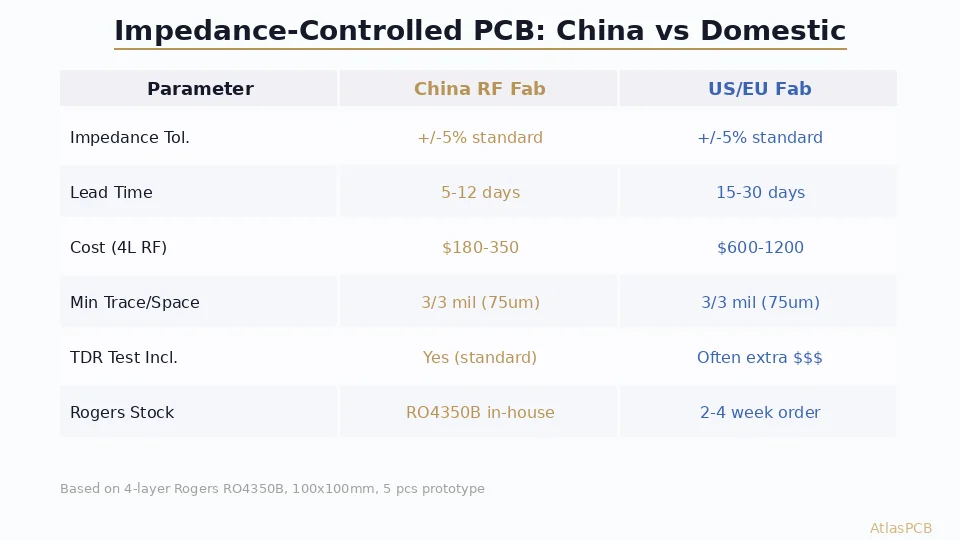
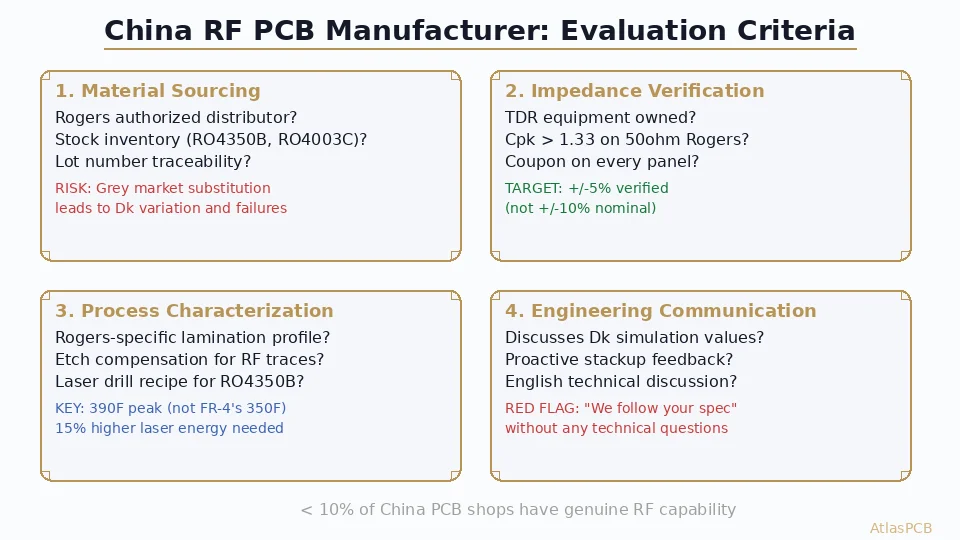
- List of RF laminates in stock (with thicknesses)
- Material CoC from Rogers/Taconic showing the factory as purchaser
- TDR impedance data from a recent RF production lot
For high-multilayer:
- Maximum layer count produced in the last quarter (not ever)
- Registration data from a 16+ layer production lot
- Microsection photos showing layer alignment
For IPC Class 3:
- IPC qualification test results (IPC-6012)
- Example quality documentation package (impedance report, material cert, inspection report)
If the manufacturer cannot provide this evidence within a reasonable timeframe (1-2 weeks), they either do not have the capability or do not have the documentation system to support it.
Step 3: Evaluate Engineering Communication
Complex boards require technical dialogue between your engineering team and the manufacturer’s CAM engineers. Evaluate:
- Response time — Does the manufacturer respond to technical questions within 24 hours?
- Technical depth — Do they ask intelligent questions about your design, or just accept everything without comment?
- Language — Can the engineering contact communicate technical details clearly in English?
- DFM feedback — Do they proactively identify manufacturability issues, or do they silently modify your design?
The silent modification problem: Some manufacturers modify designs without notifying the customer — widening traces, adjusting pad sizes, changing via positions — to make the board easier to manufacture. For complex boards, this can change impedance, violate clearance requirements, or break routing. A good manufacturer contacts you before making any change.
Step 4: Start with a Qualification Order
Before committing production volume, place a small qualification order:
- Order 5-10 pieces of your actual design (not a test coupon)
- Request full quality documentation: impedance report, microsection, material cert
- Measure impedance independently (or have a third party measure)
- Cross-section at least one board to verify via quality, registration, and plating thickness
- Run your board through functional test or environmental stress screening
The qualification order is not optional for complex boards. The $500-2,000 cost of a qualification run is trivial compared to the cost of a failed production lot.
Managing China-Specific Risks
Material Substitution
Material substitution is a real risk — particularly for expensive laminates like Rogers and Taconic. A manufacturer may substitute a cheaper alternative without disclosure, either intentionally (cost savings) or through supply chain error.
Mitigation:
- Require material Certificate of Conformance (CoC) with every shipment
- Verify the CoC shows the correct laminate type, thickness, and lot number
- For critical applications, request that the manufacturer photograph the material label before processing
- Consider third-party incoming material inspection for first production lots
Intellectual Property
Sending Gerber files to any manufacturer requires trust. Practical IP protection measures:
- Use NDA agreements (enforceable in China if properly structured under Chinese law)
- Work with manufacturers who serve major brands (they have IP protection systems in place)
- Consider splitting manufacturing across multiple factories if the design is extremely sensitive
- Remove unnecessary information from fab packages (BOM, schematic, application context)
Communication Gap
Technical miscommunication causes more failures than technical incapability. When working with Chinese manufacturers:
- Specify everything in writing — do not assume anything is “obvious”
- Use visual references (annotated Gerber screenshots, stackup diagrams) alongside text
- Confirm critical specifications in the order acknowledgment
- If possible, work with a manufacturer that has English-speaking engineering staff — not just sales staff using translation tools
Quality Consistency
First-article quality may differ from ongoing production quality. This is not unique to China, but the distance and communication barrier amplify the risk.
Mitigation:
- Define incoming quality inspection criteria before production begins
- Require impedance test data and dimensional measurements with every shipment
- Establish a formal corrective action process (8D or equivalent) for non-conformances
- Conduct periodic re-qualification (annually or after any process change)
Why Use an Intermediary for Complex Boards
Working directly with a Chinese factory gives you the best price — but for complex boards, the price advantage may be offset by:
- Qualification effort — Finding and qualifying the right factory takes 2-6 months
- Communication overhead — Technical discussions through time zones and language barriers
- Quality management — Monitoring ongoing quality from 10,000 km away
- Material verification — Confirming material sourcing without physical access
- Problem resolution — Debugging failures requires technical dialogue, often urgently
An intermediary like Atlas PCB maintains ongoing relationships with qualified factories, handles technical communication in both languages, and provides engineering review before files reach the factory floor. The cost premium (typically 15-30%) buys risk reduction and engineering support.
How Atlas PCB Works with Chinese Manufacturers
Atlas PCB is not a broker that forwards your files to the cheapest available factory. We maintain a qualified partner network of Tier 1 manufacturers with verified capabilities:
- Factory qualification: Every manufacturing partner is audited for specific capabilities — HDI, RF, high-multilayer, IPC Class 3 — with production evidence, not just certificates
- Engineering review: Every order goes through our 12-hour human engineering pre-audit before reaching the factory. Issues are caught and resolved in English before production begins.
- Material verification: We verify material sourcing for RF laminates and specialty materials, with CoC documentation from material manufacturers
- Technical communication: All factory communication happens in Chinese through our engineering team. You receive summarized technical decisions in English for your approval.
- Quality documentation: Every shipment includes impedance test data, material certificates, and inspection records
- Minimum order: 1 piece — prototypes receive the same qualification-level attention as production runs
Frequently Asked Questions
Can Chinese manufacturers produce high-quality complex PCBs?
Yes. China’s Tier 1 PCB manufacturers produce HDI boards for the world’s leading smartphone brands, RF boards for 5G telecom infrastructure, and IPC Class 3 boards for automotive radar and medical imaging systems. Quality depends entirely on which factory you select. China has over 2,000 PCB manufacturers ranging from hobbyist-grade commodity shops to world-class facilities with IATF 16949 and AS9100 certification. The key is proper factory selection, qualification, and ongoing quality management.
How do I verify a Chinese PCB manufacturer’s capabilities?
Start with third-party certifications (ISO 9001 minimum, IATF 16949 for automotive) and verify them through the issuing body’s database. Then request production-specific evidence: cross-section photos, impedance test data, and yield statistics for your specific technology (layer count, via type, material). Finally, place a qualification order of 5-10 boards with full quality documentation, and independently verify the results. Do not rely on website claims, sample boards, or capability brochures alone.
What is the typical lead time for complex PCBs from China?
Prototype lead times for complex boards range from 10-20 working days depending on technology and material availability. Standard multilayer prototypes (4-8 layer FR4) are faster at 5-10 working days. Production quantities add 5-10 working days beyond prototype timing. Specialty materials (Rogers, Taconic) add time if they must be sourced per order. Realistic planning should include 3-5 days for engineering review and DFM resolution before production clock starts.
Summary
- China has world-class PCB manufacturing capability for complex boards — but quality varies enormously between manufacturers
- Tier matters: a Tier 3 factory cannot reliably produce Tier 1 boards regardless of price
- Verify capabilities with production evidence, not website claims or sales presentations
- Place a qualification order before committing production volume
- Material substitution, communication gaps, and quality consistency are manageable risks with proper processes
- An engineering intermediary reduces risk for complex boards by handling technical communication, material verification, and quality oversight
Need a complex PCB from China — without the qualification headache? Upload your Gerbers for a free engineering review, or talk to an engineer about your project requirements.
Related guides: [HDI PCB Manufacturer]/blog/hdi-pcb-manufacturer/) | [RF PCB Manufacturer]/blog/rf-pcb-manufacturer/) | [Multilayer FR4 PCB Manufacturer]/blog/multilayer-fr4-pcb-manufacturer/)
Further Reading
- PCB Manufacturer China: Engineering-Grade Fabrication
- Custom PCB Manufacturing Services
- HDI PCB Design Guide: Stackup Rules, Via Structures & DFM Checklist
- HDI PCB Technology: Microvias, Laser Drilling, and High-Density Design
- PCB Sequential Lamination: Process, Design Rules, and When You Need It
- Controlled Impedance PCB: Design, Stackup & Testing Explained
- Impedance Controlled PCB Manufacturer: ±5% Guaranteed with TDR Testing
- Rogers 4350B vs FR4: When to Upgrade Your PCB Material
- PCB DFM Checklist: 50 Points to Review Before Sending Gerbers
- PCB Manufacturer with Engineering Review: Why Human DFM Audit Matters
About AtlasPCB — We specialize in complex PCB manufacturing for HDI, RF, and high-reliability applications. Explore our HDI PCB manufacturing capabilities, or get an RF and high-frequency PCB services . Every order includes free engineering review. Get your quote.
Reviewed by AtlasPCB Engineering Team — IPC-certified manufacturing specialists with 15+ years of production experience in HDI, RF, and high-reliability PCB fabrication. Content based on factory floor data and real customer design reviews.
Frequently Asked Questions
Can Chinese manufacturers produce high-quality complex PCBs?
How do I verify a Chinese PCB manufacturer's capabilities?
What is the typical lead time for complex PCBs from China?
- pcb manufacturer china
- complex pcb
- HDI
- RF
- high reliability