· AtlasPCB Engineering · Engineering · 11 min read
FR-4 vs Rogers PCB Cost: When the RF Material Premium Actually Pays for Itself
A detailed cost analysis comparing FR-4 and Rogers (RO4350B, RO4003C) PCB fabrication — covering material costs, processing premiums, hybrid stackup strategies, and the engineering breakpoints where Rogers becomes the economical choice.
Quick Answer
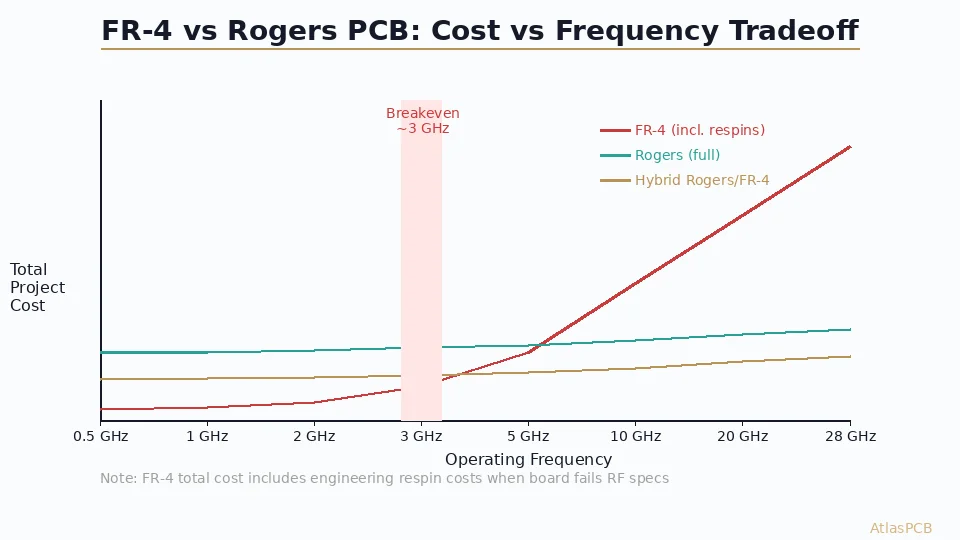
Rogers RO4350B PCB fabrication costs 3-8x more than equivalent FR-4 boards in raw material alone, with processing surcharges adding another 20-40%. However, for designs operating above 3 GHz, the Rogers premium often pays for itself by eliminating one or two board respins that would be needed to compensate for FR-4's unpredictable dielectric loss and Dk variation at RF frequencies. Hybrid stackups combining Rogers RF layers with FR-4 structural layers cut the material premium by 40-60% while maintaining RF performance.
Quick Answer: The Cost Comparison
| Parameter | FR-4 (Standard) | FR-4 (Low-Loss) | Rogers RO4350B | Rogers RO4003C |
|---|---|---|---|---|
| Material cost per sheet (18x24”) | $15-25 | $40-80 | $120-200 | $150-250 |
| Fabrication premium | Baseline | +15-25% | +20-40% | +25-45% |
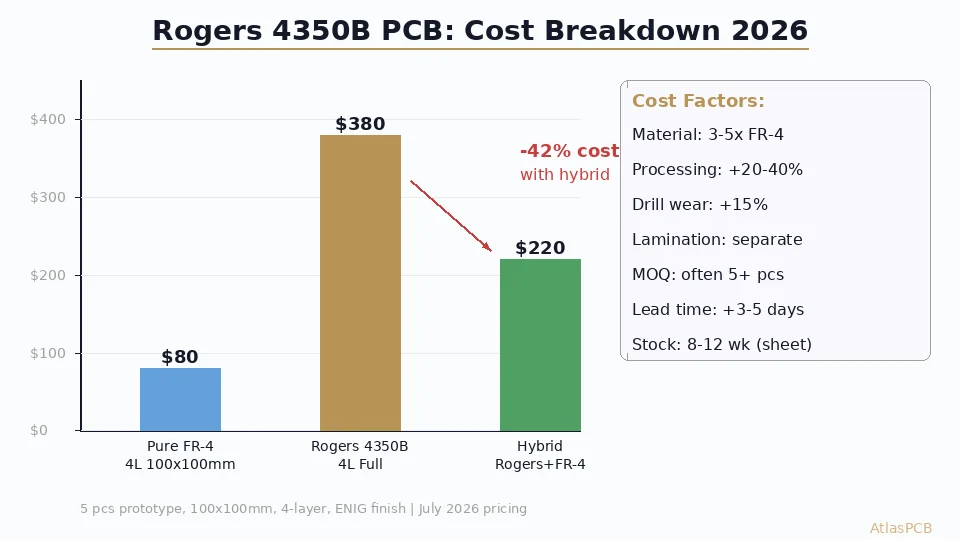
| 4L prototype cost (5 pcs, 100x100mm) | $50-80 | $80-120 | $200-400 | $250-450 |
| Production cost (100 pcs) | $8-15/pc | $12-22/pc | $35-70/pc | $45-85/pc |
| Dk tolerance | +/-0.15 | +/-0.08 | +/-0.04 | +/-0.04 |
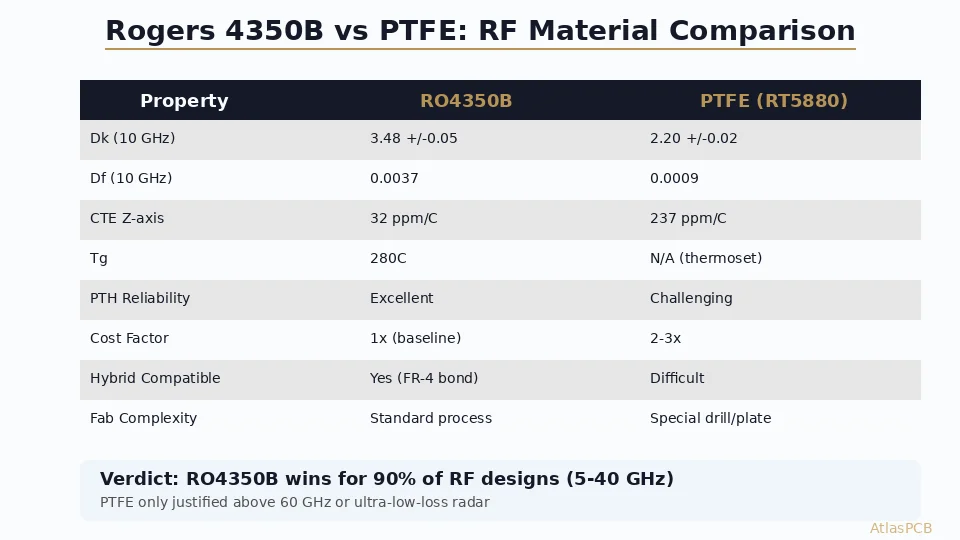
| Df at 10 GHz | 0.020-0.025 | 0.008-0.012 | 0.0037 | 0.0027 |
| Lead time (material) | Stock | 1-2 weeks | 4-8 weeks | 6-10 weeks |
The cost premium for Rogers is real — but so is the engineering cost of debugging FR-4 designs that fail above 3 GHz. A single board respin at $5,000+ in engineering time often exceeds the lifetime material premium for a product that ships 1,000 units.
Understanding Where the Cost Comes From
The Rogers price premium has three components, and understanding each helps you make informed material decisions rather than defaulting to “FR-4 is cheaper.”
Raw material cost is the largest factor. Rogers Corporation manufactures PTFE-based and thermoset ceramic-filled laminates in relatively small volumes compared to the massive FR-4 industry. The raw laminate costs 5-10x more per square foot than commodity FR-4 from manufacturers like Shengyi or Isola. This is simply the cost of precision-engineered dielectric materials with Dk tolerance held to +/-0.04 across the sheet, versus FR-4’s typical +/-0.15 variation.
Processing premium adds 20-40% to fabrication cost because Rogers materials have different mechanical and chemical properties than FR-4. The laminate is harder on drill bits (increasing tooling cost), requires modified desmear chemistry (permanganate doesn’t work on PTFE surfaces — plasma desmear is needed), and has different thermal expansion characteristics that require modified lamination profiles for hybrid stackups where Rogers bonds to FR-4 prepreg.
In our production, Rogers panels run on dedicated press programs with slower heat-up rates to prevent material stress, and hybrid panels require specially selected bondply materials (typically Rogers 4450F or Arlon 47N) that are compatible with both the Rogers laminate and FR-4 prepreg adhesion. These process steps reduce throughput by 30-40% compared to a standard FR-4 run.
Material procurement lead time imposes a hidden cost. Rogers laminates are ordered against forecast, not held in bulk stock the way FR-4 is. If your design requires RO4350B and the distributor is out of stock in the required thickness, you may face 8-12 week lead times. This schedule risk has real project cost — missed market windows, delayed prototyping cycles, or premium pricing for expedited material shipments.
RF PCB MANUFACTURING
Rogers and Hybrid Stackups from a China RF PCB Manufacturer
We stock RO4350B and RO4003C in common thicknesses. Hybrid FR-4/Rogers stackups are our standard workflow, not a special request.
Get RF Board Quote ›
The Engineering Case for Rogers: When FR-4 Costs More in the Long Run
The raw fabrication cost comparison tells only part of the story. The total cost of a PCB design includes engineering time, prototype iterations, yield loss, and field reliability. At RF frequencies, FR-4’s material properties create engineering costs that often exceed the Rogers material premium.
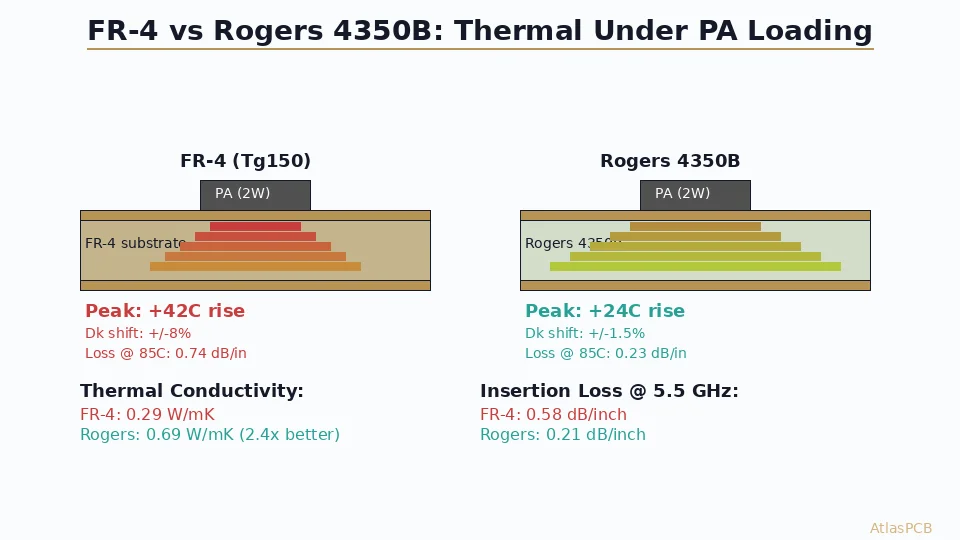
Dielectric constant variation is the primary issue. FR-4 Dk varies with resin content, glass weave direction, and manufacturing batch. A trace designed for 50 ohms on FR-4 might measure 47 or 53 ohms depending on where on the panel it falls and which laminate batch was used. At 2.4 GHz (WiFi), this variation is manageable — a 6% impedance deviation causes modest return loss degradation. At 5.8 GHz (WiFi 6E), the same Dk variation creates 12-15% impedance shift that noticeably degrades filter and matching network performance. At 24-28 GHz (5G mmWave), FR-4 is simply not viable.
Rogers RO4350B holds Dk at 3.48 +/-0.04 across the full sheet and batch-to-batch. This 1% Dk tolerance translates to approximately 0.5% impedance variation from material alone. For the RF engineer, this means the simulation matches the fabricated hardware within measurement uncertainty — no empirical tuning, no re-spin to compensate for material variation.
Dielectric loss (Df) is the second factor. FR-4 has Df of 0.020-0.025 at 10 GHz. Rogers RO4350B has Df of 0.0037. For a 50mm transmission line at 10 GHz, the insertion loss difference is approximately 0.8 dB per line. In a phased array antenna with 16 feed lines, that’s potentially 12+ dB of total system loss difference between FR-4 and Rogers. No amount of amplifier gain recovers this efficiently — and amplifiers add noise figure, power consumption, and cost.
The respin calculation: A typical RF board prototype cycle costs $5,000-15,000 in engineering time (simulation, layout, testing, documentation). If an FR-4 prototype fails to meet specifications due to material-related performance shortfall, the respin cost is $5,000-15,000 plus 4-6 weeks of schedule delay. The Rogers material premium for 5 prototype boards is $150-350 over FR-4. One saved respin pays for Rogers material across the entire product lifetime for volumes under 10,000 units.
The Hybrid Stackup Strategy: Getting Rogers Performance at Near-FR-4 Cost
The smartest approach for most RF-plus-digital designs is not “all Rogers” or “all FR-4” — it’s a hybrid stackup that places Rogers material only where RF performance demands it.
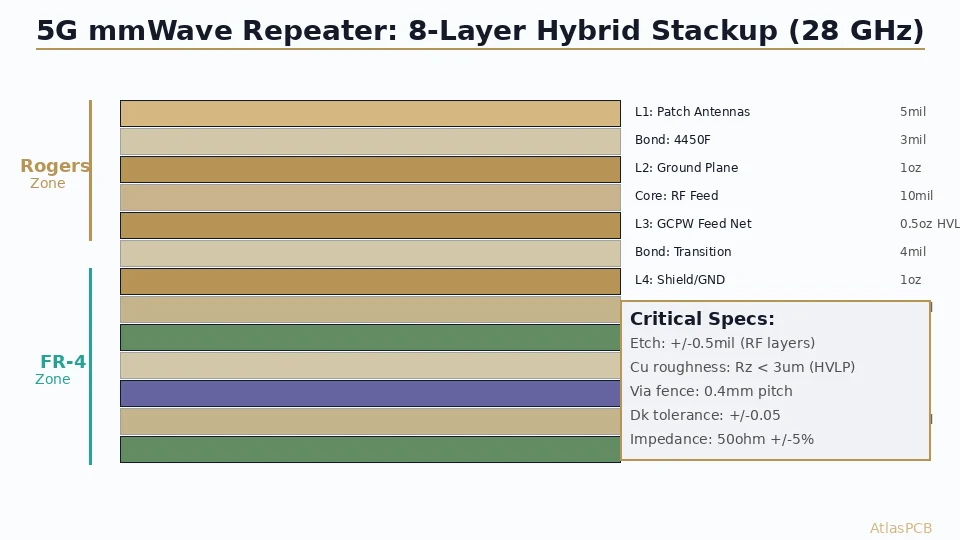
A typical 6-layer hybrid stackup for a WiFi 6E module:
| Layer | Material | Purpose |
|---|---|---|
| L1 (Top) | Rogers RO4350B, 10 mil | RF traces, antenna elements |
| Prepreg | Rogers 4450F bondply | Bonding Rogers to FR-4 |
| L2 | FR-4 copper | Ground plane (RF reference) |
| Core | FR-4, 40 mil | Structural core |
| L3 | FR-4 copper | Power plane |
| Prepreg | Standard FR-4 prepreg | |
| L4 | FR-4 copper | Digital routing |
| Core | FR-4, 40 mil | Structural core |
| L5 | FR-4 copper | Ground plane |
| Prepreg | Rogers 4450F bondply | |
| L6 (Bottom) | Rogers RO4350B, 10 mil | RF traces, antenna (if needed) |
This stackup uses Rogers material on only the two outer layers where RF traces reside. The inner four layers are standard FR-4 carrying power, ground, and digital signals that have no RF performance requirement. Material cost is approximately 40-50% of an all-Rogers 6-layer board, while RF performance on the outer layers is identical to a pure Rogers construction.
The critical design rule for hybrid stackups: keep RF-sensitive circuits (matching networks, filters, feed lines, antenna traces) on the Rogers layers. Route digital signals, power distribution, and low-frequency control lines on the inner FR-4 layers. The two material systems should not share impedance-controlled traces within the same routing layer, because the Dk discontinuity at the Rogers/FR-4 boundary on a single layer creates an impedance step that degrades return loss.
In our hybrid stackup production, we use Rogers 4450F prepreg (or Arlon 47N for high-Tg requirements) as the bonding layer between Rogers laminate and FR-4 cores. This bondply is specifically formulated for mixed-material adhesion and has a Dk of approximately 3.54, which provides a reasonable impedance transition between the Rogers layer (Dk 3.48) and FR-4 reference planes. We simulate the full hybrid stackup in Polar Si9000 to verify impedance targets account for the bondply dielectric properties.
HYBRID STACKUP EXPERTS
Rogers/FR-4 Hybrid Stackups — Optimized for Cost and Performance
We design hybrid stackups that put Rogers where you need it and FR-4 everywhere else. Full impedance simulation included with every RF board order.
Cost Optimization Strategies for Rogers PCB Orders
Beyond hybrid stackups, several engineering and procurement decisions can significantly reduce the cost impact of Rogers material:
Panel utilization matters more with expensive material. Rogers laminate at $150-200 per sheet means every square inch of waste is expensive. Work with your manufacturer to optimize array size and panel layout. A 10% improvement in panel utilization on Rogers saves $15-20 per panel — trivial for FR-4 but meaningful when you’re paying 5x more for material.
Standard thickness selection reduces lead time and cost. Rogers stocks popular thicknesses (10, 20, 30, 60 mil for RO4350B) at distributors. Non-standard thicknesses may require factory-direct ordering with 12+ week lead times. Design your stackup around available thicknesses rather than requiring custom presses.
Volume pricing breaks differ from FR-4. Because Rogers material cost dominates the board price, volume discounts are less dramatic than FR-4 boards where labor amortization drives the cost curve. A 10x quantity increase on a Rogers board might reduce per-unit cost by 30-40%, versus 60-70% for FR-4. Factor this into production cost models.
Consider RO4003C vs RO4350B. RO4003C has lower Df (0.0027 vs 0.0037) but costs approximately 25% more due to lower production volume. Unless your link budget requires the extra 0.001 Df improvement, RO4350B is the cost-optimized choice for most designs below 30 GHz. Above 30 GHz, the Df difference becomes significant enough to justify RO4003C’s premium.
Qualification boards: For production programs, negotiate material pricing through your manufacturer rather than specifying “Rogers only.” Manufacturers who stock Rogers benefit from volume purchasing agreements and pass through better pricing than spot-market procurement. We maintain stock of RO4350B in 10 and 20 mil thicknesses specifically to avoid spot-market premiums and extended lead times for our customers.
Decision Framework: FR-4 vs Rogers vs Hybrid
| Frequency Range | Recommended Material | Rationale |
|---|---|---|
| DC - 1 GHz | Standard FR-4 | Df and Dk variation irrelevant at this frequency |
| 1 - 3 GHz | FR-4 (low-Dk variant) or Hybrid | Low-Dk FR-4 works if loss budget allows; hybrid if tight specs needed |
| 3 - 10 GHz | Hybrid Rogers/FR-4 | Rogers on RF layers, FR-4 elsewhere. Most cost-effective for WiFi 6E, 5G sub-6 |
| 10 - 30 GHz | Rogers (full or hybrid) | FR-4 loss is unacceptable; pure Rogers for antenna layers |
| 30+ GHz | Rogers RO4003C or PTFE | Minimum loss required; no FR-4 anywhere in the signal path |
The decision ultimately depends on three factors: your operating frequency (determines if FR-4 loss is acceptable), your production volume (determines if the material premium matters at product-level BOM), and your respin budget (determines if saving $200 on prototypes is worth risking a $10,000 respin if FR-4 fails to perform).
For most RF engineers we work with, the practical answer is hybrid stackups using Rogers RO4350B for the RF layers and FR-4 for everything else. This delivers 80-90% of the RF performance of pure Rogers at 40-50% of the cost, with the added benefit of maintaining FR-4 mechanical properties (CTE match, stiffness, drill compatibility) for the structural portion of the board.
COST-OPTIMIZED RF
Not Sure If You Need Rogers?
Send us your design — our RF engineers recommend the most cost-effective material choice based on your operating frequency, loss budget, and volume requirements.
Get Material Recommendation ›Choosing a China RF PCB Manufacturer for Rogers Fabrication
When sourcing Rogers PCBs from China, verify these capabilities:
Material stocking: Does the manufacturer maintain Rogers inventory or procure per-order? Stock availability eliminates 4-8 weeks of material lead time. Ask which thicknesses and grades they hold in regular inventory.
Hybrid lamination experience: Mixed-material stackups require specific press profiles and bondply selection. A manufacturer running their first hybrid stackup on your design is a risk. Ask for reference panels or cross-section photos of previous hybrid builds.
Dk characterization at frequency: The manufacturer should simulate impedance using Dk values at your operating frequency, not just the 10 GHz datasheet value. At 77 GHz (automotive radar), even Rogers Dk shifts slightly from the published 10 GHz figure, and the manufacturer should have characterization data for their specific laminate lot.
Panel-to-panel consistency: For production volumes, request Cpk data on impedance measurements across multiple panels. A Cpk above 1.33 indicates the process is well-controlled; below 1.0 suggests significant panel-to-panel variation that will cause yield loss on tight-tolerance designs.
ATLASPCB
Rogers PCB Manufacturer with In-House Material Stock
RO4350B and RO4003C in stock. Hybrid stackup simulation included. TDR-verified impedance on every panel. From prototype to production volume.
Upload Your RF Design ›
Reviewed by AtlasPCB Engineering Team — 15+ years in advanced PCB fabrication for RF, HDI, and rigid-flex applications.
Related Reading:
About AtlasPCB — We specialize in complex PCB manufacturing for HDI, RF, and high-reliability applications. Explore our RF and high-frequency PCB services, Rogers RO4350B PCB manufacturing, or get an multilayer PCB fabrication up to 30 layers . Every order includes free engineering review. Get your quote.
Reviewed by AtlasPCB Engineering Team — IPC-certified manufacturing specialists with 15+ years of production experience in HDI, RF, and high-reliability PCB fabrication. Content based on factory floor data and real customer design reviews.
Frequently Asked Questions
How much more does a Rogers PCB cost compared to FR-4?
At what frequency should I switch from FR-4 to Rogers?
Can I use a hybrid Rogers/FR-4 stackup to save cost?
Why does Rogers cost more to process, not just in material?
Is Rogers material cost increasing in 2026?
- FR-4 vs Rogers PCB
- Rogers 4350B stackup
- RF PCB design and manufacturing
- China RF PCB manufacturer
- PCB cost