· AtlasPCB Engineering Team · News · 11 min read
US Weighs New Semiconductor Tariffs: How Expanded Duties Could Reshape PCB Supply Chains and Board-Level Costs
The Trump administration is considering sweeping new tariffs on semiconductors that could push landed costs on Chinese chips to roughly 75%, with duties expanding to cover laptops, data center servers, and gaming hardware. Combined with CCL prices up 70% year-over-year and FR-4 lead times stretching to six to eight weeks, hardware teams face an unprecedented cost environment heading into Q4 2026.
Quick Answer
The US is considering new semiconductor tariffs under an expanded Section 232 framework that would impose duties on a broader range of tech products including laptops, data center servers, and gaming hardware. Chinese-origin chips already face a cumulative 75% landed tariff, and the proposed expansion would increase board-level assembly costs across the electronics industry while compounding existing PCB material shortages.
Washington Eyes Broad Semiconductor Duties as Industry Braces for Another Cost Shock
The Trump administration is reportedly weighing a significant expansion of tariffs on semiconductors imported into the United States, a move that would extend duties to an expanded range of technology products including laptops, data center servers, and gaming hardware. According to reports from CNBC, Reuters, and Politico published on August 27, the proposed measures remain in early phases and are subject to significant changes before implementation. However, the direction of travel is clear: Washington is moving toward a broader tariff envelope that would increase costs across the electronics value chain, with direct implications for PCB buyers, assembly houses, and hardware engineering teams already contending with the worst material shortage environment in years.
The proposed expansion builds on an already aggressive tariff framework. Section 301 duties on Chinese-origin semiconductors were doubled to 50% in 2024, and Section 232 tariffs at 25% began phasing in during Q3 2026. For Chinese chips, the cumulative effect is a landed tariff burden of approximately 75% — a level that fundamentally alters sourcing economics and forces hardware companies to rethink component strategies, assembly locations, and even board-level design decisions.
The Proposed Section 232 Expansion and Its Scope
The new measures under consideration would operate through an expanded Section 232 framework, which the administration has used to impose tariffs on goods deemed critical to national security. Unlike the product-specific Section 301 tariffs that have targeted Chinese goods since 2018, Section 232 duties apply based on the product category regardless of origin country, though bilateral negotiations have produced carve-outs for key allies.
The scope of the proposed expansion is notable for its breadth. Rather than targeting bare semiconductor components alone, the administration is reportedly considering duties on finished and semi-finished products that contain semiconductors, including laptop computers, data center server hardware, and gaming consoles and peripherals. This product-level approach means that tariffs would reach further into the electronics supply chain than previous semiconductor-focused measures, affecting not just chip importers but companies importing assembled electronic products that incorporate those chips.
According to sources cited by CNBC and Politico, the rollout would likely be staggered, with different product categories phasing in over several quarters rather than arriving in a single implementation date. This approach mirrors the administration’s handling of previous Section 232 actions and provides some lead time for industry adjustment, though the uncertainty around specific timelines and rates creates its own challenges for procurement planning.
The Current Tariff Landscape: A Country-by-Country View
Understanding the proposed expansion requires context on the existing tariff stack that has built up over the past two years. The semiconductor tariff environment as of August 2026 varies dramatically depending on the country of origin, creating a patchwork of cost structures that shapes global sourcing decisions.
China faces the steepest burden. The 50% Section 301 tariff (doubled from 25% in 2024) combines with the 25% Section 232 duty to produce a cumulative landed tariff of approximately 75% on Chinese-origin semiconductors entering the United States. At this level, a chip with a factory-gate price of $1.00 in Shenzhen costs $1.75 at the US border before freight, brokerage, and other landed-cost additions. For cost-sensitive consumer electronics where component margins are already thin, this differential is prohibitive for Chinese sourcing on many chip categories.
Taiwan occupies a uniquely favorable position. Under a bilateral framework negotiated in 2025, Taiwanese semiconductor exports are exempt from Section 232 duties entirely. Given that TSMC and other Taiwanese foundries produce the majority of the world’s advanced logic chips, this carve-out represents a significant competitive advantage for Taiwan-sourced components and partially insulates the most critical segment of the semiconductor supply chain from tariff disruption.
South Korea pays the full 25% Section 232 rate, adding meaningful cost to chips produced by Samsung and SK Hynix — two of the world’s largest memory and logic manufacturers. Japan fared better in negotiations, securing a reduced rate of 15% that reflects both its strategic alliance with the United States and the critical role of Japanese semiconductor equipment and specialty chip manufacturers in the global supply chain.
For PCB buyers and assembly houses sourcing components across multiple origins, this rate disparity means that two otherwise identical chips can carry vastly different landed costs depending on where they were fabricated. This complexity cascades directly into BOM cost models and forces procurement teams to track tariff jurisdiction at the individual line-item level.
How Semiconductor Tariffs Cascade Into PCB and Assembly Costs
The connection between semiconductor tariffs and PCB industry economics runs deeper than the simple arithmetic of component price increases. For the hardware engineers and procurement professionals who make up AtlasPCB’s customer base, the impact manifests across several dimensions.
The most direct effect is on PCBA (printed circuit board assembly) costs. In a typical electronic assembly, semiconductor components account for 60 to 80 percent of the total bill of materials. When tariffs add 25 to 75 percent to the cost of those components depending on origin, the arithmetic flows through to the assembled board. A server motherboard with $800 in Chinese-origin chipsets that previously cleared customs at $800 now arrives at $1,400 under the full 75% tariff stack. Even for assemblies using a mix of chip origins, the blended tariff impact on total BOM cost can easily reach 10 to 25 percent — a range that exceeds the entire margin for many contract electronics manufacturers.
The proposed expansion to data center servers is particularly significant for PCB demand dynamics. The AI infrastructure buildout that has driven unprecedented demand for high-layer-count, low-loss PCBs depends on massive server deployments. If tariffs are applied to imported server hardware, two effects follow. First, domestically assembled servers become comparatively more attractive, increasing demand for US-based PCB assembly capacity that is already constrained. Second, the total cost of AI infrastructure rises, potentially slowing deployment timelines and shifting demand patterns for the advanced PCB substrates used in GPU accelerator cards and high-speed interconnects.
Concerned About Tariff Impact on Your Next Build?
AtlasPCB helps hardware teams navigate tariff complexity with multi-region fabrication options and transparent landed-cost analysis. Lock in pricing before new duties take effect. Get a quote
Compounding Pressure: Tariffs Meet the Worst Material Shortage in a Decade
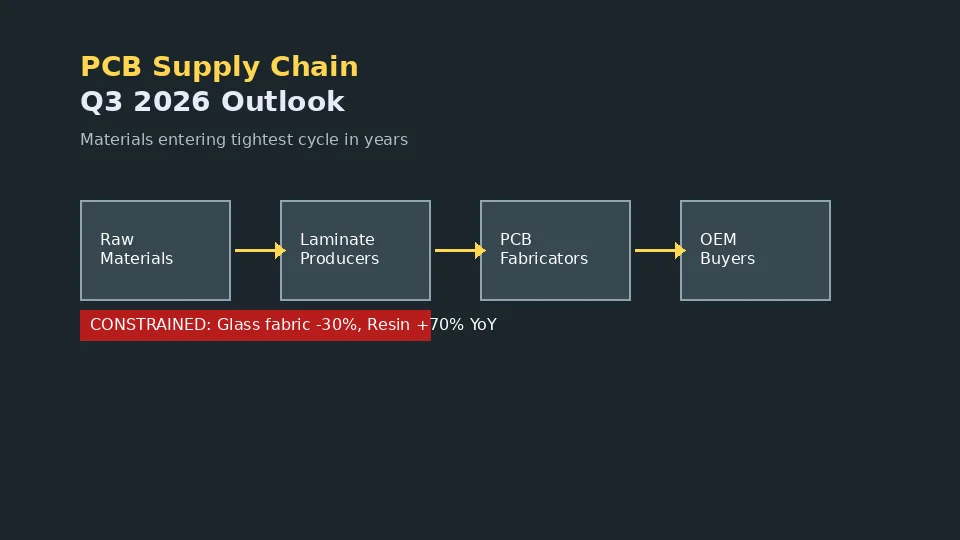
The semiconductor tariff expansion arrives at a moment when the PCB industry is already under extraordinary strain from material shortages that have pushed lead times and costs to levels not seen since the post-pandemic supply crisis. As we reported in our coverage of the August 2026 material shortage, the Jubail petrochemical complex — which supplies approximately 70% of the world’s high-purity PPE resin used in PCB laminates — has been offline since March. The consequences have rippled through every level of the supply chain.
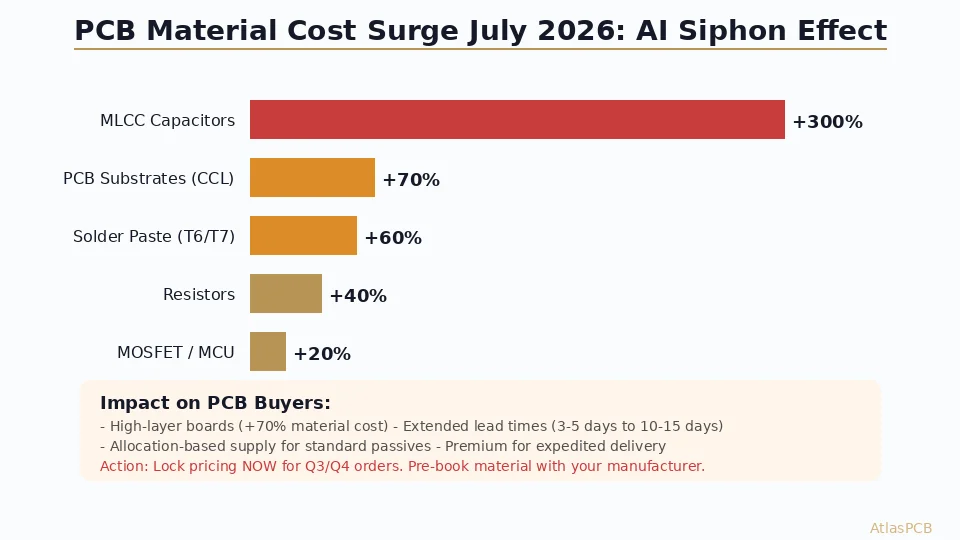
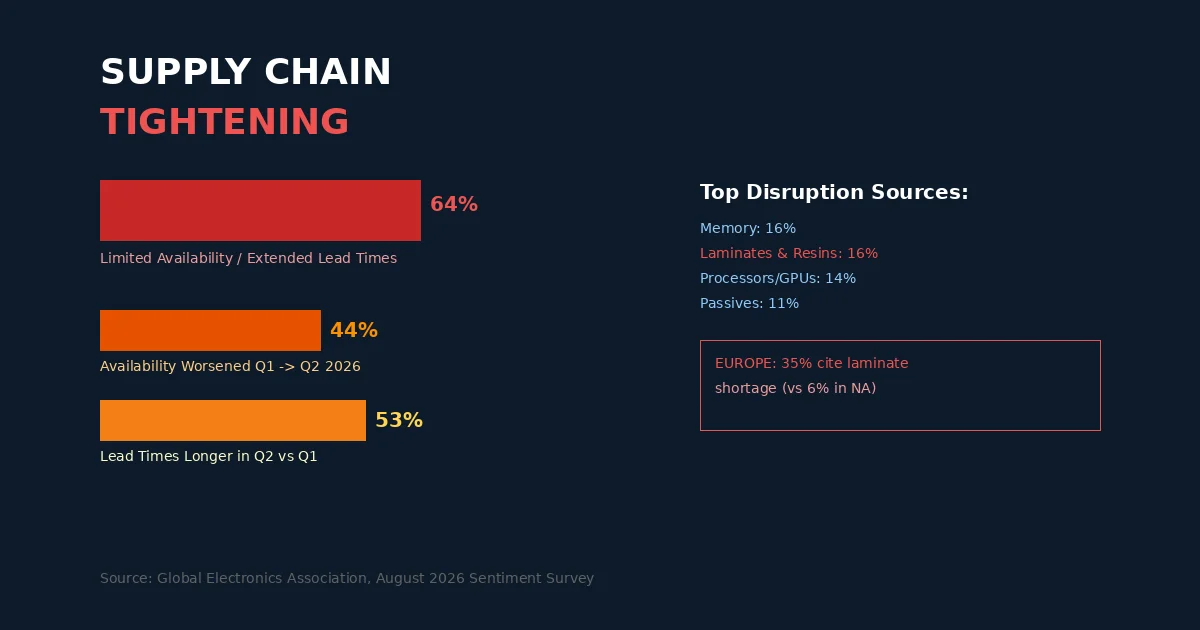
Epoxy resin lead times have jumped from three weeks to fifteen. Copper-clad laminate (CCL) prices are up 70% year-over-year. Standard FR-4 lead times have stretched from a normal two to three weeks to six to eight weeks, and advanced low-loss laminates required for high-speed digital and RF applications now quote at 14 to 18 weeks. Some Chinese manufacturers are quoting delivery dates extending into 2028 for certain product categories, according to Electronics Weekly reporting from August 2026.
The simultaneous pressure from tariff cost increases and material cost increases creates an environment unlike anything the electronics industry has faced previously. When base material costs and component costs rise together while lead times extend across both supply chains, the compounding effect on total project costs can exceed what either factor would produce in isolation. Hardware programs budgeted at pre-2026 cost assumptions may find themselves facing 30 to 50 percent total cost overruns when material inflation and tariff escalation are combined.
This dual-pressure environment also narrows the options available to procurement teams. In a tariff-only scenario, switching to non-China semiconductor sources provides relief. In a material-shortage-only scenario, paying premium prices secures allocation. When both pressures apply simultaneously, the available supply of affordable alternatives shrinks from both directions, and the cost of maintaining production continuity rises accordingly.
What Hardware Engineers and Procurement Teams Should Do Now
The uncertainty around the proposed tariff expansion — measures are in early phases and subject to significant changes, according to every source reporting on the proposal — makes definitive planning difficult. However, the direction of trade policy over the past three years provides enough signal to justify proactive measures rather than a wait-and-see approach.
The first priority is locking in pricing and lead times on active programs. For PCB fabrication, this means placing orders or securing blanket purchase agreements at current pricing through at least Q1 2027. Material costs and tariff rates are both more likely to increase than decrease over the next two quarters, making current prices the effective floor rather than the ceiling. As we detailed in our analysis of the Section 301 exclusion expiry approaching in November, the bare-board tariff environment is tightening in parallel with the semiconductor-level changes.
Second, engineering teams should review BOM compositions with tariff jurisdiction in mind. Identifying which semiconductor components in your designs originate from Chinese fabrication facilities versus Taiwanese, Korean, or Japanese sources enables more accurate landed-cost modeling and highlights opportunities to substitute equivalent parts from lower-tariff origins. This exercise is particularly valuable for designs still in the prototyping phase, where component selection has not yet been locked by qualification testing.
Third, diversifying the PCB supply chain across multiple fabrication regions provides both tariff mitigation and supply security. Companies sourcing exclusively from a single country are exposed to both tariff risk and the concentration risk that the current material shortage has made painfully visible. A multi-source strategy that spans Chinese, Southeast Asian, and potentially domestic fabrication provides resilience against the kind of disruptions now arriving from multiple directions simultaneously.
Finally, consider the timeline implications for products in development. If your design requires advanced packaging, high-layer-count substrates, or chips from tariff-exposed origins, the cost assumptions embedded in your business case may need revision. Revisiting financial models now — before committing to production tooling and supplier contracts — is considerably less expensive than discovering a 20% cost overrun after product launch commitments have been made.
Plan Ahead for Q4 2026 and Beyond
Whether you need multi-region sourcing options, landed-cost comparisons, or expedited fabrication to beat tariff deadlines, our engineering team can help you build a resilient supply strategy. Get a quote
Looking Ahead: What to Watch
The semiconductor tariff situation will evolve over the coming weeks and months as the administration refines its approach and industry stakeholders respond. Several developments warrant close attention. Any formal Federal Register notice initiating a Section 232 investigation or proposing specific duty rates on new product categories would signal that the measures are moving from consideration to implementation. Congressional responses, particularly from members representing states with significant semiconductor manufacturing or consumption, will indicate whether legislative action might modify or accelerate the administration’s timeline. And bilateral trade negotiations — especially with South Korea and Japan, which are actively seeking rate reductions — could reshape the country-by-country tariff landscape before new measures take effect.
AtlasPCB will continue to monitor these developments and provide analysis relevant to our customers’ fabrication and assembly decisions. In an environment where tariff policy, material availability, and geopolitical dynamics are all moving simultaneously, having current information and diversified supply options is not a luxury but a competitive requirement.
Reviewed by AtlasPCB Engineering Team
Sources: CNBC reporting on semiconductor tariff proposals (August 27, 2026), Reuters via US News, Politico trade policy coverage, TariffWise tariff rate database, Electronics Weekly PCB shortage analysis (August 2026). Tariff rates and policy details reflect conditions and proposals as of late August 2026 and are subject to change. This article provides general market commentary and does not constitute legal, customs, or trade compliance advice. Consult a licensed customs broker or trade attorney for specific tariff classification and compliance determinations.
About AtlasPCB — We specialize in complex PCB manufacturing for HDI, RF, and high-reliability applications. Explore our instant online PCB quote, or get an impedance-controlled PCB manufacturing . Every order includes free engineering review. Get your quote.
Reviewed by AtlasPCB Engineering Team — IPC-certified manufacturing specialists with 15+ years of production experience in HDI, RF, and high-reliability PCB fabrication. Content based on factory floor data and real customer design reviews.
Frequently Asked Questions
What are the current US tariff rates on semiconductors by country of origin?
How do semiconductor tariffs affect PCB and PCBA pricing?
What should procurement teams do now to prepare for potential semiconductor tariff expansion?
Are PCB material shortages related to the semiconductor tariff situation?
- semiconductor tariffs
- PCB supply chain
- trade policy
- Section 232
- PCB pricing
- AI hardware
- electronics manufacturing