· AtlasPCB Engineering Team · News · 7 min read
PCB Material Shortage Intensifies August 2026: Glass Cloth Prices Surge 18% in Single Month
The PCB supply chain crisis deepens in August 2026 as electronic glass cloth prices jump 18% in one month, CCL costs rise 70% year-over-year, and AI server demand consumes advanced board capacity. Analysis of causes, timeline, and procurement strategies for hardware teams.
Glass Cloth Hits Record Prices as PCB Supply Chain Tightens Further
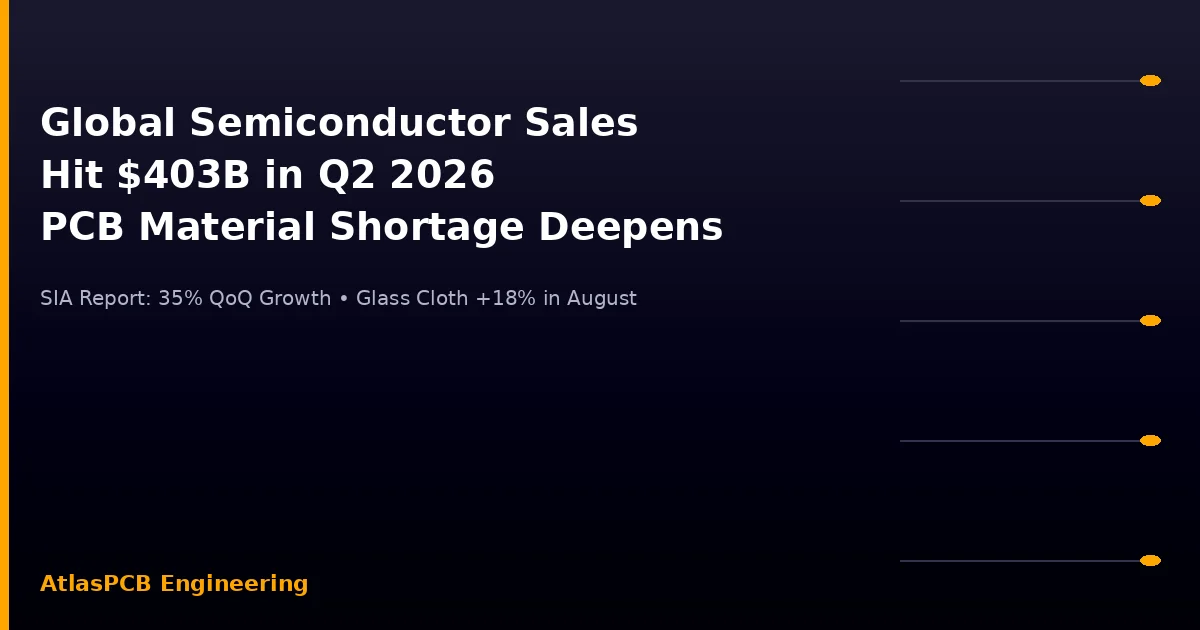
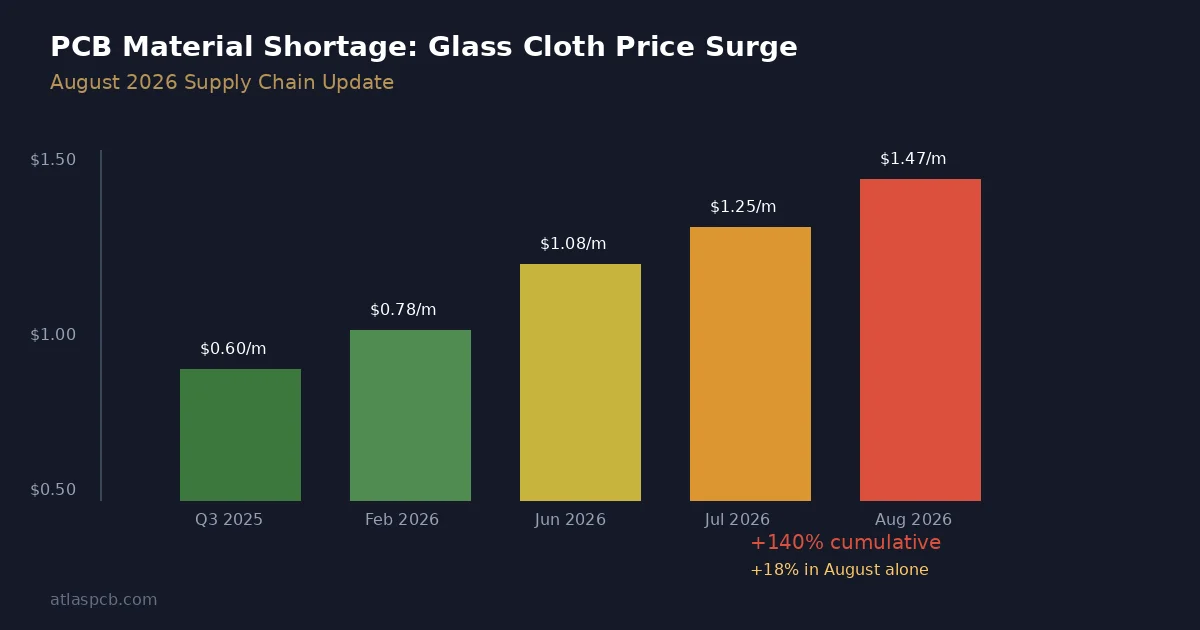
The global printed circuit board supply chain entered its most constrained period in recent memory during August 2026, driven by the convergence of unprecedented AI infrastructure demand, upstream material shortages, and geopolitical supply disruptions. Electronic glass fiber cloth — the reinforcement material in virtually all PCB laminates — surged 18 percent in a single month, reaching $1.47 per meter for standard 7628 specification, representing a cumulative 140 percent increase from the cyclical bottom established in Q3 2025.
The price trajectory has accelerated sharply. After relatively stable pricing through most of 2025, glass cloth began climbing at approximately 12 percent per month from February through May 2026. June brought an inflection point as AI server orders flooded the supply chain, pushing prices past the dollar mark. July sustained the momentum with a 16 percent monthly increase, and August’s 18 percent surge confirms that the supply-demand imbalance continues to widen rather than stabilize.
For specialty grades required in high-speed AI server boards — Low-Dk and ultra-thin glass cloth specifications — the situation is far more severe. Spot market prices for these materials have reached $21.90 to $37.95 per meter, with procurement lead times stretching to three to four months. These premium specifications are essential for the low-loss laminates used in 112G SerDes interconnects and advanced packaging substrates that AI accelerator boards require.
Multiple Supply Disruptions Converge
The current shortage stems from three reinforcing supply-side constraints that have aligned simultaneously.
The dominant factor is the artificial intelligence infrastructure buildout consuming material capacity at an exponential rate. Traditional servers use 8 to 14 layer PCBs that consume approximately 3 to 5 meters of glass cloth per unit. High-performance AI servers with 16 to 30 layer boards — and in specialized architectures, boards exceeding 70 layers — consume 30 to 50 meters per machine. This represents a 3x to 10x increase in glass cloth demand per server unit, and hyperscale data center operators are ordering tens of thousands of these machines per quarter.
TTM Technologies’ record Q2 2026 results underscore this demand surge. The company reported quarterly revenue of $1.0 billion on August 5, a 37 percent year-over-year increase driven primarily by AI data center orders. This single data point illustrates the scale at which advanced PCB capacity is being consumed by AI applications.
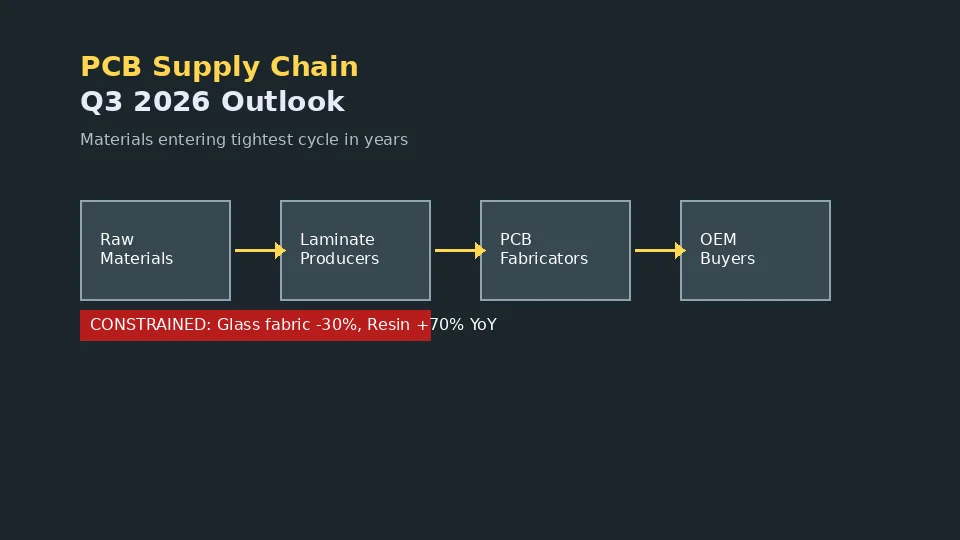
The second factor is the Jubail petrochemical complex disruption in Saudi Arabia, offline since March due to ongoing Middle East conflict. This facility supplies approximately 70 percent of the world’s high-purity PPE resin used in laminate manufacturing. Epoxy resin lead times have jumped from three weeks to fifteen, affecting even standard FR-4 materials that were historically considered commodity items.
The third constraint is upstream capacity reallocation. Leading glass cloth weavers have shifted air-jet loom capacity away from standard specifications (7628, 2116, 1080) toward high-margin Low-Dk specialty fabrics demanded by AI server board manufacturers. This rational economic decision by weavers — serving higher-margin customers first — has severely constricted supply of the standard-grade fabrics that serve the vast majority of conventional PCB production.
Downstream Cost Transmission Accelerates
Glass cloth represents 25 to 40 percent of copper clad laminate manufacturing cost, making CCL pricing highly sensitive to glass cloth fluctuations. Major CCL suppliers have responded with successive price increases throughout 2026, with FR-4 CCL sheet prices surging from approximately $16.05 to over $27.70 per sheet — an increase exceeding 70 percent year-over-year.
The India Printed Circuit Association (IPCA) reports that copper clad laminate prices have increased by more than 300 percent over the past year in some categories, particularly affecting smaller manufacturers with limited procurement leverage. The association has approached the Indian government seeking emergency measures including import duty exemptions on critical PCB materials, working capital assistance for smaller manufacturers, and financial support to prevent further industry disruption.
PCB manufacturers across rigid, flex, and HDI categories are adjusting quotes upward by 20 percent or more to reflect the new material cost reality. Lead times have expanded significantly: standard FR-4 boards now require six to eight weeks versus the historical two to three weeks, while advanced low-loss laminates for high-speed applications stretch to 14 to 18 weeks.
Industry-wide glass cloth inventory levels have dropped to just 3 to 10 days, forcing many weaving mills to operate on advance-payment or quota allocation systems. This critically low buffer means any additional demand shock or supply interruption — however minor — could trigger further price spikes and allocation disputes.
Capacity Expansion Bottlenecked by Equipment
Expanding glass cloth production capacity requires specialized air-jet looms, over 90 percent of which are manufactured by Japanese equipment makers. These precision machines currently face delivery lead times extending to multiple years, creating a fundamental bottleneck that prevents rapid supply response regardless of market price signals.
New PCB fabrication capacity coming online in late 2026 through 2027 is already substantially pre-allocated to AI customers who have signed long-term capacity agreements with major manufacturers. This pre-allocation means the capacity additions will primarily serve the AI segment, providing limited relief for non-AI PCB applications.
Electronics Weekly reports that some Chinese PCB manufacturers are now quoting 2028 delivery dates for orders placed in August 2026, particularly for advanced multilayer boards requiring low-loss materials. Industry bodies have warned that output for non-priority applications could decline by 30 to 40 percent over the next three months if the supply situation does not improve.
What This Means for Hardware Engineering Teams
The supply chain constraints carry several practical implications for product development and procurement teams planning board builds in the current environment.
Material lead time must be factored into project schedules from the earliest design phase. For any board using advanced materials — low-loss laminates, high-Tg FR-4, or Rogers/PTFE hybrids — procurement should begin immediately upon design freeze rather than waiting for final Gerber release. Even standard FR-4 boards now require planning horizons of six to eight weeks minimum.
Material substitution flexibility provides significant leverage. Boards originally specified with premium low-loss materials should be evaluated for whether standard mid-loss laminates (such as Isola 370HR or ITEQ IT-180A) can meet electrical requirements. Many designs specify premium materials with significant margin — a signal integrity simulation using actual material parameters often confirms that a lower-grade laminate satisfies performance requirements while dramatically improving availability.
Volume commitments and demand forecasting earn priority allocation. Manufacturers prioritize customers who provide rolling forecasts and commit to consistent volumes over spot buyers placing unpredictable orders. Establishing a production capacity agreement — even for moderate quantities — locks in both pricing and delivery priority.
Panel utilization optimization reduces material consumption. Working with your manufacturer to optimize panelization — maximizing board count per panel and minimizing waste — becomes more valuable as material costs rise. A 10 percent improvement in panel utilization directly translates to a 10 percent reduction in material cost exposure.
Market Outlook Through 2027
Industry analysts project glass cloth prices continuing upward through Q4 2026, potentially reaching $1.75 to $2.19 per meter for standard 7628 specification — representing up to 260 percent cumulative growth from the 2025 baseline. The squeeze is expected to persist well into 2027, particularly for non-AI applications that cannot command priority allocation from material suppliers.
The structural nature of AI demand — which represents a permanent increase in material consumption per server unit rather than a cyclical inventory build — suggests that even after new capacity comes online, pricing will settle at levels substantially higher than the 2025 baseline. Industry participants should plan for a new cost equilibrium rather than anticipating a return to previous pricing levels.
For hardware teams navigating this environment, the most effective strategy combines early material procurement, design flexibility for material substitution, strong manufacturer relationships with consistent demand signals, and panel optimization to minimize waste. Teams that adapt their procurement processes to the new supply reality will maintain delivery schedules; those that continue with just-in-time ordering assumptions face significant project delays.
Reviewed by AtlasPCB Engineering Team — 15+ years in advanced PCB fabrication for RF, HDI, and rigid-flex applications.
Related Reading:
About AtlasPCB — We specialize in complex PCB manufacturing for HDI, RF, and high-reliability applications. Explore our instant online PCB quote . Every order includes free engineering review. Get your quote.
Reviewed by AtlasPCB Engineering Team — IPC-certified manufacturing specialists with 15+ years of production experience in HDI, RF, and high-reliability PCB fabrication. Content based on factory floor data and real customer design reviews.
- PCB supply chain
- material shortage
- glass cloth
- CCL pricing
- AI server demand
- procurement strategy
- PCB industry 2026