· atlaspcb-team · news · 8 min read
Electronic Glass Cloth Prices Surge 140% Since 2025: AI Server Demand and Equipment Bottlenecks Drive PCB Material Crisis
Standard 7628 electronic glass cloth has risen from $0.60/m to $1.47/m in twelve months, with specialty Low-Dk grades reaching $37/m on spot markets. The structural shortage reshapes PCB procurement strategies worldwide.
Glass Cloth Prices Hit Record Levels as AI Demand Outpaces Loom Capacity
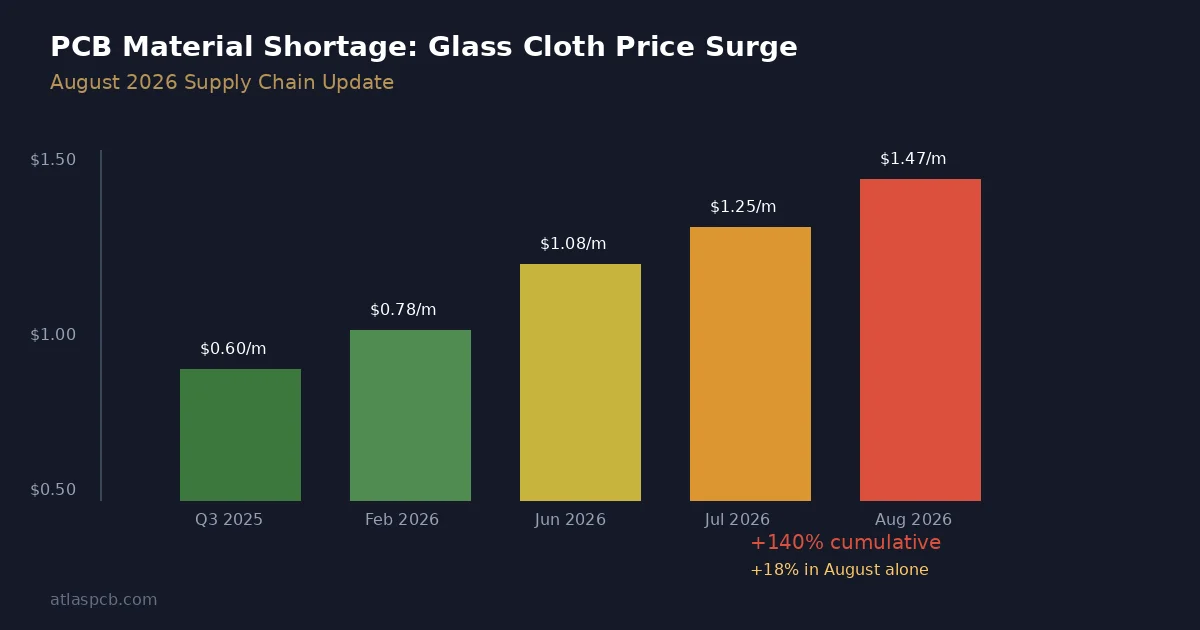
The electronic glass cloth market — the foundational reinforcement fabric inside every copper-clad laminate sheet used to manufacture printed circuit boards — has reached crisis-level pricing in August 2026. Standard 7628 specification glass cloth, which traded at approximately $0.60 per meter during the Q3 2025 cyclical bottom, has surged to $1.47 per meter in August 2026, representing a cumulative 140% increase in twelve months. The trajectory shows no signs of reversal: industry forecasts project prices reaching $1.75 to $2.19 per meter by Q4 2026, which would represent up to 260% growth from 2025 baseline levels.
The price acceleration has intensified dramatically in recent months. After relatively modest 12% monthly increases during the February through May 2026 recovery phase, the market shifted into a higher gear. June saw a $0.10/meter single-month jump as AI server demand collided with upstream capacity reallocation. July continued with a 16% surge to $1.24-1.27 per meter. August delivered a record 17-18% monthly increase, breaking through the $1.47 threshold as mainstream specifications experienced their steepest single-month gain in the current cycle.
More striking than the standard-grade increases are the specialty fabric premiums. High-Dk and Low-Dk ultra-thin glass cloths — the grades required for high-speed AI server PCBs operating at 112 Gbps PAM4 and beyond — now command spot market prices of $21.90 to $37.95 per meter, with lead times stretching to three to four months. These are not commodity fluctuations but structural revaluations driven by demand that has outgrown manufacturing capacity by a wide margin.
Why AI Servers Consume 10x More Glass Cloth Than Traditional Hardware
The mathematics of AI infrastructure demand explain the supply-demand imbalance. A traditional enterprise server employs an 8 to 14 layer PCB that consumes approximately 3 to 5 meters of glass cloth per unit during laminate manufacturing. Each layer of a PCB requires reinforcement fabric — typically one or two sheets of prepreg glass cloth between copper foil layers during the lamination stack.
Modern AI training and inference servers operate on an entirely different scale. High-performance GPU servers from companies deploying NVIDIA H200, B200, and next-generation Rubin platforms utilize 16 to 30+ layer mainboards with additional high-layer-count backplanes and switch boards. Some specialized AI server architectures employ PCBs with 70+ layers for their main interconnect substrates. A single AI server can therefore consume 30 to 50 meters of glass cloth — representing a 3x to 10x material intensity increase per unit compared to conventional servers.
When hyperscale data center operators are deploying tens of thousands of these AI servers per quarter, the aggregate glass cloth demand surge overwhelms an industry that was sized for traditional computing growth rates. The glass cloth industry’s total global capacity was built to serve a market growing at 5-8% annually, not one experiencing 30-50% year-over-year demand surges from a single application category.
Compounding the volume increase is a specification shift. AI server PCBs require low-loss laminates with controlled dielectric properties for signal integrity at 56 GHz and above. These PCBs specify Low-Dk glass cloth variants that are more difficult to weave, require specialized yarn compositions, and have lower production throughput per loom-hour than standard 7628 fabric. The most advanced AI boards demand NE-glass or D-glass compositions that were specialty products with limited production capacity before the AI infrastructure boom.
The Equipment Bottleneck That Prevents Quick Resolution
Unlike many commodity markets where price signals rapidly attract new capacity investment, the glass cloth supply chain faces a fundamental equipment constraint that prevents rapid supply response. The specialized air-jet looms used for electronic-grade glass fabric weaving are manufactured primarily by Japanese equipment suppliers. Current delivery lead times for new weaving equipment extend to 18-24 months from order placement.
This means that even aggressive capacity expansion commitments made in early 2026 — when the shortage was already evident — will not deliver meaningful new output until late 2027 at the earliest. The global glass cloth industry cannot simply run existing equipment harder: these precision looms already operate at or near maximum utilization rates, and the fabric quality standards required for electronic applications prohibit shortcuts in weaving parameters.
Meanwhile, existing producers face a strategic allocation decision. With Low-Dk specialty fabrics commanding premium prices 5-10x higher than standard grades, weavers are rationally shifting loom capacity away from 7628 and 2116 standard specifications toward higher-margin specialty production. This capacity reallocation improves individual manufacturer profitability but constricts supply of the standard fabrics that constitute the majority of FR-4 laminate production volume. The result is a shortage across virtually every glass cloth category simultaneously, albeit with varying severity.
Industry-wide inventory levels have collapsed to 3 to 10 days of stock, down from the typical 30-45 day buffer maintained during balanced market conditions. Many weaving mills have shifted to advance-payment or quota-based allocation systems, requiring customers to commit and pay months before delivery. Some suppliers have paused new order acceptance entirely for certain high-demand grades.
Cascading Impact Through the PCB Supply Chain
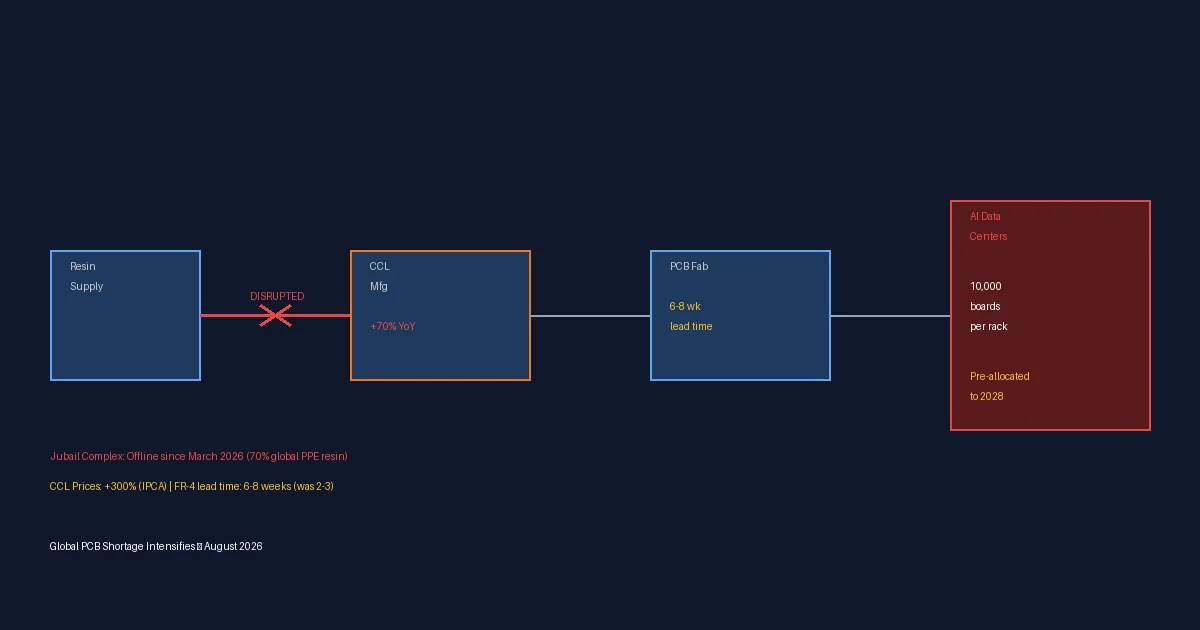
Glass cloth represents 25-40% of copper-clad laminate manufacturing cost for standard FR-4 grades. The cumulative 140% increase in cloth pricing has forced successive CCL price increases throughout 2026, with major producers including Nan Ya Plastics, Kingboard Laminates, and ITEQ issuing multiple round of increases. FR-4 laminate sheet pricing has risen from approximately $16 per sheet to $27+ in 2026, representing over 70% inflation at the CCL level.
These cost increases transmit directly to PCB manufacturers, who face simultaneous pressure from elevated copper foil prices, rising chemical costs, and now the glass cloth-driven laminate inflation. PCB fabricators across rigid, flex, and HDI categories have implemented quote adjustments of 20% or more in recent months, with many adopting “supply-guaranteed but not price-guaranteed” policies that allow mid-order repricing when material costs shift significantly between quote acceptance and production scheduling.
For PCB buyers, the practical effects extend beyond pricing. Lead times for standard multilayer boards have stretched considerably. Material allocation systems mean that smaller and mid-volume orders face more acute availability pressure than large-volume programs with established material reservations. Some fabricators report that Q3-Q4 2026 production capacity is substantially pre-committed, with new orders competing for any remaining slots rather than being scheduled on demand.
What This Means for PCB Procurement Strategy
The glass cloth supply crisis is not a temporary blip but a structural market condition expected to persist through at least mid-2027. PCB buyers and hardware engineering teams should consider several strategic adjustments.
Early capacity reservation has become essential rather than optional. For production programs with firm build schedules in Q4 2026 or Q1 2027, securing manufacturing slots and material allocation now — even months ahead of needed delivery — prevents the risk of availability gaps when production dates arrive. The traditional approach of requesting quotes a few weeks before needed delivery dates is no longer viable in this market.
Design flexibility offers tangible cost benefits during material shortages. Engineers who can qualify multiple laminate systems for their products (for example, both Shengyi S1000-2M and ITEQ IT-180A for mid-Tg applications) give their fabrication partners flexibility to use whichever material is currently available. Single-source material specifications create procurement bottlenecks when that specific laminate faces allocation constraints.
Stackup optimization can reduce material consumption. A design that achieves its electrical requirements with a 6-layer stackup rather than an 8-layer alternative consumes 25% less glass cloth per board, which translates to meaningful cost and availability advantages during shortage conditions. DFM collaboration with fabricators to explore layer count optimization is more valuable now than at any point in recent memory.
Long-term supplier relationships with manufacturers who maintain diversified material sourcing and strategic inventory buffers outperform transactional procurement in shortage environments. Fabricators with established relationships across multiple CCL suppliers and geographic sourcing regions can navigate allocation constraints that leave smaller or newer suppliers unable to fulfill commitments.
Market Outlook and Recovery Timeline
Industry analysts project meaningful supply relief beginning in mid-to-late 2027 as new yarn production capacity and additional weaving lines commissioned during 2026 gradually enter service. However, the recovery will likely be gradual rather than sudden — the combination of continued AI demand growth, data center construction timelines, and the multi-year nature of glass cloth capacity expansion suggests that the market will transition from acute shortage to tight-but-manageable conditions rather than returning to the surplus conditions of 2024-2025.
For the remainder of 2026, prices are expected to continue rising, with the Q3 peak season (August through October) coinciding with consumer electronics builds, automotive production cycles, and ongoing AI infrastructure expansion. Q4 2026 forecasts of $1.75-2.19 per meter represent the industry consensus for standard 7628 specification fabric. Specialty grades for AI applications may see even steeper trajectories as their demand continues growing faster than dedicated capacity can be added.
The glass cloth supply crisis underscores a broader reality of the current electronics manufacturing landscape: the infrastructure demands of artificial intelligence have grown faster than the multilayer supply chain originally built for steady-state computing growth can accommodate. Materials, equipment, and capacity that were adequate for a pre-AI world are proving structurally insufficient for the new demand environment, and the timeline for rebalancing supply and demand extends well beyond the planning horizons of most product development cycles.
Reviewed by AtlasPCB Engineering Team
About AtlasPCB — We specialize in complex PCB manufacturing for HDI, RF, and high-reliability applications. Explore our full PCB manufacturing capabilities, or get an instant online quote . Every order includes free engineering review. Get your quote.
Reviewed by AtlasPCB Engineering Team — IPC-certified manufacturing specialists with 15+ years of production experience in HDI, RF, and high-reliability PCB fabrication. Content based on factory floor data and real customer design reviews.
- glass cloth
- PCB raw materials
- CCL prices
- supply chain
- AI servers
- PCB material shortage
- e-glass fabric
- procurement