· atlaspcb-team · news · 7 min read
PCB Raw Material Crisis Deepens: CCL Prices Up 70%, Lead Times Triple as AI Demand and Resin Shortage Collide
The global PCB supply chain faces its worst disruption in decades. Copper clad laminate prices have surged 70% year-over-year while lead times for standard FR-4 stretch to 8 weeks. What hardware teams need to know and do now.

The global PCB industry is experiencing its most severe supply disruption in decades. What began as scattered lead time extensions in early 2026 has escalated into a full-blown raw material crisis that is reshaping procurement strategies across the electronics sector. Copper clad laminate prices have surged 70% year-over-year, standard FR-4 lead times have tripled, and some Chinese manufacturers are now quoting delivery dates stretching into 2028 for orders placed just last month.
This is not a temporary blip. Two massive, simultaneous supply shocks — explosive AI datacenter demand and a catastrophic disruption to the world’s resin supply — have collided to create a shortage that will define hardware procurement for the next 12 to 18 months.
The Perfect Storm: AI Demand Meets Resin Shortage
To understand the severity of the current crisis, you need to appreciate the scale of both forces now pulling at the PCB supply chain.
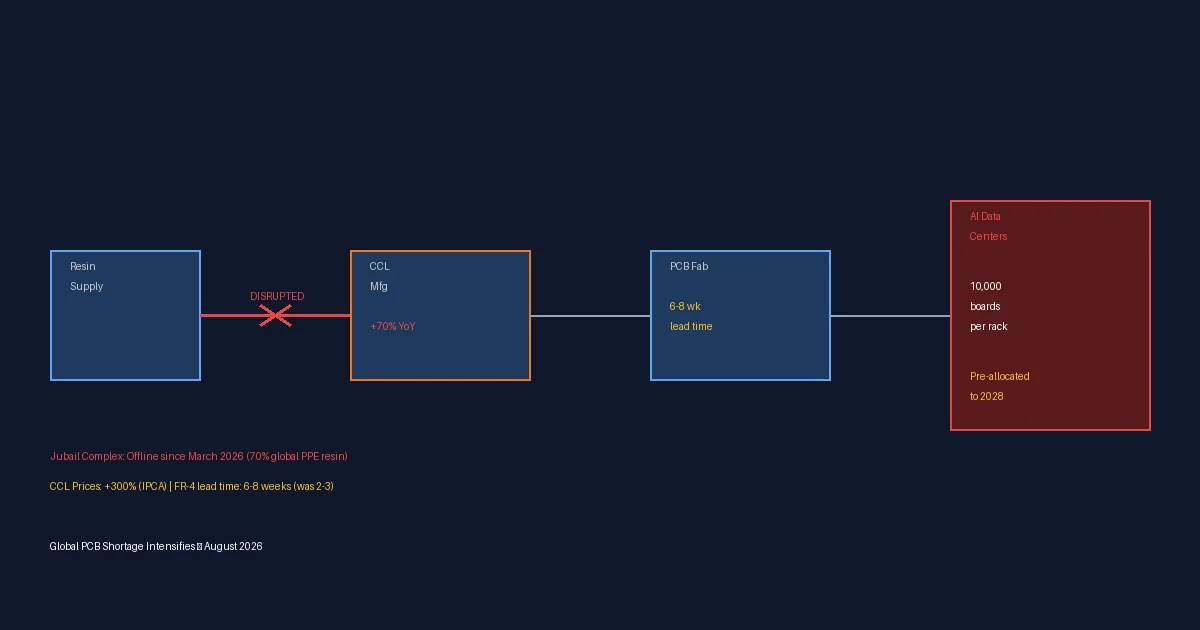
On the demand side, the buildout of AI datacenter infrastructure has consumed PCB manufacturing capacity at a rate the industry simply did not anticipate. A single AI server rack can require up to 10,000 individual printed circuit boards when you account for GPU modules, networking switches, power distribution, and support infrastructure. Multiply that across the hundreds of thousands of racks being deployed globally, and you begin to grasp why fabricators are running at maximum capacity with order books full through 2027.
On the supply side, the crisis traces back to a single catastrophic point of failure. The Jubail petrochemical complex in Saudi Arabia — which supplies approximately 70% of the world’s high-purity polyphenylene ether (PPE) resin used in advanced laminates — has been offline since March 2026 due to ongoing Middle East conflict. This facility’s output underpins the entire laminate supply chain, and its absence has sent shockwaves through every tier of PCB manufacturing.
The results are stark. According to reporting from Electronics Weekly, epoxy resin lead times have jumped from a manageable 3 weeks to a staggering 15 weeks. Glass cloth prices climbed 18% in a single month, per Lead-PCB’s latest market report. And copper clad laminate — the foundational material in virtually every PCB — has seen price increases that vary from alarming to extraordinary depending on which market you examine.
The Numbers Paint a Grim Picture
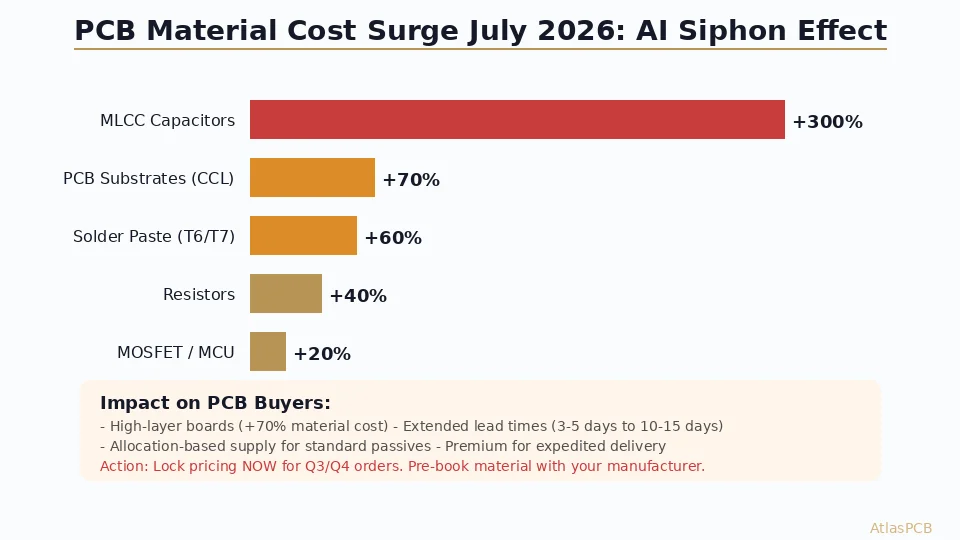
The headline figure of 70% year-over-year CCL price increases tells only part of the story. Some buyers report 40% price jumps in a single month as spot market availability tightens. The India Printed Circuit Association (IPCA) has documented CCL price increases of 300% over the past year in certain grades, prompting the Indian government to actively seek import duty exemptions on critical PCB raw materials to prevent its domestic electronics manufacturing sector from grinding to a halt.
For hardware teams accustomed to predictable procurement cycles, the lead time situation is equally disorienting. Standard FR-4 material that once shipped in 2 to 3 weeks now carries lead times of 6 to 8 weeks. Advanced low-loss laminates — the Megtron and Rogers materials essential for high-frequency RF designs, advanced networking equipment, and high-speed computing — have stretched to 14 to 18 weeks. For teams working on products with specific material requirements, this effectively means planning nearly five months ahead for laminate availability alone.
Industry analysts estimate that overall PCB output could decline 30 to 40% over the next three months as material constraints cascade through fabrication capacity. Factories cannot run boards they cannot source materials for, regardless of how many orders sit in their queues.
Impact on Hardware Teams
The practical consequences for engineering and procurement teams are significant and immediate. Projects with aggressive timelines face difficult choices: redesign around available materials, accept substantial schedule slips, or pay premium prices for whatever stock remains accessible.
The crisis disproportionately affects smaller and mid-sized hardware companies. New fabrication capacity coming online in late 2026 and into 2027 is largely pre-allocated to major AI infrastructure customers who secured supply agreements months or even years in advance. This leaves the broader electronics industry competing for a shrinking pool of available material, with pricing increasingly determined by willingness to pay rather than established supplier relationships.
Teams designing consumer electronics, industrial controls, automotive subsystems, and medical devices — sectors that typically consume standard to mid-tier laminate materials — find themselves in direct competition with hyperscale datacenter buyers whose budgets dwarf traditional PCB procurement spending.
Looking Ahead: The 2027 Outlook
The honest assessment is that relief will come slowly. New laminate production capacity is being built, but construction timelines for chemical processing facilities mean meaningful additional output won’t arrive until mid-to-late 2027 at the earliest. Even then, much of this capacity has already been contracted to AI-focused customers.
The Jubail complex’s return to operation remains uncertain and tied to geopolitical factors entirely outside the electronics industry’s control. Alternative PPE resin sources exist but at lower purity grades and significantly reduced volumes — nowhere near sufficient to replace Jubail’s output.
What this means practically is that the 2026-2027 period will reward organizations that adapt their procurement strategies now rather than waiting for the market to normalize. The companies that emerge with intact production schedules will be those that treated this as a structural shift rather than a temporary inconvenience.
What You Can Do Now
From our position as a PCB manufacturer working across multiple factories and material supply chains, we see clear patterns in which customers are navigating this crisis successfully and which are being caught unprepared. The difference comes down to proactive planning and flexibility.
First, add 4 to 6 weeks to every timeline in your project plan. The lead times quoted today assume material is available when your order enters the queue — an assumption that frequently proves optimistic in the current environment. Building buffer into your schedule now prevents costly expedite fees and production line disruptions later.
Second, evaluate material alternatives with your engineering team. Where designs specify high-Tg FR-4, consider whether mid-Tg alternatives can meet your thermal and reliability requirements. Every grade substitution you can accept expands the pool of available material. This isn’t about compromising quality — it’s about identifying where specifications carry margin that can be traded for availability.
Third, lock in capacity through blanket purchase orders. Fabricators are prioritizing customers with committed volume because it allows them to plan material procurement with confidence. A blanket PO covering your projected 6-month demand gives your supplier justification to allocate material on your behalf.
Fourth, pre-stock laminates for your most critical projects. If you have designs entering production in Q4 2026 or Q1 2027 with specific material requirements, work with your fabricator to secure and hold that material now. The cost of carrying inventory for a few months is trivial compared to a production delay.
Finally, communicate proactively with your PCB supplier. Share your roadmap, even at a high level. Suppliers who understand your upcoming needs can flag risks early and suggest alternatives before you’re locked into a timeline that the market can no longer support.
Worried About Lead Times?
Get a current availability check and quote. We maintain pre-allocated material stocks across our factory network.
Check AvailabilityHow AtlasPCB Is Responding
Our multi-factory network across China’s PCB manufacturing base gives us structural advantages in a constrained market. Rather than relying on a single fabrication partner, we maintain relationships with specialized facilities across different regions — each with their own material supply agreements and inventory positions. When one factory faces allocation limits on a particular laminate grade, we can often source from another facility with available stock.
We’ve also pre-negotiated material allocations with multiple CCL suppliers, securing committed volumes of standard FR-4 and select high-frequency laminates through early 2027. This doesn’t make us immune to the crisis, but it means our customers benefit from supply resilience that a single-factory relationship simply cannot provide in today’s market.
Our engineering review process now includes a material availability assessment as a standard step. Before your design enters production, we verify current lead times for your specified materials and proactively recommend alternatives where availability is constrained. This catches potential delays before they become schedule-breaking surprises.
The current market rewards preparation, flexibility, and strong supplier relationships. We’re committed to keeping our customers informed, offering transparent lead time guidance, and leveraging every advantage our network provides to keep projects moving forward through this unprecedented disruption.
Reviewed by AtlasPCB Engineering Team
About AtlasPCB — We specialize in complex PCB manufacturing for HDI, RF, and high-reliability applications. Explore our full PCB manufacturing capabilities, or get an instant online quote . Every order includes free engineering review. Get your quote.
Reviewed by AtlasPCB Engineering Team — IPC-certified manufacturing specialists with 15+ years of production experience in HDI, RF, and high-reliability PCB fabrication. Content based on factory floor data and real customer design reviews.
- PCB shortage
- raw materials
- supply chain
- CCL prices
- industry news