· atlaspcb-team · news · 6 min read
64% of Electronics Manufacturers Report Supply Constraints as Q2 2026 Conditions Worsen Across Memory, Laminates, and GPUs
The Global Electronics Association's August 2026 Sentiment Survey reveals that nearly two-thirds of electronics manufacturers face limited component availability or extended lead times. Laminates and resins — critical PCB raw materials — rank among the top disruption sources, with European manufacturers particularly affected as 35% cite laminate shortages versus just 6% in North America.
Global Sentiment Survey Confirms Multi-Front Supply Chain Pressure
The Global Electronics Association published its August 2026 Global Sentiment Survey on August 21, revealing that supply chain conditions for electronics manufacturers have deteriorated significantly through the first half of 2026. The findings confirm what PCB buyers and fabricators have experienced for months: availability is constrained across multiple material and component categories simultaneously, with no near-term relief in sight.
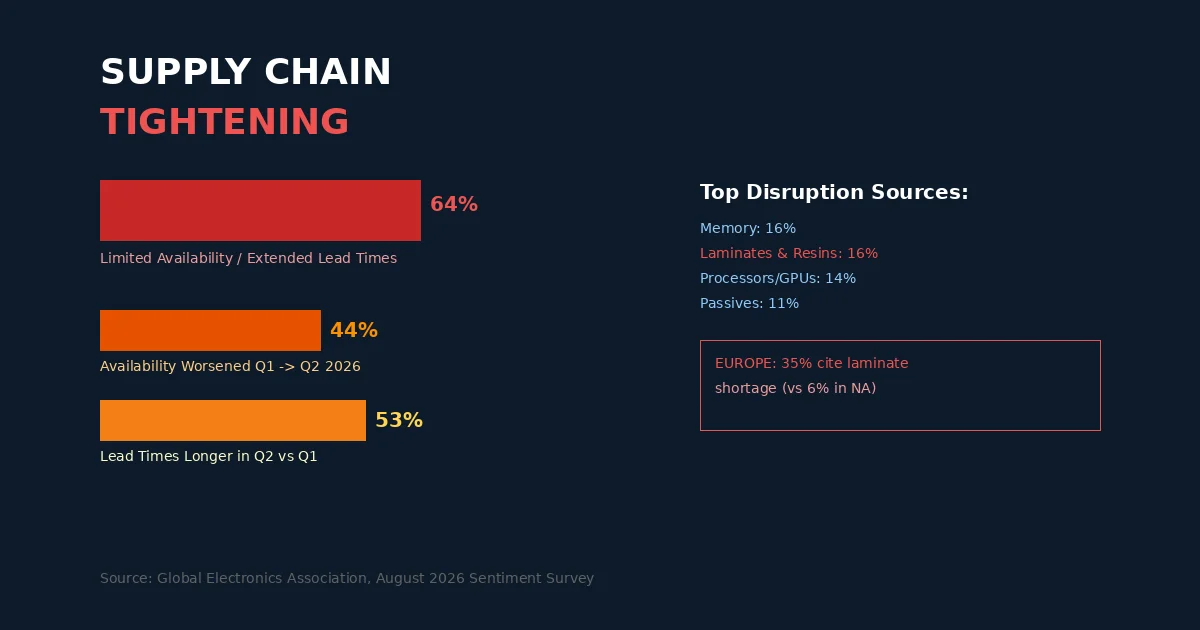
The headline number is stark: 64% of global electronics manufacturers report that the components and materials they rely on are available only with limited availability or extended lead times. Not a single survey respondent described current market conditions as “readily available with excess supply.” This unanimity of constraint — zero respondents reporting excess supply — signals a market that has moved decisively from balance into shortage territory.
The directional trend is equally concerning for procurement teams planning Q3 and Q4 production. More than four times as many respondents say market availability worsened in Q2 2026 compared to Q1 (44%) as say it improved (10%). The remaining 42% report conditions roughly unchanged — meaning the market is either sliding or holding at an already-constrained level without recovery. For manufacturers who built inventory buffers during the relative calm of late 2025, those buffers are now being consumed faster than they can be replenished.
Laminates and Resins: A Top-Tier Disruption Source
For the PCB industry specifically, the survey’s finding on laminates and resins ranks as the most consequential data point. Laminates and resins tied with memory components as the leading sources of supply disruption, each cited by 16% of respondents globally. This ranking places PCB raw materials alongside semiconductor memory — a category that has historically received far more media and industry attention — as an equally significant bottleneck in the electronics manufacturing pipeline.
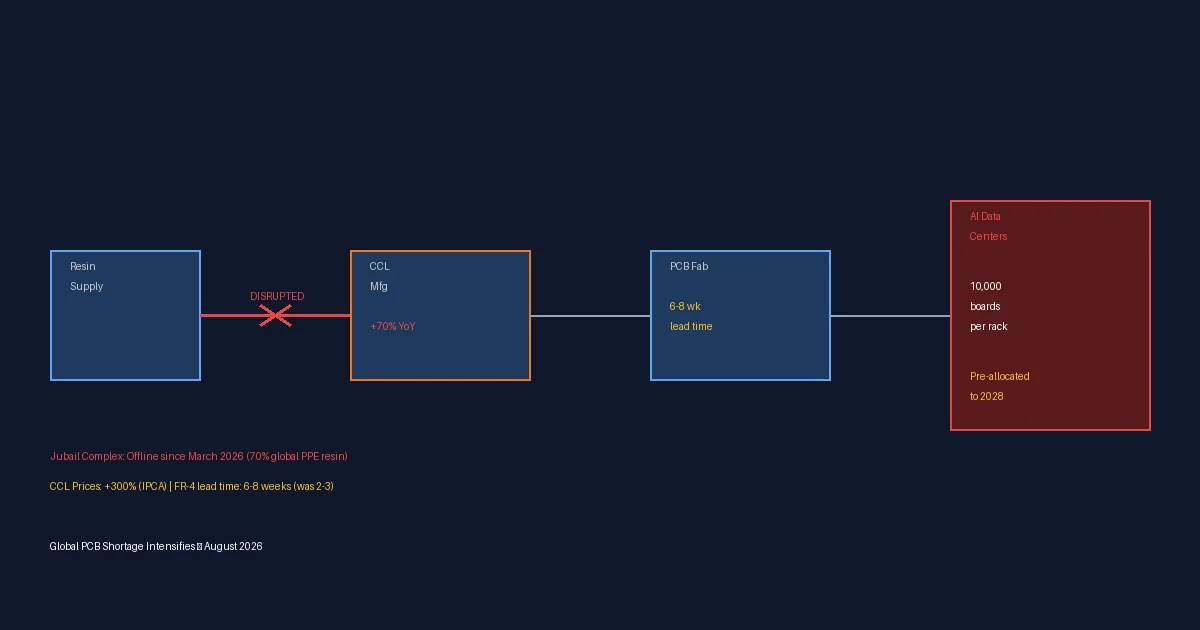
The laminate shortage has multiple contributing factors that have compounded throughout 2026. The disruption at Saudi Arabia’s Jubail petrochemical complex — offline since March due to regional conflict — has choked the supply of high-purity PPE (polyphenylene ether) resin that feeds approximately 70% of global laminate production. Simultaneously, AI data center construction has absorbed unprecedented volumes of advanced low-loss laminates (Megtron 6/7, Panasonic R-5775K, Isola Tachyon) for high-layer-count server boards. Standard FR-4 materials, while not directly consumed by AI hardware, have been affected as laminate manufacturers reallocate production capacity toward higher-margin advanced grades.
The result is a dual squeeze: standard FR-4 lead times have extended from the normal 2-3 weeks to 6-8 weeks, while advanced low-loss laminates now quote 14-18 weeks in some regions. CCL (copper-clad laminate) prices have surged approximately 70% year-over-year, with some procurement managers reporting 40% increases within a single month during Q2.
Regional Disparities Create Uneven Impact
The survey reveals significant regional variation in supply chain pressure that reflects different manufacturing specializations and supply chain dependencies across geographies.
European manufacturers are disproportionately affected by laminate and resin shortages, with 35% of European respondents citing this category as their primary disruption source — more than five times the rate reported by North American manufacturers (6%). This disparity likely reflects Europe’s greater dependence on imported laminate materials and fewer domestic CCL producers compared to North America, where suppliers like Isola and Arlon maintain local manufacturing. European PCB fabricators have traditionally sourced laminates from Asian suppliers, and the combination of shipping disruptions and Asian capacity being absorbed by domestic AI demand has left European supply lines particularly exposed.
In the Asia-Pacific region, passive components create the most pronounced strain, cited by 33% of APAC respondents. The passive component shortage reflects the enormous volumes consumed by consumer electronics, automotive, and industrial applications concentrated in the region, combined with limited capacity expansion for commodity MLCCs and chip resistors as capital investment has favored higher-margin semiconductor and advanced packaging facilities.
North American manufacturers face a more distributed challenge without a single dominant bottleneck, which may reflect the region’s more diversified supply base and aggressive inventory building during 2025 when availability was relatively open.
Lead Times Extending With No Recovery Signal
Beyond availability, the survey tracks lead time trends — and the trajectory is clearly negative. More than half of respondents (53%) report that supplier lead times for components and materials were longer in Q2 2026 than in Q1. Just 3% report lead times shortened. The 50-point spread between those experiencing longer versus shorter lead times represents one of the most lopsided readings in the survey’s recent history.
Extended lead times create cascading operational challenges that go beyond simple procurement delays. Longer lead times force manufacturers to increase safety stock levels (tying up working capital), extend planning horizons (reducing ability to respond to demand changes), and accept larger minimum order quantities from suppliers protecting their own position. For PCB fabricators specifically, laminate lead time extensions mean that quick-turn delivery promises to end customers become increasingly difficult to fulfill without carrying significant raw material inventory — a financial burden that falls disproportionately on smaller manufacturers with limited capital reserves.
Implications for PCB Buyers and Design Engineers
The survey data reinforces several practical implications for hardware teams currently designing or procuring PCBs:
Material selection decisions should account for availability differences. Standard FR-4 from major suppliers (Shengyi, Kingboard, ITEQ) remains more available than specialty materials. Designs that specify proprietary or single-source laminates face the highest risk of extended delays. Where performance requirements allow, qualifying alternative laminate grades provides procurement flexibility.
Lead time expectations need recalibration. The industry has not returned to pre-2024 delivery norms, and the data suggests further extension rather than recovery through the remainder of 2026. Engineers should engage fabricators early in the design process to confirm material availability before committing to specific substrates in their stackup.
Regional sourcing diversification provides some buffer. The survey’s regional data suggests that supply pressure varies geographically — manufacturers with multi-region supply chain options can potentially exploit these differences, though shipping costs and qualification requirements limit the flexibility for some programs.
Volume commitments secure priority allocation. In constrained markets, fabricators and material suppliers prioritize customers with forecasted volumes and long-term agreements over spot buyers. Establishing quarterly volume commitments — even approximate ranges — positions buyers for better allocation when materials are tight.
Concerned About Material Availability for Your Next Build?
AtlasPCB maintains strategic inventory positions on FR-4, high-Tg, and Rogers laminates. Upload your Gerber files for a material availability check alongside your production quote — we confirm substrate lead times before you commit.
Check Material AvailabilityReviewed by AtlasPCB Engineering Team
Data sourced from the Global Electronics Association August 2026 Global Sentiment Survey, published August 21, 2026. Supply chain context informed by industry reporting from Electronics Weekly, I-Connect007, and manufacturer earnings commentary from Q2 2026. Regional laminate pricing reflects market conditions observed in our procurement operations as of mid-August 2026.
About AtlasPCB — We specialize in complex PCB manufacturing for HDI, RF, and high-reliability applications. Explore our quick-turn PCB manufacturing from 24 hours . Every order includes free engineering review. Get your quote.
Reviewed by AtlasPCB Engineering Team — IPC-certified manufacturing specialists with 15+ years of production experience in HDI, RF, and high-reliability PCB fabrication. Content based on factory floor data and real customer design reviews.
- supply chain
- material shortage
- laminates
- PCB materials
- electronics manufacturing
- lead times