· AtlasPCB Engineering · News · 10 min read
PCB Tariff Alert: Section 301 Exclusions for 2-Layer and 4-Layer Boards Expire November 9, 2026
US importers of China-origin printed circuit boards face a critical deadline as Section 301 exclusions under HTS 9903.88.69 expire November 9, 2026. Two-layer and four-layer rigid PCBs currently shielded from the 25% product tariff will face full 37.5% combined duty rates after the expiry. Here is what PCB buyers need to know and how to prepare.
The November 9 Deadline That Affects Every China-Sourced PCB Order
A significant tariff event is approaching that will directly impact the landed cost of printed circuit boards imported from China into the United States. The current Section 301 product exclusion covering certain two-layer and four-layer rigid PCBs under HTS 9903.88.69 is set to expire at 11:59 PM Eastern Time on November 9, 2026. After this deadline, unless the United States Trade Representative issues a further extension, qualifying boards that currently avoid the 25% Section 301 product tariff will face the full combined duty rate of approximately 37.5%.
This exclusion has been extended multiple times since its original implementation, but each extension has carried no guarantee of renewal. For engineering teams and procurement managers placing orders with Chinese PCB fabricators, the remaining window between now and the November deadline represents the last confirmed period of reduced tariff exposure for these specific product categories.
Understanding the Current Tariff Structure on China-Origin PCBs
The tariff landscape for PCBs imported from China into the United States has changed substantially in 2026 following the Supreme Court ruling that struck down IEEPA reciprocal tariffs in February. The current structure as of August 2026 consists of two primary layers that combine to determine the total duty burden on each shipment.
The first layer is the Section 301 forced-labor tariff, which replaced the expired Section 122 temporary surcharge on July 24, 2026. For China-origin goods, this base layer is 12.5%, placing China in the higher tier alongside 45 other economies. This tariff applies broadly to essentially all Chinese imports regardless of product category.
The second layer is the Section 301 product-specific tariff, which remains at 25% for most electronics categories including bare printed circuit boards classified under HTS 8534.00. This product tariff has been in effect since the original Section 301 trade actions and continues unchanged through the various structural shifts in 2026.
For PCBs without an active exclusion, the combined effective rate is 37.5% (12.5% base plus 25% product tariff) applied to the customs value of the goods. On a $10,000 shipment of bare PCBs at FOB pricing, this translates to $3,750 in duty before adding Merchandise Processing Fee, customs brokerage, and freight. Compared to sourcing the same boards from a non-China, standard-tier economy (which would pay only the 10% base tariff with no Section 301 product layer), the China premium is 27.5 percentage points.
Which PCBs Currently Qualify for the Exclusion
The Section 301 exclusion under HTS 9903.88.69 does not cover all printed circuit boards from China. The exclusion is narrowly defined to cover specific product descriptions, and importers must verify that their specific boards match the qualifying criteria precisely.
Based on current Federal Register guidance, the exclusion applies to certain two-layer and four-layer rigid printed circuit boards that meet the specific product descriptions in the exclusion notice. The critical qualifiers include the layer count (only two-layer and four-layer boards qualify), the board construction (rigid boards only — flexible and rigid-flex circuits are not covered), and the base material (glass-reinforced insulating substrates, which covers standard FR-4 and similar glass-epoxy laminates).
Boards that do not qualify under this exclusion include multilayer boards with more than four layers, flexible printed circuits, rigid-flex combinations, boards on non-glass-reinforced substrates (such as aluminum-base or ceramic), and printed circuit board assemblies (PCBAs) with mounted components. For these non-qualifying categories, the full 37.5% combined tariff has applied throughout 2026 regardless of the exclusion status.
The practical implication for many AtlasPCB customers is significant: engineers designing complex multilayer boards (6 layers and above), HDI boards, or boards on specialty materials have already been paying the full 37.5% rate throughout 2026. The November deadline specifically affects buyers of simpler two-layer and four-layer rigid FR-4 boards — which paradoxically represents a very large volume of the overall PCB import market because these layer counts dominate industrial, automotive sensor, consumer electronics, and IoT applications.
Timeline of 2026 Tariff Changes Affecting PCB Importers
The 2026 tariff environment has been unusually volatile for electronics importers. Understanding the sequence of events provides context for the November deadline and helps procurement teams anticipate what may come next.
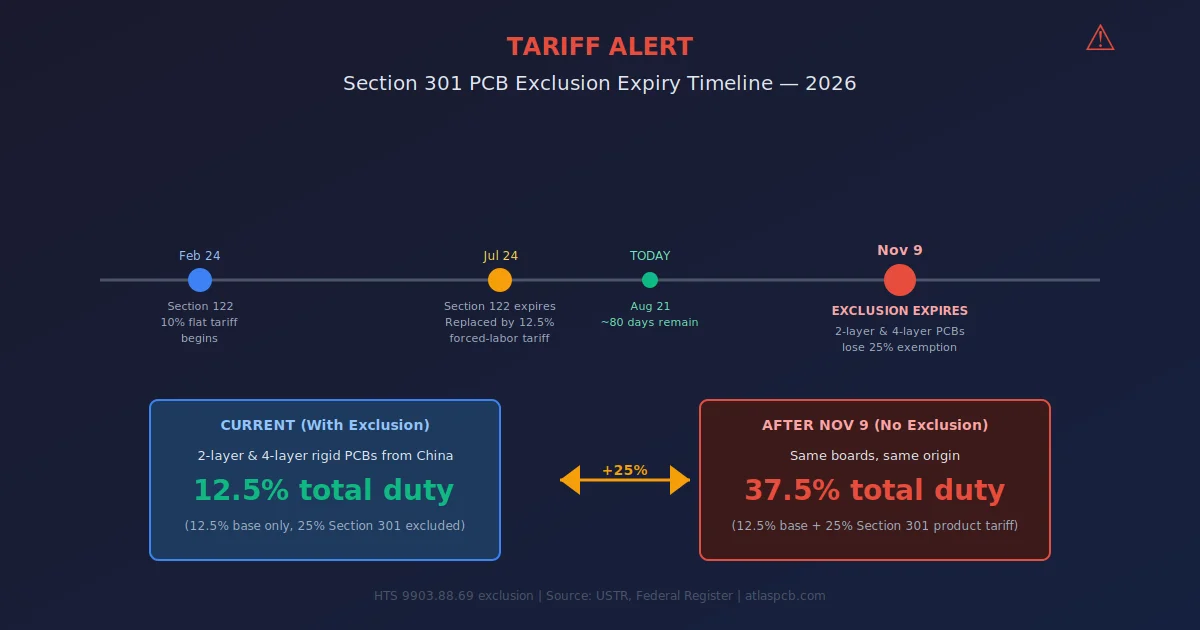
In February 2026, the Supreme Court struck down IEEPA reciprocal tariffs in a 6-3 decision. Hours later, the administration signed a 10% flat tariff under Section 122 of the Trade Act of 1974, effective February 24. This simplified the tariff landscape temporarily — nearly every country paid the same 10% rate, stacking on top of existing Section 301 product tariffs for China-origin goods.
The Section 122 tariff operated under a hard 150-day statutory limit. It expired on schedule at 12:01 AM Eastern on July 24, 2026, because Congress did not authorize an extension. It was immediately replaced by the two-tier Section 301 forced-labor tariff: 10% for most economies and 12.5% for a list of 46 countries including China, Vietnam, and Thailand.
Throughout these base-layer changes, the Section 301 product-specific tariff of 25% on China-origin PCBs has remained constant, and the exclusion under HTS 9903.88.69 for qualifying two-layer and four-layer boards has continued uninterrupted. The exclusion shields qualifying boards from the 25% product layer only — they still pay the base layer (currently 12.5%) regardless.
The next scheduled inflection point is November 9, 2026, when the exclusion expires. If it is not renewed, qualifying two-layer and four-layer boards will immediately face the full 25% Section 301 product tariff in addition to the 12.5% base, bringing their total duty from 12.5% to 37.5%.
Cost Impact Analysis for PCB Buyers
For procurement teams currently benefiting from the exclusion on two-layer and four-layer board purchases, the November expiry represents a 25-percentage-point increase in duty rates — effectively tripling the tariff burden from 12.5% to 37.5%. On typical order volumes, this creates substantial cost exposure.
Consider a mid-size hardware company purchasing $50,000 per month in two-layer and four-layer rigid PCBs from Chinese fabricators. Under the current exclusion, monthly duty costs approximately $6,250 (12.5% of customs value). After November 9, monthly duty would increase to approximately $18,750 (37.5%). The annual incremental cost is $150,000 — a figure that exceeds many companies’ entire engineering budgets and demands advance planning.
Even for smaller prototype-phase companies purchasing $5,000-10,000 monthly in simple PCBs, the shift adds $1,250-2,500 per month in unexpected duty costs that were not budgeted when the product development timeline was established.
The cost dynamics also shift the competitive calculus between sourcing regions. Under the current exclusion, China-sourced two-layer and four-layer boards carry a 2.5% tariff disadvantage compared to standard-tier non-China sources (12.5% versus 10%). After the exclusion expires, that gap widens to 27.5% (37.5% versus 10%) — a differential large enough to make alternative sourcing regions cost-competitive even when their factory-gate prices are 15-20% higher than Chinese equivalents.
Strategic Options for PCB Buyers Before the Deadline
Engineering and procurement teams have approximately 80 days (as of this writing) to prepare for the potential exclusion expiry. Several strategies can mitigate cost impact depending on order volume, design flexibility, and supply chain structure.
The most immediate option is inventory pull-forward. Orders placed now with delivery before November 9 lock in the current 12.5% duty rate. For standard two-layer and four-layer boards with established designs and proven fabrication processes, pulling forward 60-90 days of inventory is relatively low-risk. Storage costs are modest compared to a 25% tariff increase, and FR-4 boards have essentially indefinite shelf life in proper storage conditions.
For companies with ongoing product development where designs are not yet finalized, consider accelerating prototype and pre-production builds to clear customs before the deadline. A design revision that arrives at the border on November 10 rather than November 8 costs 25% more in duty — a strong incentive to compress development timelines where possible.
Longer-term, the tariff differential creates genuine economic motivation to evaluate non-China fabrication sources. Vietnam, Thailand, Taiwan, and South Korea all have growing PCB manufacturing capabilities for two-layer and four-layer boards. While lead times may be longer and qualification processes require investment, the 27.5% duty advantage post-November can justify these transition costs for sustained production volumes.
For complex multilayer boards (6+ layers) that were never covered by the exclusion, the sourcing calculus is unchanged — these boards have faced 37.5% throughout 2026 and the November deadline does not affect them. Companies already paying full tariff on advanced boards may find that their current sourcing strategy already accounts for this cost layer.
What History Suggests About Renewal Prospects
USTR has extended Section 301 exclusions multiple times since their original implementation, but extensions have become shorter in duration and more uncertain in recent cycles. The current exclusion period was itself an extension of a previous extension, with each renewal generating industry uncertainty and last-minute scrambling.
Industry associations including IPC have lobbied consistently for exclusion renewals, arguing that domestic U.S. PCB manufacturing capacity is insufficient to absorb the volume currently imported from China, particularly for high-volume two-layer and four-layer consumer and industrial boards. The counter-argument from trade policy advocates is that maintained tariff pressure accelerates reshoring and alternative-source development — a position that has gained political support in 2026.
No announcement regarding the November 9 deadline has been made as of mid-August 2026. Historically, USTR has announced extension decisions between 30 and 60 days before expiry, suggesting that clarity may emerge in September or October. Companies that cannot tolerate the uncertainty should plan assuming the exclusion expires and treat any renewal as an upside scenario rather than a baseline assumption.
Implications for PCB Design and Specification Decisions
The tariff structure creates an unusual design incentive that engineers should be aware of even though it should never drive primary engineering decisions. Under the current exclusion regime, two-layer and four-layer boards carry dramatically lower import costs than boards with higher layer counts. This creates a financial preference for keeping designs at four layers or fewer when technically feasible — a preference that may disappear entirely if the exclusion expires (because all boards would then face 37.5% regardless of layer count).
After the exclusion expires, the tariff penalty becomes layer-count-neutral: a two-layer board and a twelve-layer board from China face the same 37.5% rate. This removes the artificial economic incentive to keep layer counts low and allows engineers to specify the technically optimal layer count without tariff considerations distorting the cost comparison.
For designs currently on four-layer boards that are under-performing due to EMC issues, routing congestion, or signal integrity compromises, the post-November tariff environment removes one barrier to upgrading. The tariff cost of a six-layer or eight-layer board will be the same percentage as a four-layer board (37.5%), so the only cost difference is the actual fabrication premium for additional layers — which is a legitimate engineering trade-off rather than an artificial policy distortion.
Monitoring and Next Steps
AtlasPCB will continue monitoring USTR announcements regarding the Section 301 exclusion renewal status and will update our customers directly as developments emerge. We recommend the following immediate actions for customers currently importing two-layer and four-layer boards under the exclusion.
Review current inventory levels and identify opportunities to pull forward 60-90 days of demand before November 9. Consult with your customs broker to verify that your current entries are correctly claiming the HTS 9903.88.69 exclusion — an incorrectly filed entry that does not claim the exclusion already pays the full rate unnecessarily. Begin evaluating alternative fabrication sources (including non-China options) for production volumes that extend beyond Q1 2027, when the tariff environment will be clearer. And ensure your landed-cost models accurately reflect the potential 37.5% rate for budgeting purposes from November forward.
Reviewed by AtlasPCB Engineering Team
Market data referenced from USTR Section 301 tariff actions page, Federal Register exclusion notices (Document 2025-21671), and US International Trade Commission HTS database. Tariff rates reflect conditions as of August 2026. This article provides general market commentary and does not constitute legal, customs, or trade compliance advice. Consult a licensed customs broker for specific tariff classification and exclusion eligibility determinations.
About AtlasPCB — We specialize in complex PCB manufacturing for HDI, RF, and high-reliability applications. Explore our instant online PCB quote . Every order includes free engineering review. Get your quote.
Reviewed by AtlasPCB Engineering Team — IPC-certified manufacturing specialists with 15+ years of production experience in HDI, RF, and high-reliability PCB fabrication. Content based on factory floor data and real customer design reviews.
- PCB tariff
- Section 301
- China PCB import
- HTS 8534
- trade policy
- PCB cost
- supply chain
- tariff exclusion