· AtlasPCB Engineering Team · News · 6 min read
Global PCB Shortage Worsens as Resin Supply Disruption and AI Demand Drive Lead Times to Record Highs
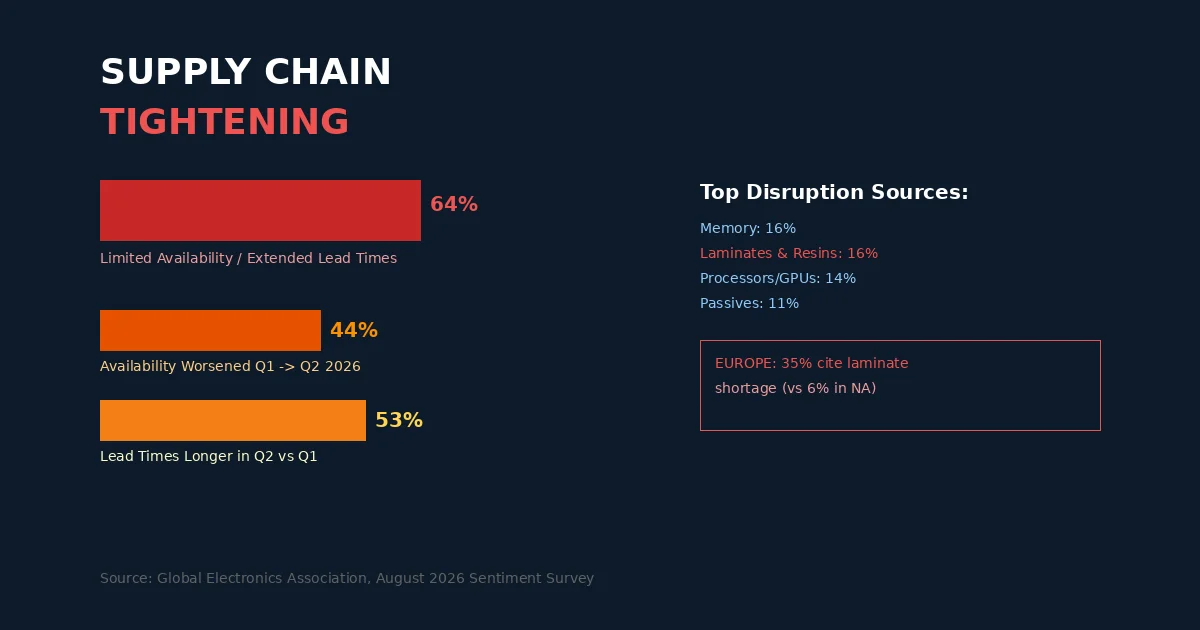
The global PCB shortage has intensified in August 2026, with some Chinese manufacturers quoting 2028 delivery dates as the Jubail petrochemical disruption chokes resin supply and AI data center demand consumes advanced board capacity. CCL prices have surged 70% year-over-year.
The global printed circuit board shortage has entered a critical new phase in August 2026, with industry reports confirming that some Chinese manufacturers are now quoting delivery dates extending into 2028 for orders placed in July. The crisis, driven by the simultaneous impact of petrochemical supply disruption and accelerating AI infrastructure demand, is affecting material availability across all PCB grades from standard FR-4 through advanced low-loss laminates.
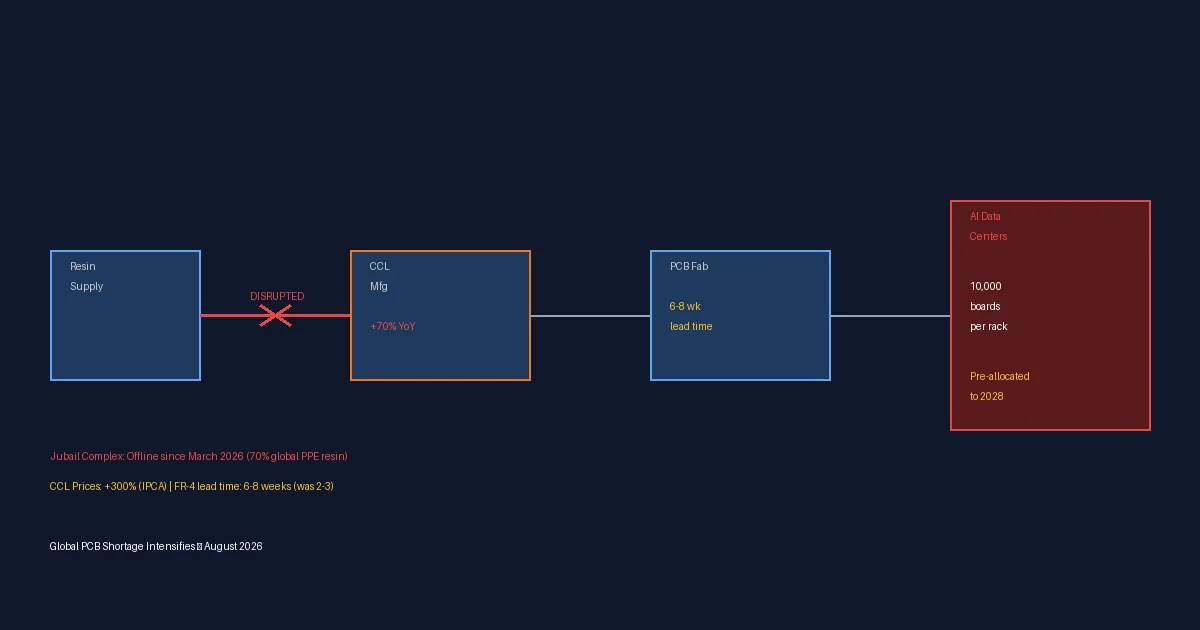
According to reporting from Electronics Weekly, the shortage has been fundamentally worsened by an extended outage at the Jubail petrochemical complex in Saudi Arabia, which supplies approximately 70% of the world’s high-purity polyphenylene ether (PPE) resin used in PCB laminates. The facility has been offline since March 2026 due to Middle East conflict, creating a structural supply gap that no alternative source can fully replace in the near term.
Reviewed by AtlasPCB Engineering Team
Material Price Escalation
The resin supply disruption has driven dramatic price increases across the copper-clad laminate (CCL) supply chain. Copper-clad laminate prices are up approximately 70% year-over-year, with some market segments experiencing 40% increases within a single month. The India Printed Circuit Association (IPCA) reports that CCL prices have increased by more than 300% over the past year in some categories, reflecting both the resin shortage and sustained copper price elevation.
These price increases flow directly through to finished PCB pricing. For standard FR-4 boards, fabricators report 30-50% price increases compared to early 2026 levels. Advanced low-loss materials (Megtron, Panasonic M-series, Rogers laminates) have seen even steeper increases due to their greater dependence on specialty resin formulations and limited alternative supply chains.
The pricing pressure is not distributed evenly across all PCB types. Multilayer boards requiring multiple prepreg sheets per lamination cycle are disproportionately affected — a 12-layer board requires 11 prepreg sheets, amplifying material cost increases multiplicatively through the stackup. Single and double-sided boards, while still affected, experience proportionally smaller per-unit cost impacts.
Lead Time Expansion
Lead times have stretched significantly beyond pre-crisis norms across all material categories. Standard FR-4 materials, which previously carried 2-3 week procurement lead times, now require 6-8 weeks. Advanced low-loss laminates have extended to 14-18 week lead times — meaning that boards specified with these materials today may not enter fabrication until late November or December 2026.
The lead time extension creates a cascading planning problem for hardware development teams. A product development cycle that previously assumed 3-week PCB fabrication must now account for 8-10 weeks of material procurement plus fabrication time, effectively doubling or tripling the total lead time from design freeze to prototype delivery.
For production quantities, the situation is more severe. Major Chinese PCB manufacturers with heavily pre-allocated capacity are quoting delivery timelines stretching 18-24 months for large orders, reflecting both material constraints and production capacity that has been contracted by AI infrastructure customers on long-term supply agreements.
AI Demand as Structural Pressure
The artificial intelligence infrastructure buildout continues to consume an outsized share of global advanced PCB capacity. A single AI server rack uses up to ten thousand circuit boards when accounting for the server motherboards, GPU interconnect boards, power distribution units, and networking switch boards required per rack. Hyperscale data center expansion programs from multiple cloud providers are pre-allocating PCB production capacity years in advance, effectively removing this capacity from availability for other customers.
The AI demand concentration disproportionately affects advanced PCB categories — high-layer-count boards (16+ layers), HDI constructions, and boards using low-loss materials for high-speed serial links. These are precisely the same categories where material supply constraints are most severe, creating a dual bottleneck that extends lead times far beyond what either factor alone would produce.
New fabrication capacity is coming online in late 2026 and early 2027 through expansion programs announced by TTM Technologies, Ibiden, and several Chinese manufacturers. However, much of this new capacity is already pre-allocated to AI customers under long-term supply agreements, providing limited relief for the broader market.
Industry Response and Government Intervention
Industry bodies have warned that PCB output could decline by 30-40% over the next three months if the resin supply situation does not improve. The projection, while alarming, reflects the mathematical reality that fabricators cannot produce boards without laminate material regardless of their available processing capacity and customer demand.
In India, the Indian Electronics Industries Association (ELCINA) and IPCA have approached the government seeking emergency measures to support manufacturers. Requested interventions include import duty exemptions on critical PCB materials (particularly CCL), working capital assistance for smaller manufacturers struggling with dramatically higher material costs, and emergency financial support to prevent business failures among companies unable to absorb the supply shock.
IPCA has specifically requested that traders be allowed to import copper-clad laminates without duties — a measure that would reduce landed material cost by 12-18% and partially offset the raw material price escalation. The crisis arrives at a particularly challenging moment for India’s PCB industry, which is attempting to scale domestic production capacity through government initiatives like the Electronics Components Manufacturing Scheme (ECMS).
Implications for PCB Buyers
For hardware engineers and procurement teams planning board orders in the current environment, several practical considerations apply. First, material selection decisions now carry significant lead time and cost implications beyond their technical merits — specifying a standard FR-4 grade rather than a premium laminate can reduce lead time by 6-10 weeks in the current market.
Second, early engagement with fabricators for material reservation is essential. Manufacturers who maintain standing material inventory or have pre-negotiated supply agreements with CCL suppliers can offer meaningfully shorter lead times than those purchasing materials on a per-order basis.
Third, panel utilization optimization has become more economically important than ever. With material costs representing a larger fraction of total board cost, designs that achieve poor panel utilization (small boards, irregular outlines, high edge waste) now pay a steeper penalty than during normal pricing conditions.
The supply situation is not expected to normalize before mid-2027 at the earliest, contingent on the Jubail facility returning to full production and new CCL manufacturing capacity reaching commercial output. Hardware teams with product launches planned for early 2027 should be placing material reservations and prototype orders now to avoid being caught in the procurement queue during the highest-demand period.
Sources: Electronics Weekly (August 2026), India Printed Circuit Association (IPCA), ELCINA industry advisory
About AtlasPCB — We specialize in complex PCB manufacturing for HDI, RF, and high-reliability applications. Explore our quick-turn PCB manufacturing from 24 hours . Every order includes free engineering review. Get your quote.
Reviewed by AtlasPCB Engineering Team — IPC-certified manufacturing specialists with 15+ years of production experience in HDI, RF, and high-reliability PCB fabrication. Content based on factory floor data and real customer design reviews.
- PCB shortage
- supply chain
- CCL prices
- AI demand
- resin supply
- FR-4
- lead times
- PCB industry news