· AtlasPCB Engineering · Engineering · 9 min read
Multilayer PCB Cost Breakdown: What Drives Pricing from 4-Layer to 20+ Layer Boards
Understand exactly what makes multilayer PCBs expensive — layer count, via technology, material selection, and impedance control. Real pricing data and optimization strategies to reduce cost without sacrificing performance.
Quick Answer
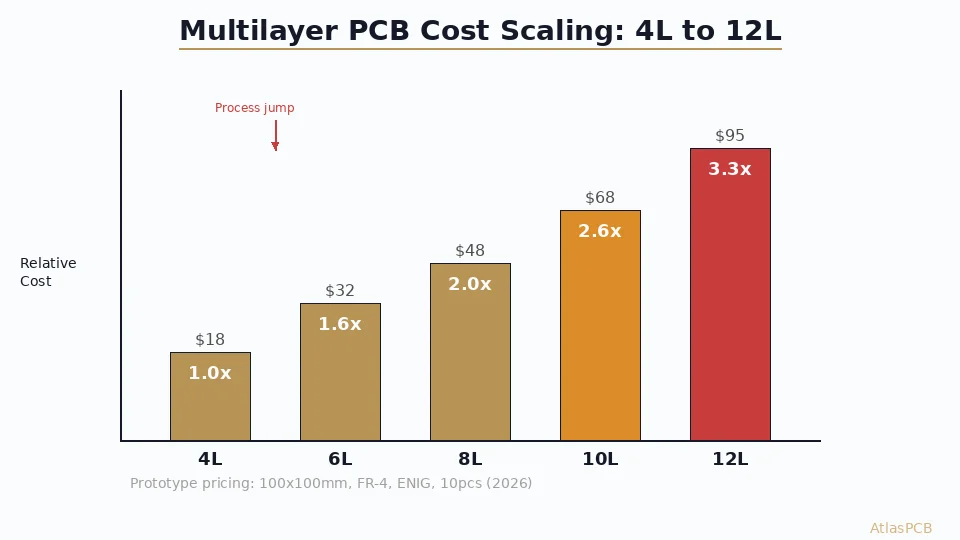
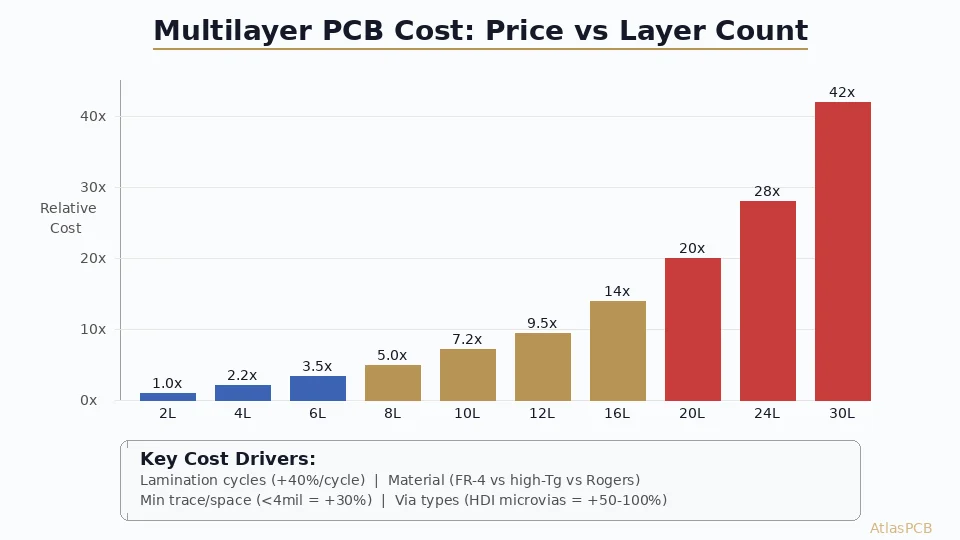
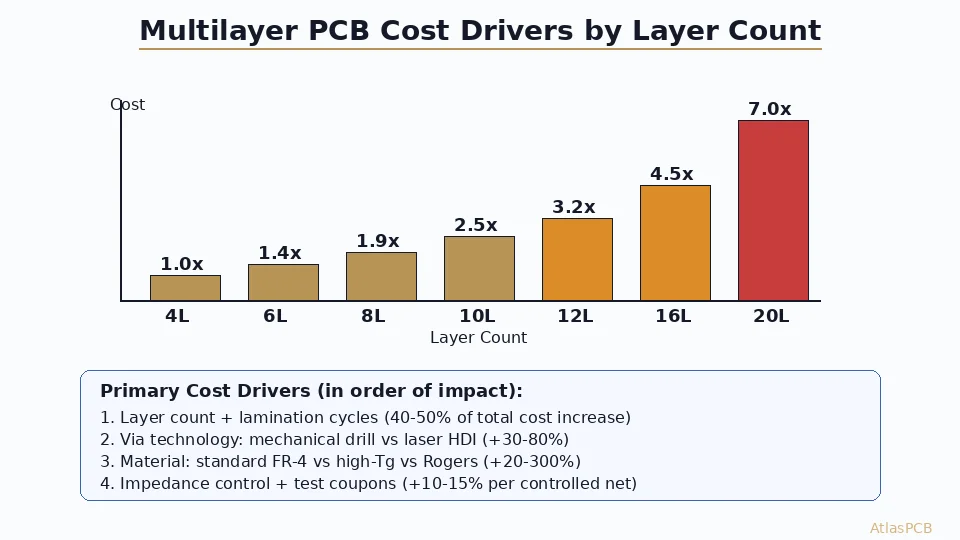
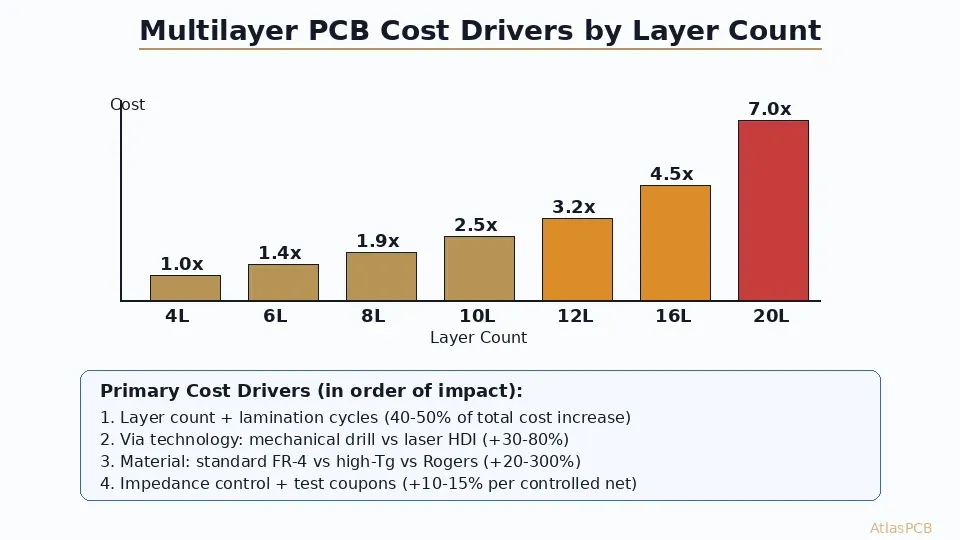
Multilayer PCB cost increases non-linearly with layer count: 4-layer boards cost 1.4-1.8x a 2-layer, 8-layer costs 1.9-2.5x, 12-layer costs 3-4x, and 20+ layers cost 6-8x baseline. The primary cost drivers are lamination cycles (each sequential press adds 15-25% to fab cost), via technology (HDI laser drilling adds 30-80% over standard mechanical drilling), material grade (Rogers or high-Tg adds 20-300% material cost), and impedance control testing (adds 10-15% for TDR coupon verification). The most effective cost reduction: minimize layer count through routing optimization and use blind/buried vias only where electrically necessary.
Quick Reference: Cost Multipliers by Layer Count
| Layer Count | Cost Multiplier (vs 2L) | Primary Cost Adder | Typical Lead Time |
|---|---|---|---|
| 2 layers | 1.0x (baseline) | — | 1-3 days |
| 4 layers | 1.4-1.8x | One press cycle, 2 extra Cu layers | 5-7 days |
| 6 layers | 1.8-2.3x | Additional core + prepreg | 7-10 days |
| 8 layers | 2.2-3.0x | Two press cycles | 10-12 days |
| 10 layers | 2.8-3.8x | Three press cycles | 12-15 days |
| 12 layers | 3.5-4.5x | Material thickness management | 14-16 days |
| 16 layers | 5.0-6.5x | Four+ press cycles, tight registration | 16-18 days |
| 20+ layers | 7.0-10.0x | Maximum registration challenge, yield risk | 18-25 days |
These ranges assume standard FR-4 Tg170, mechanical drilling only, ENIG finish, and +/-10% impedance tolerance. HDI, Rogers, or tighter specs push costs toward the upper end of each range.
The Four Pillars of Multilayer PCB Cost
Understanding multilayer pricing requires understanding that cost does not scale linearly with complexity — it compounds. Each additional manufacturing step introduces both direct cost (material, machine time) and indirect cost (yield loss, quality risk). A 12-layer board is not 6x the cost of a 2-layer board because it requires 6x the copper; it’s 3.5-4.5x because the lamination process becomes exponentially more demanding.
The four primary cost pillars, in order of impact on your final pricing:
1. Lamination cycles (40-50% of cost increase): Every sequential press operation adds 15-25% to fabrication cost. A 4-layer board needs one press cycle. An 8-layer typically needs two (laminate inner 4 layers, then build up outer layers). A 16-layer board may need four or more sequential presses. Each press cycle isn’t just machine time — it’s alignment verification, temperature profiling, press maintenance, and the cumulative yield risk of each thermal cycle potentially causing delamination or registration shift on inner layers.
2. Via technology (20-35% of cost in HDI designs): Standard mechanical drilling (0.15mm minimum) costs relatively little — a drill machine processes thousands of holes per minute. But when your design requires laser-drilled microvias (0.075-0.1mm), each via takes 8-15 milliseconds of UV laser time, and the sequential buildup layers required for blind/buried vias add entire lamination cycles. Stacked microvias requiring copper-filled and planarized vias add further — each fill and planarization step is essentially a re-plating and surface finishing operation.
3. Material selection (10-40% depending on grade): Standard FR-4 Tg170 is the baseline. High-speed materials like Panasonic Megtron 6 add 40-60% material cost. Rogers 4350B adds 200-300% for the laminate sheets alone, though in hybrid builds (Rogers outer, FR-4 inner) the premium is 80-150% total. The material cost impact increases with layer count simply because more sheets of premium material are consumed.
4. Impedance control and testing (5-15% of total): Specifying impedance control adds cost in two ways: the fabricator must design and include test coupons on every panel (consuming panel area), and must perform TDR testing on those coupons (adding test labor and equipment time). At +/-10% tolerance, this is relatively straightforward. At +/-5%, the fabricator must tighten etch control and may need to scrap panels that would otherwise pass visual inspection — increasing effective yield loss by 3-8%.
INSTANT PRICING
Get Your Multilayer PCB Quote in Minutes
Upload your Gerber files for instant pricing on 4-30 layer boards. Our system automatically identifies the optimal panel layout and manufacturing process for lowest cost.
Compare Prices ›
Real Pricing Examples: What You’ll Actually Pay
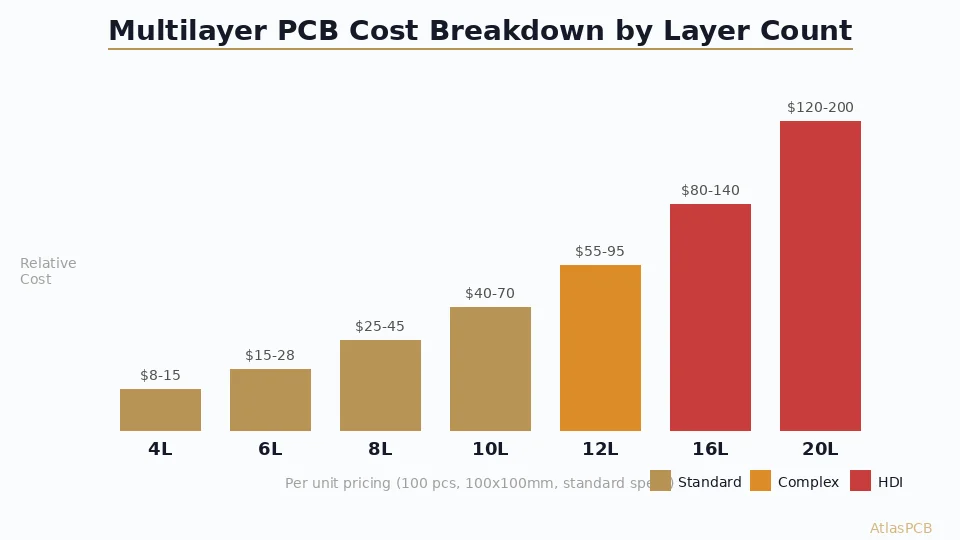
To give concrete context rather than abstract multipliers, here are representative pricing scenarios based on our production data (July 2026, quantities of 10 pieces, standard ENIG finish, 100x100mm board size):
4-layer, standard FR-4 Tg170, no impedance control: $12-18 per piece. This is the workhorse configuration for most embedded systems, IoT products, and general digital electronics. At this complexity level, material and overhead dominate cost rather than process complexity.
8-layer, FR-4 Tg170, +/-10% impedance, 0.2mm min drill: $28-42 per piece. The jump to 8 layers reflects two lamination cycles and increased registration complexity. This is where most mid-complexity designs land — high-speed digital (PCIe Gen 3/4, DDR4/5), mixed-signal converters, and FPGA carrier boards.
12-layer, high-Tg FR-4, +/-5% impedance, 0.15mm min drill: $55-85 per piece. The tight impedance tolerance and fine drilling push this into premium territory. Typical applications: 100G networking switches, high-performance computing, and defense electronics requiring IPC Class 3.
16-layer, hybrid Rogers/FR-4, HDI 1+N+1, back-drilling: $120-180 per piece. This represents a complex telecom or radar application where RF performance on outer layers and high-density routing on inner layers must coexist. The combination of specialty material, HDI processing, and back-drilling makes this a premium build.
20+ layer, all FR-4, standard through-hole: $95-140 per piece. Interestingly, a 20-layer board without HDI or exotic materials can be cheaper than a 12-layer HDI Rogers board — because the process is straightforward (just more lamination cycles of standard material) with no laser drilling or hybrid material bonding challenges.
Cost Optimization Strategies That Actually Work
Having processed thousands of multilayer designs, we’ve identified the optimizations that reliably reduce cost without compromising electrical performance:
Layer count reduction through routing optimization is the single most impactful change. Going from 10 layers to 8 saves 20-30% on fabrication cost and 3-5 days on lead time. The practical approach: before committing to layer count, attempt BGA fanout with one fewer via pair, use differential pair routing more aggressively (one pair replaces two single-ended traces), and verify that your power distribution actually requires dedicated planes versus pour regions on signal layers.
Standard vias with back-drilling instead of blind/buried vias saves 30-50% compared to HDI. If your high-speed signals can tolerate 5-8mil via stubs (common for signals below 10 GHz), back-drilling removes the stub without requiring sequential lamination. We achieve back-drill depth accuracy of +/-3mil, which is sufficient for most applications below 16 Gbps per lane.
Panel utilization optimization is often overlooked. A 98x48mm board is dramatically cheaper per piece than a 102x52mm board — because the former fits 32 per standard 18x24 panel while the latter fits only 24 per panel (33% more expensive per piece just from the 4mm size increase). If your board outline is flexible by even 2-3mm, ask your fabricator what size maximizes panel density.
COST OPTIMIZATION
Need Help Reducing Your Board Cost?
Our engineers review stackups for cost optimization opportunities. We regularly help customers save 20-40% by suggesting layer count reductions, via strategy changes, or panel layout improvements.
Request Design Review ›Volume Pricing: How Quantity Affects the Equation
Multilayer PCB pricing follows a staircase model with quantity. The key transitions:
1-5 pieces (prototype): Per-piece cost is dominated by NRE — tooling charges, film generation, and test setup that are amortized across very few boards. A single 10-layer prototype might cost $60-80/piece; the same board at 5 pieces drops to $40-55/piece.
10-50 pieces (pilot run): NRE is mostly amortized. Per-piece cost reflects actual material, machine time, and labor. This is where the multiliers in our table above apply most directly.
100-500 pieces (low volume production): Panel optimization kicks in. The fabricator can dedicate a full production run, reducing setup changeover cost. Expect 15-25% reduction versus prototype pricing.
1000+ pieces (production): Material purchasing at volume (laminate sheets, copper foil, chemicals) reduces material cost 10-15%. More importantly, the fabricator can optimize their production flow — running your panels during optimal machine utilization windows and batching similar specifications together. Production pricing is typically 40-60% lower per piece than prototype pricing for the same specification.
The key takeaway: if you’re ordering prototypes and the per-piece cost seems high, request a production quantity estimate simultaneously. Often the production price is reasonable enough to justify the design complexity, even if the prototype run feels expensive.
HDI PCB MANUFACTURER
From Prototype to Production — One Supplier
Consistent quality from 1 piece to 10,000+. No re-qualification between prototype and production builds. Same process, same engineers, same results.
View Capabilities ›Summary: Spend Where It Matters
The most cost-effective multilayer designs share common traits: they use the minimum layer count that meets electrical requirements, employ standard via technology wherever possible (reserving HDI for true density constraints), specify standard materials for non-critical layers while reserving premium materials for the layers that need them, and include impedance control only on nets that actually require it.
Work with your fabricator early in the design process — ideally during stackup planning rather than after layout is complete. A 15-minute consultation about layer count, via strategy, and material selection can save thousands of dollars across the production lifecycle of your product.
ATLASPCB
Get Detailed Multilayer Pricing Today
Upload your design files for instant multilayer PCB pricing. Our quote includes layer-by-layer cost breakdown and optimization suggestions — so you know exactly what drives your price.
Get Instant Quote ›
Reviewed by AtlasPCB Engineering Team — 15+ years in advanced PCB fabrication for RF, HDI, and rigid-flex applications.
Related Reading:
About AtlasPCB — We specialize in complex PCB manufacturing for HDI, RF, and high-reliability applications. Explore our HDI PCB manufacturing capabilities, multilayer PCB fabrication up to 30 layers, or get an instant online PCB quote . Every order includes free engineering review. Get your quote.
Reviewed by AtlasPCB Engineering Team — IPC-certified manufacturing specialists with 15+ years of production experience in HDI, RF, and high-reliability PCB fabrication. Content based on factory floor data and real customer design reviews.
Frequently Asked Questions
Why does an 8-layer PCB cost nearly 2x a 4-layer board?
How much does HDI (laser drilling) add to multilayer PCB cost?
What is the cheapest way to reduce multilayer PCB cost?
Does board size affect multilayer cost significantly?
- multilayer PCB
- PCB cost
- PCB pricing
- HDI cost
- layer count
- PCB manufacturing
- cost optimization