· AtlasPCB Engineering · Engineering · 10 min read
Rogers 4350B PCB Pricing in 2026: Full Cost Breakdown, Hybrid Stackup Savings, and Minimum Order Economics
A transparent cost analysis of Rogers RO4350B PCB fabrication in 2026 — covering material premiums, processing surcharges, hybrid stackup cost optimization, minimum order economics, and how to reduce your Rogers board cost by 40-60% without sacrificing RF performance.
Quick Answer
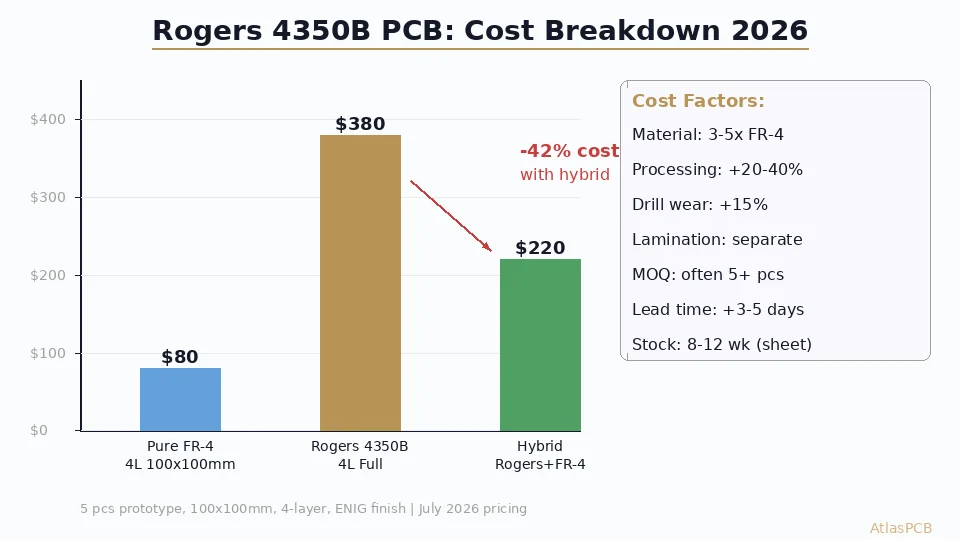
A 4-layer Rogers RO4350B prototype (100x100mm, 5 pieces, ENIG) costs $200-450 from a qualified China RF fabricator in July 2026, compared to $50-80 for equivalent FR-4. The cost breaks down as: material 45-55% (Rogers sheet stock at $80-120/sqft vs FR-4 at $8-15/sqft), processing surcharge 25-35% (separate press cycles, specialized drill bits, tighter registration), and standard fabrication 15-25%. Hybrid Rogers/FR-4 stackups reduce the total cost to $120-250 — a 40-45% saving — by limiting Rogers material to only the RF signal layers.
Quick Answer: Rogers 4350B PCB Cost Summary (July 2026)
| Configuration | 5 pcs (100x100mm) | 20 pcs (100x100mm) | 100 pcs (100x100mm) |
|---|---|---|---|
| 4L Full Rogers RO4350B, ENIG | $200-450 | $450-800 | $1,200-2,500 |
| 4L Hybrid (Rogers outer + FR-4 inner), ENIG | $120-250 | $280-500 | $750-1,500 |
| 4L Standard FR-4, ENIG (reference) | $50-80 | $90-150 | $250-500 |
| 6L Full Rogers, ENIG | $400-800 | $800-1,500 | $2,500-5,000 |
| 6L Hybrid (2 Rogers + 4 FR-4), ENIG | $200-400 | $450-850 | $1,400-2,800 |
These prices reflect July 2026 market conditions from qualified China RF fabricators with Rogers material in stock. Domestic US/EU pricing is typically 2-3x these figures.
What Drives Rogers PCB Cost: The Three Components
The total fabrication cost of a Rogers RO4350B board breaks down into three distinct components, and understanding each one reveals where optimization opportunities exist.
Component 1: Material Cost (45-55% of total)
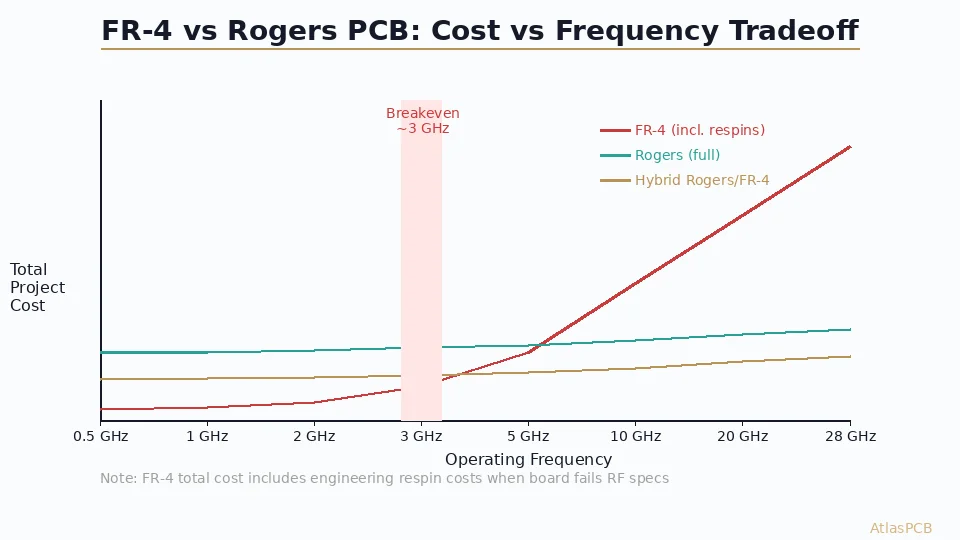
Rogers RO4350B laminate costs approximately $80-120 per square foot in sheet form, depending on thickness and copper cladding weight. By comparison, standard FR-4 laminate costs $8-15 per square foot — roughly an 8-10x material cost multiplier. This is the single largest cost driver and the reason hybrid stackups provide such dramatic savings.
The material cost calculation for your specific board depends on panel utilization. A standard Rogers panel is 18” x 24” (some fabricators use 18” x 12” or 12” x 18” cut sheets). If your board is 100mm x 100mm (roughly 4” x 4”), you can fit approximately 16-20 boards on a single panel. The material cost per board is then: ($100/panel) / 18 boards = approximately $5.50 in Rogers material per layer-pair. For a 4-layer full Rogers board, that is roughly $11 in material alone.
However, this simple calculation ignores the prepreg situation. Rogers bonding films (like RO4450F bondply) cost $40-70 per square foot — less than core material but still far above FR-4 prepreg ($3-8/sqft). A 4-layer full Rogers stackup uses 2 sheets of RO4350B core and RO4450F bondply, while a hybrid uses 1 sheet of Rogers (outer layers) bonded to FR-4 inner layers with standard prepreg.
In our production facility, we track material consumption per order and have observed that material accounts for 48-53% of the total quoted price on typical 4-layer Rogers prototype orders. This percentage decreases slightly for larger board areas (better panel utilization) and increases for smaller boards (more waste per panel).
ROGERS IN STOCK
No Material Lead Time — Rogers Ships Immediately
RO4350B in 0.254mm, 0.508mm, 0.762mm, and 1.524mm — cut from warehouse stock, not ordered per-job. Your RF prototype enters production within 24 hours of DFM approval.
Get Rogers Quote ›
Component 2: Processing Surcharge (25-35% of total)
Rogers laminates require different manufacturing processes than FR-4 at nearly every production step. These process differences drive a 20-40% surcharge over standard fabrication:
Drilling: RO4350B is a ceramic-filled PTFE composite. The ceramic filler (glass-reinforced hydrocarbon with silica filler) is significantly more abrasive than FR-4’s woven glass/epoxy matrix. Standard carbide drill bits lose accuracy faster when drilling Rogers — tool life drops from approximately 3,000 hits on FR-4 to 1,000-1,500 hits on Rogers. This means more frequent bit changes, slower drill speeds, and higher tooling cost per panel.
Lamination: Rogers materials cannot be co-processed with FR-4 in the same press cycle. They require different pressure profiles, temperature ramps, and hold times. A fabricator running 50 FR-4 panels simultaneously can only run 10-20 Rogers panels per press opening. This lower throughput translates directly to higher per-panel cost allocation for equipment and labor.
Etch compensation: Impedance-controlled Rogers boards require tighter trace width accuracy than standard FR-4 work. The etch process must be tuned separately — Rogers boards typically run at slower conveyor speeds through the spray etcher to achieve uniform copper removal across the entire panel. Slower processing means lower throughput.
Desmear and surface preparation: Standard permanganate desmear chemistry does not work on Rogers PTFE surfaces. Plasma desmear or sodium etch treatment is required to activate the PTFE surface for copper adhesion during plating. This is an additional process step that FR-4 boards skip entirely.
Component 3: Standard Fabrication Overhead (15-25% of total)
The remaining cost covers operations identical to FR-4 fabrication: imaging, plating, solder mask application, surface finish (ENIG, HASL, etc.), electrical testing, and final inspection. These costs are essentially identical between Rogers and FR-4 boards of the same layer count and complexity.
The practical implication: for very simple boards (2-layer, large features, no impedance control), the standard fabrication component is a smaller percentage of total cost, and the material premium dominates. For complex boards (8+ layers, fine-pitch, multiple controlled-impedance classes), the fabrication overhead grows and the material premium becomes a smaller percentage — though still the largest single component.
Hybrid Stackup: The 40-60% Cost Reduction Strategy
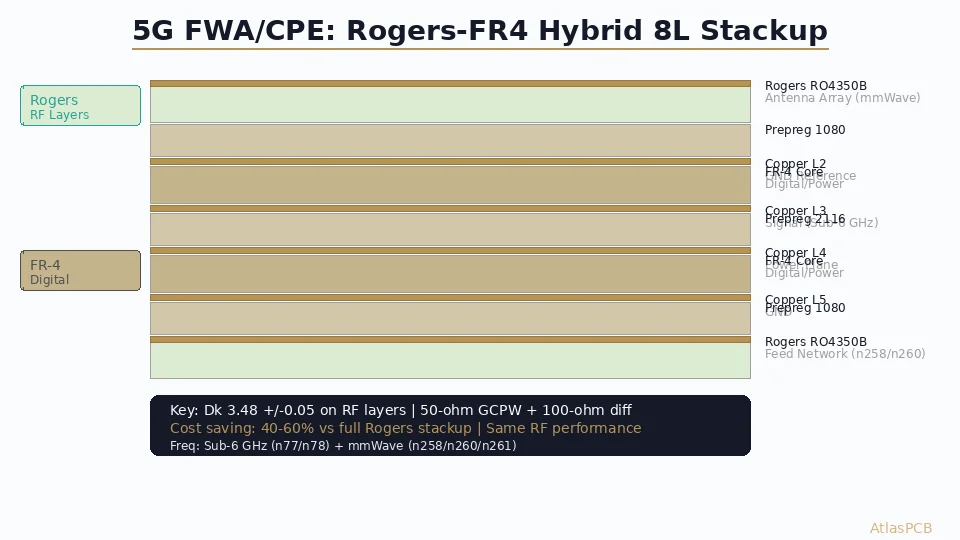
The most impactful cost optimization for Rogers PCB designs is the hybrid stackup — placing Rogers material only on layers that carry RF signals and using standard or low-loss FR-4 for everything else. This is not a compromise; it is the engineering-optimal approach for most RF designs.
The principle is simple: RF signals at 3-40 GHz propagate on the outer layer or on specific inner signal layers. Power planes, digital buses, and structural layers do not need Rogers’ low-loss tangent (0.0037 at 10 GHz) or tight Dk tolerance (+/-0.05). These layers perform identically on standard FR-4 (Dk = 4.3-4.5, loss tangent 0.02) because they carry either DC power or low-frequency digital signals where dielectric loss is negligible.
Hybrid stackup examples:
4-layer hybrid (most common for RF prototypes):
- Layer 1: Rogers RO4350B (0.508mm) — RF signal layer
- Prepreg: Standard FR-4 prepreg (bonding layer)
- Layer 2: FR-4 — Ground plane (reference for L1 microstrip)
- Core: FR-4 core (0.8-1.2mm) — structural
- Layer 3: FR-4 — Power plane or digital routing
- Layer 4: FR-4 — Digital signals or second ground
Cost saving: 40-45% versus full Rogers (only 1 Rogers sheet instead of 2 cores + bondply)
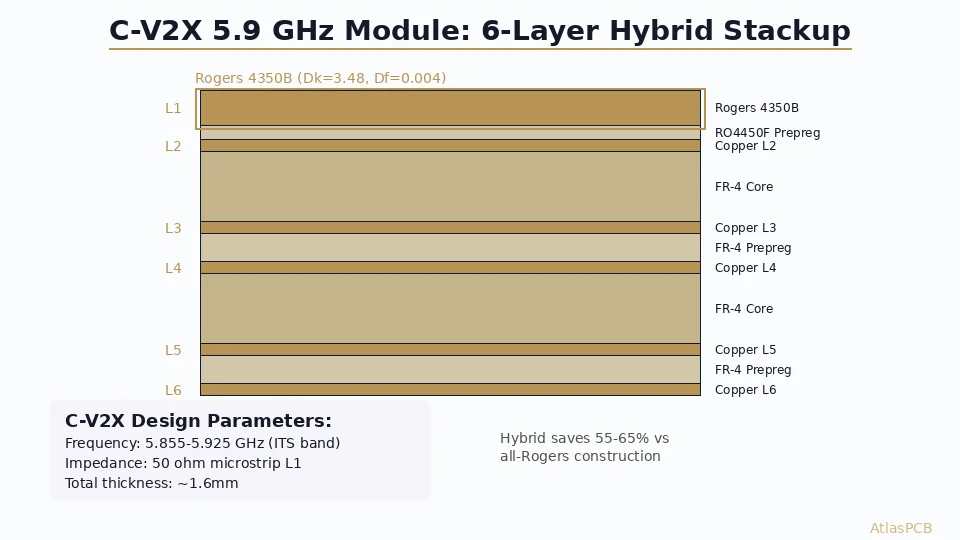
6-layer hybrid (RF + digital mixed design):
- Layer 1: Rogers RO4350B — RF transmit/receive
- Prepreg: FR-4 prepreg
- Layer 2: FR-4 — Ground plane
- Core: FR-4
- Layer 3: FR-4 — Digital high-speed
- Prepreg: FR-4 prepreg
- Layer 4: FR-4 — Power
- Core: FR-4
- Layer 5: FR-4 — Ground plane
- Layer 6: Rogers RO4350B — Second RF layer (if needed)
Cost saving: 50-60% versus full 6-layer Rogers
The key design consideration for hybrid stackups is the CTE (coefficient of thermal expansion) mismatch between Rogers (X/Y: 10-12 ppm/C) and FR-4 (X/Y: 14-17 ppm/C). For most commercial applications with operating temperatures between -20C to +85C, this mismatch is manageable. For automotive (-40C to +125C) or space (-55C to +125C) thermal cycling, additional reliability qualification may be warranted.
In our production experience, hybrid Rogers/FR-4 boards represent approximately 65% of all Rogers orders we manufacture. Pure Rogers construction is reserved primarily for filters, couplers, and antenna arrays where every layer carries RF energy.
HYBRID STACKUP OPTIMIZATION
Cut Your Rogers Board Cost by 40-60%
Send your design requirements and we propose an optimized hybrid stackup — Rogers where it matters, FR-4 where it does not. Same RF performance, significantly lower cost.
Minimum Order Economics: When Does Rogers Become Cost-Effective?
The fixed-cost component of Rogers fabrication (setup, press programming, impedance coupon design, TDR calibration) means that per-unit cost drops dramatically with quantity. Here is how the economics play out across order sizes:
| Quantity | Per-Unit Cost (4L Rogers, 100x100mm) | Setup % of Total | Notes |
|---|---|---|---|
| 1 pc | $150-250 | 50-60% | Expensive per-unit, acceptable for first-article |
| 5 pcs | $40-90 | 25-30% | Sweet spot for prototyping |
| 20 pcs | $22-40 | 12-15% | Small-batch production |
| 50 pcs | $15-28 | 6-8% | Panel optimization kicks in |
| 100 pcs | $12-25 | 3-5% | Full production pricing |
| 500+ pcs | $8-18 | <2% | Volume negotiation territory |
The practical takeaway: ordering 5 pieces instead of 1 or 2 provides the best cost-per-unit improvement. Going from 1 to 5 units roughly halves your per-unit cost because the setup charge distributes across more boards. The next significant step-down occurs around 50 pieces when panel utilization optimization becomes worthwhile (arranging your board dimensions to maximize the number of parts per Rogers panel).
For engineering prototyping, we generally recommend ordering 5-10 pieces per revision. The marginal cost of pieces 6-10 is minimal (already covered setup), and having spare boards for destructive testing, cross-sectioning, or providing to test engineers saves time on subsequent orders.
2026 Market Factors Affecting Rogers Pricing
Several market dynamics are pushing Rogers PCB costs upward in 2026, and engineers budgeting for RF prototypes should be aware of these trends:
Rogers Corporation price increases: Two price adjustments (8% in late 2025, 5% in Q1 2026) have increased sheet stock pricing by approximately 13% year-over-year. These increases reflect upstream copper foil costs and constrained PTFE supply.
5G infrastructure demand: Global 5G base station deployment continues to consume significant Rogers material volume, particularly RO4350B and RO4835 for antenna feeds and filters. This sustained demand keeps distributor inventory tight.
Automotive radar proliferation: The expansion from single radar (front-facing only) to 5-corner radar in new vehicle platforms has multiplied per-vehicle Rogers consumption by 4-5x. Tier 1 automotive suppliers have locked in long-term supply agreements, further constraining spot market availability.
Fabricator response: To maintain pricing competitiveness despite material inflation, qualified China RF fabricators are pursuing three strategies — (1) bulk purchasing directly from Rogers Corporation under annual volume agreements, (2) optimizing panel utilization through multi-project panelization (combining multiple customer orders on shared panels), and (3) investing in process efficiency to reduce the per-panel processing surcharge. These strategies partially offset the material price increases for end customers.
COST OPTIMIZATION
Lock In Rogers Pricing Before Next Increase
With Rogers material in warehouse stock, our pricing reflects current inventory cost — not the next price increase. Get your quote now while current batch pricing holds.
Get Instant Quote ›Cost Optimization Checklist
Before finalizing your Rogers PCB design for quotation, review these optimization opportunities:
- Hybrid stackup — use Rogers only on RF layers (saves 40-60%)
- Board panelization — align dimensions to maximize panel utilization (saves 10-15%)
- Quantity batching — order 5+ pieces minimum (setup amortization)
- Surface finish selection — HASL-lead-free instead of ENIG where solderability allows (saves $20-40 per order)
- Thickness optimization — thinner Rogers cores (0.254mm vs 0.762mm) use less material per unit area
- Standard Rogers grades — RO4350B and RO4003C are stocked; exotic grades (RO3003, RO3006) require special orders
- Combined orders — if you have multiple RF designs in development, combining into a single multi-project panel reduces total cost
ATLASPCB
Get Your Rogers 4350B Quote — Material in Stock, Ships in 5-12 Days
Full Rogers or hybrid stackup — we quote both options so you can compare. RO4350B, RO4003C, and RO3003 in warehouse. Impedance control +/-5% included. TDR report standard.
Upload Gerbers ›
Reviewed by AtlasPCB Engineering Team — 15+ years in advanced PCB fabrication for RF, HDI, and rigid-flex applications.
Related Reading:
About AtlasPCB — We specialize in complex PCB manufacturing for HDI, RF, and high-reliability applications. Explore our RF and high-frequency PCB services, Rogers RO4350B PCB manufacturing, or get an multilayer PCB fabrication up to 30 layers . Every order includes free engineering review. Get your quote.
Reviewed by AtlasPCB Engineering Team — IPC-certified manufacturing specialists with 15+ years of production experience in HDI, RF, and high-reliability PCB fabrication. Content based on factory floor data and real customer design reviews.
Frequently Asked Questions
How much does a Rogers 4350B PCB cost in 2026?
Why is Rogers RO4350B so much more expensive than FR-4?
How can I reduce Rogers PCB cost without losing RF performance?
Has Rogers material pricing increased in 2026?
What is the minimum order quantity for Rogers 4350B boards?
- Rogers 4350B stackup
- Rogers PCB manufacturer
- RF PCB design and manufacturing
- China RF PCB manufacturer
- PCB cost