· AtlasPCB Engineering · Engineering · 11 min read
Impedance-Controlled PCB Manufacturer: China RF Fabricator vs Domestic US/EU — Cost, Tolerance, and Lead Time Compared
A practical comparison between China-based RF PCB manufacturers and domestic US/EU fabricators for impedance-controlled boards — covering tolerance capabilities, TDR testing, Rogers material availability, lead times, and total cost of ownership for RF designs above 3 GHz.
Quick Answer
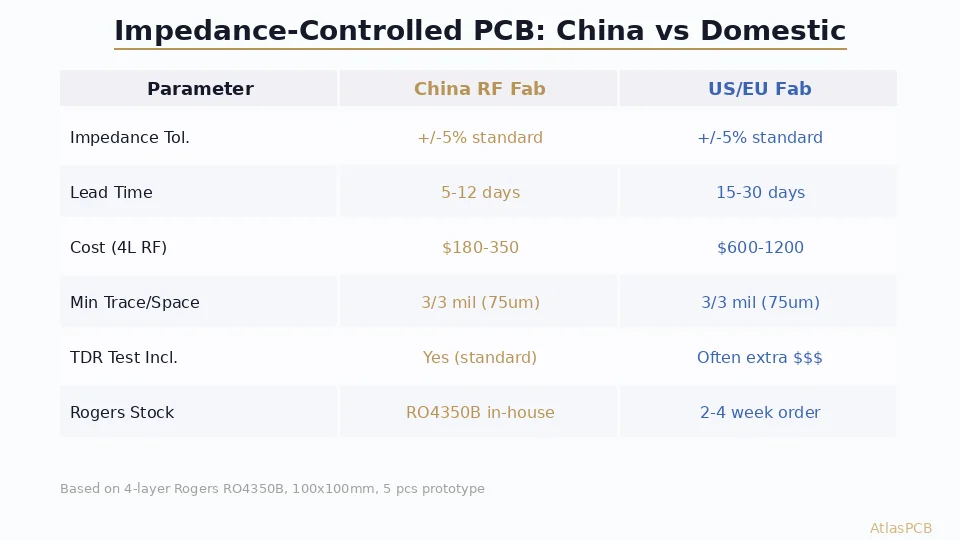
China-based RF PCB manufacturers deliver impedance-controlled boards at 40-65% lower cost than US/EU domestic fabricators with comparable +/-5% tolerance capability, but with 5-12 day lead times versus 15-30 days domestically. The key differentiator is not tolerance capability — qualified China RF fabs run identical Polar Si9000 field solvers and TDR equipment — but rather Rogers material stock availability, with top China fabs holding RO4350B and RO4003C sheet stock in-house versus the 4-8 week material lead time domestic shops face when ordering from Rogers Corporation.
Quick Answer: China vs Domestic for Impedance-Controlled RF Boards
| Parameter | China RF Fabricator | US/EU Domestic |
|---|---|---|
| Impedance tolerance | +/-5% (standard), +/-3% (available) | +/-5% (standard), +/-3% (premium) |
| 4L Rogers prototype cost | $180-350 | $600-1,200 |
| Standard lead time | 5-12 days fab + 2-3 days ship | 15-30 days |
| Rush availability | 3-5 day fab + express air | 5-10 days (2-3x premium) |
| TDR test report | Included (standard) | Often extra $50-200 |
| Rogers stock | In-house (RO4350B, RO4003C) | Order per job (4-8 weeks) |
| Field solver | Polar Si9000 / equivalent | Polar Si9000 / equivalent |
| Min trace/space | 3/3 mil (75 um) | 3/3 mil (75 um) |
The short version: if your impedance-controlled RF design uses standard Rogers materials and requires +/-5% tolerance, a qualified China RF PCB manufacturer delivers identical electrical performance at roughly half the cost and a third of the lead time.
Why the Cost Gap Exists (It Is Not About Capability)
The misconception that “domestic means better quality” for impedance-controlled boards persists primarily because of how the PCB supply chain evolved in the early 2000s. Back then, China fabricators genuinely lacked the equipment and process control for tight-tolerance RF work. That gap closed completely by approximately 2015, yet the pricing differential remains because of structural economics, not technical capability.
The cost difference comes from three sources. First, labor and facility costs in Shenzhen, Huizhou, or Wuxi run 60-70% below equivalent US or German operations. Second, material procurement advantages — a China-based manufacturer processing 200+ Rogers panels per month negotiates volume pricing that a domestic shop running 20 panels per month simply cannot access. Third, and perhaps most critically, China RF specialists hold Rogers sheet stock in their warehouse. When you order a 4-layer RO4350B board from a domestic US shop, they typically need to order the laminate from Rogers Corporation (lead time: 4-8 weeks) or from a distributor (2-4 weeks). A China RF fab cuts from stock the same day your Gerber files pass DFM review.
In our facility, we maintain rolling inventory of RO4350B, RO4003C, and RO3003 in multiple thicknesses (0.254mm, 0.508mm, 0.762mm, 1.524mm). This eliminates the single largest lead-time bottleneck for RF prototypes and means your impedance-controlled board enters production within 24 hours of engineering sign-off, not 4 weeks.
IMPEDANCE-CONTROLLED RF BOARDS
Rogers In Stock, Ships in 5-12 Days
RO4350B, RO4003C, RO3003 — in-house stock, +/-5% impedance standard on every panel. Upload your Gerber files for an instant stackup review.
Get RF Board Quote ›
Impedance Control Capability: Identical Tools, Identical Results
The engineering process for impedance-controlled PCB fabrication is standardized globally. Whether a board is manufactured in Shenzhen or Stuttgart, the workflow follows the same path:
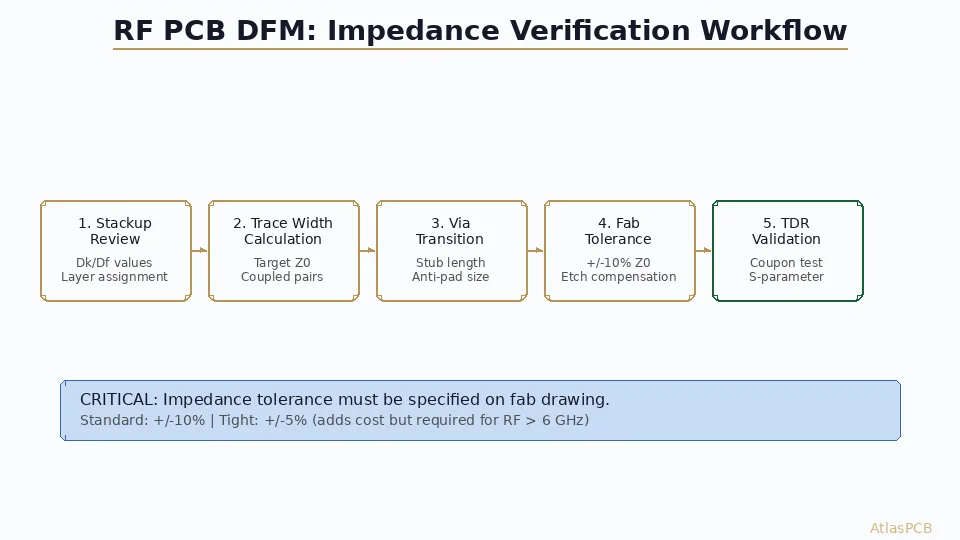
Pre-production: The manufacturer imports your stackup into a 2D field solver (Polar Si9000 is the industry standard, though some use Altium’s PDN Analyzer or in-house tools based on the same Maxwell’s equations). They model the actual prepreg and core thicknesses from their material inventory — because the same Rogers product from the same lot can have slightly different measured Dk depending on resin content percentage and pressing conditions. The solver calculates required trace widths for your target impedance, accounting for the specific material batch they will use.
Production: Etch compensation algorithms adjust artwork to hit the calculated trace width after chemical etching. This is where process control matters: a well-equipped factory maintains etch uniformity across the panel within +/-0.5 mil (12.7 um). China RF specialists achieve this with the same Chemcut or MECO spray etching equipment used in US fabs — the equipment vendors sell globally.
Verification: Every production panel includes dedicated impedance test coupons in the panel border. After fabrication, a TDR (Time Domain Reflectometry) system measures actual impedance along the coupon traces. Panels outside the specified tolerance are rejected. In our production line, we run TDR measurement on 100% of impedance-controlled panels — this is not a sampling exercise but a serial verification.
The measured results we achieve on RO4350B are typically within +/-3-4% of target, well inside the +/-5% specification. This consistency comes from controlling the variables that actually matter: dielectric thickness uniformity after pressing, trace width consistency across the panel, and copper surface roughness (which affects Dk at frequencies above 10 GHz through the Hammerstad-Jensen rough conductor model).
Where Domestic Fabricators Still Have Advantages
This comparison would be incomplete without acknowledging scenarios where a US or EU fabricator makes more sense:
ITAR-controlled designs — if your RF board is for a defense application with ITAR (International Traffic in Arms Regulations) restrictions, you must fabricate domestically. No exceptions, regardless of cost savings. China-based manufacturing is simply not an option for controlled technology.
IP-sensitive prototypes — some companies with pre-patent RF designs prefer domestic fabrication to minimize IP exposure. This is a valid business decision, though it is worth noting that reputable China fabricators enforce NDAs and have equal legal incentive to protect customer designs (their reputation is their business).
Ultra-fast local iteration — if your engineering team needs a board back in 48-72 hours and you are located near a domestic quick-turn shop (e.g., San Jose for Silicon Valley teams), a local fabricator eliminates the 2-3 day international shipping component. For pure speed-to-bench, nothing beats driving to your fab and picking up boards.
Exotic materials beyond Rogers — if your design requires Taconic TLY, Nelco N4000-13 EP SI, or other specialty laminates that China fabs may not stock, domestic fabricators with distributor relationships can sometimes source these faster through local channels.
For everything else — standard Rogers materials, commercial RF applications, non-ITAR designs — a qualified China RF fabricator delivers superior value.
RF PCB ENGINEERING REVIEW
Not Sure About Your Stackup?
Our RF engineers review impedance stackups before production — verifying field solver accuracy against our actual material batch data. Upload Gerbers + stackup file for review.
View RF Capabilities ›How to Qualify a China RF PCB Manufacturer (Practical Checklist)
Not all China-based PCB manufacturers are equal. The industry ranges from commodity FR-4 shops that will accept (and botch) your Rogers order, to dedicated RF fabrication specialists with equipment and process expertise matching any facility globally. Here is what separates the qualified from the pretenders:
1. Ask for their Polar stackup simulation of YOUR design. A qualified RF fab does not just accept your specified trace widths — they re-simulate using their actual material batch Dk values and prepreg thicknesses. If a manufacturer tells you “just send Gerbers, we will figure it out,” walk away. A proper RF fabricator asks for your impedance requirements, models them against their inventory, and returns a stackup proposal showing calculated trace widths before you approve production.
2. Request TDR test reports from recent production. Ask for 3-5 sample TDR reports from boards similar to yours (same Rogers material, similar layer count). Look at the measured values versus targets — a good fab consistently hits within +/-3% on 4-layer Rogers boards. If they cannot produce recent TDR reports quickly, they are not running impedance-controlled work regularly.
3. Verify Rogers material is in-stock, not just orderable. Ask explicitly: “Do you have RO4350B in 0.508mm thickness in your warehouse today?” A dedicated RF manufacturer answers immediately with lot numbers. A general-purpose fab says “we can order it.”
4. Check their trace width capability and etch uniformity. For impedance work above 10 GHz, trace width accuracy is critical because a 0.5 mil variation translates to 2-3 ohm impedance shift on thin dielectrics. Ask for their process capability data — etch uniformity across the panel should be +/-0.5 mil or better.
5. Confirm IPC certification level. IPC-6012 Class 2 minimum for commercial RF work, Class 3 for automotive/aerospace/medical RF applications. This is your baseline quality system verification.
Total Cost of Ownership: Beyond the Unit Price
Engineers evaluating quotes often focus on the per-board fabrication price. For impedance-controlled RF designs, the total cost of ownership includes factors that dramatically favor the China RF manufacturer model:
Board respins. An RF prototype that fails first-pass validation costs not just the $600-1200 fabrication price but also 3-6 weeks of schedule delay. China RF fabs with fast turnaround and included stackup review reduce respin probability. In our experience across several hundred RF designs per year, our pre-production stackup review catches approximately 15-20% of designs with impedance model errors before they reach fabrication — errors that would have resulted in out-of-spec boards and a mandatory respin.
TDR testing fees. When a domestic fabricator charges $100-200 per design for TDR test reports as an add-on, and you run 10-15 RF prototype iterations per year, that is $1,000-3,000 annually in testing fees alone. China RF specialists include this as standard because they run TDR on every impedance panel regardless — it is part of their quality system, not a profit center.
Material waste on canceled orders. If a domestic shop orders Rogers material for your job (4-8 week lead time) and you cancel or modify the design during that window, you often eat a material restocking or non-cancelation fee. With a China fab holding material in stock, there is no pre-order — your material is cut from inventory when production begins.
TOTAL COST COMPARISON
Compare Your Current RF Board Costs
Upload your existing design for a side-by-side comparison quote. Impedance specs, Rogers material, TDR testing — all included in one line-item price.
Compare Prices ›Communication and Engineering Support Comparison
One legitimate concern engineers raise about working with China-based fabricators is communication friction — timezone differences, language barriers, and the risk of specification misunderstandings on precision RF work. This concern was more valid five years ago than it is today, but it deserves honest discussion.
Timezone overlap: China (UTC+8) overlaps with US Pacific time in the early morning (approximately 5-8 PM China time = 1-4 AM Pacific, or equivalently, 9 AM Pacific catches China engineers at their evening shift). Most established China RF fabs now staff English-speaking applications engineers across extended hours specifically for international customers. Email turnaround for technical questions is typically 4-8 hours during business days.
Specification precision: For impedance-controlled work, the specification is inherently numerical and unambiguous — target impedances, tolerances, layer stackups, and material callouts leave little room for misinterpretation. The risk of communication error is far lower than for, say, cosmetic or mechanical specifications where subjective interpretation matters. A 50-ohm microstrip on RO4350B with +/-5% tolerance means exactly the same thing in any language.
Engineering review depth: In our facility, applications engineers review every impedance-controlled design against three criteria before production release: (1) are the specified trace widths achievable with our current etch process capability, (2) does the stackup model match real material parameters from our inventory, and (3) are there DFM violations in the via transitions between controlled-impedance layers. This review catches issues that even experienced RF designers miss — typically reference plane discontinuities beneath controlled traces that would cause local impedance excursions.
Decision Framework: When to Use Each Source
| Your Situation | Recommended Source |
|---|---|
| ITAR/export-controlled RF design | Domestic (mandatory) |
| Pre-patent, highly IP-sensitive | Domestic (risk management) |
| Need boards in 48h, located near fab | Domestic quick-turn |
| Exotic laminate not stocked in China | Domestic or broker |
| Standard Rogers, commercial application | China RF specialist |
| Volume production (50+ panels/month) | China RF specialist |
| Budget-constrained prototype iteration | China RF specialist |
| Hybrid Rogers/FR-4 stackup | China RF specialist |
| First time ordering RF boards, need guidance | China RF specialist with eng. support |
ATLASPCB
Ready to Try a China RF PCB Manufacturer?
Upload your Gerber files and impedance requirements. We return a stackup simulation within 24 hours — before you commit to production. RO4350B and RO4003C in stock, +/-5% standard, TDR report included.
Upload Gerbers ›
Reviewed by AtlasPCB Engineering Team — 15+ years in advanced PCB fabrication for RF, HDI, and rigid-flex applications.
Related Reading:
About AtlasPCB — We specialize in complex PCB manufacturing for HDI, RF, and high-reliability applications. Explore our RF and high-frequency PCB services, Rogers RO4350B PCB manufacturing, or get an impedance-controlled PCB manufacturing . Every order includes free engineering review. Get your quote.
Reviewed by AtlasPCB Engineering Team — IPC-certified manufacturing specialists with 15+ years of production experience in HDI, RF, and high-reliability PCB fabrication. Content based on factory floor data and real customer design reviews.
Frequently Asked Questions
Can China PCB manufacturers achieve the same impedance tolerance as US/EU fabricators?
How much cheaper is impedance-controlled PCB fabrication in China versus domestically?
What is the lead time for impedance-controlled PCBs from China?
Do China RF PCB manufacturers include TDR testing?
What should I verify before choosing a China impedance-controlled PCB manufacturer?
- impedance controlled PCB manufacturer
- China RF PCB manufacturer
- RF PCB design and manufacturing
- Rogers PCB manufacturer
- PCB fabrication