· Marcus Lin · Engineering · 9 min read
China RF PCB Manufacturer
How to evaluate and select a China-based RF PCB manufacturer for Rogers, PTFE, and hybrid stackups. Covers qualification criteria, communication expectations, common pitfalls, and what separates a capable RF house from a standard PCB shop quoting Rogers material.
Quick Answer
When selecting a China RF PCB manufacturer, verify three things before sending Gerber files: they stock Rogers/PTFE materials from authorized distributors (not grey market), they demonstrate TDR-verified impedance control at ±5% or better with actual test coupon data, and they can discuss your specific stackup intelligently in English without defaulting to generic templates. Most shops quoting Rogers boards are standard FR-4 factories adding a material surcharge — genuine RF capability requires specialized etching, lamination profiles, and test equipment that fewer than 10% of China PCB manufacturers actually possess.
The Core Problem: Most Shops Cannot Actually Do RF
The China PCB manufacturing market contains over 2,500 registered PCB manufacturers, ranging from small prototype shops to massive production facilities running 24/7. When you search for “China RF PCB manufacturer” and receive quotes from a dozen companies, the challenge is not finding someone willing to take your money — it is finding someone who will actually deliver a board that meets your RF performance requirements.
The fundamental issue is that fabricating a Rogers-based PCB and fabricating an RF-performing PCB are not the same thing. Any shop with a lamination press can bond Rogers material into a stackup. Achieving the ±5% impedance control, low insertion loss, and dimensional accuracy that make an RF board actually function requires specialized process engineering, characterized parameters, and test equipment that most standard shops simply do not possess.
In our experience working with international hardware teams, roughly 60% of first-time RF orders from unqualified China manufacturers result in boards that fail to meet impedance specifications by more than 10%. The boards look fine visually, pass basic continuity testing, and even measure reasonable DC resistance — but fail when subjected to TDR or VNA characterization at operating frequency.
RF PCB SPECIALIST
Skip the Qualification Uncertainty
We process Rogers RO4350B, RO4003C, and PTFE weekly. Every RF panel includes TDR verification with coupon data shipped alongside your boards.

Qualification Criteria: What to Verify Before Ordering
1. Material Sourcing and Inventory
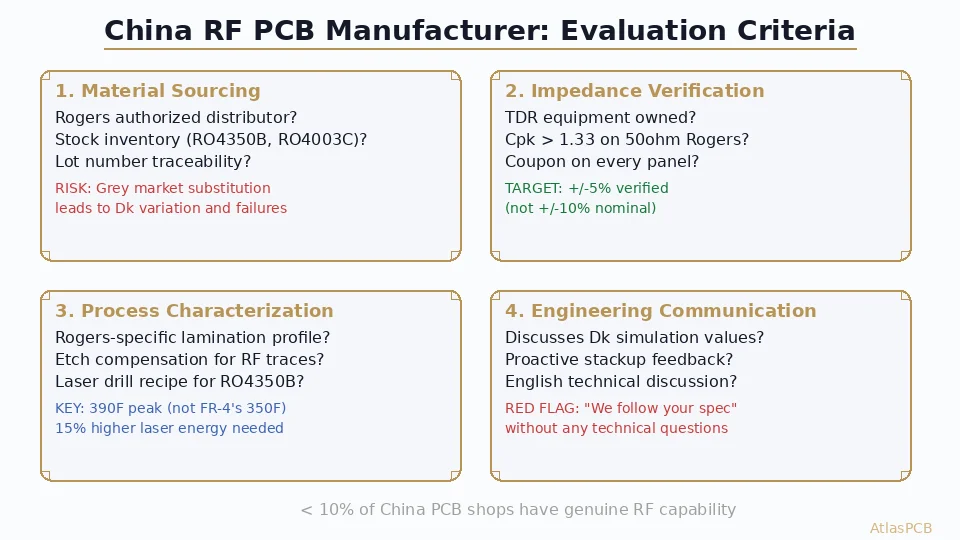
Ask three direct questions: Where do you purchase Rogers material? Do you keep inventory, and which thicknesses? Can you provide the material certificate with lot number for my order?
A manufacturer with genuine RF capability stocks common Rogers configurations (RO4350B in 10, 20, 30mil; RO4003C in 8, 20mil) because they process these materials regularly. A shop that needs to source material for every RF order is likely handling these jobs infrequently — and infrequent processing means uncharacterized process parameters and higher risk of first-article failures.
The lot number traceability matters because Rogers material properties can vary slightly between production lots (within spec, but the specific Dk value affects your impedance). A shop tracking lot numbers can correlate their TDR data to material batches, enabling tighter impedance prediction for repeat orders.
2. Impedance Control Evidence
Request their impedance control capability documentation. What you want to see:
- Cpk data: Statistical process capability index for impedance control. Cpk > 1.33 indicates ±5% is routinely achievable. Ask for their Cpk on 50-ohm microstrip on RO4350B specifically.
- TDR equipment: What instrument they use (brand, model). Time-domain reflectometry requires equipment costing $20,000-100,000 — shops without this equipment cannot verify impedance, period.
- Coupon design: How they design test coupons, where they place them on the panel, and whether coupons are measured on every panel or sampled.
- Historical data: Ask for a sample TDR report from a recent Rogers job (with customer details redacted). The format and detail level tells you whether this is routine practice or something they offer but rarely perform.
3. Process Characterization for Rogers
Rogers RO4350B processes similarly to FR-4, but “similarly” is not “identically.” A qualified RF manufacturer has characterized:
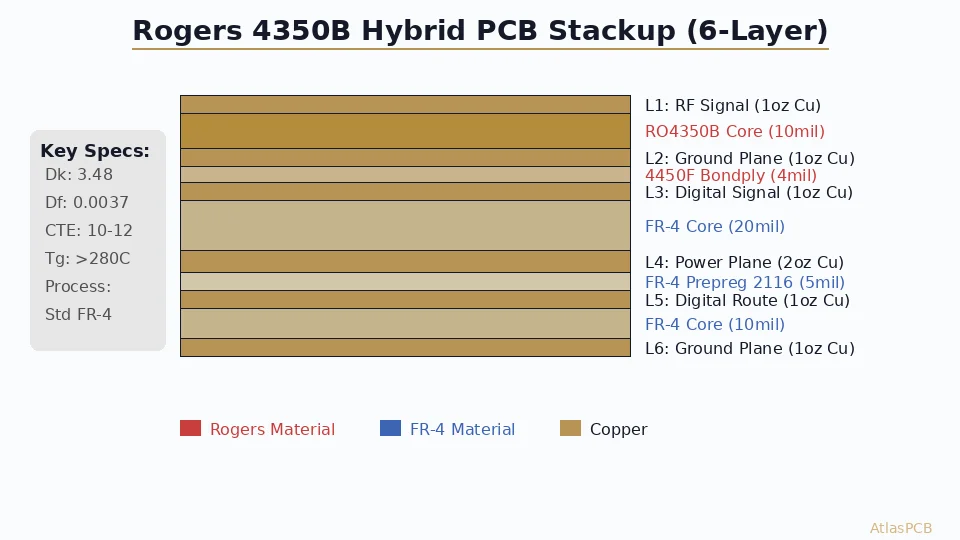
- Lamination profile: RO4350B requires 390F peak temperature versus 350F for standard FR-4 prepreg. The ramp rate, dwell time, and cooling profile affect Dk and adhesion. A shop using their FR-4 profile for Rogers will get inconsistent results.
- Etch compensation: At RF frequencies, the trace width accuracy directly determines impedance. The manufacturer must know their specific etch bias for Rogers panels (which differs from FR-4 due to different copper foil types typically used).
- Drill parameters: While mechanical drilling of RO4350B uses standard parameters, laser drilling requires ~15% higher energy density due to ceramic filler content. Ask whether they have laser drill recipes specifically for Rogers.
IMPEDANCE GUARANTEE
±5% Impedance Control with TDR Data on Every Panel
Not sampled. Not estimated. Every production panel measured against your impedance targets with coupon data included in shipment. Rogers, PTFE, and hybrid stackups.
Upload Design for Quote ›Common Pitfalls When Ordering RF PCBs from China
The “We Do Rogers” Claim
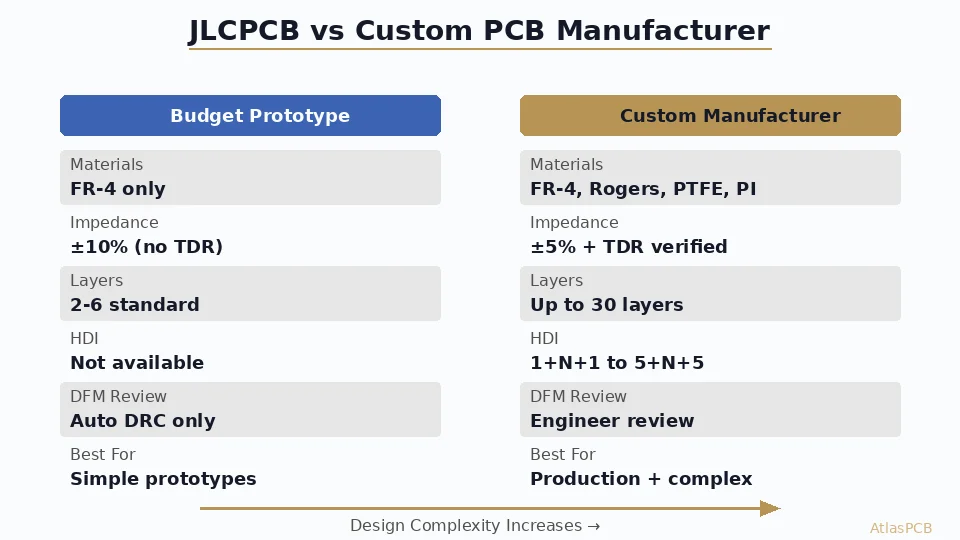
Every PCB manufacturer in Shenzhen will tell you they handle Rogers material. The reality is that most are standard FR-4 shops who will add Rogers to your lamination stack without adjusting their process parameters, etch compensation, or testing procedures. The result: boards that contain Rogers material but do not achieve Rogers-grade RF performance.
The tell-tale sign: if a manufacturer quotes a Rogers board at only 2-3x the price of an equivalent FR-4 board, they are likely not performing TDR verification, not characterizing etch bias for Rogers, and not using proper lamination profiles. Genuine RF fabrication with full impedance verification typically costs 4-6x a standard FR-4 board of equivalent complexity.
Grey Market Material Risk
Rogers laminates cost $45-80 per square foot. This creates a financial incentive for material substitution or unauthorized sourcing. Grey-market material may have been improperly stored (humidity exposure degrades adhesion), may be off-spec material rejected by Rogers QC, or may not be Rogers at all — some manufacturers substitute lower-cost Taiwanese or Chinese PTFE-blend materials that approximate Rogers’ Dk but have significantly worse Df and thermal stability.
Our procurement process requires material certificates directly from Rogers Corporation’s authorized supply chain. We verify lot numbers against Rogers’ database for critical applications.
Communication Gaps in Stackup Engineering
The most common failure mode in international RF PCB ordering is a communication gap between the designer’s intent and the manufacturer’s interpretation. An engineer specifies “50-ohm controlled impedance on Rogers 4350B” — but the manufacturer does not ask about:
- Which Dk value to use in simulation (catalog 3.48 vs. pressed effective 3.52-3.55)
- Copper roughness specification (standard ED vs. low-profile)
- Ground plane pour requirements beneath RF traces
- Whether the ±5% tolerance applies to the test coupon or to traces within the board routing area
A qualified RF manufacturer asks these questions proactively because they understand the engineering implications. A shop that accepts your specification without questions is either extremely experienced (unlikely for a first-time customer) or does not understand what they are committing to deliver.
ENGINEERING COMMUNICATION
Your Stackup Questions Answered by RF Process Engineers
Our engineering team provides pre-production stackup review, impedance simulation with actual process parameters, and design feedback — in English — before fabrication begins.
Get Engineering Review ›What a Qualified China RF PCB Manufacturer Delivers
When you find the right partner, China-based RF PCB manufacturing offers compelling advantages over domestic alternatives in most Western markets:
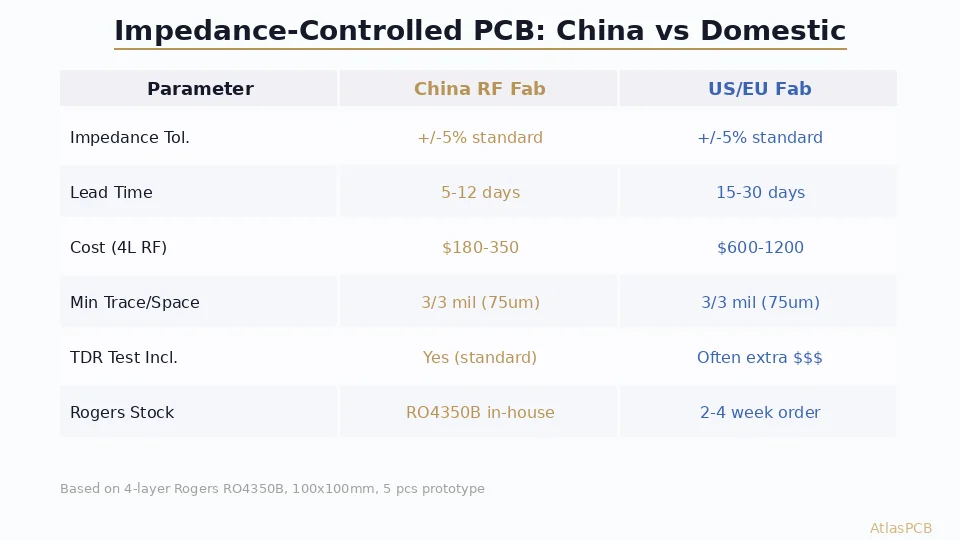
Cost: Even with Rogers material and full TDR verification, a qualified China RF manufacturer typically quotes 40-60% below equivalent US or European shops. The savings come from lower labor costs, integrated material purchasing power, and economies of scale — not from cutting corners on process quality.
Lead time: 10-14 days for prototype Rogers boards (including TDR verification) is standard. US domestic alternatives typically quote 3-4 weeks for equivalent RF capability, sometimes longer for exotic materials.
Material availability: China houses major Rogers distribution hubs serving the massive telecommunications infrastructure market. Common materials (RO4350B, RO4003C, RO3003) are typically in stock, whereas smaller Western shops may need to order material per-job.
Volume capability: When your RF design transitions from prototype to production (1000+ pieces), Chinese manufacturers offer seamless scaling with consistent process parameters. Many Western RF specialists are prototype-only shops that cannot support volume manufacturing.
The key is finding the 5-10% of Chinese manufacturers who combine these cost/lead-time advantages with genuine RF engineering capability. The qualification process described above helps identify them reliably.
Evaluation Checklist for International Teams
Before committing to a China RF PCB manufacturer, verify:
| Criterion | Minimum Acceptable | Preferred |
|---|---|---|
| Rogers material sourcing | Authorized distributor certificate | Direct Rogers supply agreement |
| Impedance tolerance | ±7% with TDR verification | ±5% with Cpk data |
| TDR equipment | Owns and operates regularly | Multiple instruments, automated testing |
| English engineering communication | Basic technical discussion | Detailed stackup review and recommendations |
| Layer capability | 8+ layers with Rogers | 14+ layers, hybrid Rogers/FR-4 |
| Minimum trace/space on Rogers | 4/4mil | 3/3mil (75μm) |
| Etch tolerance (antenna patterns) | ±1.0mil | ±0.5mil |
| First article documentation | TDR report + cross-section | Full package with material certificates |
| Quality certifications | ISO 9001 | ISO 9001 + IPC-6012 Class 2/3 |
| Lead time (prototype) | 14-18 days | 10-12 days |
ATLASPCB
China RF PCB Manufacturing — Engineering-Grade Quality
Rogers RO4350B/4003C/3003 in stock. ±5% impedance with TDR on every panel. Hybrid stackups to 14 layers. English engineering support from RF-specialized process team.
Get Quote with Stackup Review ›
Reviewed by AtlasPCB Engineering Team — 15+ years in advanced PCB fabrication for RF, HDI, and rigid-flex applications.
Related Reading:
About AtlasPCB — We specialize in complex PCB manufacturing for HDI, RF, and high-reliability applications. Explore our RF and high-frequency PCB services, Rogers RO4350B PCB manufacturing, or get an impedance-controlled PCB manufacturing . Every order includes free engineering review. Get your quote.
Reviewed by AtlasPCB Engineering Team — IPC-certified manufacturing specialists with 15+ years of production experience in HDI, RF, and high-reliability PCB fabrication. Content based on factory floor data and real customer design reviews.
Frequently Asked Questions
How many PCB manufacturers in China can actually fabricate RF boards on Rogers?
What should I check in a China RF PCB manufacturer's sample before production?
Is grey-market Rogers material a real problem in China?
What communication level should I expect from a China RF PCB manufacturer?
How does lead time compare between standard and RF PCB orders from China?
- China RF PCB manufacturer
- Rogers PCB
- RF PCB
- impedance controlled PCB
- PCB fabrication
- high frequency PCB