· AtlasPCB Engineering Team · News · 9 min read
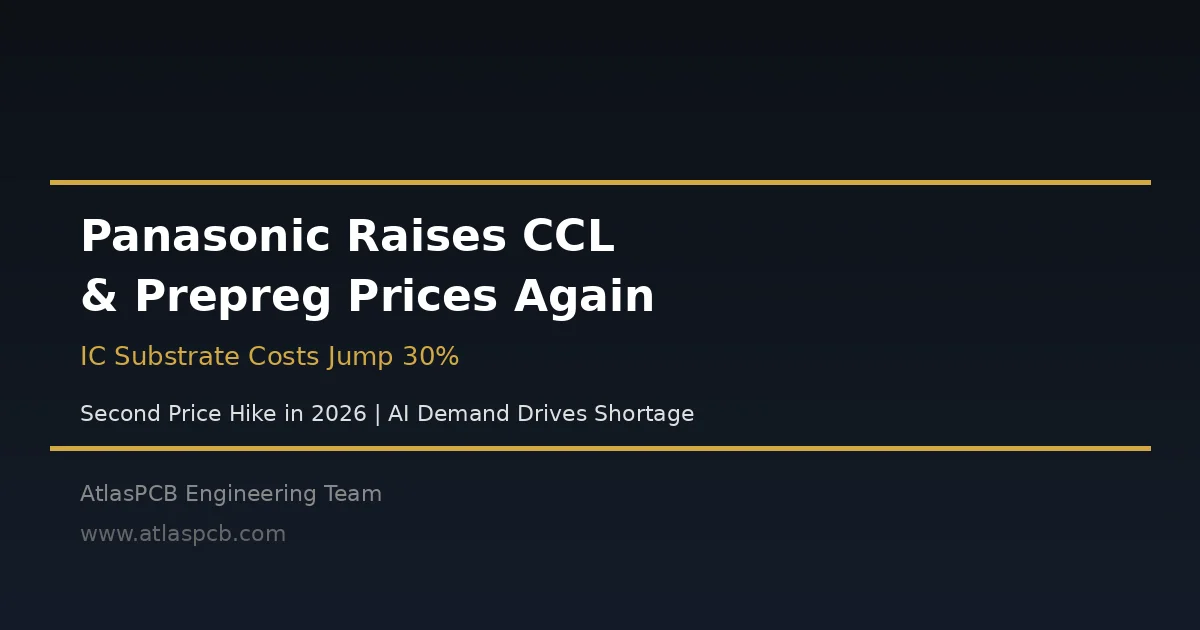
Panasonic Raises CCL and Prepreg Prices for Second Time in 2026 as IC Substrate Material Costs Jump 30 Percent
Panasonic, Japan's largest copper-clad laminate manufacturer, has implemented its second round of CCL and prepreg price increases in 2026, with IC substrate material costs reportedly climbing approximately 30 percent. The move compounds industry-wide supply tightness driven by surging AI server demand for high-end laminate grades and delayed CCL capacity expansion projects.
Reviewed by AtlasPCB Engineering Team
Panasonic Implements Second CCL and Prepreg Price Increase of 2026
Panasonic, Japan’s leading manufacturer of copper-clad laminate, has raised prices on its CCL, prepreg, and related PCB material products for the second time this year, according to a September 2, 2026 report from Digitimes. The latest increase is particularly significant for the IC substrate segment, where material costs have reportedly jumped approximately 30 percent. The move sends a clear signal to the global PCB supply chain: raw material costs are accelerating, and relief is unlikely in the near term.
This second round of increases comes after Panasonic already adjusted pricing earlier in 2026, reflecting persistent cost pressures from elevated copper and resin feedstock prices, constrained manufacturing capacity, and extraordinary demand from the AI semiconductor ecosystem. As the dominant supplier of high-performance laminate materials used in IC substrates, high-density interconnect (HDI) boards, and advanced multilayer PCBs, Panasonic’s pricing decisions reverberate across virtually every segment of the printed circuit board industry.
IC Substrate Materials Bear the Heaviest Impact
The 30 percent cost increase on IC substrate materials stands out as the most consequential element of Panasonic’s latest pricing action. IC substrates serve as the critical interconnect layer between semiconductor dies and the broader PCB assembly, and they demand the highest-grade laminate materials available. These substrates require extremely low-loss dielectric properties, ultra-thin copper foil compatibility, and tight dimensional stability tolerances that only a handful of global CCL manufacturers can consistently deliver.
Panasonic’s MEGTRON series, particularly the M6, M7, and M8 grades, has become the de facto standard for high-frequency, low-loss applications in AI accelerator packaging, advanced networking equipment, and high-performance computing platforms. The M8 grade and above, designed for applications operating at millimeter-wave frequencies and beyond, face especially acute supply constraints as AI infrastructure buildouts consume available capacity at an unprecedented rate.
For PCB fabricators specializing in IC substrates, a 30 percent material cost increase directly compresses margins unless those costs are passed through to their customers. Given that high-grade laminate materials can represent 40 to 60 percent of total IC substrate manufacturing cost, this increase translates to a meaningful jump in finished substrate pricing.
AI Server Demand Driving Unprecedented Strain on High-End CCL Supply
The broader context behind Panasonic’s pricing decision is the relentless growth in AI server deployments worldwide. Every major hyperscale cloud provider and AI infrastructure company is scaling up GPU and custom accelerator installations, and each of those systems requires multiple layers of advanced PCB technology built on high-end CCL and prepreg materials.
A single AI server rack can contain dozens of high-layer-count PCBs and IC substrates, each consuming significant quantities of premium laminate material. As training clusters scale from thousands to tens of thousands of accelerators, the aggregate demand for M6-grade and above CCL has outpaced the industry’s ability to expand production capacity. This supply-demand imbalance is the fundamental driver behind the pricing pressure that Panasonic and other CCL manufacturers are now formalizing through successive price increases.
The situation is further compounded by the trend toward higher layer counts and thicker stackups in next-generation server platforms. Boards that previously required 16 to 20 layers are being redesigned with 24 to 30 or more layers to accommodate faster SerDes interfaces and denser power delivery networks. Each additional layer in the stackup means more prepreg and core material consumption per board, amplifying the demand multiplier on an already constrained material supply.
Lock In Material Pricing Before the Next Increase
With CCL costs climbing for the second time this year, securing material commitments now can protect your project budgets. AtlasPCB works directly with laminate suppliers to offer competitive pricing on FR-4, high-Tg, and high-frequency materials.
Get a Quote TodayCCL Expansion Delays Tighten Supply Further
Adding to the pricing pressure, Digitimes reported on August 20, 2026 that several CCL capacity expansion projects across Asia are facing significant delays. New production lines that were expected to come online in late 2026 and early 2027 have encountered equipment delivery bottlenecks, construction setbacks, and qualification timeline extensions. These delays mean that the additional CCL supply the industry had been counting on to ease the current tightness will arrive later than planned, extending the period of constrained availability and elevated pricing.
The expansion delays are particularly problematic for high-end CCL grades, which require specialized production equipment, cleanroom environments, and lengthy customer qualification cycles. Unlike commodity-grade FR-4 laminate, where multiple suppliers can ramp production relatively quickly, the high-performance CCL segment is concentrated among a small number of manufacturers with deep expertise in resin chemistry and copper foil processing. Panasonic, along with a handful of competitors, effectively controls the supply of materials that the most advanced PCB applications depend on.
Industry-Wide Pricing Pressure Expected to Intensify
Panasonic’s decision to raise prices for a second time in 2026 is widely expected to prompt similar actions from other major CCL manufacturers. Shengyi Technology, China’s largest CCL producer and a major supplier to domestic and international PCB fabricators, faces comparable cost pressures from copper and resin feedstocks. Taiwan-based ITEQ, which has carved out a strong position in mid-to-high-frequency laminate materials, and Nan Ya Plastics, a major volume CCL supplier, are both likely evaluating their own pricing adjustments. Isola, a key Western supplier of advanced laminate systems, may also follow suit as global material costs continue to rise.
When the market leader moves on pricing, it typically establishes a new floor that the rest of the industry gravitates toward within one to two quarters. PCB fabricators and their customers should anticipate a rolling wave of CCL and prepreg price increases across multiple suppliers through the remainder of 2026 and into early 2027.
What This Means for PCB Buyers
The practical implications of Panasonic’s price increases extend well beyond the laminate suppliers and PCB fabricators. For hardware companies, contract electronics manufacturers, and engineering teams procuring printed circuit boards, several near-term consequences are likely.
First, PCB unit pricing will rise. Fabricators operating on thin margins cannot absorb a 30 percent increase in substrate-grade materials or even the more modest increases on standard CCL grades without adjusting their own pricing. Buyers should expect quotation revisions on active programs and higher pricing on new orders, particularly for boards specifying high-performance laminate materials.
Second, lead times may extend. As CCL supply tightens and fabricators compete for limited material allocations, production scheduling becomes more constrained. Projects that require specific laminate grades from Panasonic or other premium suppliers may face longer queue times as fabricators manage their material inventory more conservatively.
Third, material substitution discussions will become more common. Fabricators and their engineering teams may propose alternative laminate systems that offer comparable electrical performance at lower cost or better availability. While material substitution requires careful validation, especially for impedance-controlled and high-frequency designs, it can be a practical strategy for managing both cost and supply risk.
Need Help Navigating Material Options?
Our engineering team can review your stackup requirements and recommend cost-effective laminate alternatives that meet your electrical and thermal specifications without compromising reliability.
Request a Stackup ReviewStrategies for Managing Rising Material Costs
PCB buyers who act proactively can mitigate some of the impact from this latest round of material price increases. Locking in material pricing through longer-term purchase commitments or blanket orders can provide cost certainty for programs with defined production schedules. Placing orders earlier in the design cycle, rather than waiting until production readiness, gives fabricators more flexibility to secure material at current pricing before the next potential increase.
Engaging with your PCB supplier’s engineering team early in the design process can also yield dividends. In many cases, minor adjustments to laminate selection, layer count optimization, or panel utilization improvements can meaningfully reduce material consumption per board without affecting electrical performance. For designs currently specifying premium-grade laminates, it is worth evaluating whether a slightly different grade from an alternative supplier could meet the design requirements at a more favorable cost point.
Diversifying the supplier base is another prudent strategy. Reliance on a single CCL manufacturer’s product line creates concentration risk that becomes especially painful during periods of supply tightness and price escalation. Qualifying secondary laminate sources, even if they are not needed immediately, provides optionality when primary supply becomes constrained.
Secure Your Production Timeline
Ordering ahead of anticipated price increases can save significant cost on volume production runs. Contact us to discuss material availability and lock in pricing for your upcoming builds.
Plan Your Order NowLooking Ahead
Panasonic’s second price increase of 2026 is a strong indicator that the PCB material market has entered a sustained inflationary cycle, driven primarily by structural demand growth from AI infrastructure and compounded by capacity expansion delays. The 30 percent jump in IC substrate material costs is particularly notable, as it suggests that the highest-performance segment of the laminate market is experiencing the most severe supply-demand mismatch.
For the broader PCB industry, the message is clear: material costs are rising, supply is tightening, and the competitive landscape for high-end laminate allocation is intensifying. Companies that plan ahead, maintain strong supplier relationships, and remain flexible on material specifications will be best positioned to navigate the months ahead.
Source: Digitimes, September 2, 2026
About AtlasPCB — We specialize in complex PCB manufacturing for HDI, RF, and high-reliability applications. Explore our Megtron 6 & 7 low-loss PCB manufacturing . Every order includes free engineering review. Get your quote.
Reviewed by AtlasPCB Engineering Team — IPC-certified manufacturing specialists with 15+ years of production experience in HDI, RF, and high-reliability PCB fabrication. Content based on factory floor data and real customer design reviews.
- CCL
- copper clad laminate
- prepreg
- Panasonic
- PCB material
- supply chain
- price increase
- IC substrate