· AtlasPCB Engineering · News · 8 min read
North American PCB Bookings Surge 62% in July 2026 as Book-to-Bill Reaches 1.46 and Shipments Accelerate
The Global Electronics Association's July 2026 PCB statistics reveal a 62% year-over-year jump in bookings and a 1.46 book-to-bill ratio, with shipments climbing 14.5% annually and 19.8% month-over-month. The data confirms that North American PCB demand has moved from recovery to expansion, with implications for lead times, material allocation, and capacity planning through year-end.

July Numbers Confirm Acceleration, Not Just Recovery
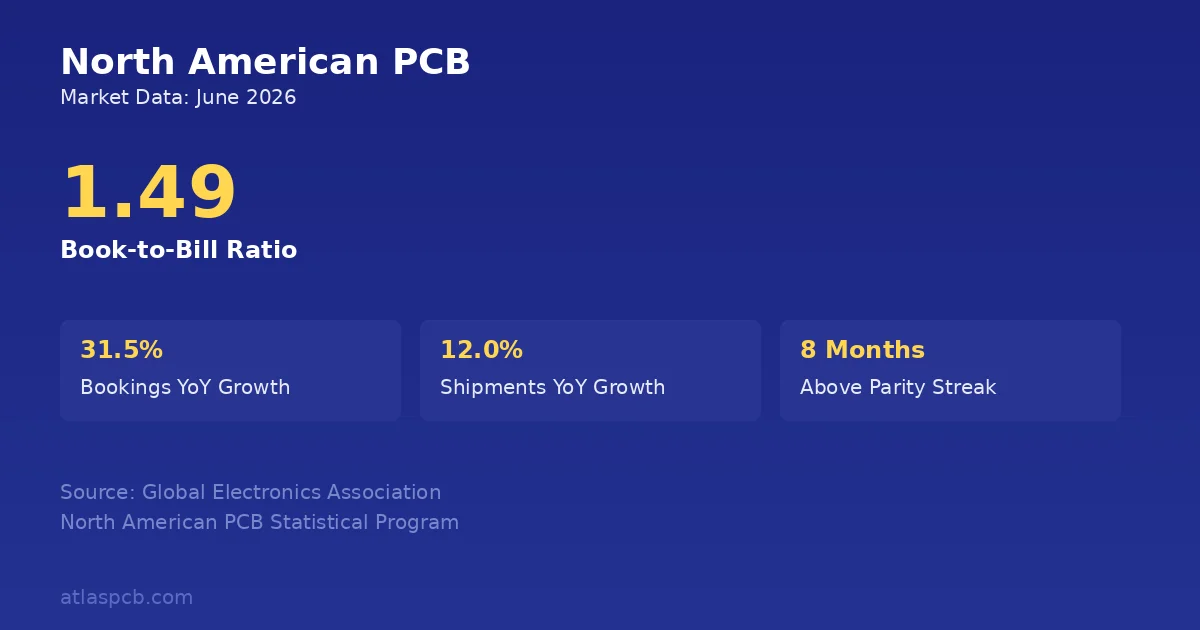
The Global Electronics Association published its July 2026 findings from the North American Printed Circuit Board Statistical Program on August 25, and the data represents the strongest single-month bookings performance of the current growth cycle. North American PCB bookings jumped 62.0% compared to July 2025, an acceleration from the 31.5% year-over-year growth recorded in June and a sharp escalation from the already elevated growth rates that have characterized the first half of the year. The three-month rolling book-to-bill ratio stands at 1.46.
Shipments also accelerated. Total North American PCB shipments in July 2026 increased 14.5% year-over-year and 19.8% compared to June, indicating that fabricators are shipping at elevated rates to work through their order books. Year-to-date shipments through July are up 13.0% compared to the same period in 2025. The fact that bookings are growing at nearly five times the rate of shipments is the critical signal in this data release — demand is accumulating faster than the industry can deliver, and the gap between orders and output is widening.
“PCB activity accelerated meaningfully in July, with strong gains in both shipments and new orders. July extends what has become a sustained period of growth for the North American PCB industry,” said Dr. Shawn DuBravac, the Global Electronics Association’s chief economist. That measured language understates the significance of the underlying trend: year-to-date bookings through July are now 33.3% above the same period last year, which itself was already a growth year relative to 2024.
What a 1.46 Book-to-Bill Actually Means for Lead Times
The book-to-bill ratio is calculated by dividing the total value of new orders booked over a rolling three-month window by the total value of shipments billed during the same period. A ratio above 1.00 indicates that incoming orders exceed outgoing shipments, meaning the industry’s backlog is growing. At 1.46, the North American PCB industry is booking nearly half again as much work as it is shipping — a level that signals meaningful lead time extension for buyers who have not already secured capacity.
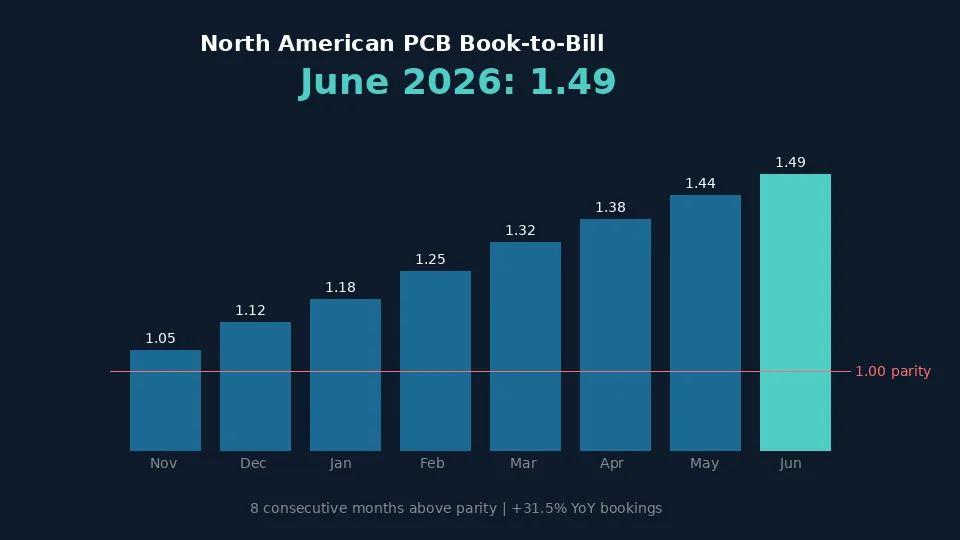
To put this number in context, the June 2026 ratio was 1.49, and the ratio has remained above parity for nine consecutive months through July. The slight sequential decline from 1.49 to 1.46 does not indicate weakening demand — July’s one-month book-to-bill actually came in at 1.39, and the three-month smoothed figure reflects the rolling average. What matters is that the ratio has remained in the 1.4 to 1.5 range for an extended period, which historically corresponds to lead time extensions of two to four weeks beyond standard quoted timelines.
For procurement teams, the practical consequence is straightforward: orders placed today will compete with a growing backlog at every fabrication facility in North America. Standard turn times that might have been quoted at three weeks earlier this year are likely now running four to five weeks, with complex multilayer and HDI builds extending further. The gap between booking and shipment growth rates suggests this pressure will intensify through the fourth quarter.
Why Bookings Are Growing So Much Faster Than Shipments
The 62% bookings growth versus 14.5% shipment growth is not a paradox but a reflection of two overlapping dynamics. The first is genuine end-demand acceleration, driven primarily by AI infrastructure buildout, data center expansion, defense electronics procurement, and the ongoing electrification of automotive and industrial systems. These sectors require advanced PCB technologies — high-layer-count multilayer boards, HDI with microvias, high-frequency laminates, and heavy copper power electronics — that consume disproportionate manufacturing capacity relative to their board count.
The second dynamic is precautionary ordering. When buyers observe rising book-to-bill ratios and extending lead times, rational procurement behavior shifts toward placing orders earlier, building safety stock, and locking in capacity allocations with preferred suppliers. This amplification effect is well documented in electronics supply chains and tends to magnify the apparent demand signal beyond what end-market consumption alone would produce. The challenge for manufacturers is distinguishing genuine demand growth from inventory-building behavior, because the two produce identical order patterns in the near term but very different demand trajectories twelve months out.
The material supply constraint adds a third dimension. As we reported in our Q3 2026 supply chain analysis, laminate and prepreg availability has tightened significantly, with specialty materials for high-frequency and high-temperature applications facing the most acute shortages. When material availability constrains output, shipment growth is physically capped regardless of how many orders sit in the backlog. The 14.5% shipment growth may represent close to the current ceiling of what North American fabricators can ship given existing material allocations.
Historical Context: Where This Cycle Stands
The current nine-month streak of book-to-bill ratios at or above parity is the longest sustained expansion period since the post-pandemic recovery of 2021-2022, when the industry benefited from a broad-based restocking cycle across consumer electronics, automotive, and industrial segments. The character of the current cycle is different. Rather than broad-based demand across all product types, the 2026 expansion is concentrated in advanced technology segments — high layer counts, fine features, specialty materials — that require greater manufacturing sophistication and longer processing times per panel.
This concentration has important implications for the market. Fabricators with capability in advanced multilayer, HDI, and RF technologies are running at or near full capacity utilization, with order backlogs stretching months forward. Fabricators focused on simpler double-sided and basic four-layer products may be experiencing solid but less dramatic growth, as these segments face different demand dynamics and more available offshore competition.
The year-to-date shipment growth of 13.0% is noteworthy in its own right. North American PCB manufacturers collectively shipped more than 13% more product through the first seven months of 2026 than they did in the same period of 2025, a growth rate that reflects real capacity expansion through additional shifts, equipment investments, and process optimization. Several major North American fabricators announced capacity expansions in 2025 and early 2026, and those investments are beginning to contribute incremental output — but not yet enough to close the gap between orders and shipments.
Implications for PCB Buyers
The July data reinforces several practical considerations for engineering teams and procurement managers planning builds through the end of 2026 and into the first quarter of 2027.
Lead time planning should assume extended timelines. Standard fabrication quotes that were accurate three months ago may underestimate current turn times by one to two weeks. Complex builds involving controlled impedance, blind and buried vias, sequential lamination, or specialty materials should factor in additional margin. Engaging your fabrication partner early in the design cycle — before layout is finalized — gives you the best chance of securing capacity without schedule surprises.
Material selection decisions matter more now than in a balanced market. Boards designed around readily available standard FR-4 laminates will move through fabrication faster than boards requiring specialty high-frequency or high-Tg materials that are subject to allocation. When your design permits flexibility in material selection, discussing alternatives with your fabricator can shave days or weeks off the schedule.
Prototype-to-production transitions deserve special attention. The statistical program data shows that prototype demand remains elevated alongside production volumes, which means quick-turn services are experiencing the same capacity pressure as standard production lines. Teams planning a prototype run followed by a production order should consider placing both orders concurrently or in rapid sequence to maintain their position in the fabricator’s scheduling queue.
For international buyers sourcing from Asian fabricators as an alternative to North American capacity, it is worth noting that the demand trends driving North American book-to-bill growth are not region-specific. AI infrastructure, defense modernization, and automotive electrification are generating capacity pressure at PCB manufacturers worldwide, and the material supply constraints are global in scope. Switching suppliers does not eliminate the fundamental capacity challenge; it merely shifts which queue your order enters.
What Comes Next
The trajectory of the book-to-bill ratio over the next two to three months will determine whether the industry is approaching a cyclical peak or entering a prolonged expansion. If bookings growth moderates while shipments continue to accelerate — as fabricator capacity expansions come online and material availability gradually improves — the ratio will naturally decline toward the 1.1 to 1.2 range that characterizes healthy, sustainable growth. If bookings continue to surge at 40% or higher year-over-year rates, the industry faces a genuine capacity crunch that could push lead times to levels not seen since the 2021 shortage period.
The September data, covering the traditionally strong fall ordering season, will be particularly telling. Historically, Q3 bookings benefit from seasonal demand as electronics manufacturers finalize designs and place production orders for holiday-season consumer products and year-end industrial equipment deliveries. If the seasonal uplift layers onto the already elevated baseline, the resulting book-to-bill could approach or exceed the 1.49 recorded in June.
For now, the July data delivers a clear message: North American PCB demand has moved beyond recovery into expansion, the supply-demand balance is tight and tightening, and engineering teams that plan ahead will navigate this environment more successfully than those that treat it as business as usual.
About AtlasPCB — We specialize in complex PCB manufacturing for HDI, RF, and high-reliability applications. Explore our full PCB manufacturing capabilities . Every order includes free engineering review. Get your quote.
Reviewed by AtlasPCB Engineering Team — IPC-certified manufacturing specialists with 15+ years of production experience in HDI, RF, and high-reliability PCB fabrication. Content based on factory floor data and real customer design reviews.
- PCB industry
- book-to-bill ratio
- PCB demand
- North American PCB
- IPC statistics
- PCB market
- supply chain