· AtlasPCB Engineering · News · 7 min read
PCB Supply Chain Enters Tightest Cycle in Years: Q3 2026 Material Outlook and What Buyers Should Do Now
Garner Osborne Circuits' Q3 2026 supply chain report confirms what fabricators worldwide are experiencing: PCB materials have moved decisively into a constrained phase driven by AI infrastructure demand, glass fabric shortages, and geopolitical instability. Here's what the data means for your next board order.
Industry Report Confirms: PCB Materials Market Now in Full Constraint Mode
On August 12, 2026, UK-based PCB fabricator Garner Osborne Circuits published its quarterly supply chain assessment, and the findings represent a significant escalation from the cautious language of their Q2 update issued just three months earlier. Where Q2 identified “early signs of tightening,” the Q3 report uses notably stronger language: the market has “moved decisively into a more restricted phase” that is “expected to influence availability through 2027 and beyond.”
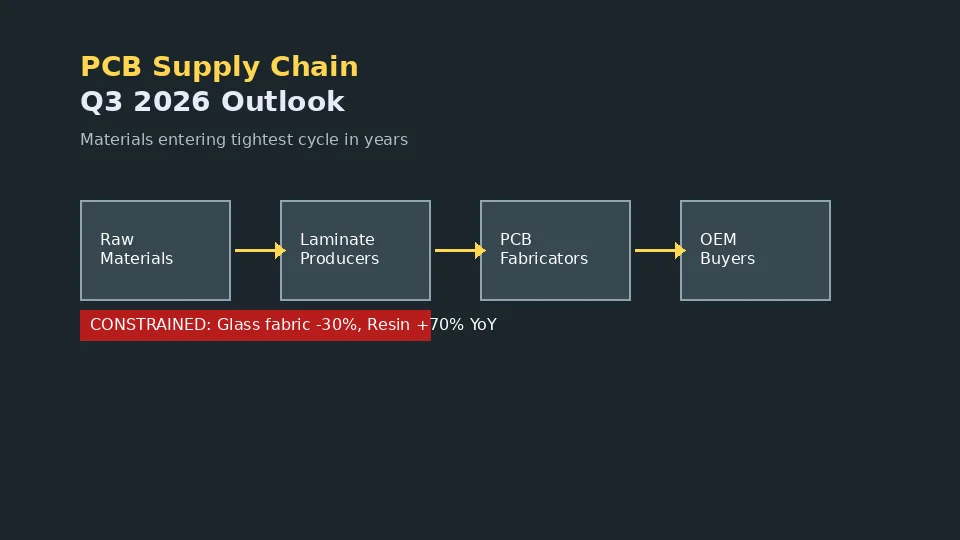
This is not a temporary supply blip or a regional bottleneck. Multiple independent data points from laminate producers, glass fabric manufacturers, resin suppliers, and semiconductor partners are converging on the same conclusion: the PCB materials supply chain is entering one of its tightest cycles in recent memory, driven by structural demand shifts rather than short-term disruptions.
For hardware engineers and procurement teams planning board orders for Q4 2026 and into 2027, the implications are significant and actionable. Lead times are extending, pricing is increasing on a month-over-month basis, and the era of “on-demand” PCB material availability is giving way to planned, allocated, and forward-committed procurement.
Three Converging Pressure Points
The current supply constraint is not caused by a single event but by the simultaneous tightening of three independent input categories, each reinforcing the others.
High-Speed Laminates: Demand Exceeding Global Capacity
The explosion of AI server deployment has created unprecedented demand for high-speed, low-loss copper-clad laminates (CCL). These specialty materials — required for the 28-40+ layer boards used in AI training clusters, network switches, and high-performance computing platforms — are growing at more than 15% annually, and 2026 demand has already surpassed the industry’s current production capacity.
Lead times for specialty high-speed laminates have extended to six months or more in some cases. Multiple price increases have occurred since late 2025, with further rises anticipated through 2027 as manufacturers ration available capacity among customers. The materials in shortest supply include ultra-low-loss grades (Df below 0.005 at 10GHz) from manufacturers like Panasonic (Megtron 6/7), Mitsubishi Gas Chemical (BT resin systems), and Taiwan Union Technology (TU series).
This constraint cascades downward: when high-speed laminate lines are running at maximum capacity, they cannot also produce the mid-loss and standard-loss materials that share production equipment. The result is tightening across the entire CCL product range, not just the premium materials.
Glass Fabric: Output Reductions of 30% or More
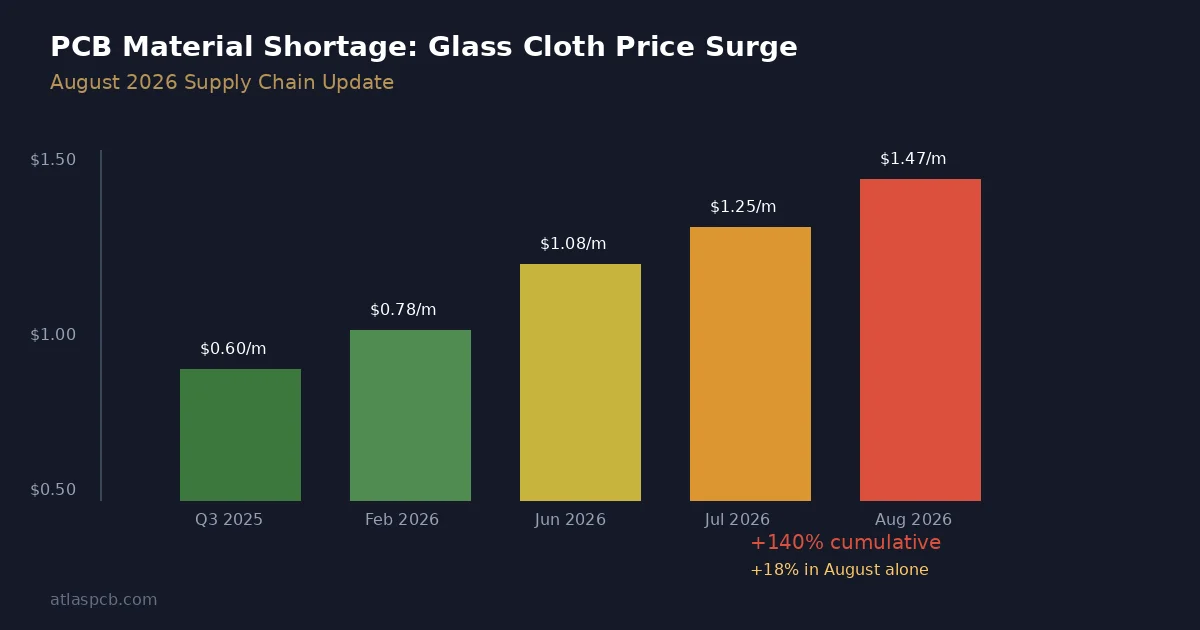
Glass fabric — the woven fiberglass reinforcement that gives PCB laminates their mechanical strength and dimensional stability — has emerged as perhaps the single most constrained input in the entire PCB materials chain. The shortage centers on thin glass styles, particularly the 1080 and 1037 designations used for fine-pitch prepreg layers in high-layer-count boards.
The root cause is a demand shift rather than a capacity failure: glass fabric manufacturers are prioritizing production of K-glass (high-modulus glass) fabrics demanded by AI infrastructure applications, which command premium pricing and larger order volumes. Standard thin E-glass styles are being deprioritized in favor of these more profitable K-glass runs, resulting in output reductions of 30% or more for standard thin styles across 2026.
Pricing for glass fabric is rising month-over-month, closely tied to allocation acceptance — meaning suppliers are effectively requiring customers to commit to long-term volume agreements as a condition of maintaining supply access. Spot purchases of thin glass fabric at standard pricing are becoming increasingly difficult to execute.
Copper Foil and Epoxy Resin Under Dual Pressure
HVLP (Hyper Very Low Profile) copper foil — the ultra-smooth copper required for low-loss high-speed PCB applications — remains tight for the same AI-driven demand reasons affecting glass fabric and laminates. The global supplier base for HVLP foil is limited to a handful of manufacturers (primarily Mitsui Mining, Furukawa Electric, and Circuit Foil), and capacity expansion requires 18-24 months of equipment procurement and qualification.
Simultaneously, epoxy resin costs have surged following geopolitical instability affecting oil pricing in the Middle East. Epoxy resin is a petrochemical derivative, and sustained crude oil price increases in 2026 have directly raised input costs for laminate producers. Copper processing fees are also rising independently, creating a compound cost pressure on the finished CCL product.
What This Means for PCB Buyers
The Garner Osborne report explicitly states that the industry is “shifting away from on-demand supply and toward planned, allocated and forward-committed procurement.” For engineers and procurement teams, this translates to several concrete actions:
Expect Lead Time Extensions
Standard PCB lead times that were 5-7 days for simple boards and 10-15 days for multilayer designs in early 2025 are now extending to 7-10 days and 15-25 days respectively. For boards requiring specialty materials (high-speed laminates, thin prepregs, HVLP copper), lead times of 4-6 weeks are becoming standard, and some configurations are quoting 8+ weeks when materials are not in stock.
Budget for Price Increases
Material cost increases are being passed through to finished board pricing. Standard FR-4 multilayer boards have seen approximately 10-15% price increases year-to-date, with high-speed material boards increasing 20-30%. Further increases are anticipated in Q4 2026 as current material contracts expire and are renegotiated at new market rates.
Lock In Materials Early
For production programs with known schedule requirements, securing material allocation in advance has become critical. This means providing your PCB fabricator with 8-12 week forecasts rather than placing orders at the last moment. Fabricators with material on hand can maintain shorter lead times; fabricators who must procure specialty materials for each order will quote longer timelines that reflect supplier lead times.
Consider Material Alternatives
Where design margins allow, consider whether equivalent performance can be achieved with more readily available materials. For example, a design specifying Megtron 6 (Df = 0.002) might perform adequately with a mid-loss material like Shengyi S1000-2ME (Df = 0.010) if the link loss budget has margin. Similarly, designs specifying 1080 prepreg might accommodate 2116 prepreg with trace width adjustments, using a glass style with better availability.
Broader Industry Context: AI Demand Reshaping PCB Economics
The supply chain tightening described in the Garner Osborne report aligns with a broader set of industry data points that collectively paint a picture of AI computing demand fundamentally reshaping the PCB materials economy.
TTM Technologies reported record quarterly revenue exceeding one billion dollars in Q2 2026, driven heavily by AI server board demand. Zhen Ding Technology’s first-half 2026 net profit jumped 209% year-over-year on similar AI-related volume. North American PCB bookings rose 31.5% year-over-year in June 2026 according to the Global Electronics Association’s latest statistical data. These are not modest growth figures — they represent a structural step-change in demand that is outstripping the supply chain’s ability to respond.
The semiconductor industry provides additional context: the Semiconductor Industry Association reported Q2 2026 global sales of 403.3 billion dollars, up 124% year-over-year, with AI-related chips driving the majority of growth. Every AI chip requires a substrate and a system board, and those boards require the same laminates, prepregs, and copper foils that are now in constrained supply.
Kinsus Interconnect approved a 19.6 billion New Taiwan Dollar expansion for ABF substrate capacity. Ellington Electronics is investing 2.98 billion RMB in high-layer-count PCB production. These massive capital investments signal industry confidence that demand will persist, but new capacity requires 18-36 months to bring online — meaning the current supply gap will persist well into 2027.
What AtlasPCB Is Doing to Protect Customer Lead Times
We maintain strategic material inventory for our most commonly used stackups and material grades. Our standard FR-4 materials (Shengyi S1000-2M, 1oz copper, 1080/2116/7628 prepreg, standard core thicknesses) are held in stock at quantities sufficient to cover 4-6 weeks of production demand without resupply. This inventory buffer allows us to maintain competitive lead times for standard constructions even as spot market availability tightens.
For specialty materials, we have established allocation agreements with primary laminate suppliers that guarantee monthly supply volumes. However, designs requiring unusual material combinations or non-standard thicknesses may face extended procurement timelines. We encourage customers with upcoming production requirements to share 8-12 week rolling forecasts so we can secure appropriate material reserves.
Our engineering team is also available to assist with material substitution analysis — identifying where equivalent electrical performance can be achieved with more readily available materials, potentially saving both cost and lead time without compromising design intent.
Reviewed by AtlasPCB Engineering Team
Market data referenced from Garner Osborne Circuits Q3 2026 Supply Chain Update (published August 12, 2026), TTM Technologies Q2 2026 earnings report, Semiconductor Industry Association Q2 2026 global sales data, and Global Electronics Association June 2026 PCB statistical report. Supply chain status reflects conditions as of mid-August 2026.
About AtlasPCB — We specialize in complex PCB manufacturing for HDI, RF, and high-reliability applications. Explore our full PCB manufacturing capabilities, or get an instant online quote . Every order includes free engineering review. Get your quote.
Reviewed by AtlasPCB Engineering Team — IPC-certified manufacturing specialists with 15+ years of production experience in HDI, RF, and high-reliability PCB fabrication. Content based on factory floor data and real customer design reviews.
- PCB supply chain
- material shortage
- glass fabric
- CCL
- AI demand
- PCB procurement
- supply chain outlook 2026