· AtlasPCB Engineering · News · 8 min read
North American PCB Book-to-Bill Hits 1.49 in June 2026: Eight Consecutive Months Above Parity Signal Sustained Demand Growth
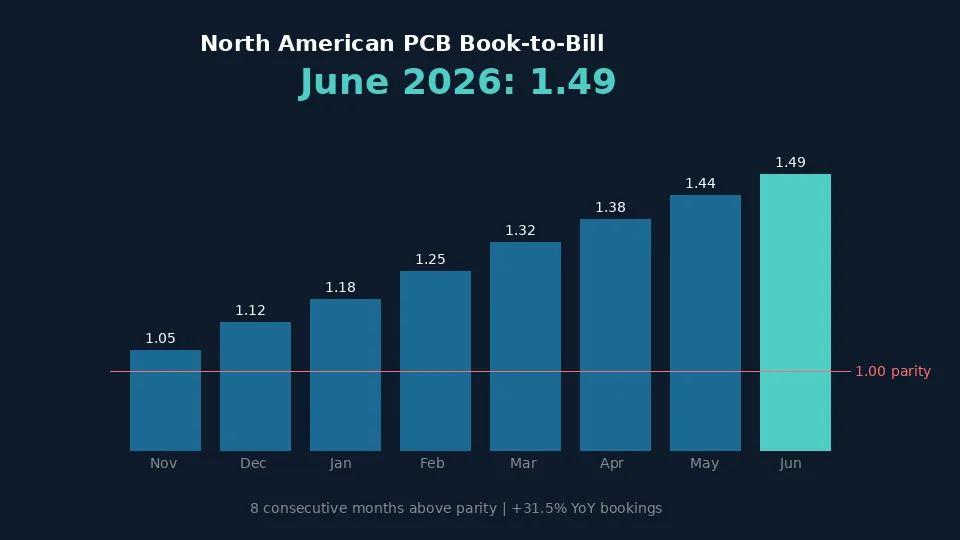
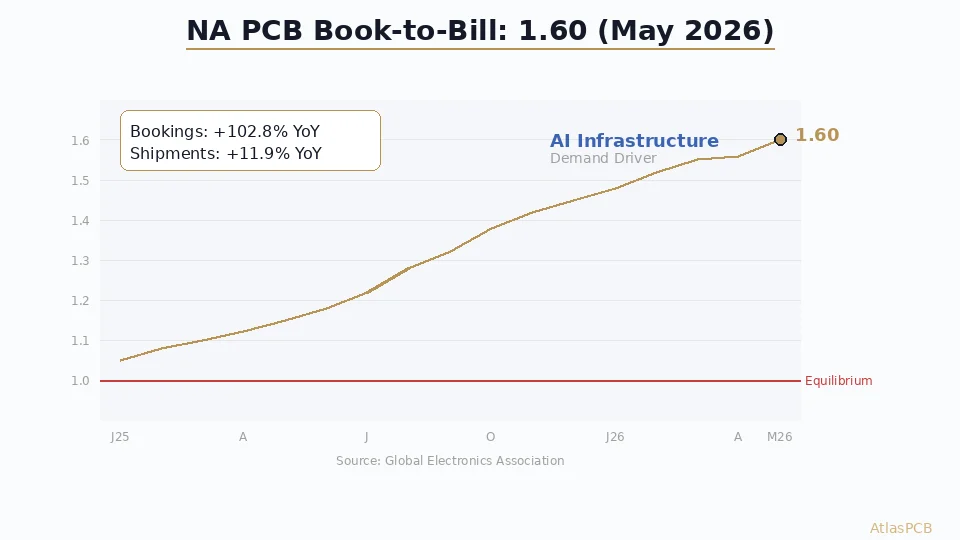
The Global Electronics Association's June 2026 PCB statistical report reveals a book-to-bill ratio of 1.49 with bookings surging 31.5% year-over-year, marking the eighth straight month at or above parity. Combined with TTM Technologies' record $1 billion quarterly revenue and ongoing material constraints, the data confirms a structural demand shift in the PCB industry driven by AI infrastructure and defense spending.
The Numbers Behind the Headline
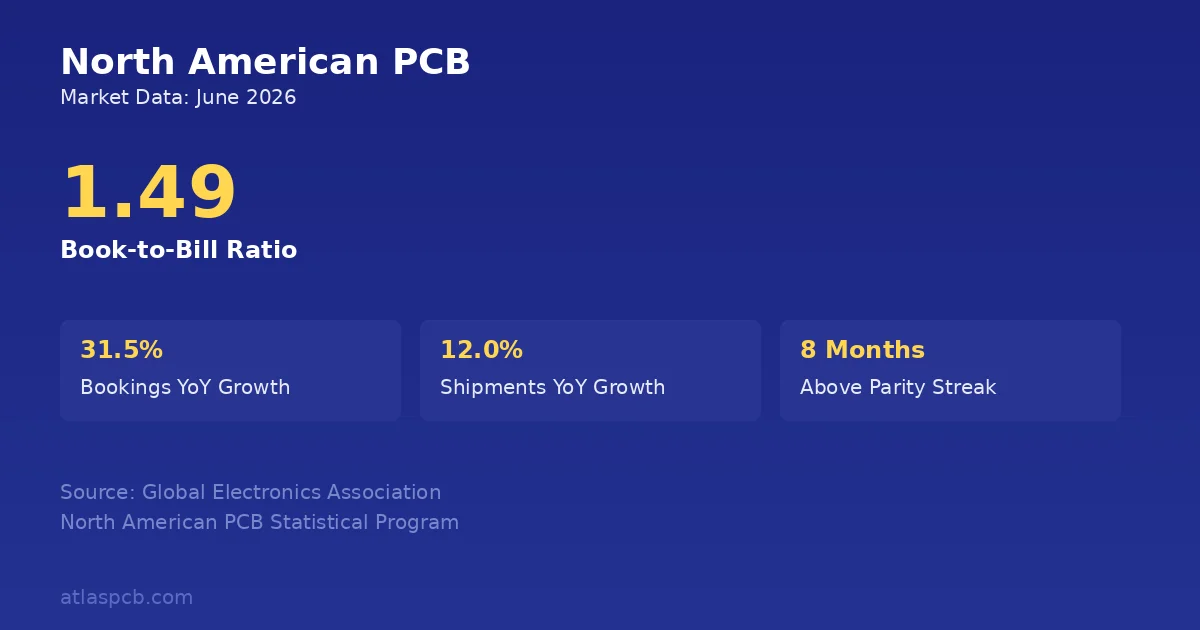
The Global Electronics Association released its June 2026 findings from the North American Printed Circuit Board Statistical Program on July 28, and the data paints a picture of an industry experiencing the strongest sustained demand cycle in recent memory. The headline number — a 1.49 book-to-bill ratio — represents the eighth consecutive month at parity or higher, a streak that has not been matched since the post-pandemic recovery period of 2021-2022.
The underlying data tells an even more compelling story. Total North American PCB bookings in June 2026 surged 31.5% compared to the same month last year, continuing a trend of aggressive year-over-year growth that has characterized 2026. Year-to-date bookings through June increased 29.0% compared to the first half of 2025, indicating that this is not a single-month anomaly but a sustained acceleration in demand across the industry.
Shipments grew more modestly at 12.0% year-over-year in June, with year-to-date shipments up 12.7%. The gap between bookings growth (29-31%) and shipments growth (12-13%) is the structural signal that matters most: demand is outpacing the industry’s ability to deliver, creating a backlog that will likely sustain elevated lead times and pricing pressure through at least Q4 2026.
Dr. Shawn DuBravac, the Global Electronics Association’s chief economist, summarized the situation concisely: “The PCB industry’s book-to-bill ratio hit an eighth straight month at or above parity in June, as PCB demand remains firm and rigid board strength continues.”
What a 1.49 Book-to-Bill Actually Means
For engineers and procurement teams who do not track industry statistics regularly, the book-to-bill ratio provides a leading indicator of supply-demand dynamics and future pricing trends. A ratio above 1.00 means that new orders received exceed shipments fulfilled during the same period — in other words, the backlog is growing.
A ratio of 1.49 specifically means that for every dollar of PCB product shipped in the trailing three-month period, $1.49 in new orders were received. This represents significant demand overhang that fabricators will work to fulfill over the coming three to twelve months. The practical implications for PCB buyers are straightforward: lead times will remain extended, pricing will continue to firm, and capacity allocation will favor customers with committed forecasts over spot-order buyers.
The three-month moving average smooths out month-to-month volatility (June bookings were down 35.9% from May’s even higher level due to a large booking spike), providing a clearer trend signal. That three-month average at 1.30 confirms sustained above-parity demand even when the June-vs-May sequential decline is factored in.
Context: Why This Cycle Is Different from 2021-2022
The 2021-2022 PCB demand spike was driven primarily by pandemic-era supply chain disruptions, semiconductor shortages creating downstream equipment delays, and pull-forward demand as OEMs built safety stock. When those temporary factors resolved, bookings normalized rapidly through 2023-2024.
The current demand cycle has fundamentally different structural drivers that are unlikely to reverse on the same timeline. The primary growth engine is AI infrastructure deployment, which has created demand for advanced substrates that did not exist at scale three years ago. TTM Technologies’ Q2 2026 results illustrate this directly: the company reported record quarterly revenue of $1.0 billion (up 37% year-over-year), with its Data Center and Networking segment surging 91% driven by AI data center PCB demand and the ramp of N+M (next-generation) circuit board architectures.
The second driver is defense and aerospace spending, which has accelerated across NATO countries and their allies in response to ongoing geopolitical tensions. Defense PCB demand tends to be rigid, long-cycle, and relatively price-insensitive — characteristics that provide fabricators with stable baseload work at premium margins.
The third factor is the reshoring and supply chain diversification trend. Companies building new manufacturing capacity in North America, Europe, and Southeast Asia (the “China Plus One” strategy) require new capital equipment that uses advanced PCBs. Each semiconductor fab, battery plant, or robotics facility under construction generates derivative demand for the test equipment, power distribution systems, and automation controllers that rely on multilayer PCBs.
Supply Constraints Amplifying the Demand Signal
The book-to-bill ratio alone would indicate a healthy industry with strong growth prospects. But combined with the supply-side constraints documented in multiple Q3 2026 industry reports, the picture becomes more urgent for buyers who have not yet secured capacity.
Garner Osborne Circuits’ Q3 2026 supply chain assessment, published in August, identified specific material categories under sustained pressure. Glass fabric — particularly thin styles like 1080 that are essential for high-density multilayer boards — is being deprioritized by weavers in favor of AI-focused K-fabric production. Output reductions of 30% or more are expected across standard glass styles through the remainder of 2026. High-speed and low-loss laminates face lead times extending beyond six months, with demand already exceeding global capacity for 2026 allocation.
The material constraints create a multiplier effect on the book-to-bill signal. Even if fabricators wanted to increase shipments to match the booking pace, they cannot obtain sufficient raw materials to do so. This structural bottleneck means the 1.49 ratio may actually understate the true demand pressure, because some potential orders are never placed due to quoted lead times that exceed project timelines.
Implications for PCB Buyers: Three Actions to Take Now
The convergence of strong demand data and constrained supply creates an environment where proactive procurement planning provides measurable competitive advantage. Based on our conversations with hundreds of hardware engineering teams placing orders through the first half of 2026, three strategies consistently differentiate teams that maintain project timelines from those that experience delays.
The first action is to convert preliminary schedules into committed forecasts. Fabricators are increasingly allocating capacity based on committed orders rather than serving the spot market. If your product development timeline indicates PCB fabrication needs in Q4 2026 or Q1 2027, placing orders or at least committing volume forecasts now — even before final design completion — secures production slots and material allocation. Many fabricators, including our facility, can work with preliminary design specifications to reserve capacity and procure long-lead materials while final layout details are completed.
The second action is to evaluate whether material flexibility can reduce lead time risk. If your design specifies a high-speed laminate like Panasonic Megtron-6 or Rogers 4350B that currently carries 8-12 week material procurement lead times, work with your fabricator to determine whether an alternative material with equivalent electrical properties but better availability could meet your performance requirements. In many cases, mid-loss FR-4 variants (Dk 3.8-4.0, Df 0.008-0.012) provide adequate performance for applications previously specified with premium laminates, at significantly reduced lead times and cost.
The third action is to consolidate fabrication with a single qualified supplier rather than splitting orders across multiple vendors. In a constrained market, suppliers prioritize their committed customer base. A customer placing consistent monthly orders receives preferential material allocation, shorter lead times, and more responsive engineering support compared to a customer who appears intermittently with urgent spot orders. The relationship dynamics of supply-constrained markets favor consistent, predictable demand patterns.
What the Data Means for the Broader Electronics Industry
The PCB book-to-bill ratio serves as a bellwether for the broader electronics manufacturing ecosystem because circuit boards are required in virtually every electronic product. A sustained above-parity ratio indicates that equipment manufacturers across all segments — from consumer electronics to industrial automation to medical devices — are placing orders for future production at an accelerating rate.
The 29% year-to-date booking growth is particularly significant because it compounds on top of the recovery growth already seen in 2025. The industry is not merely returning to pre-slowdown levels; it is establishing a new baseline of demand that reflects structural changes in how much PCB content modern electronic systems require. An AI server consumes ten times more PCB material than a traditional server. An electric vehicle contains three to five times more PCB content than a combustion vehicle. A 5G base station uses significantly more advanced substrate material than a 4G installation.
These structural multipliers mean that even modest growth in end-equipment unit volumes translates to outsized growth in PCB material consumption. The industry data from the Global Electronics Association confirms that this structural shift is now flowing through the supply chain at scale, not merely as a forecast but as committed orders backed by customer purchase orders.
For engineers designing products that will enter production in 2027 or beyond, the message is clear: engage your PCB supply chain early, provide visibility into your requirements, and design for manufacturing flexibility where possible. The era of on-demand PCB procurement with minimal lead times has given way to a planned, allocated, and capacity-constrained market that rewards forward planning.
Secure your production capacity before lead times extend further
AtlasPCB maintains strategic material reserves for standard and high-speed laminates. Submit your preliminary design files or BOM for a capacity assessment and material availability check — we can lock in production slots and begin material procurement while your design is finalized.
Check Availability and Get QuoteReviewed by AtlasPCB Engineering Team
About AtlasPCB — We specialize in complex PCB manufacturing for HDI, RF, and high-reliability applications. Explore our full PCB manufacturing capabilities . Every order includes free engineering review. Get your quote.
Reviewed by AtlasPCB Engineering Team — IPC-certified manufacturing specialists with 15+ years of production experience in HDI, RF, and high-reliability PCB fabrication. Content based on factory floor data and real customer design reviews.
- PCB industry
- book-to-bill ratio
- PCB demand
- AI hardware
- PCB market
- supply chain
- IPC statistics