· Priya Nair · Engineering · 8 min read
Immersion Tin vs Immersion Silver
A direct engineering comparison of immersion tin and immersion silver surface finishes — covering cost, shelf life, solderability, signal integrity, and failure modes. Includes decision matrix for choosing between ISn and IAg based on your assembly process, storage constraints, and reliability requirements.
Quick Answer
Immersion silver offers better high-frequency signal performance and longer shelf life (6-12 months sealed) but costs 15-25% more than immersion tin. Choose tin for cost-sensitive consumer products with fast inventory turns; choose silver for RF, high-speed digital, or boards stored more than 3 months before assembly.
Quick Answer: Immersion Tin or Immersion Silver?
| Criterion | Immersion Tin (ISn) | Immersion Silver (IAg) |
|---|---|---|
| Typical cost adder over bare copper | +8-12% | +15-25% |
| Shelf life (proper storage) | 6 months | 6-12 months (vacuum sealed) |
| Solderability window | Excellent within 30 days | Excellent within 6 months |
| High-frequency performance | Adequate to 3 GHz | Superior above 1 GHz |
| Multiple reflow cycles | 2-3 cycles | 3-5 cycles |
| Tin whisker risk | Yes (mitigated by reflow) | None |
| Tarnish sensitivity | Low (oxidation is slow) | High (sulfur, humidity) |
| Best application | Consumer, automotive, cost-sensitive | RF, high-speed digital, medical |
If your boards ship to assembly within 30 days of fabrication and you are working at frequencies below 3 GHz, immersion tin gives you excellent solderability at lower cost. If you need longer shelf life, operate above 1 GHz, or require multiple assembly passes, immersion silver justifies its premium.
Layer Structure and Chemistry
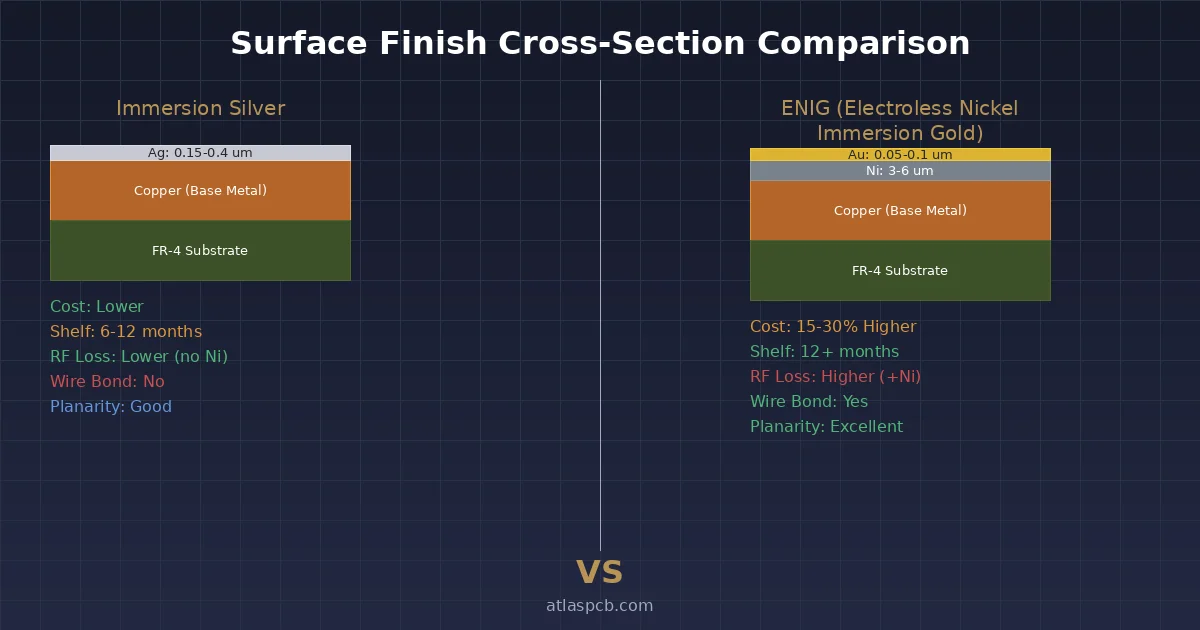
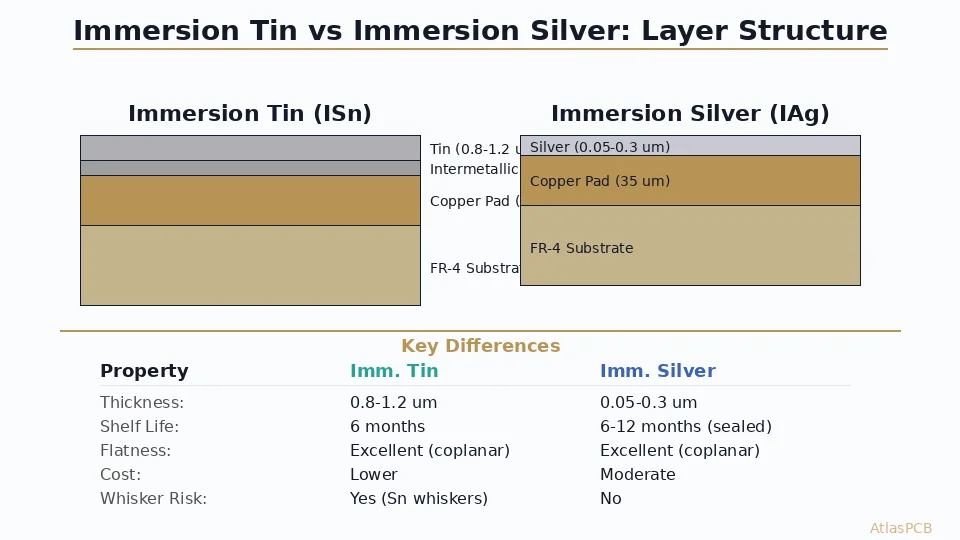
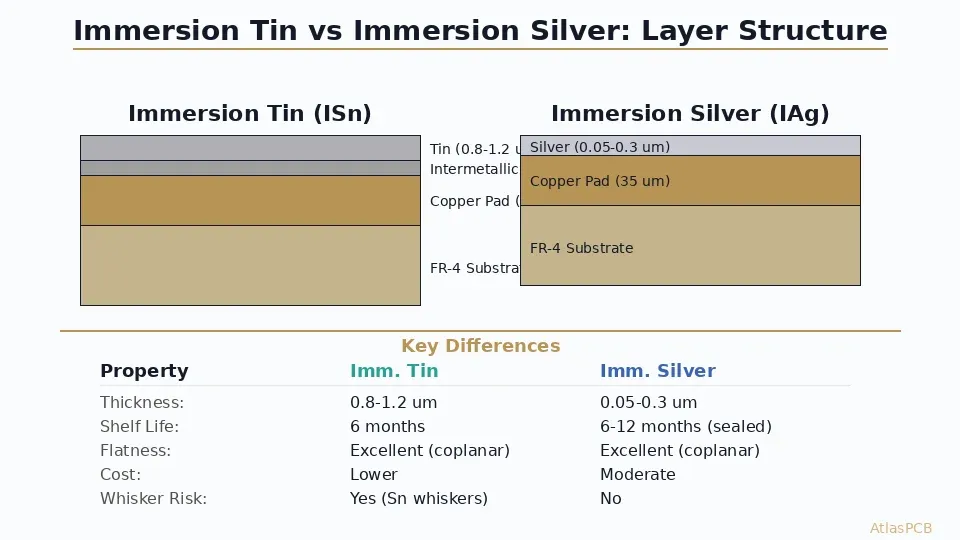
Immersion tin deposits through a chemical displacement reaction where copper atoms on the pad surface are replaced by tin atoms from a stannous solution. The resulting tin layer is typically 0.8 to 1.2 micrometers thick — significantly thicker than immersion silver’s 0.05 to 0.3 micrometers. This thickness difference fundamentally shapes how each finish behaves during storage and assembly.
The ISn process creates a thin intermetallic compound (Cu6Sn5) at the copper-tin interface almost immediately after deposition. This intermetallic layer actually aids solder wetting during reflow, but it also means the pure tin layer gradually converts to intermetallic over time, effectively reducing the solderable surface. After about 6 months at room temperature, enough of the tin has converted that solder wetting becomes unreliable.
Immersion silver works by a simpler displacement mechanism, depositing a very thin layer of pure silver directly onto the copper pad. Because silver does not form intermetallic compounds with copper at room temperature, the coating remains metallurgically stable indefinitely. The shelf life limitation comes entirely from surface tarnish — silver sulfide (Ag2S) formation from exposure to atmospheric sulfur compounds.
SURFACE FINISH EXPERTISE
Not Sure Which Finish Fits Your Design?
Our engineers review your BOM, assembly process, and storage timeline to recommend the optimal surface finish — no guesswork.
Get Finish Recommendation ›
Cost Analysis: When the Price Difference Matters
The cost gap between immersion tin and immersion silver is real but often overstated. On a standard 4-layer board with 200 cm² of pad area, the surface finish contributes roughly $0.15-0.25/board for ISn versus $0.25-0.40/board for IAg at production volumes above 100 panels. The absolute dollar difference is small, but at high volumes with thin margins, it compounds.
Where immersion tin truly wins on cost is in the simplified storage and handling. Because ISn is less sensitive to environmental contamination than IAg, fabricators can store work-in-progress boards in standard packaging without vacuum sealing or sulfur-free materials. This operational simplicity reduces logistics cost by roughly 3-5% compared to IAg lines that require dedicated clean-room storage areas and specialty packaging materials.
However, the total cost of ownership shifts when you factor in assembly yield. If ISn boards sit in inventory beyond 60 days, solder paste wetting becomes inconsistent, and you start seeing tombstoning, insufficient solder joints, and head-in-pillow defects on BGAs. One wave of assembly rejects can wipe out months of surface finish savings. For supply chains with unpredictable inventory turns, immersion silver’s longer window provides meaningful insurance against yield loss.
Signal Integrity and RF Performance
For digital designs operating below 2 GHz, both finishes perform nearly identically. The thin deposit layers have negligible impact on impedance or insertion loss at these frequencies, and your controlled-impedance stackup dominates signal quality.
The difference emerges above 3 GHz, where skin effect confines current flow to the outermost fractions of a micrometer on conductor surfaces. Silver’s electrical conductivity (6.3 x 10^7 S/m) is the highest of any element — about 6% better than copper and roughly 8x better than tin. At millimeter-wave frequencies (28 GHz and above), a silver-finished pad surface measurably outperforms tin-finished pads in both insertion loss and return loss at connector interfaces.
For high-speed SerDes channels running at 25-56 Gbaud (PAM4), the pad finish impact is small relative to via stub losses and dielectric absorption. But in aggregate across a 100+ pin connector field, IAg provides 0.1-0.2 dB better insertion loss — meaningful when you are already at the channel loss budget limit. RF PCB engineers working with Rogers or PTFE materials almost universally specify immersion silver for this reason.
HIGH-FREQUENCY PCB FABRICATION
RF Boards with Immersion Silver on Rogers Laminates
We fabricate RF/microwave boards on RO4350B, RO4003C, and PTFE with IAg finish. Impedance tolerance within +/-5%.
Upload Your RF Design ›Reliability and Failure Modes
The most discussed failure mode for immersion tin is tin whisker growth. These crystalline filaments can grow to lengths exceeding 1mm and cause short circuits between fine-pitch leads. The risk is highest in high-humidity, high-temperature environments where compressive stress in the tin layer drives whisker nucleation.
In practice, the reflow soldering process mitigates most whisker risk by converting the pure tin surface to a tin-lead or tin-silver-copper alloy. Post-reflow, the exposed tin on unsoldered areas (test pads, fiducials) retains some whisker risk, but field failures are rare on boards assembled within the recommended shelf life window. For Class 3 reliability applications (aerospace, medical implants), most engineers avoid the debate entirely by specifying ENIG or hard gold for connector contacts.
Immersion silver’s primary failure mode is tarnish-induced solderability loss. Silver sulfide forms when boards are exposed to sulfur compounds — common in corrugated cardboard packaging, certain rubber bands, and industrial environments. A tarnished IAg board appears yellowish-brown rather than bright silver, and solder paste will not wet properly on the degraded surface.
The prevention is straightforward: store IAg boards in sulfur-free packaging (polyethylene bags, not cardboard boxes) with humidity indicator cards. Vacuum sealing with desiccant extends useful life to 12 months. Once tarnished, boards can sometimes be rescued with a mild acid microetch, but this is a rework operation that adds cost and risk.
RELIABLE PCB MANUFACTURING
IPC-6012 Class 2 and Class 3 Boards with Optimal Finish Selection
We help you select the right surface finish based on your assembly timeline, storage conditions, and reliability class.
Get Instant Quote ›Decision Framework: Which Finish for Your Application?
Choose immersion tin when your supply chain moves fast — boards fabricated, shipped, and assembled within 30-60 days with no extended warehouse storage. Consumer electronics, LED lighting, and high-volume automotive modules with just-in-time delivery are ideal ISn applications. The finish is also preferred when you need excellent pad coplanarity for fine-pitch QFN and BGA packages, as the thicker tin deposit self-levels more effectively than the ultra-thin silver layer.
Choose immersion silver when signal integrity matters, when boards may sit in inventory for extended periods, or when your assembly process involves multiple reflow passes (such as double-sided SMT followed by selective soldering). Medical devices, telecommunications infrastructure, and RF/microwave applications benefit from IAg’s superior electrical properties and wider process window.
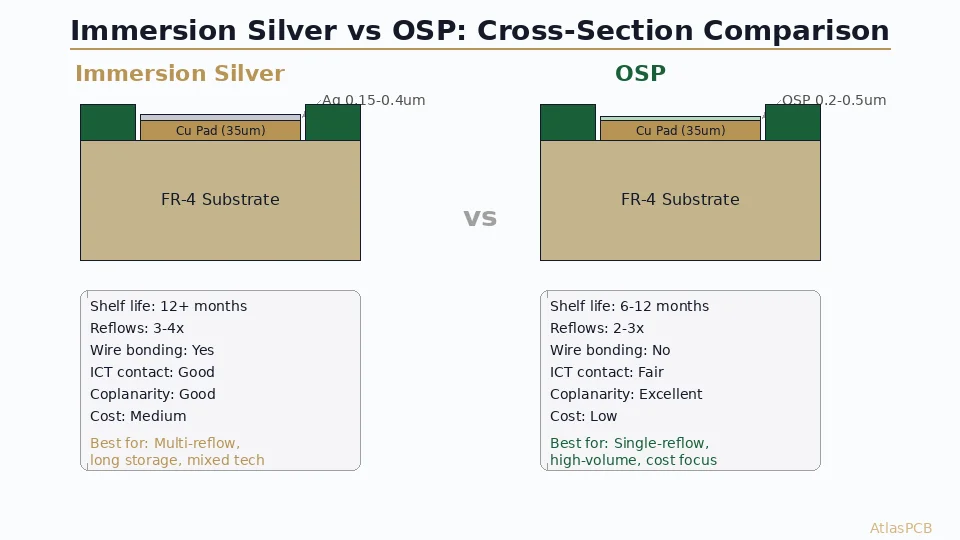
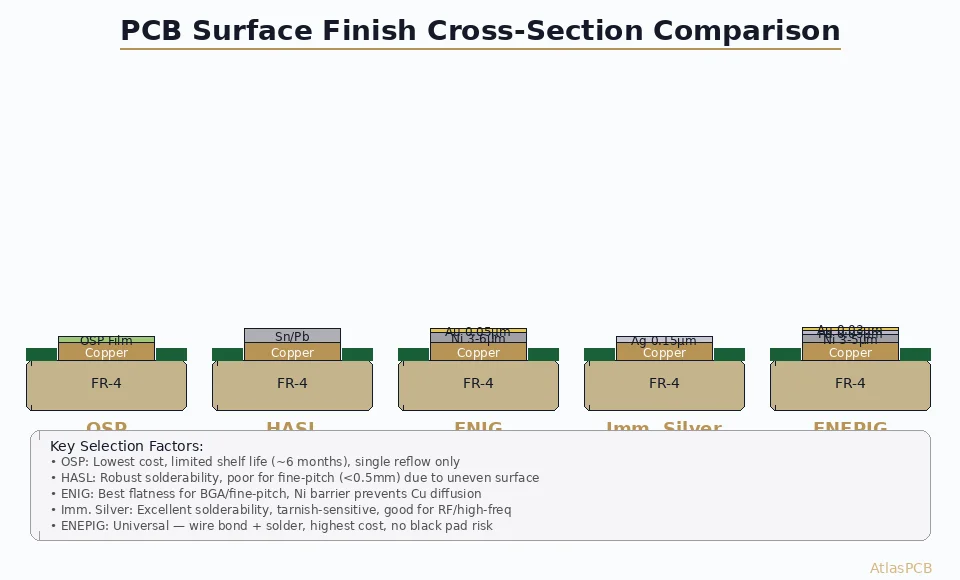
For designs where neither finish perfectly fits — perhaps you need long shelf life AND lowest cost — consider OSP (organic solderability preservative) as a third option. OSP costs less than both ISn and IAg but requires tighter assembly process control and does not survive multiple reflow cycles.
| Application | Recommended Finish | Rationale |
|---|---|---|
| High-volume consumer (fast turns) | Immersion Tin | Lowest cost, adequate shelf life |
| RF/Microwave above 3 GHz | Immersion Silver | Best signal performance |
| Multi-pass assembly (2+ reflows) | Immersion Silver | Survives thermal cycling |
| Automotive (long supply chain) | Immersion Silver or ENIG | Storage tolerance |
| LED lighting modules | Immersion Tin | Cost-optimized, fast assembly |
| Medical Class III | ENIG | Avoid both ISn and IAg risks |
| Fine-pitch BGA (< 0.5mm) | Immersion Tin or ENIG | Coplanarity critical |
ATLASPCB
Ready to Order? We Support All Surface Finishes
ISn, IAg, ENIG, HASL, OSP, Hard Gold — upload your Gerber files and select your finish. Instant pricing with 5-day standard lead time.
Upload Gerber Files ›
Related Reading:
About AtlasPCB — We specialize in complex PCB manufacturing for HDI, RF, and high-reliability applications. Explore our RF and high-frequency PCB services, or get an PCB assembly services . Every order includes free engineering review. Get your quote.
Reviewed by AtlasPCB Engineering Team — IPC-certified manufacturing specialists with 15+ years of production experience in HDI, RF, and high-reliability PCB fabrication. Content based on factory floor data and real customer design reviews.
Frequently Asked Questions
Is immersion tin RoHS compliant?
Does immersion tin cause tin whiskers?
Can immersion silver tarnish affect solderability?
Which surface finish is better for high-frequency RF PCBs?
- pcb
- surface-finish
- immersion-tin
- immersion-silver
- soldering