· Dr. Chen Wei · Engineering · 8 min read
Autonomous PCB Layout in 2026
Autonomous PCB layout tools have matured from research demos to production-ready systems. This deep-dive compares Quilter's physics-based routing, Siemens Fuse AI agents, and Flux.ai's cloud-native approach — analyzing where each excels and what it means for PCB fabrication.
Quick Answer
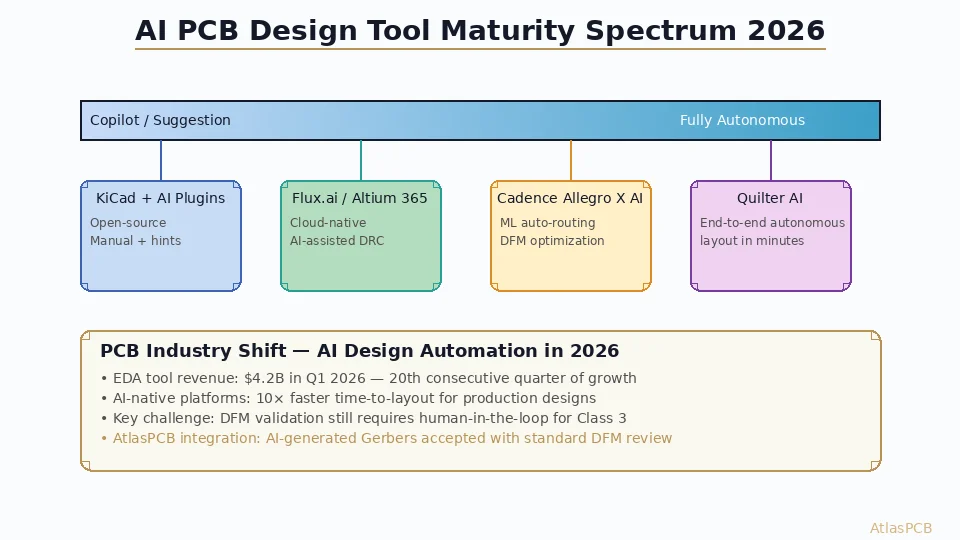
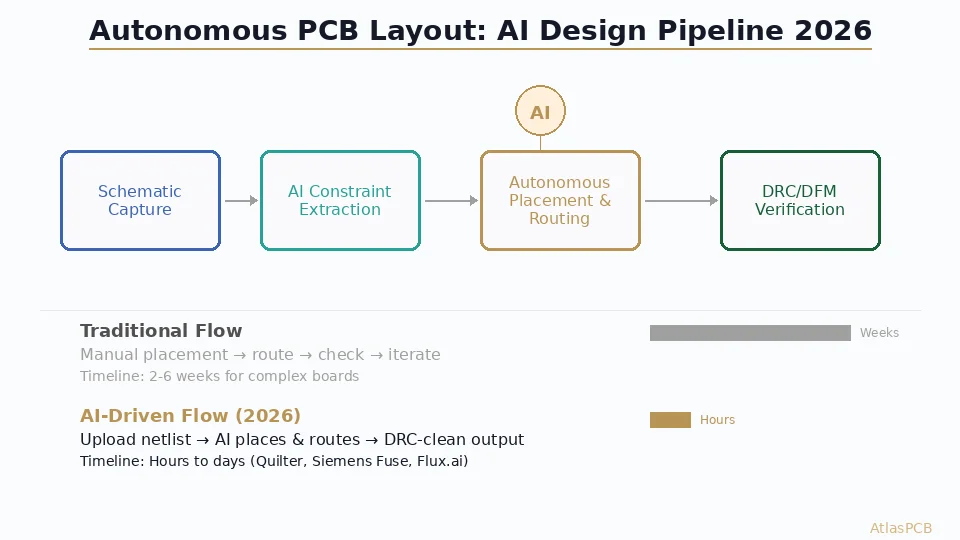
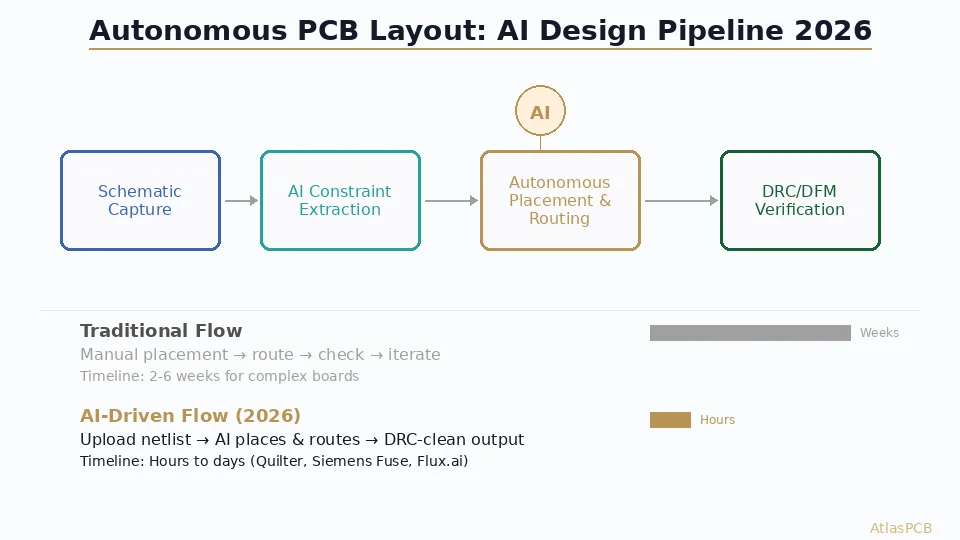
Autonomous PCB layout tools in 2026 — led by Quilter (physics-based autonomous routing), Siemens Fuse (AI agent orchestration across EDA workflows), and Flux.ai (cloud-collaborative AI-assisted design) — can reduce PCB layout time from weeks to hours for moderately complex boards (4-8 layers, <1000 components), though complex high-speed designs still require human verification of signal integrity, thermal management, and manufacturing constraints.
The State of Autonomous PCB Design in 2026
Something remarkable has happened in PCB design tooling between 2024 and 2026. What were research demonstrations and beta products have become production-ready tools with real customer deployments, published case studies, and measurable time savings.
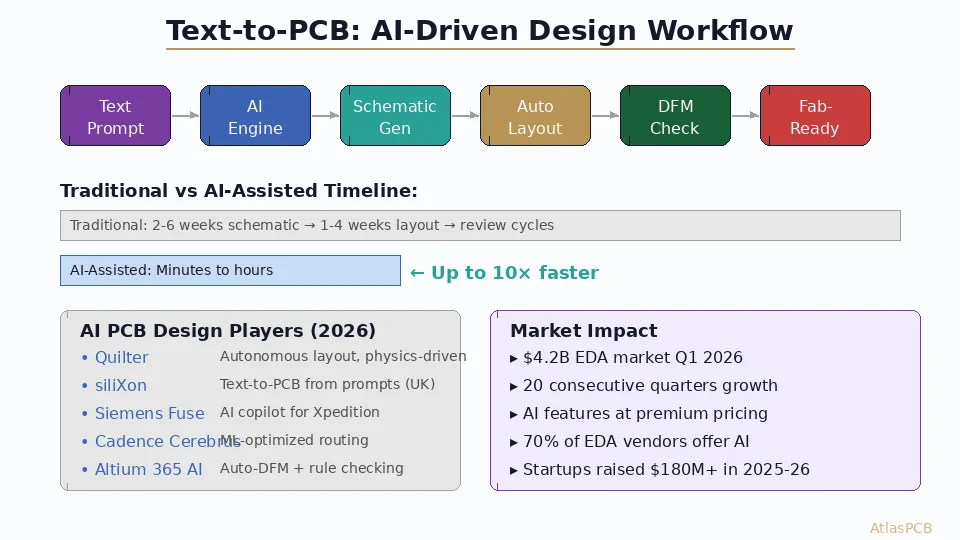
The PCB layout step — historically a 2-6 week bottleneck where skilled layout engineers manually place components and route traces — is being compressed to hours or days by three competing approaches to AI-driven automation.
This article examines the technical approaches, real-world capabilities, and practical limitations of the three leading autonomous PCB layout systems in 2026.
Quilter: Physics-Based Autonomous Layout
Technical Approach
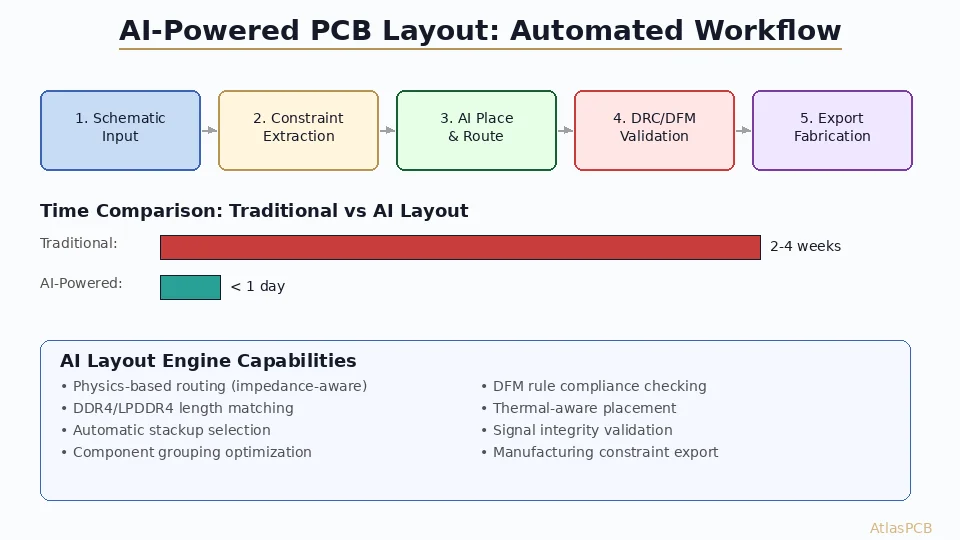
Quilter takes the most aggressive approach to autonomy. Their system:
- Accepts a netlist (schematic capture output) with component specifications
- Extracts constraints automatically — understanding pin functions, impedance requirements, and interface protocols from component datasheets and net names
- Performs placement using physics-based optimization (not just heuristics)
- Routes all nets with full DRC compliance, impedance control, and length matching
- Delivers a fabrication-ready output that passes standard DRC checks
Their “Project Speedrun” demonstration showed a complete multi-layer board designed from schematic to fabrication-ready layout in hours rather than the weeks a traditional workflow would require.
Key Differentiator: Circuit Comprehension
Quilter’s system doesn’t just route traces between arbitrary pins. It understands what circuits do:
- Identifies power delivery networks and applies appropriate plane strategy
- Recognizes high-speed differential pairs and applies impedance-matched routing
- Understands decoupling capacitor placement requirements relative to IC power pins
- Distinguishes analog sensitivity from digital noise tolerance
Validated in Hardware
Critically, Quilter has published results showing boards designed by their AI that:
- Boot successfully under real workloads
- Pass signal integrity measurements
- Meet thermal performance targets
- Achieve first-spin success (no respin required)
Current Limitations
- Best suited for digital-dominant boards (MCU, FPGA, memory, communication interfaces)
- Complex mixed-signal and RF designs still require human intervention
- Does not yet account for factory-specific DFM capabilities
- Mechanical integration (connector placement, mounting holes, keep-outs) needs human input
Siemens Fuse: AI Agent Orchestration
Technical Approach
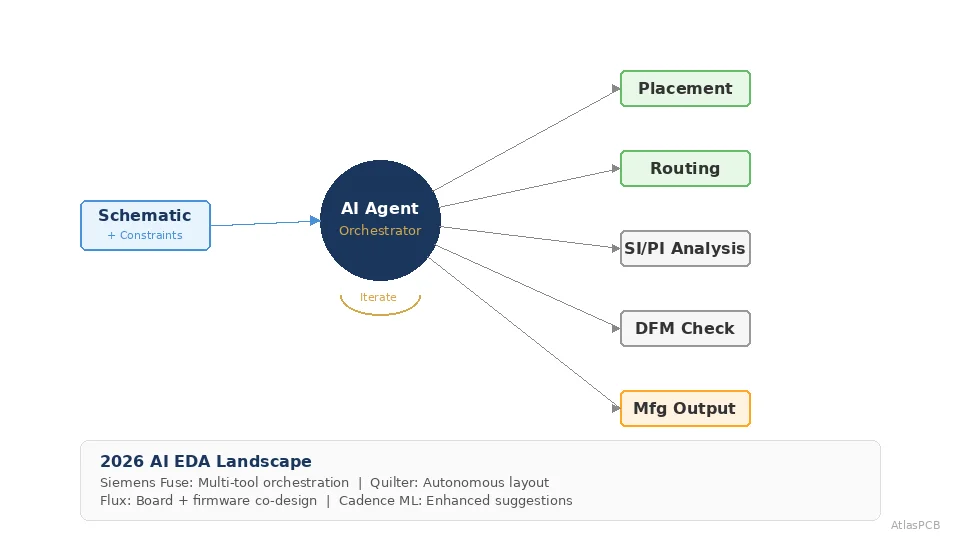
Siemens launched Fuse EDA in early 2026 as an AI agent that orchestrates across their full EDA toolchain:
- Not a standalone layout engine, but an intelligent orchestrator
- Coordinates between Xpedition (layout), Calibre (verification), HyperLynx (SI/PI), and Valor (manufacturing)
- Uses natural language interaction for design intent specification
- Leverages the massive design database from Siemens’ enterprise customer base
Key Differentiator: Workflow Integration
Fuse doesn’t replace the engineer — it automates the tedious parts of their existing workflow:
- Auto-generates constraint sets from interface specifications
- Suggests placement based on signal flow analysis
- Routes non-critical nets automatically while engineers focus on critical paths
- Generates manufacturing documentation automatically from design data
- Performs SI/PI analysis and flags violations without manual setup
Enterprise Focus
Siemens’ approach targets large engineering teams where:
- Design reuse is paramount (leveraging past project knowledge)
- Manufacturing data continuity matters (connected to Valor factory intelligence)
- Multiple disciplines collaborate (schematic, layout, SI, thermal, manufacturing)
- Compliance and traceability are required (automotive, aerospace, medical)
Current Limitations
- Requires Siemens ecosystem investment (licensing cost)
- Less applicable to small teams or simple designs where a standalone tool suffices
- AI agent capabilities are evolving rapidly — feature set changes monthly
- Autonomous capability less aggressive than Quilter (augmentation vs. replacement)
Flux.ai: Cloud-Native Collaborative AI
Technical Approach
Flux.ai provides a cloud-native PCB design platform with AI features integrated throughout:
- Browser-based design environment (no local installation)
- Real-time collaboration (multiple engineers editing simultaneously)
- AI-assisted component selection and placement
- Automated routing with constraint awareness
- Integrated simulation and DFM checks
Key Differentiator: Accessibility and Collaboration
Flux.ai targets a different market segment:
- Hardware startups and small teams without enterprise EDA licenses
- Remote/distributed teams needing real-time collaboration
- Rapid prototyping workflows where speed outweighs precision
- Education and maker communities
Cloud Advantages
- Version control and design history built-in
- Component library continuously updated with availability data
- Computation-heavy tasks (routing, simulation) run on cloud servers
- No local hardware requirements beyond a browser
Current Limitations
- Less mature autonomous capability compared to Quilter
- May not meet Class 3 reliability requirements for complex designs
- Cloud dependency (no offline work capability)
- IP sensitivity concerns for some defense/proprietary applications
AI-Designed Boards Need Expert Fabrication
Whether your PCB was designed by AI or human hands, AtlasPCB provides engineering DFM review, controlled-impedance fabrication, and first-article inspection to ensure your design performs as intended.
Upload Your Design →Comparison Matrix
| Capability | Quilter | Siemens Fuse | Flux.ai |
|---|---|---|---|
| Autonomy Level | Full (netlist → layout) | Augmented (AI assists human) | Partial (AI helps at each step) |
| Best For | Startups, speed-focused teams | Enterprises, complex systems | Small teams, collaboration |
| Layer Count | Up to 12+ demonstrated | Unlimited (full Xpedition) | Up to 8-10 typical |
| SI/PI Integration | Basic impedance control | Full HyperLynx integration | Cloud-based estimation |
| DFM Awareness | Generic rules | Factory-specific (Valor) | Standard rule checking |
| Pricing Model | Per-design or subscription | Enterprise license | Freemium/subscription |
| Output Format | Standard Gerber/ODB++ | All industry formats | Standard Gerber |
| Deployment | Cloud API | On-premise + cloud | Cloud-only |
Impact on PCB Fabrication
Changing Customer Expectations
As autonomous tools proliferate, PCB fabricators should expect:
- Faster iteration cycles — customers designing in hours will expect quote responses in hours, not days
- More DRC-compliant designs — AI tools enforce rules consistently, reducing DFM exceptions
- Increased volume of unique designs — lower layout cost enables more custom hardware
- Less DFM knowledge at the customer — AI hides manufacturing constraints, requiring fabricator feedback
Manufacturing Intelligence Feedback Loop
The most sophisticated implementations create a feedback loop:
- Fabricator publishes capability data (min trace/space, via sizes, layer count, materials)
- AI tools incorporate these constraints during layout
- Result: designs that are fabrication-ready without engineering review iterations
Siemens’ Valor integration represents this most directly, but all three platforms are moving toward manufacturing-aware design.
Quality Implications
AI-designed boards tend to be:
- More consistent — same rules applied everywhere, no human fatigue
- More optimized — algorithms explore placement/routing spaces humans cannot
- Less creative — may miss non-obvious solutions an experienced engineer would find
- Potentially over-constrained — applying worst-case rules everywhere vs. relaxing where safe
The Engineer’s Role Evolving
The PCB layout engineer’s role is not disappearing — it is elevating:
Traditional role (declining):
- Manual component placement
- Interactive trace routing
- DRC fixing
- Documentation generation
Emerging role (growing):
- AI output review and validation
- Complex design decisions AI cannot make (thermal, mechanical, SI tradeoffs)
- Manufacturing liaison and DFM optimization
- System architecture and partition strategy
- Constraint specification and verification
The engineer who understands both the physics and the manufacturing becomes more valuable as AI handles routine execution.
Practical Recommendations for 2026
For Hardware Startups
- Use Quilter or Flux.ai for rapid prototyping (first board in days, not weeks)
- Get AI-generated designs reviewed by your fabricator before committing to production
- Budget for potential respins on complex designs until AI tools mature further
For Enterprise Teams
- Evaluate Siemens Fuse within existing Xpedition deployments
- Use AI for non-critical board sections while engineers handle sensitive circuitry
- Build design reuse libraries that make AI more effective over time
- Establish DFM feedback loops with preferred fabricators
For PCB Fabricators
- Accept and validate AI-generated manufacturing data without bias
- Provide machine-readable capability files for AI tool integration
- Maintain engineering review services — they become more valuable as design barriers lower
- Invest in fast-turnaround quoting to match faster design cycles
Design Complexity Thresholds: Where AI Excels and Where It Struggles
Understanding the boundaries of current AI capability helps engineers make informed decisions about when to trust autonomous layout and when to intervene.
AI Handles Well (2026 State of the Art)
- Standard digital boards (4-8 layers, MCU + memory + peripherals): Fully autonomous layout with high first-spin success rates
- Power delivery: AI can properly size planes, place decoupling capacitors, and manage current density
- Constraint-driven routing: Length matching, impedance control, and spacing rules are algorithmic strengths
- BGA escape routing: Optimal fan-out patterns that humans find tedious
- Component grouping: Identifying functional blocks and keeping them together
AI Struggles With (Requires Human Oversight)
- Thermal management: Heat flow is 3D and depends on enclosure, airflow, and component power profiles that AI may not have access to
- Mixed-signal partition: The analog/digital boundary decision requires system-level understanding
- RF matching networks: Smith chart optimization and parasitic sensitivity require specialized knowledge
- Mechanical integration: Connector placement relative to enclosures, flex-rigid bend areas, heat sink clearance
- Manufacturing-specific rules: Individual factory capabilities (minimum via aspect ratio, copper balancing requirements, panel utilization) vary significantly
The 80/20 Rule in Practice
Most engineers report that AI handles approximately 80% of routing work in standard designs, while the remaining 20% — critical high-speed buses, sensitive analog sections, thermal bottlenecks — requires human expertise. The time savings are still enormous: reducing a 3-week layout to 2-3 days of AI execution plus 1-2 days of human review and refinement.
Looking Ahead: 2027 and Beyond
The trajectory of improvement suggests several developments within 12-18 months:
- Multi-physics awareness: AI incorporating thermal simulation, stress analysis, and vibration modeling into placement decisions
- Manufacturing feedback loops: Real factory yield data flowing back to improve AI decision-making
- Collaborative AI: Multiple specialized AI agents handling different aspects of design simultaneously
- Generative schematic: AI suggesting circuit architectures, not just laying out human-created schematics
- Continuous improvement: Designs improving automatically as new manufacturing data or design rule updates become available
The PCB design profession is not dying — it is being liberated from tedium and elevated to focus on the engineering decisions that truly matter for product success.
Further Reading
- AI-Powered EDA Tools in 2026: Autonomous Agents in PCB Design
- Siemens Xpedition Standard AI PCB Design for SMBs
- PCB Laser Direct Imaging: LDI vs. Phototool
- Signal Integrity PCB Design Guide
From AI Design to Physical Board
Regardless of how your PCB is designed, it needs expert fabrication. AtlasPCB combines automated DFM analysis with experienced engineering review, controlled-impedance processing, and 100% electrical testing — bridging the gap between AI-generated layouts and reliable physical hardware.
About AtlasPCB — We specialize in complex PCB manufacturing for HDI, RF, and high-reliability applications. Explore our full PCB manufacturing capabilities, or get an instant online quote . Every order includes free engineering review. Get your quote.
Reviewed by AtlasPCB Engineering Team — IPC-certified manufacturing specialists with 15+ years of production experience in HDI, RF, and high-reliability PCB fabrication. Content based on factory floor data and real customer design reviews.
Frequently Asked Questions
Can AI fully replace human PCB layout engineers?
Which autonomous PCB design tool should I choose in 2026?
How does autonomous PCB layout affect manufacturing quality?
- AI
- PCB design
- autonomous layout
- Quilter
- Siemens Fuse
- Flux.ai
- EDA tools
- machine learning
- hardware engineering
- design automation