· Marcus Lin · News · 8 min read
PFAS Restriction Proposals Are Coming for PCB
EU and US PFAS restrictions will impact PCB solder masks, conformal coatings, and flux. Here's the timeline, affected materials, and alternatives.

Quick Answer
Proposed EU and US restrictions on per- and polyfluoroalkyl substances (PFAS) will significantly impact PCB manufacturing, particularly solder masks, conformal coatings, flux formulations, and certain surface finishes that rely on fluorinated chemistry. The EU's universal PFAS restriction under REACH is expected to take effect between 2027-2029 with sector-specific transition periods, while the US EPA is pursuing parallel restrictions. PCB manufacturers must begin qualifying PFAS-free alternatives now to avoid supply chain disruptions.
The End of “Forever Chemicals” in PCB Manufacturing
Per- and polyfluoroalkyl substances — the family of synthetic chemicals known colloquially as “forever chemicals” — have been workhorses in PCB manufacturing for decades. Their unique combination of chemical resistance, thermal stability, and surface-tension properties made them invaluable in solder masks, conformal coatings, flux formulations, and surface treatments. Now, a convergence of regulatory action in Europe and the United States is set to force the PCB industry to find alternatives, with implications that reach every level of the supply chain.
The regulatory picture has sharpened considerably in 2026. The European Chemicals Agency (ECHA) has advanced its universal PFAS restriction proposal under the REACH framework, with formal adoption expected by mid-2027 and enforcement timelines that give most industrial sectors 18 months to 5 years to comply. In the US, the EPA has proposed its own restrictions under the Toxic Substances Control Act (TSCA), targeting the most commonly used PFAS compounds in industrial manufacturing. For PCB fabricators and their customers, this is no longer a distant regulatory threat — it’s an active transition that demands attention now.
Where PFAS Lives in PCB Manufacturing
To understand the scope of the challenge, it’s important to map exactly where fluorinated chemicals appear in the [PCB manufacturing process]/blog/pcb-manufacturing-process/):
Solder Mask
This is the most significant exposure point. Modern liquid photoimageable (LPI) [solder masks]/blog/pcb-solder-mask-guide/) commonly contain fluorosurfactants as leveling agents and wetting additives. These PFAS-based additives ensure uniform coating, prevent cratering and fisheyes, and enable the solder mask to flow smoothly over copper traces and substrate features. Typical PFAS content is small — often <1% by weight — but it falls squarely within the scope of proposed restrictions.
The major solder mask suppliers (Taiyo, Tamura, Lackwerke Peters, Huntsman) have all been developing PFAS-free formulations. Current-generation alternatives typically use silicone-based or modified hydrocarbon leveling agents. Performance on standard multilayer boards is generally comparable, but fine-pitch applications below 100μm pad spacing and HDI designs with tight feature geometries may require additional process optimization.
Conformal Coating
[Conformal coatings]/blog/conformal-coating-pcb/) represent the second major area of PFAS exposure. Fluorinated acrylic and fluorinated urethane coatings have been popular choices for harsh-environment applications — automotive under-hood, marine, aerospace — because of their exceptional moisture and chemical resistance. These coatings are essentially PFAS-based by design, not just as trace additives.
The transition here is more challenging. Alternative conformal coating chemistries — including parylene, silicone-based, and modified acrylic formulations — exist but generally don’t match the breadth of performance that fluorinated coatings provide. Each alternative excels in specific areas while requiring compromises in others:
- Parylene: Excellent barrier properties but requires vacuum deposition, making it significantly more expensive
- Silicone-based: Good moisture resistance and flexibility but lower chemical resistance
- Modified acrylics: Most direct drop-in replacement but with reduced performance in extreme chemical exposure environments
Flux Chemistry
No-clean flux formulations frequently use fluorosurfactants to control wetting behavior and ensure consistent solder joint formation. While the PFAS content in flux is typically very low, it’s present across virtually all mainstream no-clean flux families. The transition to PFAS-free flux is technically straightforward — several alternatives are already commercially available — but requires requalification of soldering processes, which is time-consuming for manufacturers with IPC J-STD-004 certifications.
Surface Finishes and Anti-Tarnish Treatments
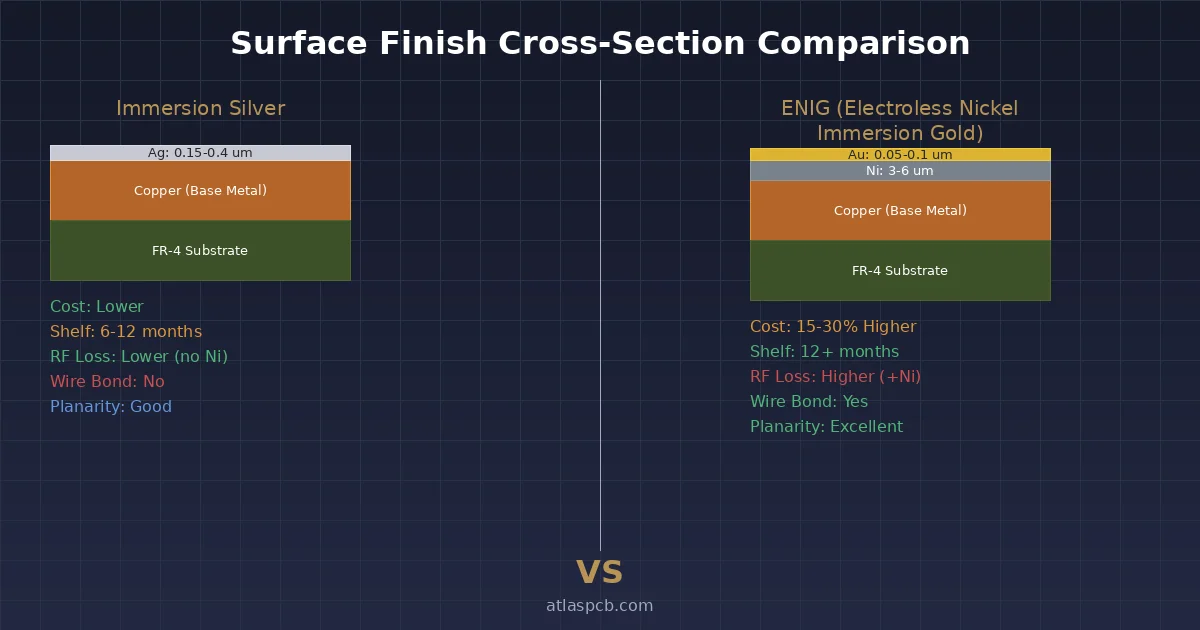
Some [surface finish]/blog/pcb-surface-finish-guide/) processes use PFAS-containing anti-tarnish agents or process additives. This primarily affects certain OSP (Organic Solderability Preservative) formulations and some proprietary post-treatment rinses used in [ENIG and ENEPIG processes]/blog/pcb-surface-finish-enig-hasl-osp-hard-gold-enepig/). The PFAS content is minimal and alternatives are readily available, making this the most manageable transition area.
Drill and Routing
PTFE (polytetrafluoroethylene) — technically a PFAS compound — is used in some drill entry and backup materials, and occasionally in lubricants for routing operations. The current regulatory proposals include exemptions or extended timelines for PTFE in manufacturing tooling applications, but this remains an area of uncertainty.
The Regulatory Timeline
Understanding the timeline is critical for planning. Here’s where things stand as of April 2026:
European Union (REACH):
- ECHA opinion adopted: Q2 2025
- European Commission formal proposal: Expected Q3 2026
- Adoption: Expected mid-2027
- Enforcement (most industrial uses): 18 months after adoption (~early 2029)
- Extended transition (critical applications without alternatives): 5-12 years
- Key detail: The restriction covers ALL PFAS compounds with ≥1 fluorinated carbon, which is the broadest possible definition
United States (EPA/TSCA):
- Proposed TSCA rule for industrial PFAS: Published January 2026
- Public comment period: Closed March 2026
- Final rule expected: Late 2026 or early 2027
- Compliance timeline: Likely 2-3 years after final rule
- Key detail: US approach may be more targeted, focusing on specific high-volume PFAS rather than the entire class
Other jurisdictions: South Korea, Japan, and Canada are pursuing parallel restrictions with slightly different scopes and timelines. China has no current PFAS restriction proposal but is monitoring international developments.
Industry Response and Readiness
The PCB industry’s readiness for PFAS transition varies significantly by segment and geography:
Large-volume manufacturers (primarily in China and Taiwan) have been the fastest to qualify PFAS-free solder mask and flux alternatives, driven by European customer requirements. Several major Chinese PCB fabricators now offer PFAS-free multilayer board production as a standard option for orders destined for EU markets.
Mid-tier and specialty manufacturers are in various stages of qualification. The challenge is particularly acute for manufacturers focused on high-reliability applications (automotive, aerospace, medical) where material change qualifications are extensive and costly.
Material suppliers are ahead of fabricators. All major solder mask, flux, and conformal coating suppliers now have PFAS-free product lines either commercially available or in late-stage qualification. The bottleneck is downstream — PCB fabricators need to qualify these new materials on their specific production lines and demonstrate equivalent performance to their customers.
What IPC Is Doing
The IPC has established a PFAS Task Group under its Environmental Leadership Committee that is:
- Developing industry guidance documents for PFAS-free material qualification
- Working with ECHA and EPA on sector-specific exemptions where no viable alternatives exist
- Creating a shared database of PFAS-free material performance data to accelerate qualification across the industry
- Advocating for realistic transition timelines that account for the complexity of PCB material qualification
What This Means for PCB Buyers
Immediate Actions (2026)
Audit your supply chain: Ask your PCB suppliers about their PFAS transition plans. Do they have qualified PFAS-free solder mask and flux? What’s their timeline?
Review your specifications: If your PCB specifications call out specific materials by trade name, check whether those materials contain PFAS. Update specifications to allow PFAS-free alternatives.
Start qualification: For new designs, consider specifying PFAS-free materials from the outset. It’s easier to design in PFAS-free from the start than to requalify existing products.
Evaluate conformal coating: If your products use fluorinated conformal coatings, this is the area requiring the most lead time for alternatives qualification. Start evaluation now.
Cost Impact
Industry estimates suggest the PFAS transition will add 2-5% to PCB material costs in the near term. This includes:
- Higher cost of PFAS-free alternative chemicals (typically 10-30% more expensive per unit)
- Process requalification expenses
- Potential yield impacts during transition (estimated 1-3% yield reduction initially)
- Testing and certification costs
These costs are expected to normalize within 2-3 years as production volumes of alternatives increase and processes stabilize.
Design Implications
For most standard PCB designs, the PFAS transition will be transparent — your boards will be manufactured with different chemistry but identical performance. However, certain applications may require design attention:
- Fine-pitch BGA and QFN assemblies: PFAS-free flux may require adjusted reflow profiles. Work with your assembler early.
- High-voltage applications: Conformal coating alternatives may have different dielectric properties. Verify your [environmental and reliability requirements]/blog/pcb-environmental-standards/) are met.
- RF and microwave boards: Some RF laminates (particularly PTFE-based) may be affected by the broadest PFAS definitions. Monitor regulatory exemptions for fluoropolymer substrates.
- [Halogen-free designs]/blog/pcb-halogen-free-materials-guide/): If you’re already specifying halogen-free materials, you may have a head start — the qualification methodology is similar.
The Broader Environmental Context
The PCB industry’s PFAS transition is part of a larger [environmental compliance]/blog/pcb-environmental-standards/) evolution that includes tightening restrictions on heavy metals, VOCs, and other substances of concern. Companies that view this as a one-time compliance exercise are missing the strategic picture.
The trend toward [sustainable PCB manufacturing]/news/scope3-emissions-electronics-pcb-supply-chain/) is accelerating, driven by both regulation and customer expectations. OEMs increasingly require environmental declarations, substance compliance documentation, and carbon footprint data from their PCB suppliers. Manufacturers that invest in clean chemistry and transparent supply chains now will have a competitive advantage as requirements continue to tighten.
The [EU circular economy regulations]/news/pcb-recycling-eu-circular-economy-2026/) for electronics add another dimension — PFAS-free PCBs will be easier to recycle and recover materials from, aligning the PFAS transition with broader sustainability goals.
Preparing for the Transition
The PFAS restriction is coming — the only questions are the exact timeline and scope of exemptions. PCB manufacturers and buyers who act proactively will experience this as an orderly transition. Those who wait for enforcement deadlines risk supply chain disruptions, expedited qualification costs, and potential market access issues in regulated jurisdictions.
The good news: the technical alternatives largely exist. The challenge is qualification, process optimization, and supply chain coordination. Start the conversation with your PCB supplier now.
Looking for a PCB manufacturer that stays ahead of industry trends? Request a quote from Atlas PCB today.
About AtlasPCB — We specialize in complex PCB manufacturing for HDI, RF, and high-reliability applications. Explore our RF and high-frequency PCB services, or get an full PCB manufacturing capabilities . Every order includes free engineering review. Get your quote.
Reviewed by AtlasPCB Engineering Team — IPC-certified manufacturing specialists with 15+ years of production experience in HDI, RF, and high-reliability PCB fabrication. Content based on factory floor data and real customer design reviews.
Frequently Asked Questions
How do PFAS restrictions affect PCB manufacturing?
When will PFAS restrictions take effect for PCBs?
What PFAS-free alternatives exist for PCB solder masks?
Will PFAS restrictions increase PCB costs?
- PFAS
- regulation
- surface finish
- solder mask
- environmental compliance