· Priya Nair · Engineering · 3 min read
Conformal Coating for PCBs
Protect your PCBs with conformal coating — compare acrylic, silicone, urethane, epoxy, and parylene coatings. Learn application methods, thickness requirements, and selection criteria.

Quick Answer
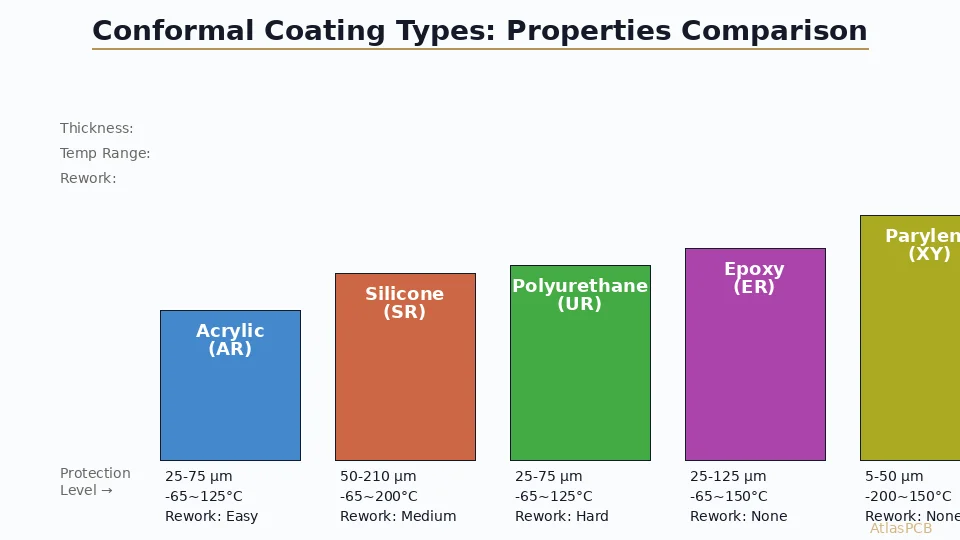
Conformal coating is a thin protective layer (25-75μm) applied over assembled PCBs to protect against moisture, dust, chemicals, and temperature extremes. Common types include acrylic (AR), silicone (SR), polyurethane (UR), and epoxy (ER), each with different protection levels and reworkability.
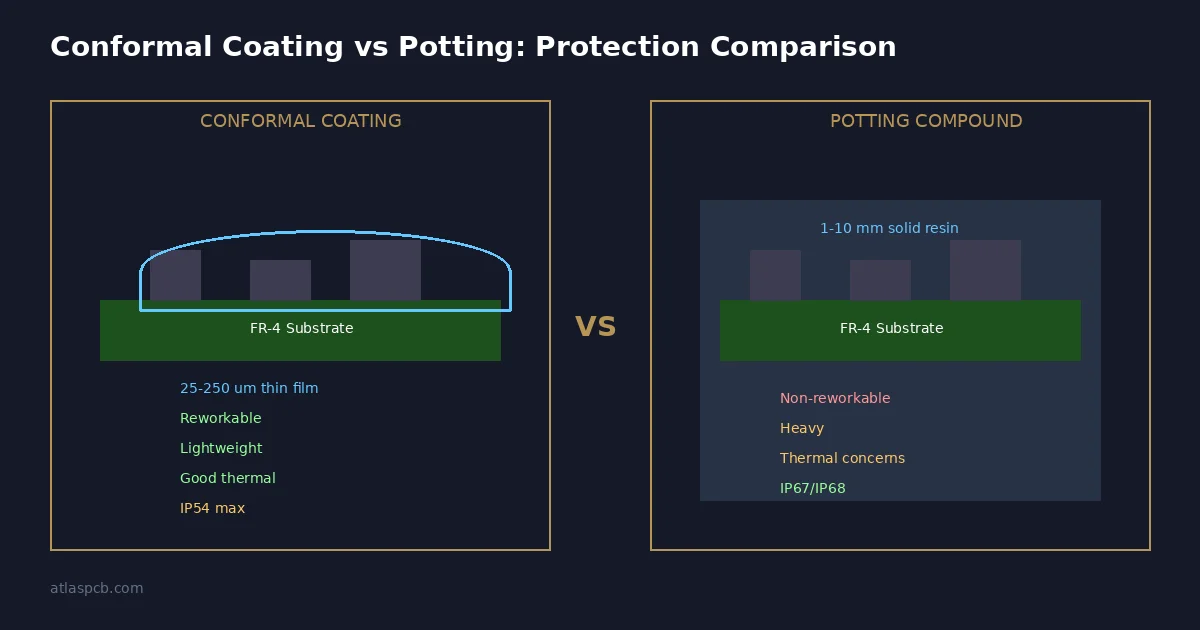
Conformal coating is a thin protective film applied to assembled PCBs to shield them from moisture, dust, chemicals, and temperature extremes. For products operating in harsh environments, it’s the difference between years of reliable operation and premature failure.
Why Conformal Coating?
Uncoated PCBs are vulnerable to:
- Moisture: Causes electrochemical migration, corrosion, and insulation breakdown
- Dust/contamination: Conductive particles cause short circuits
- Chemical exposure: Flux residues, cleaning agents, industrial chemicals
- Thermal shock: Rapid temperature changes cause condensation
- Salt spray: Coastal and marine environments corrode exposed copper
Coating Types Compared
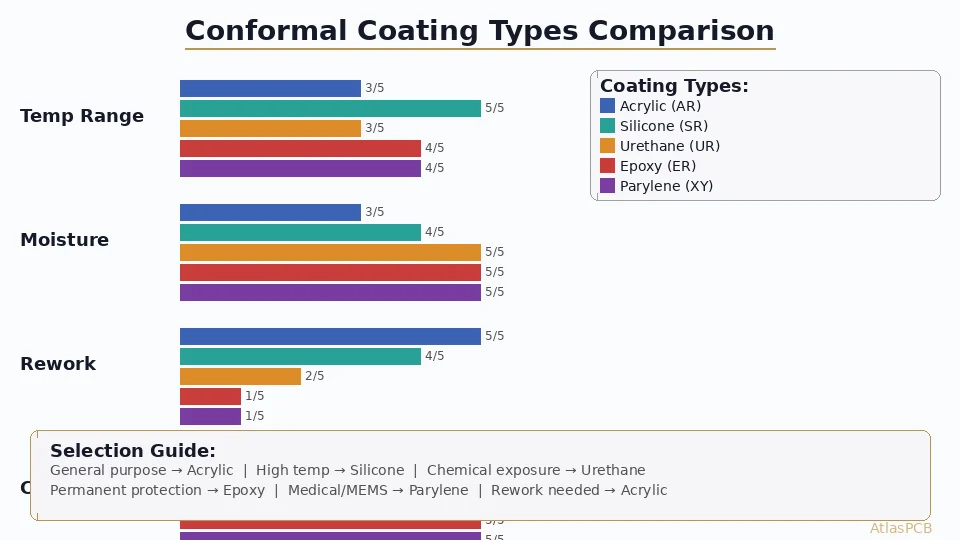
| Property | Acrylic (AR) | Silicone (SR) | Urethane (UR) | Epoxy (ER) | Parylene (XY) |
|---|---|---|---|---|---|
| Moisture resistance | Good | Excellent | Excellent | Excellent | Excellent |
| Chemical resistance | Fair | Good | Excellent | Excellent | Excellent |
| Temperature range | -65 to +125°C | -65 to +200°C | -65 to +125°C | -65 to +150°C | -65 to +200°C |
| Reworkability | Easy | Moderate | Difficult | Very difficult | Very difficult |
| Thickness | 25-75um | 50-200um | 25-75um | 25-50um | 5-25um |
| Application | Spray/dip | Spray/dip | Spray/dip | Brush/dip | Vapor deposition |
| Cost | Low | Medium | Medium | Low | High |
| Cure time | Minutes (UV) | Hours (heat) | Hours (moisture) | Hours (heat) | Hours (vacuum) |
Acrylic (AR) — Most Popular
Easy to apply and rework (dissolves in solvent). Good all-around protection. Ideal for consumer and industrial products where rework may be needed.
Silicone (SR) — Best for Temperature
Excellent flexibility and wide temperature range. Best for automotive under-hood and outdoor equipment. Soft coating doesn’t stress solder joints during thermal cycling.
Urethane (UR) — Best Chemical Resistance
Excellent resistance to solvents and chemicals. Hard, abrasion-resistant coating. Ideal for industrial and chemical environments.
Parylene (XY) — Best Overall Protection
Vapor-deposited at molecular level — uniform coverage even on sharp edges and tight spaces. Thinnest coating with best protection. Ideal for medical implants, military, aerospace. Most expensive.
Application Methods
Spray Coating
- Manual or automated spray booth
- Most common method for production
- Masking required for connectors and test points
- Thickness control: +/-15um achievable
Selective Coating (Robot)
- Programmable dispensing robot applies coating only where needed
- No masking required — saves time and labor
- Best for high-volume production
- Precise edge definition
Dip Coating
- Entire board immersed in coating material
- Uniform coverage on all surfaces
- Requires masking of connectors and areas that must remain uncoated
- Best for high-volume, simple board geometries
Vapor Deposition (Parylene only)
- Board placed in vacuum chamber
- Parylene dimer sublimated, pyrolyzed, and deposited at molecular level
- Most uniform coverage of any method
- No masking possible — must pre-mask or laser-ablate openings
Design Considerations
Keep-Out Areas
- Connectors (must remain uncoated for mating)
- Test points (for production testing)
- Switches and buttons
- LEDs (coating can dim output)
- Adjustment potentiometers
- Battery contacts
- Heat sinks (coating reduces thermal transfer)
Board Design for Coating
- Define coating and no-coat areas in assembly drawing
- Add solder mask dams around keep-out areas (helps contain coating)
- Consider test point accessibility (ICT fixtures may need coating removed)
- Mark coating boundaries in silkscreen for visual inspection
Standards and Testing
IPC-CC-830: Qualification of Conformal Coating
Defines test methods for evaluating conformal coatings:
- Insulation resistance after moisture exposure
- Thermal shock resistance
- Fungus resistance
- Flexibility
- Flammability
MIL-I-46058C (Legacy Military Standard)
Five coating types defined: AR, ER, SR, UR, XY. Still widely referenced.
Conclusion
Conformal coating is essential for any product operating outside of controlled indoor environments. Acrylic is the default choice for most applications due to its good protection, easy application, and reworkability. Silicone excels in extreme temperatures, urethane in chemical environments, and parylene for ultimate protection in medical and aerospace. Plan coating into your design from the start — defining keep-out areas and test access points early avoids expensive redesigns later.
Further Reading
[PCB Solder Mask: Types, Colors, and Functions Explained]/blog/pcb-solder-mask-guide/)
[IPC Class 3 Requirements: The Complete Guide for Designers]/blog/ipc-class-3-requirements/)
About AtlasPCB — We specialize in complex PCB manufacturing for HDI, RF, and high-reliability applications. Explore our full PCB manufacturing capabilities, or get an instant online quote . Every order includes free engineering review. Get your quote.
Reviewed by AtlasPCB Engineering Team — IPC-certified manufacturing specialists with 15+ years of production experience in HDI, RF, and high-reliability PCB fabrication. Content based on factory floor data and real customer design reviews.
Frequently Asked Questions
What is conformal coating on a PCB?
Which conformal coating type is best?
- conformal coating
- pcb protection
- reliability
- harsh environment