· News · 5 min read
PCB Supply Chain Under Dual Pressure: AI Hardware Demand and Shipping Route Disruptions Drive Material Shortage and Price Increases
A convergence of AI-driven demand for high-end PCB substrates and ongoing shipping disruptions through West Asian routes is creating material shortages and price pressure across the PCB industry. Here is what hardware teams need to know about current lead times and how to protect project schedules.
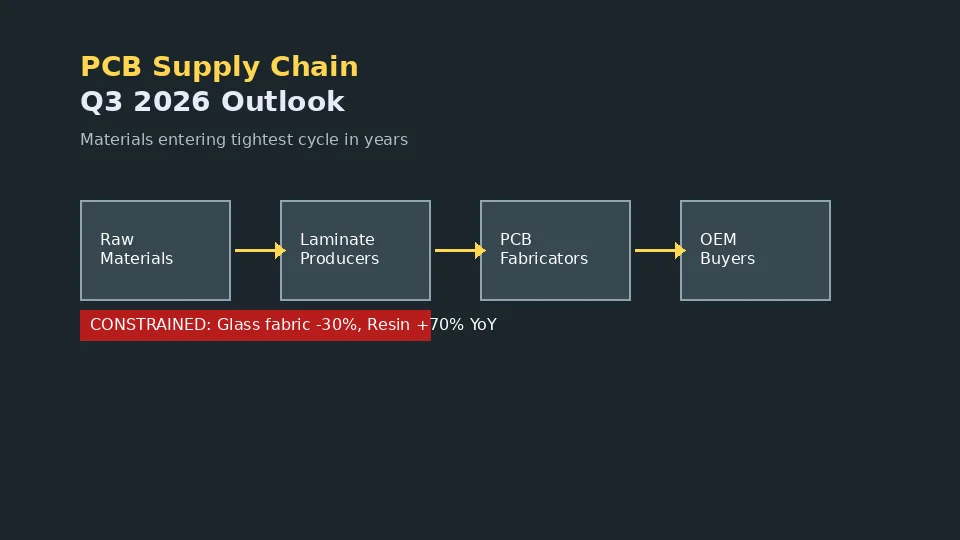
The PCB industry is experiencing a structural supply squeeze in mid-2026, driven by two simultaneous forces: accelerating demand for advanced substrates used in AI server hardware, and persistent shipping route disruptions affecting raw material logistics through key trade corridors. The result is material price increases across multiple substrate grades and extended lead times that affect projects from prototype through volume production.
What Is Happening
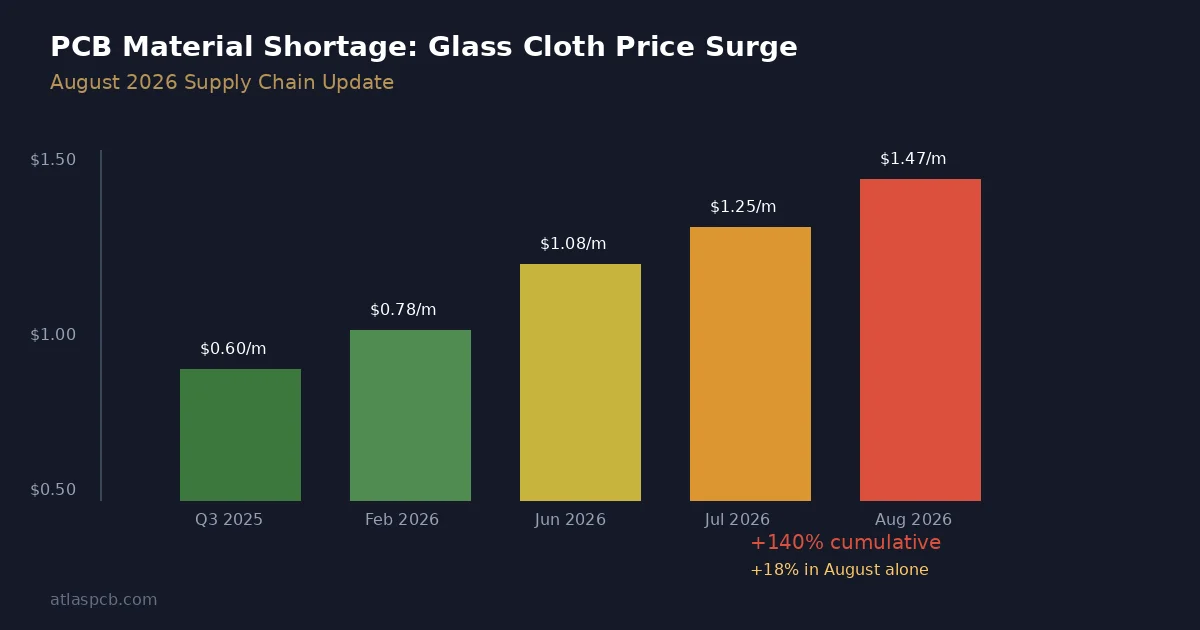
Multiple industry sources confirm that copper-clad laminate (CCL) pricing has increased significantly in 2026, with high-performance grades (the low-Dk/Df laminates used in AI server and high-speed networking boards) seeing the sharpest increases. Standard FR-4 has not been spared — as laminate manufacturers redirect production capacity toward higher-margin AI server substrates, allocation for commodity grades has tightened.
The Economic Times reported on August 2 that the combination of AI hardware demand, rising material costs, and supply chain disruptions in key shipping routes has triggered a printed circuit board shortage affecting the broader electronics industry. Component diversion toward high-end AI hardware is creating downstream pressure on PCB availability for industrial, automotive, and consumer applications.
Separately, the PCEA (Printed Circuit Engineering Association) August 2026 issue dedicated its cover to the AI server boom’s impact on PCB manufacturing, noting that “the relentless surge in demand for AI servers continues to drive a huge call for materials and components” and questioning whether manufacturing capacity can scale to meet growing demand.
The AI Demand Driver
The mechanism is straightforward but its scale is unprecedented. AI server motherboards and networking equipment require:
- High-layer-count HDI boards (20-30 layers with sequential lamination)
- Ultra-low-loss laminates (Megtron 6/7, Panasonic high-speed grades, Isola Astra MT77)
- Substrate-like PCBs for HBM interposer and GPU package substrates
- High-speed backplane boards with controlled impedance at 112 Gbps PAM4
These boards consume disproportionate amounts of material per unit area (more layers, thicker copper, premium laminates) and require manufacturing capacity that displaces production of simpler boards. When a fabricator allocates a lamination press for a 30-layer AI server board requiring three sequential lamination cycles, that press is unavailable for six standard 4-layer FR-4 boards during the same production window.
The foundry-level pricing increases compound the effect. Samsung Foundry and TSMC have both announced wafer price increases (approximately 15% and 5-10% respectively), which flow through to IC costs and further incentivize board-level cost reduction through manufacturing consolidation — putting more demand pressure on capable PCB fabricators.
The Shipping Route Factor
Ongoing disruptions in West Asian shipping routes continue to affect raw material logistics. Key PCB materials — copper foil, glass fiber cloth, and specialty resins — move through trade corridors that include Red Sea and Gulf routes. Extended shipping times and increased freight costs add both time and cost to the material supply chain.
For PCB fabricators sourcing materials from multiple regions, these logistics constraints translate to:
- Longer raw material replenishment cycles
- Higher inventory carrying costs (which get passed to customers)
- Reduced ability to accept rush orders when material buffers are depleted
- Occasional production delays when specific laminate grades are temporarily unavailable
Current Impact on Lead Times
Based on industry reports and our own supply chain observations, approximate lead time impacts as of August 2026:
Standard FR-4 (TG150/TG170):
- Prototype (1-5 boards): Minimal impact, 5-7 day lead times maintained from in-stock material
- Production (100+ boards): Add 3-5 days versus Q1 2026 baselines for material procurement
High-speed laminates (Megtron 6, Isola I-Tera):
- Prototype: 10-14 days (previously 7-10)
- Production: 18-25 days (previously 12-18)
Rogers/PTFE RF substrates:
- Stable — Rogers maintains strong inventory management and these are less affected by AI demand
HDI with sequential lamination:
- 1-step: Add 2-3 days for material
- 3+ step: Add 5-7 days due to premium prepreg availability
How to Protect Your Project Schedule
For hardware teams planning builds in Q3-Q4 2026, several strategies mitigate supply chain risk:
Lock in material early. If you know your stackup and layer count, inform your fabricator before finalizing layout. Many fabricators (including AtlasPCB) can pre-order laminate based on preliminary specifications, securing allocation before your Gerber files are ready.
Accept equivalent material grades. Specify acceptable alternatives in your fabrication notes. If your design requires “TG170 FR-4” rather than a specific brand, your fabricator has multiple sourcing options. Insisting on a single laminate brand (e.g., only Shengyi S1000-2M, no alternatives) may create unnecessary delays.
Consider hybrid stackups for high-speed designs. Rather than all-Megtron construction (which faces the tightest supply), consider hybrid stackups that place premium material only on signal layers while using standard high-Tg FR-4 on power and ground planes. This reduces premium material consumption by 40-60% while maintaining signal integrity where it matters.
Consolidate with integrated fabricators. Fabricators who maintain direct relationships with laminate manufacturers (rather than sourcing through distributors) have better visibility into allocation and shorter replenishment cycles. Ask your fabricator about their material supply chain structure.
AtlasPCB Material Position
We maintain rolling stock agreements with multiple CCL suppliers (Shengyi, ITEQ, Ventec, and Rogers) that provide allocation guarantees across our standard material portfolio. For standard FR-4 and high-Tg grades, our current inventory supports prototype orders with no additional lead time impact. For high-speed and specialty grades, we provide material availability confirmation within 24 hours of inquiry.
If you are planning a production build on premium laminates (Megtron, Isola Astra, or multi-step HDI), contact our engineering team early in your design cycle. We can confirm material availability and lock in allocation before your design is complete, eliminating supply uncertainty from your project timeline.
Sources: Economic Times (August 2, 2026), PCEA Magazine (August 2026), GlobX Supply Chain Analysis (mid-2026), TrendForce semiconductor pricing data.
About AtlasPCB — We specialize in complex PCB manufacturing for HDI, RF, and high-reliability applications. Explore our quick-turn PCB manufacturing from 24 hours, or get an instant online PCB quote . Every order includes free engineering review. Get your quote.
Reviewed by AtlasPCB Engineering Team — IPC-certified manufacturing specialists with 15+ years of production experience in HDI, RF, and high-reliability PCB fabrication. Content based on factory floor data and real customer design reviews.
- PCB supply chain
- PCB material shortage
- AI server PCB
- CCL pricing
- PCB lead time
- supply chain disruption