· Sophia Reyes · News · 4 min read
I-Connect007 May 2026
The May 2026 issue of I-Connect007 PCB magazine focuses on how additive processes affect signal integrity — highlighting the convergence of manufacturing innovation and high-speed design requirements.

May 2026 Issue Explores Critical Manufacturing-Design Interface
The May 2026 issue of I-Connect007’s flagship PCB magazine brings a focused examination of how additive metallization processes directly impact signal integrity — a topic that sits at the increasingly critical intersection of manufacturing capability and high-speed design performance.
The issue’s editorial theme, “Signal Integrity & Metallization,” reflects growing industry recognition that copper deposition methods have measurable effects on insertion loss, impedance consistency, and high-frequency performance. This is particularly relevant as PCB designs push into 56+ Gbps per lane data rates where every manufacturing variable becomes electrically significant.
Source: I-Connect007, PCB Magazine, May 2026
Key Topics Covered
Additive processes and signal consequences
Columnist Marcy LaRont’s analysis, “Additive Processes, Signal Consequences” (May 19, 2026), examines how different metallization techniques produce copper with different grain structures, surface roughness profiles, and adhesion characteristics — all of which directly affect high-frequency signal propagation.
Key findings highlighted:
- Surface roughness variation: Different plating chemistries produce Rz values from 0.8 to 4.0 μm — a 5× range that translates to up to 0.5 dB/inch insertion loss difference at 28 GHz
- Grain structure effects: Electroplated copper grain orientation affects skin-effect losses differently than electroless deposits
- Adhesion vs. performance trade-off: Higher adhesion (rougher profiles) correlates with higher loss, creating design optimization challenges
Direct metallization advances
Carmichael Gugliotti of MacDermid Alpha Electronics Solutions presents direct metallization as a strategic manufacturing direction, arguing it enables fabricators to better serve AI infrastructure, HPC, and EV applications while improving environmental footprint.
PCB East 2026 takeaways
Coverage of PCB East 2026 confirms that “AI infrastructure, increasing power density, and growing system complexity” are the primary drivers reshaping the industry — extending well beyond semiconductor advances alone.
Industry Implications
The convergence of signal integrity and metallization isn’t academic. It has practical consequences:
Material-process matching: Low-loss laminates (Megtron 7, TU-872 SLK) deliver their advertised Df values only when paired with compatible metallization processes. The wrong copper treatment can negate expensive material investments.
Specification tightening: OEMs are beginning to specify copper roughness profiles in fabrication drawings — not just copper weight — as data rates increase.
Manufacturing qualification: Fabricators serving high-speed applications need validated data showing their specific process achieves target insertion loss — not just theoretical values from laminate datasheets.
Design-fab collaboration: Engineers designing for 112 Gbps PAM4 must understand their fabricator’s metallization process to create accurate channel simulations.
What This Means for High-Speed PCB Buyers
For engineers designing boards with data rates above 25 Gbps per lane:
- Ask your fabricator about copper profile: Request Rz measurement data for their standard process
- Specify profile requirements: For critical channels, specify maximum Rz (e.g., “HVLP ≤1.5 μm Rz”)
- Validate with coupon testing: Include stripline insertion loss coupons on production panels
- Consider process impact on simulation: Use measured (not assumed) copper roughness in SI modeling
Understanding the trade-offs
The signal integrity-metallization relationship creates a design triangle:
Adhesion ↔ Loss ↔ Cost
- Higher adhesion requires rougher copper profiles (better reliability, higher loss)
- Lower loss requires smoother copper (better performance, potential adhesion concerns)
- Advanced low-profile treatments (VLP, HVLP) balance both but cost 15-30% more
For 28+ GHz applications (5G mmWave, radar, satellite), the difference between standard oxide treatment (Rz 3-4 μm) and HVLP (Rz 1.0-1.5 μm) can mean 0.8-1.2 dB/inch difference in insertion loss — the difference between a working link budget and a failed one.
The emerging specification trend
Leading OEMs are now including these specifications in their PCB fabrication drawings:
COPPER ROUGHNESS REQUIREMENT:
- Signal layers (impedance-controlled): Rz ≤ 2.0 μm (HVLP treatment)
- Power/ground planes: Standard oxide (Rz ≤ 4.0 μm)
- Measurement method: IPC-TM-650, 2.2.17 (profilometer)
- Report: Include copper roughness test coupon per panel
This trend will likely become standard practice for all high-speed designs within 2-3 years as data rates continue increasing.
Also in This Issue
Other notable coverage from the May 2026 edition:
- PCB East 2026 recap: AI infrastructure driving unprecedented demand for advanced PCB technology, thermal management, and high-density interconnect
- FCC “China lab ban” clarification: James Kim separates fact from fear, confirming most PCB testing is unaffected by recent regulatory changes
- UV curable conformal coatings book release: New publication by Dow engineers Brian Chislea and Cody Schoener explores next-generation coating technologies
- Taiwan TPCA AI knowledge base launch: Taiwan’s PCB industry association creates AI-specific knowledge platform for fabricators
- Active PCB market analysis: Industry remains active with “high-value activity flowing through” in AI, defense, and automotive segments
At AtlasPCB, we understand that metallization quality directly impacts signal integrity performance. Our high-speed PCB manufacturing process achieves controlled copper roughness profiles compatible with 56+ Gbps designs. We provide insertion loss test data and TDR measurements for critical applications. Get a quote for your high-speed design.
Further Reading
- Eye Diagram Interpretation for PCB Signal Integrity
- High-Speed PCB Material Dk/Df Comparison
- Differential Impedance for PCIe Gen5 and DDR5
- RF Transmission Line Loss Budgeting
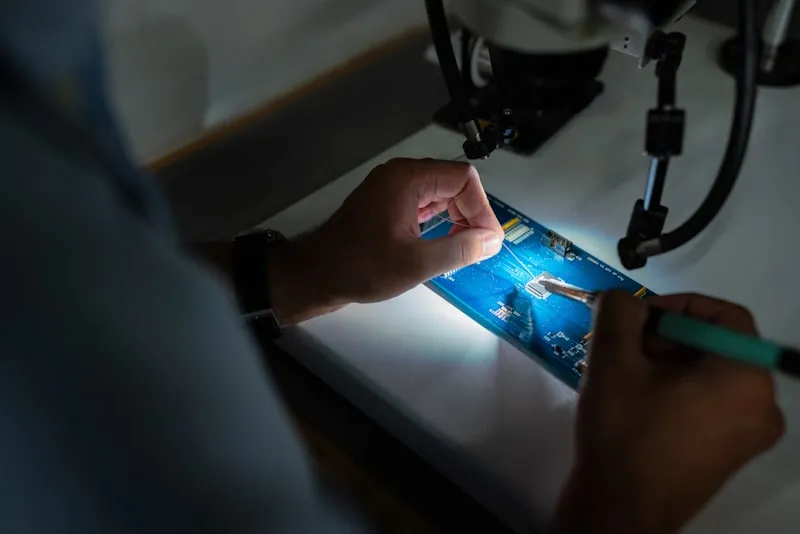
Image: ThisisEngineering via Unsplash
About AtlasPCB — We specialize in complex PCB manufacturing for HDI, RF, and high-reliability applications. Explore our impedance-controlled PCB manufacturing, or get an Megtron 6 & 7 low-loss PCB manufacturing . Every order includes free engineering review. Get your quote.
Reviewed by AtlasPCB Engineering Team — IPC-certified manufacturing specialists with 15+ years of production experience in HDI, RF, and high-reliability PCB fabrication. Content based on factory floor data and real customer design reviews.
- news
- signal integrity
- additive metallization
- I-Connect007
- PCB industry
- high-speed design
- manufacturing trends
- 2026