· Priya Nair · Engineering · 6 min read
How to Specify Via-in-Pad for BGA Fanout
Complete DFM guide for specifying via-in-pad (VIPPO) on your PCB fab drawing. Covers hole sizes, plating fill requirements, cap plating thickness, IPC-4761 types, and the exact callouts your fabricator needs to build it right the first time.
Quick Answer
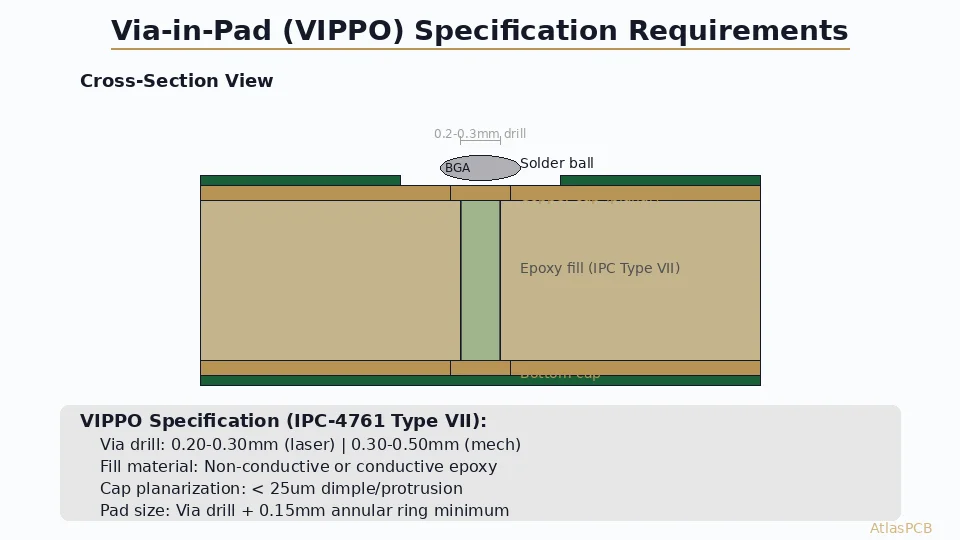
To correctly specify via-in-pad, your fab drawing must call out IPC-4761 Type VII (filled and capped), state maximum dimple depth (typically less than 1 mil or 25 micrometers), specify via drill diameter (0.1-0.15mm for microvias, 0.2-0.3mm for mechanical drill), and require copper cap plating thickness of 0.5-1.0 mil minimum over the fill.
Quick Answer: Via-in-Pad Fab Drawing Callout
Your fab drawing note should include all of these for via-in-pad pads:
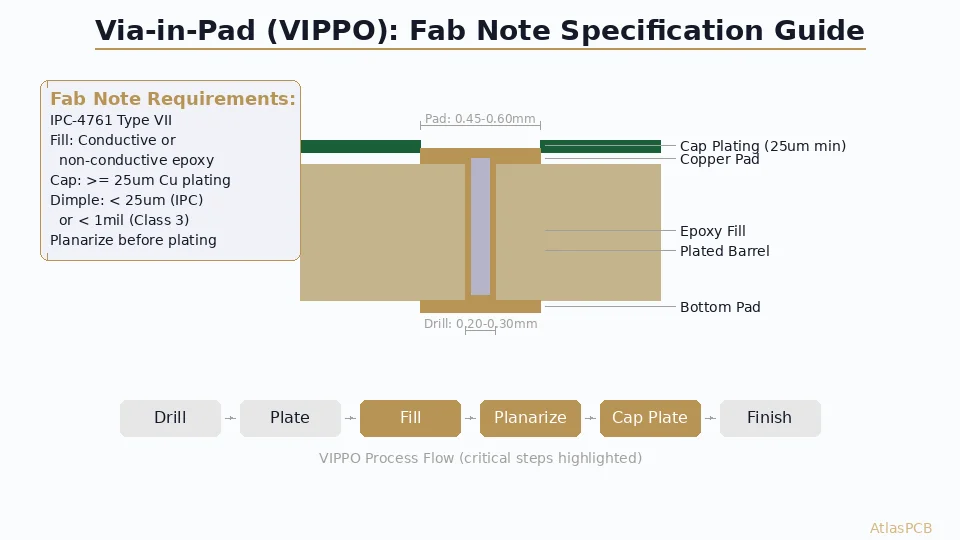
VIA-IN-PAD REQUIREMENTS (IPC-4761 Type VII):
- Via fill: Non-conductive epoxy per IPC-4761 Type VII
- Cap plating: Min 0.5 mil (12.7 μm) copper over fill
- Surface dimple: Max 1.0 mil (25 μm) concavity or convexity
- Surface finish applied over cap plating
- Via drill: [specify diameter] mm
- Applicable pads: [list reference designators or note "all BGA pads"]
If your fabricator asks “do you want filled vias?” — this is what they need from you.
Why Via-in-Pad Matters for BGA Routing
Standard dog-bone fanout (via adjacent to pad) works for BGAs down to 0.8mm pitch. Below that, there is no physical room for a via plus trace between adjacent pads.
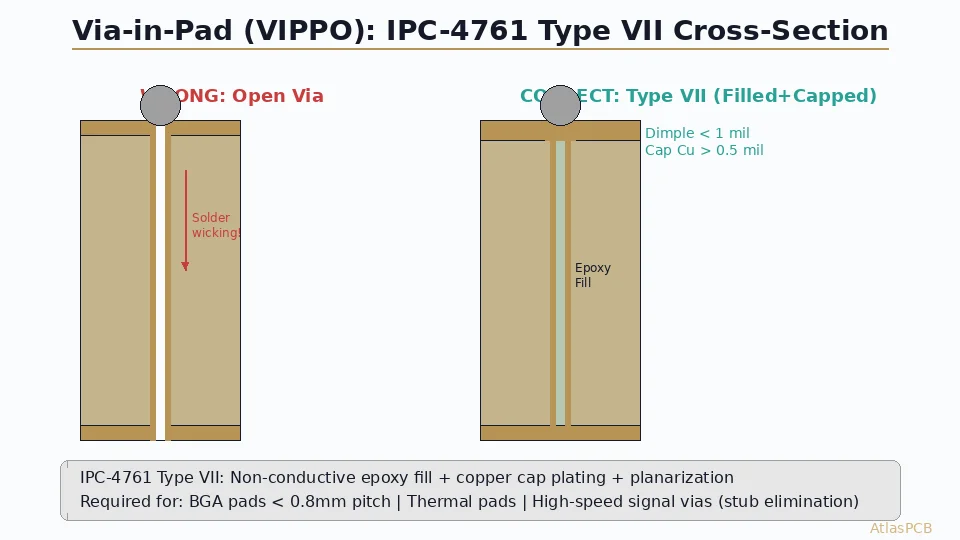
Via-in-pad places the via directly inside the BGA pad, eliminating the dog-bone stub and giving you:
- Direct vertical connection from BGA ball to inner layer
- No via stub resonance (critical above 10 GHz)
- Shorter current path for power/ground
- Denser routing capability for 0.4-0.65mm pitch BGAs
The trade-off: your fabricator needs explicit DFM specs or they may process the vias incorrectly, leading to solder voiding, pad cratering, or assembly defects.
DFM REVIEW INCLUDED
We Check Your Via-in-Pad Specs Before Fabrication
AtlasPCB engineers review BGA pad definitions, via sizes, and fill requirements as part of every HDI order to prevent assembly issues.
Upload Gerber ›
Complete DFM Parameter Table
| Parameter | Standard Requirement | High-Reliability Requirement |
|---|---|---|
| Fill material | Non-conductive epoxy | Per IPC-4761 Type VII |
| Cap plating Cu thickness | Min 0.5 mil (12.7 μm) | Min 0.8 mil (20 μm) |
| Max dimple (concavity) | 1.0 mil (25 μm) | 0.5 mil (12.7 μm) |
| Max protrusion (convexity) | 1.0 mil (25 μm) | 0.5 mil (12.7 μm) |
| Via drill (microvia) | 0.075-0.15 mm | 0.1 mm typical |
| Via drill (mechanical) | 0.2-0.3 mm | 0.2-0.25 mm |
| Aspect ratio limit | 0.8:1 (laser), 8:1 (mech.) | 0.6:1 (laser), 6:1 (mech.) |
| Pad diameter over via | Via + 6 mil min annular ring | Via + 8 mil min |
| Surface finish over cap | Any (ENIG, ImAg, OSP) | ENIG recommended |
Step-by-Step: How to Specify Via-in-Pad in Your Design
Step 1: Identify Which Pads Need Via-in-Pad
Not every via needs filling. Focus on:
- BGA pads where pitch prevents dog-bone routing (less than 0.8mm)
- Thermal pads (exposed pads) on QFN/DFN packages
- High-speed signal vias where stub resonance must be eliminated
- Power vias under large ICs where thermal resistance must be minimized
Step 2: Choose Via Size Based on Pitch
| BGA Pitch | Pad Diameter | Max Via Drill | Via Type |
|---|---|---|---|
| 1.0 mm | 0.5 mm | 0.3 mm | Mechanical |
| 0.8 mm | 0.4 mm | 0.25 mm | Mechanical |
| 0.65 mm | 0.35 mm | 0.2 mm | Mechanical |
| 0.5 mm | 0.25 mm | 0.15 mm | Laser microvia |
| 0.4 mm | 0.2 mm | 0.1 mm | Laser microvia |
Step 3: Specify in Your Fab Drawing
Include these exact notes on your fabrication drawing (Layer 0 or dedicated fab notes layer):
Note 1 — Via Fill Requirement:
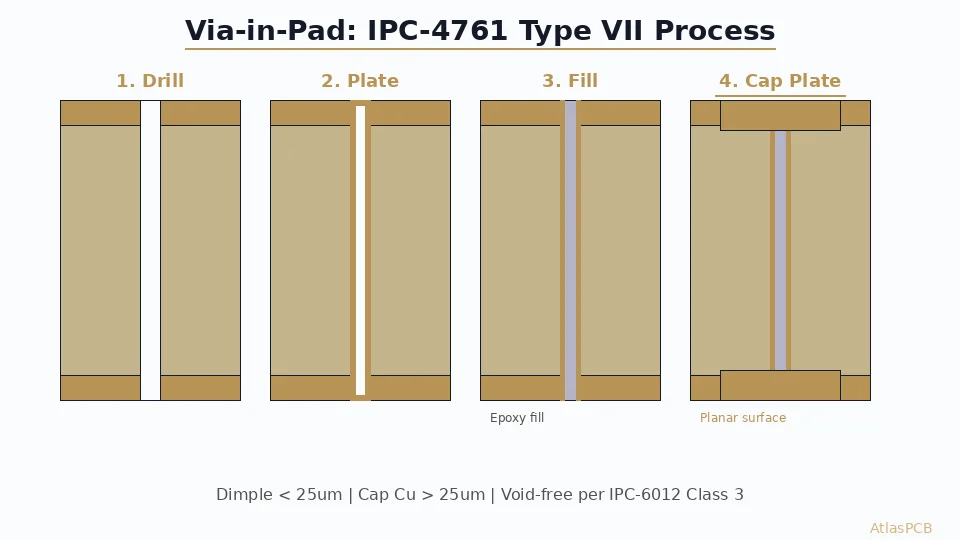
“All vias located within SMD pads (via-in-pad) shall be filled with non-conductive epoxy and planarized per IPC-4761 Type VII. Maximum surface dimple shall not exceed 25 micrometers (1.0 mil) concavity or convexity after cap plating.”
Note 2 — Cap Plating:
“Minimum 12.7 micrometers (0.5 mil) copper cap plating required over filled vias before surface finish application.”
Note 3 — Via Identification:
“Via-in-pad locations identified by [choose one]: all vias within SMD pad boundaries / drill chart callout / fab drawing detail view.”
Step 4: Verify Your Stackup Supports It
Common mistakes:
- Via drill too large for pad (annular ring violation after registration)
- Aspect ratio exceeding fab capability (0.3mm drill through 3.2mm board = 10.6:1)
- Forgetting that cap plating adds copper thickness to pad (affects solder paste volume)
HDI CAPABILITY
Laser Drill Down to 0.075mm
AtlasPCB supports via-in-pad with both laser microvias and mechanical drills. Up to 5+N+5 HDI buildup with stacked and staggered configurations.
View HDI Services ›Common DFM Mistakes to Avoid
Mistake 1: Not specifying dimple tolerance
Problem: Your fabricator fills vias but doesn’t planarize sufficiently. Result: 3-4 mil dimple causes solder paste print defects and BGA voiding above 25%.
Fix: Always specify maximum dimple in your fab notes. Standard: 1 mil. High-reliability: 0.5 mil.
Mistake 2: Via too close to pad edge
Problem: Registration tolerance causes via to break out of pad boundary. Exposed copper fill has no solderable surface finish.
Fix: Ensure minimum 3 mil (75 μm) annular ring from via edge to pad edge, accounting for drill registration tolerance (typically +/- 2 mil for mechanical, +/- 1 mil for laser).
Mistake 3: Forgetting thermal relief on power planes
Problem: Via-in-pad on power pins connected with full copper pour. During reflow, massive thermal mass prevents proper solder melting on that pad.
Fix: Use thermal relief on internal power connections for via-in-pad BGA pads, or discuss with your assembly house for adjusted reflow profiles.
Mistake 4: Specifying conductive fill without thermal need
Problem: Conductive epoxy fill costs 2-3x more than non-conductive fill and has no benefit for signal vias.
Fix: Use non-conductive fill for signal and I/O vias. Reserve conductive fill only for thermal vias under power components where thermal conductivity through the via is critical.
AVOID COSTLY RESPINS
Submit Your Design for DFM Check
We flag via-in-pad issues, annular ring violations, and aspect ratio problems before fabrication starts.
Get DFM Feedback ›IPC-4761 Via Protection Types Reference
| Type | Description | Use Case |
|---|---|---|
| I | Tented (covered with dry film) | Non-critical vias |
| II | Tented and covered (soldermask both sides) | Standard through-hole |
| III | Plugged (non-conductive paste, not planarized) | General SMD proximity |
| IV | Plugged and covered | Better plug, still not flat |
| V | Filled (conductive or non-conductive, planarized) | Thermal vias |
| VI | Filled and covered | Enhanced fill protection |
| VII | Filled and capped (planarized + copper cap) | Via-in-pad (VIPPO) |
Type VII is what you need for via-in-pad. Anything less risks assembly defects under BGA pads.
ATLASPCB
Ready to Order HDI Boards with Via-in-Pad?
Upload your Gerber files. We verify via-in-pad specs, stackup feasibility, and provide DFM feedback within 24 hours.
Get Instant Quote ›
Related Reading:
About AtlasPCB — We specialize in complex PCB manufacturing for HDI, RF, and high-reliability applications. Explore our HDI PCB manufacturing capabilities, or get an free engineering DFM review . Every order includes free engineering review. Get your quote.
Reviewed by AtlasPCB Engineering Team — IPC-certified manufacturing specialists with 15+ years of production experience in HDI, RF, and high-reliability PCB fabrication. Content based on factory floor data and real customer design reviews.
Frequently Asked Questions
What IPC standard covers via-in-pad?
What is acceptable dimple depth for via-in-pad?
What fill materials are used for via-in-pad?
Can regular mechanical drills be used for via-in-pad?
Does via-in-pad add cost?
- via-in-pad
- DFM
- BGA fanout
- PCB fabrication
- VIPPO