· Marcus Lin · Engineering · 10 min read
RF PCB Cost Breakdown
Detailed pricing analysis of RF PCB fabrication costs, breaking down material, processing, tolerance, and testing surcharges. Covers Rogers RO4350B, RT/duroid, Taconic, and Megtron pricing with optimization strategies for budget-conscious RF engineers.
Quick Answer
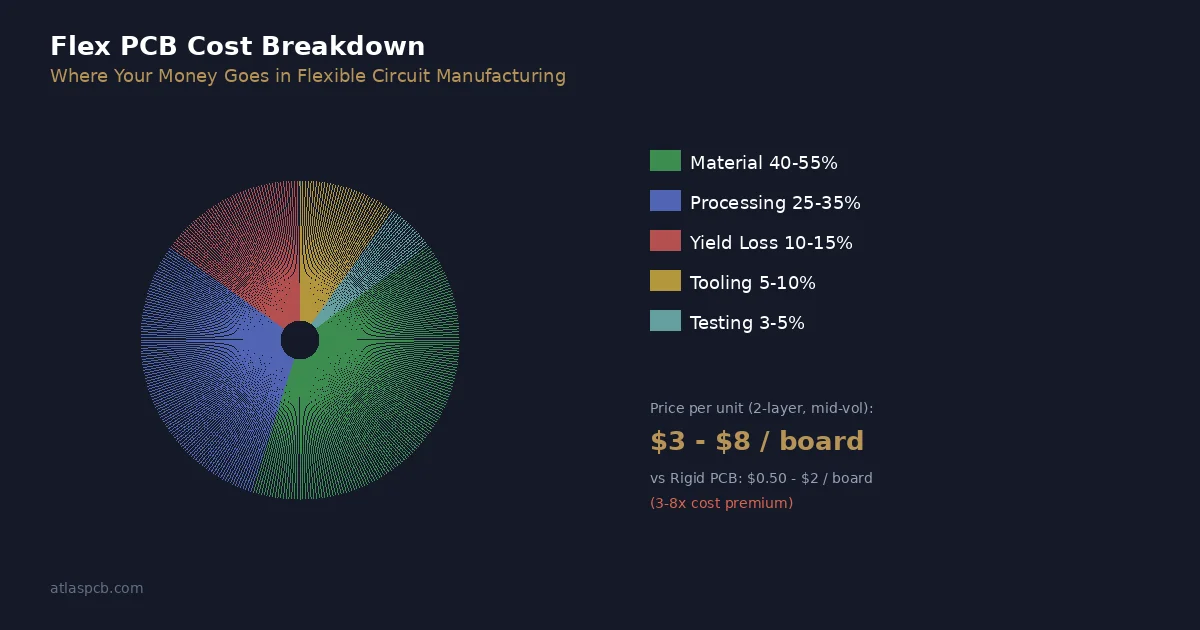
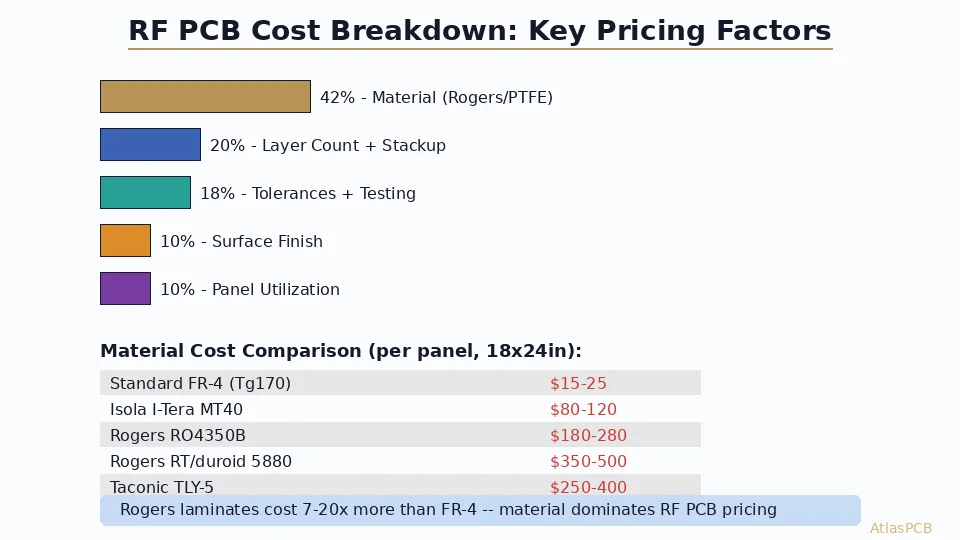
RF PCB fabrication costs 3-15x more than equivalent FR-4 boards, with material accounting for 40-55% of the total price. Rogers RO4350B panels cost $180-280 versus $15-25 for standard FR-4 (a 7-12x premium), and this material cost cascades through every processing step because scrap of expensive laminate is far more costly than scrap of FR-4.
Quick Answer: RF PCB Price Ranges by Material
| Material System | Cost vs FR-4 | Panel Cost (18x24”) | Typical Board Cost (50x50mm, 4L) | Best For |
|---|---|---|---|---|
| Standard FR-4 (Tg170) | 1x (baseline) | $15-25 | $8-15 (proto) | Digital only |
| Isola I-Tera MT40 | 4-6x | $70-110 | $35-65 (proto) | 10-25 Gbps digital |
| Rogers RO4350B | 7-12x | $180-280 | $80-150 (proto, hybrid) | 1-10 GHz RF |
| Rogers RO3003 | 10-15x | $250-380 | $120-220 (proto) | 10-40 GHz |
| Taconic TLY-5 | 10-14x | $250-400 | $110-200 (proto) | Antenna, mmWave |
| Rogers RT/duroid 5880 | 15-22x | $350-500 | $180-350 (proto) | 40+ GHz, satellite |
The cost reality: Material alone accounts for 40-55% of your RF PCB price. Everything else — drilling, etching, plating, testing — totals less than the laminate cost. This is why material selection is the single biggest lever for RF PCB cost optimization.
Breaking Down the 42%: Why Material Dominates RF PCB Pricing
In standard FR-4 fabrication, raw material represents 15-25% of the finished board cost. Labor, equipment amortization, and overhead dominate the price structure. This ratio inverts completely for RF laminates, and understanding why reveals the pricing logic behind every RF PCB quotation.
Rogers Corporation and other RF laminate manufacturers produce materials using fundamentally different chemistry than FR-4. Where FR-4 is woven fiberglass cloth impregnated with commodity epoxy resin (available from dozens of global suppliers at $5-8/kg), RF laminates use engineered ceramics (aluminum oxide, titanium dioxide), PTFE-based resins, or hydrocarbon polymer systems with precisely controlled dielectric properties. Rogers RO4350B, for example, uses a proprietary thermoset hydrocarbon/ceramic filler system that achieves Dk of 3.48 with a tolerance of +/-0.05 — a manufacturing precision that standard FR-4 does not even attempt to specify.
The raw material cost for these engineered dielectrics is $80-200 per square meter versus $8-15 per square meter for standard FR-4 prepreg. Panel utilization compounds this: an 18x24 inch manufacturing panel yields perhaps 20-40 boards for a typical 50x50mm RF design. When the panel material costs $250 versus $20, each individual board carries $6-12 in material cost versus $0.50-1.00 for FR-4 — a permanent cost floor that no amount of volume leverage can eliminate.
Furthermore, RF laminate scrap costs hurt disproportionately. In our facility, typical first-pass yield for complex multilayer boards runs 85-92%. On FR-4, scrapping 10% of panels costs $2-3 per panel. On Rogers RO4350B, the same 10% scrap rate costs $25-35 per panel. This risk premium gets priced into every RF quotation regardless of whether scrap actually occurs on your specific job — because the manufacturer must cover their statistical yield loss across all RF jobs.
We’ve found that approximately 30% of our RF PCB customers significantly overspend by specifying all-Rogers stackups when a hybrid approach would deliver identical electrical performance at 50-70% lower cost. The optimization opportunity is substantial for any design where RF traces exist on only one or two layers.
RF PCB SPECIALISTS
Get Accurate RF PCB Pricing in 24 Hours
Upload your RF design and we quote both full-Rogers and hybrid stackup options. Most customers save 30-50% with our hybrid recommendation.
Get RF PCB Quote ›
Processing Surcharges: The Hidden 20%
Beyond material, RF PCBs incur processing surcharges that don’t apply to standard FR-4 work. These add 15-25% to the non-material cost and are often poorly understood by designers receiving their first RF quotation.
PTFE handling premium (5-10% surcharge): Pure PTFE laminates (RT/duroid, TLY-5, and similar) require sodium-naphthalene etch treatment or plasma processing before copper can adhere to the surface. PTFE’s natural surface energy is so low that standard oxide treatment produces inadequate peel strength. This surface preparation step adds both chemical cost and processing time. Non-PTFE RF laminates (RO4350B, I-Tera, Megtron) do not require this treatment, which is one reason Rogers 4000-series laminates have become the default choice for designs below 20 GHz — they process with standard FR-4 compatible chemistry.
Tight impedance tolerance (3-7% surcharge): Standard PCBs specify +/-10% impedance tolerance, which allows normal manufacturing variation in trace width and dielectric thickness. RF designs at 5+ GHz typically require +/-5% or tighter, demanding tighter etch process control (target +/-0.3mil trace width variation instead of +/-0.5mil) and incoming dielectric thickness verification. Some manufacturers achieve this through 100% impedance testing rather than process control — the cost is similar either way.
Mixed-dielectric lamination (5-8% surcharge): Hybrid stackups with Rogers on outer layers and FR-4 cores require specialized lamination profiles. The cure temperature and pressure for bonding these dissimilar materials differs from standard FR-4 lamination, and the process window is narrower. Our lamination engineers use modified press cycles with slower ramp rates (1.5-2.0 C/minute versus 3-4 C/minute for all-FR-4) to prevent material stress at the Rogers/FR-4 interface. This longer cycle time reduces daily press output by 20-30%, which gets passed through as a surcharge.
RF-specific testing (2-5% surcharge): Beyond standard impedance verification, many RF designs require insertion loss testing, phase matching verification, or TDR measurements that go beyond the typical electrical test suite. Fixture-based RF testing for production quantities adds $500-2000 in NRE for test fixture fabrication.
Five Strategies to Reduce Your RF PCB Cost
Based on our experience quoting thousands of RF boards annually, these optimizations deliver the most consistent cost savings without compromising RF performance:
Strategy 1: Hybrid stackup design. If your RF traces exist on only layers 1 and 2, use Rogers for those layers and standard high-Tg FR-4 for inner power and ground planes. A typical 6-layer hybrid (2x RO4350B + 4x FR-4) costs 40-55% less than an all-Rogers 6-layer stackup while delivering identical RF performance because the electromagnetic fields on microstrip and stripline traces interact primarily with the immediately adjacent dielectric layers.
Strategy 2: Panel utilization optimization. RF laminates are expensive per square inch. Maximizing boards per panel reduces per-unit material cost proportionally. Work with your manufacturer to choose board dimensions that efficiently tile the manufacturing panel. A 48x48mm board might yield 35 pieces per panel, while a 50x50mm board on the same panel yields only 30 — a 17% cost difference from a 2mm dimensional change. Our quoting team automatically optimizes panelization for minimum waste on RF jobs.
Strategy 3: Consolidate RF testing. If your design uses coupled transmission lines (directional couplers, Wilkinson dividers, hybrid couplers), verify critical parameters on a test coupon rather than 100% board testing. A dedicated coupon with representative structures costs far less to test than probing every port on every board. For production of 100+ boards, this approach saves $5-15 per board in testing costs.
Strategy 4: Consider Isola I-Tera or Megtron for 1-10 GHz. Rogers RO4350B is the default recommendation for RF work, but for applications below 10 GHz where Df matters more than absolute Dk stability, Isola I-Tera MT40 or Megtron 6 offer comparable loss performance at 40-60% lower material cost. These materials also process with standard FR-4 chemistry (no PTFE handling premium).
Strategy 5: Design for standard dielectric thickness. Rogers RO4350B is stocked in 6.6mil (0.168mm), 10mil (0.254mm), 20mil (0.508mm), and 30mil (0.762mm) thicknesses. Non-standard thicknesses require special orders with 8-12 week lead times and minimum order quantities. Designing your impedance targets around stocked thicknesses ensures availability and avoids MOQ premiums.
COST-OPTIMIZED RF FABRICATION
We Stock Rogers RO4350B and RO4003C for Fast-Turn RF Boards
Standard thicknesses in stock for 5-day prototype delivery. Hybrid stackup engineering included with every RF quotation.
Get RF Pricing ›Volume Pricing: How Cost Scales from Prototype to Production
RF PCB pricing follows a steeper volume discount curve than standard FR-4 because fixed costs (material setup, lamination qualification, test fixture NRE) amortize over more units. Here is typical pricing progression for a representative 4-layer hybrid Rogers/FR-4 board (50x50mm, 2x RO4350B + 2x FR-4):
| Quantity | Price Per Board | vs Prototype | Notes |
|---|---|---|---|
| 5 pcs (prototype) | $95-130 | Baseline | Individual panel processing |
| 10 pcs | $70-95 | -25% | Panel sharing starts |
| 25 pcs | $50-70 | -40% | Full panel batch |
| 50 pcs | $38-55 | -55% | Multi-panel, setup amortized |
| 100 pcs | $28-42 | -65% | Production run pricing |
| 500 pcs | $18-28 | -75% | Volume material pricing kicks in |
| 1000+ pcs | $14-22 | -80% | Full production economics |
The sharpest price break occurs between 10 and 50 pieces, where panel utilization and setup amortization create a step-function cost reduction. For this reason, we typically recommend engineers order 20-30 prototypes if they are confident in the design — the per-unit cost at 25 pieces is often 40% lower than at 5 pieces, making the total expenditure only marginally higher while providing significantly more testing inventory.
At production volumes (500+), the Rogers material cost becomes the dominant and largely irreducible floor. At this stage, the only meaningful cost levers are panel utilization (board dimensioning), yield improvement (DFM optimization), and material grade substitution if electrical specifications allow.
RF PCB MATERIALS IN STOCK
Prototype to Production RF PCB Fabrication
Rogers RO4350B, RO4003C, RT/duroid 5880, and Taconic TLY-5 in standard thicknesses. Hybrid stackup engineering included with every quote.
Decision Framework: Choosing the Right RF Laminate for Your Budget
The laminate selection should be driven by operating frequency, loss budget, and cost sensitivity — in that priority order. Here is the decision logic our applications engineers use when helping customers optimize material selection:
Below 3 GHz: Standard high-Tg FR-4 (Dk 4.2-4.5) handles most applications adequately. The loss tangent of FR-4 (0.015-0.020) introduces acceptable insertion loss for trace lengths under 100mm. Save RF laminate budget for designs that actually need it.
3-10 GHz: Rogers RO4350B (Dk 3.48, Df 0.0037) or Isola I-Tera MT40 (Dk 3.45, Df 0.0031) provide the best price/performance ratio. Hybrid stackup with FR-4 inner layers is the standard approach. At this frequency range, the choice between Rogers and Isola is primarily commercial (pricing, lead time) rather than technical — both deliver comparable RF performance.
10-28 GHz: Rogers RO3003 (Dk 3.0, Df 0.0010) or Taconic TLY-5 (Dk 2.2, Df 0.0009) become necessary. At these frequencies, the Df difference between RO4350B (0.0037) and RO3003 (0.0010) translates to 3-4x less insertion loss per centimeter of trace. Hybrid stackups are still viable but require careful attention to the via transitions between Rogers and FR-4 layers.
Above 28 GHz (mmWave): Rogers RT/duroid 5880 (Dk 2.2, Df 0.0009) is the established standard. Material cost is high ($350-500 per panel) but there are no viable cheaper alternatives at 40+ GHz. Panel utilization and design miniaturization become the primary cost optimization tools.
ATLASPCB
Need Help Choosing the Right RF Material for Your Budget?
Submit your design with frequency requirements and budget target. Our RF applications engineers recommend the most cost-effective material and stackup combination.
Get Material Recommendation ›
Reviewed by AtlasPCB Engineering Team — 15+ years in advanced PCB fabrication for RF, HDI, and rigid-flex applications.
Related Reading:
About AtlasPCB — We specialize in complex PCB manufacturing for HDI, RF, and high-reliability applications. Explore our RF and high-frequency PCB services, Rogers RO4350B PCB manufacturing, or get an instant online PCB quote . Every order includes free engineering review. Get your quote.
Reviewed by AtlasPCB Engineering Team — IPC-certified manufacturing specialists with 15+ years of production experience in HDI, RF, and high-reliability PCB fabrication. Content based on factory floor data and real customer design reviews.
Frequently Asked Questions
How much does a Rogers 4350B PCB cost per board?
What is the cheapest RF laminate that works for 5G applications?
Can I mix Rogers and FR-4 in the same stackup to save cost?
Why do RF PCBs require tighter tolerances?
- RF PCB cost
- Rogers pricing
- high-frequency laminate
- PCB pricing
- RF design