· Marcus Lin · Engineering · 8 min read
Isola 370HR vs Panasonic Megtron 4
A practical comparison of Isola 370HR and Panasonic Megtron 4 (R-1755C) for mid-speed digital designs, covering Dk/Df, thermal reliability, cost, and real-world use cases.
Quick Answer
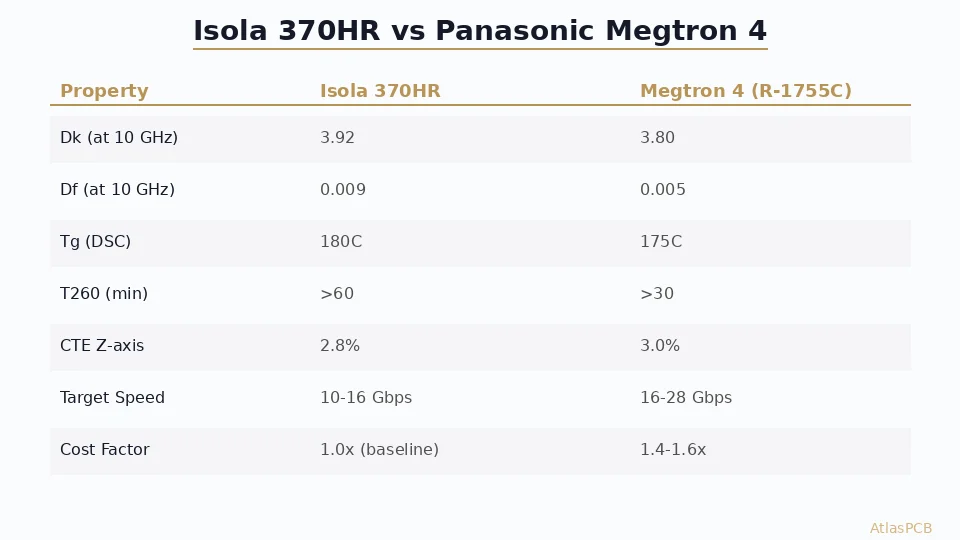
Choose Isola 370HR for 10-16 Gbps designs where thermal reliability (T260 >60 min) and cost matter most; choose Megtron 4 for 16-25 Gbps where Df of 0.005 at 10 GHz provides the extra insertion loss margin.
Quick Decision: 370HR or Megtron 4?
If your fastest interface runs at or below 16 Gbps NRZ and your channel length stays under 8 inches, Isola 370HR delivers the performance you need at roughly 60-70% of the cost of Megtron 4. If you are designing for 25GBASE-T Ethernet, PCIe Gen 5, or 400G optics with PAM4 signaling, Megtron 4’s dissipation factor of 0.005 at 10 GHz gives you the loss budget headroom that 370HR cannot.
| Parameter | Isola 370HR | Megtron 4 (R-1755C) |
|---|---|---|
| Dk at 10 GHz | 3.92 | 3.80 |
| Df at 10 GHz | 0.009 | 0.005 |
| Tg (DSC) | 180C | 175C |
| T260 endurance | >60 min | >30 min |
| CTE Z-axis (50-260C) | 2.8% | 3.0% |
| Target data rate | 10-16 Gbps NRZ | 16-28 Gbps NRZ/PAM4 |
| Relative cost | 1.0x (baseline) | 1.4-1.6x |
| Availability | Global, multi-source | Primarily APAC supply |
Signal Loss: The Engineering Difference
The performance gap between these two materials becomes tangible when you run actual channel simulations. On a 6-inch stripline at 12.5 GHz (the Nyquist frequency for 25 Gbps NRZ), 370HR introduces approximately 1.8 dB more insertion loss per trace than Megtron 4. That delta sounds modest in isolation, but in a system with multiple via transitions, connector interfaces, and package breakouts, those 1.8 dB represent the difference between a passing and failing eye diagram.
In our production line, we routinely build 370HR boards for networking equipment running 10G Ethernet and PCIe Gen 3/4 backplanes. The material handles these speeds without issue because the total channel loss budget at 5 GHz Nyquist is generous enough to accommodate Df of 0.009. Where we see engineers make mistakes is when they spec 370HR for a 25G retimer-to-QSFP channel that runs 12 inches — the eye closes completely at the receiver and no amount of equalization saves it.
Megtron 4 opens up design space precisely because its 45% lower Df translates directly to longer reach. Our SI team’s rule of thumb: every 0.004 reduction in Df buys you roughly 3 additional inches of channel length at 25 Gbps before you hit the receiver sensitivity wall.
HIGH-SPEED PCB MATERIALS
Not Sure Which Laminate Fits Your Design?
Our engineers review your stackup and recommend the optimal material for your data rate and budget.
Get Stackup Recommendation ›
Thermal Reliability: Where 370HR Has the Edge
Here is where 370HR genuinely outperforms Megtron 4, and it matters more than many designers realize. The T260 endurance spec — the time a laminate survives at 260C before delamination — tells you how forgiving the board will be during lead-free reflow and rework cycles.
370HR’s T260 exceeds 60 minutes. Megtron 4 typically achieves 30-40 minutes. For a board that sees one or two reflow passes in production and no rework, both materials are fine. But in our experience building complex BGA assemblies for aerospace and medical customers, boards frequently go through 3-5 thermal excursions: initial reflow, rework of a failed component, conformal coating cure, and possibly a field repair. Each pass eats into that T260 budget.
We have seen Megtron 4 boards develop micro-delamination at layer 4-5 interfaces after the fourth reflow pass — something that never happens with 370HR under the same conditions. If your product requires IPC Class 3 reliability with multiple rework allowances, 370HR’s superior thermal endurance becomes a material selection factor that outweighs the 0.004 Df advantage of Megtron 4.
The Tg values are comparable (180C vs 175C), so both materials maintain dimensional stability through standard lead-free profiles. The real differentiator is that Z-axis CTE number combined with T260: 370HR’s tighter CTE of 2.8% means less barrel stress on plated vias during thermal cycling, which directly impacts reliability for boards with aspect ratios above 10:1.
Cost and Availability: Practical Manufacturing Considerations
From a procurement standpoint, 370HR enjoys significantly broader global availability. Isola manufactures in the US, Europe, and Asia, meaning your fabricator likely stocks standard thicknesses (3-5 mil cores, 4-6 mil prepreg) without lead-time surprises. Megtron 4, while widely used in APAC fabrication, can add 1-2 weeks of lead time for Western-hemisphere fabs that need to import it.
The raw material cost difference of 40-60% compounds when you factor in processing. Megtron 4 requires tighter lamination parameters — lower ramp rates and more precise temperature profiling during pressing — which adds processing time. Our factory runs 370HR on standard high-Tg press cycles with no special handling, while Megtron 4 jobs require dedicated recipe validation for each new stackup configuration.
For prototype quantities (1-10 boards), the per-unit impact is minimal — maybe $50-150 extra on a 10-layer board. For production volumes above 500 panels, the material delta becomes a significant line item that product managers notice in BOM cost reviews.
COMPARE YOUR OPTIONS
Get Pricing for Both Materials
Upload your Gerbers and we will quote both 370HR and Megtron 4 options side by side.
Compare Prices ›When to Use Each: Application Decision Matrix
Choose Isola 370HR when:
- Your highest-speed interface is PCIe Gen 4, 10G Ethernet, or USB 3.2 Gen 2
- Channel lengths are under 8 inches for your fastest nets
- The board requires IPC Class 3 reliability with multiple rework cycles
- Budget optimization matters and you need multi-source qualification
- Your fabricator is outside Asia and lead time is constrained
Choose Panasonic Megtron 4 when:
- You are designing for 25G/50G Ethernet, PCIe Gen 5, or 400G optical modules
- PAM4 signaling requires every fraction of a dB in your loss budget
- Channel simulation shows 370HR fails eye mask with less than 1 dB margin
- Your fabricator is in Asia with established Panasonic supply relationships
- The product lifecycle does not require more than 2-3 reflow exposures
Consider a hybrid stackup when:
- Only 2-4 layers carry high-speed signals while the remaining layers are power/ground/low-speed GPIO
- Cost sensitivity is high but you cannot compromise on one critical interface
- You want to prototype on full Megtron 4 and migrate to hybrid for production cost savings
In our facility, approximately 30% of high-speed designs we fabricate use hybrid stackups. The typical configuration pairs Megtron 4 cores on layers 3-4 and 5-6 (where differential pairs route) with 370HR prepreg everywhere else. This approach cuts material cost by 20-30% while delivering identical electrical performance on the critical signal layers.
HYBRID STACKUP DESIGN
Need a Custom Stackup with Mixed Materials?
We design hybrid stackups that balance performance and cost. Share your layer requirements.
Get Stackup Review ›Standards Compliance and Qualification
Both materials meet IPC-4101 slash sheet requirements and carry UL 94 V-0 flammability ratings. For designs requiring AS9100 or IATF 16949 traceability, ensure your fabricator maintains lot-level material traceability regardless of which laminate you select — this is a fabricator qualification issue, not a material limitation.
370HR is qualified to IPC-4101/126 (high-performance FR-4 class), while Megtron 4 qualifies under IPC-4101/129 (low-loss non-woven reinforcement). The practical implication: if your customer’s procurement spec calls out “IPC-4101/126 or equivalent,” 370HR is a direct hit while Megtron 4 requires an engineering deviation approval — even though it performs better electrically.
For the decision framework: start with your channel simulation. If the simulation shows comfortable margin on 370HR (3+ dB eye height margin at the receiver), there is no engineering justification for spending more on Megtron 4. If the simulation shows marginal performance or failure on 370HR, Megtron 4 is the natural next step before jumping to ultra-low-loss materials like Megtron 6 or Tachyon that carry a 3-4x cost premium.
ATLASPCB
Ready to Finalize Your Material Selection?
Upload your design files. Our engineers will recommend 370HR, Megtron 4, or a hybrid approach based on your actual signal requirements.
Upload Gerber and Get Quote ›
Reviewed by AtlasPCB Engineering Team — 15+ years in advanced PCB fabrication for RF, HDI, and rigid-flex applications.
Related Reading:
About AtlasPCB — We specialize in complex PCB manufacturing for HDI, RF, and high-reliability applications. Explore our impedance-controlled PCB manufacturing, or get an Megtron 6 & 7 low-loss PCB manufacturing . Every order includes free engineering review. Get your quote.
Reviewed by AtlasPCB Engineering Team — IPC-certified manufacturing specialists with 15+ years of production experience in HDI, RF, and high-reliability PCB fabrication. Content based on factory floor data and real customer design reviews.
Frequently Asked Questions
What is the Df of Isola 370HR at 10 GHz?
Is Megtron 4 worth the price premium over 370HR?
Can I mix Isola 370HR and Megtron 4 in a hybrid stackup?
What is the maximum data rate for Isola 370HR?
- pcb-materials
- high-speed-design
- signal-integrity
- laminate-selection