· Marcus Lin · Engineering · 7 min read
Megtron 6 vs Rogers 4350B
Compare Megtron 6 and Rogers 4350B across Dk, Df, thermal performance, cost, and multilayer compatibility. Engineering decision guide for 5G, radar, and high-speed digital applications.
Quick Answer
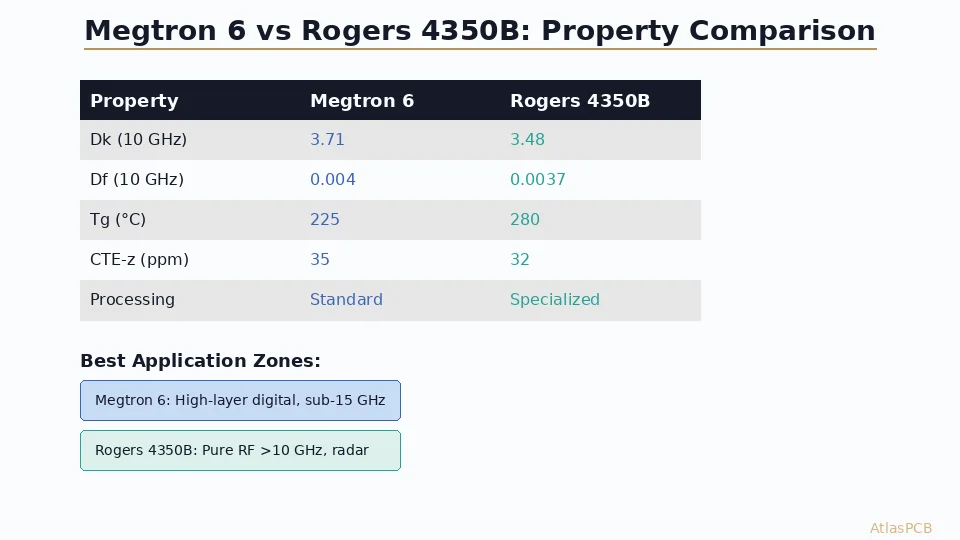
Choose Rogers 4350B (Dk 3.48, Df 0.0037 at 10 GHz) for pure RF/microwave circuits operating above 10 GHz where the lowest possible loss is critical and your design is 2–6 layers. Choose Megtron 6 (Dk 3.71, Df 0.004 at 10 GHz) for high-speed digital or mixed-signal designs with 8+ layers where multilayer fabrication compatibility, lower cost (30–40% less than Rogers), and standard FR-4 processing are priorities. Both materials support impedance-controlled designs to 40 GHz+, but Rogers 4350B offers tighter Dk tolerance (±0.05) versus Megtron 6 (±0.10), making it superior for narrowband filter and coupler designs.
The High-Frequency Laminate Decision
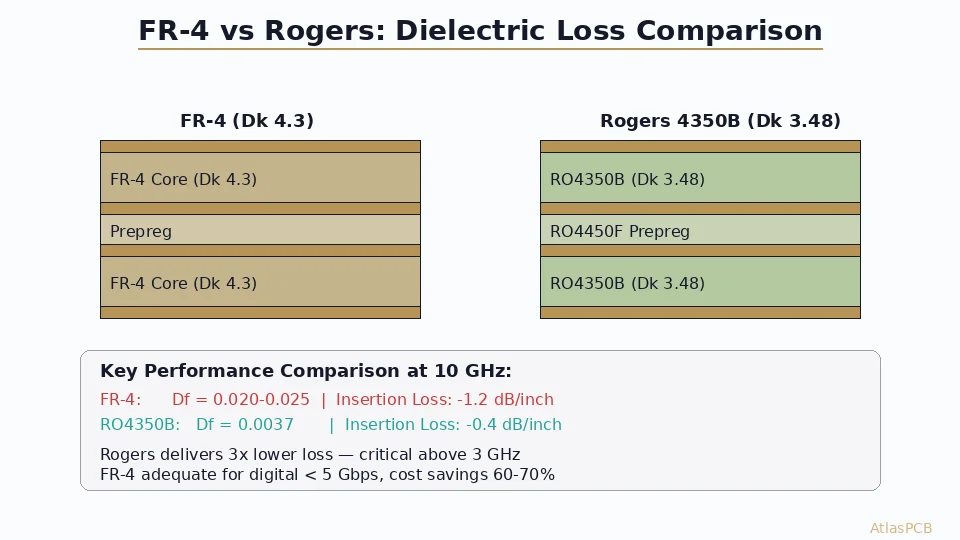
When your signal frequencies climb above 3 GHz, standard FR-4 laminate becomes a liability. Its dielectric loss (Df ~0.020) devours signal energy, its inconsistent Dk makes impedance control unpredictable, and its moisture absorption shifts performance with humidity. You need a low-loss laminate—but which one?
Two materials dominate the “premium but not exotic” segment of the PCB laminate market: Panasonic Megtron 6 and Rogers 4350B. Both are established, widely available, and capable of excellent high-frequency performance. But they represent fundamentally different design philosophies, and choosing the wrong one costs you either money or performance.
This guide gives you the engineering data to make that decision with confidence.
Head-to-Head: Material Properties
| Property | Megtron 6 (R-5775K) | Rogers 4350B | Why It Matters |
|---|---|---|---|
| Dk (10 GHz) | 3.71 +/- 0.10 | 3.48 +/- 0.05 | Impedance accuracy and trace width |
| Df (10 GHz) | 0.004 | 0.0037 | Signal loss per unit length |
| Dk (28 GHz) | 3.66 | 3.43 | mmWave performance |
| Df (28 GHz) | 0.006 | 0.005 | Critical for 5G mmWave |
| Tg (C) | 225 | 280 | Thermal reliability |
| CTE-z (ppm/C) | 35 | 32 | Via reliability in thermal cycling |
| Moisture absorption | 0.19% | 0.06% | Environmental stability |
| Peel strength (N/mm) | 0.8 | 0.6 | Conductor adhesion |
| Dk tolerance | +/- 0.10 | +/- 0.05 | Narrowband circuit accuracy |
| Processing | Standard FR-4 | Specialized (lower pressure) | Manufacturing complexity |
What the Numbers Mean in Practice
At 10 GHz with a 50-ohm microstrip on 0.2 mm substrate:
- Rogers 4350B: insertion loss of approximately 0.22 dB/cm
- Megtron 6: insertion loss of approximately 0.26 dB/cm
- Standard FR-4: insertion loss of approximately 0.65 dB/cm
The difference between Megtron 6 and Rogers 4350B is ~0.04 dB/cm—measurable but often irrelevant for traces under 10 cm. However, at 28 GHz, the gap widens to ~0.12 dB/cm, which compounds significantly over antenna feed networks and long interconnects.
When to Choose Rogers 4350B
Rogers 4350B is your material when:
1. Pure RF/Microwave Circuits (>10 GHz)
If your design is a power amplifier, LNA, filter bank, or antenna array operating above 10 GHz, Rogers’ lower Df and tighter Dk tolerance directly translate to predictable performance. The +/-0.05 Dk tolerance means your 50-ohm lines stay within +/-1 ohm—critical for matching networks where a 2-ohm error causes measurable VSWR degradation.
2. Narrowband Filter and Coupler Designs
Coupled-line filters, Wilkinson dividers, and branch-line couplers depend on precise electrical length. Rogers’ Dk consistency batch-to-batch means your tuned circuit performs the same on production boards as it did on prototypes.
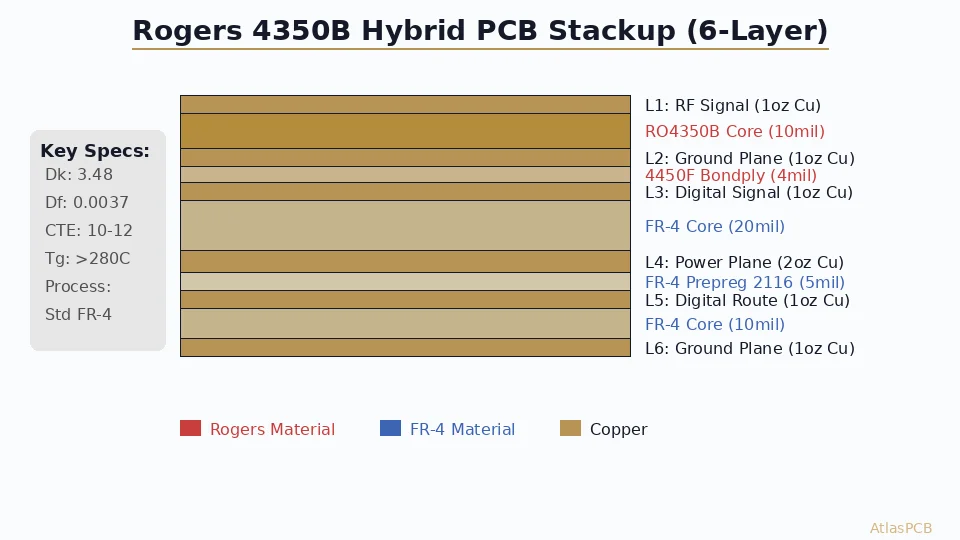
3. Low Layer Count (2–6 Layers)
Rogers 4350B works beautifully in 2–6 layer constructions typical of RF front-end modules. The material cost premium is manageable when you’re only buying a few layers, and the specialized processing is straightforward for experienced RF board houses.
4. Automotive Radar (76–81 GHz)
At 77 GHz, every 0.001 difference in Df matters. Rogers 4350B (or its newer sibling RO4835) remains the workhorse for automotive radar modules, where loss directly impacts detection range.
RF MATERIAL EXPERTS
Need Help Choosing Between Rogers and Megtron?
Upload your stackup and our RF engineers will recommend the optimal material for your frequency, layer count, and budget.
Get Material Recommendation ›
When to Choose Megtron 6
Megtron 6 is your material when:
1. High-Layer-Count Digital Designs (8–40+ Layers)
Server motherboards, network switches, and HPC modules with 12–40 layers need a low-loss material that processes like FR-4. Megtron 6 uses the same lamination temperatures, drill speeds, and plating chemistry as standard constructions—your fabricator doesn’t need special equipment or training.
2. Mixed-Signal Designs
If your board has both high-speed digital (PCIe Gen5/6, 112G PAM4 SerDes) and some RF content, Megtron 6 provides adequate performance for both without the cost explosion of an all-Rogers stackup.
3. Cost-Sensitive Volume Production
Megtron 6 costs 30–40% less than Rogers 4350B per panel. At volume (>500 boards/month), this difference can be $5–20 per board depending on size—directly impacting your BOM cost.
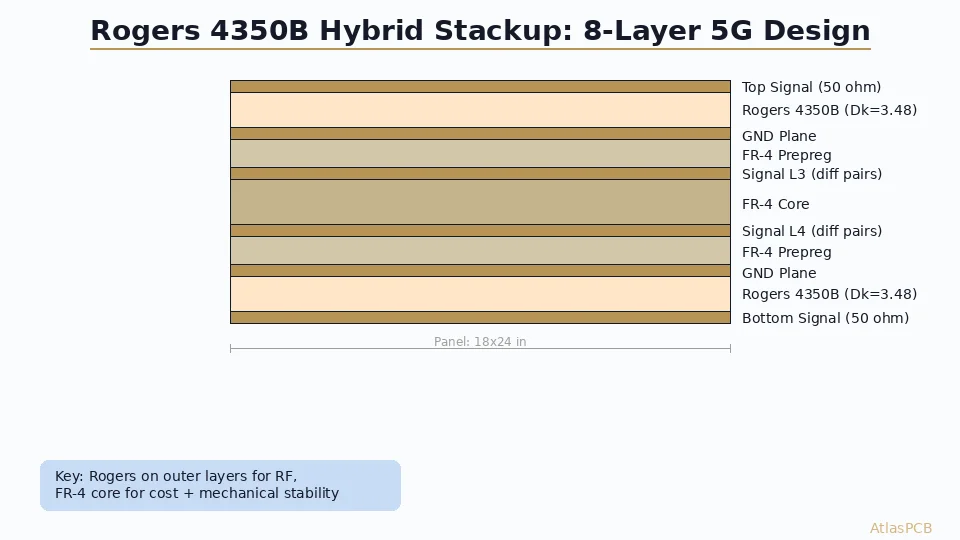
4. Hybrid Stackup Designs
The most cost-effective approach for many designs: use Megtron 6 on high-speed signal layers and standard FR-4 on power/ground/low-speed layers. This hybrid approach is impossible with Rogers due to processing incompatibility.
5. 5G Sub-6 GHz and High-Speed Digital to 15 GHz
For frequencies below 15 GHz, Megtron 6’s Df of 0.004 provides excellent signal integrity. The performance difference versus Rogers at these frequencies rarely justifies the cost and fabrication complexity trade-offs.
Cost Comparison
| Factor | Megtron 6 | Rogers 4350B |
|---|---|---|
| Raw material (per m2) | $80–120 | $150–220 |
| Processing premium | None (standard FR-4) | +15–25% (specialized) |
| Yield rate | 95%+ (standard process) | 85–92% (tighter tolerances) |
| Minimum order | Standard | Often higher minimums |
| Lead time | Standard (2–3 weeks) | +1–2 weeks typically |
| Total board cost (8L, 100x150 mm) | $35–55 | $65–95 |
For a 12-layer design with 4 signal layers needing low-loss material, a hybrid Megtron 6 + FR-4 stackup typically costs 60–70% of an all-Megtron design and 40–50% of an all-Rogers construction.
INSTANT QUOTE
Compare Rogers vs Megtron Pricing for Your Design
Upload Gerber files and get side-by-side quotes for both material options. No commitment required.
Get Instant Quote ›Fabrication Considerations
Rogers 4350B Manufacturing Notes
- Drill: Use lower speeds (150–200 SFM) to prevent delamination at hole walls
- Lamination: Peak temperature 390C, lower pressure (150–200 psi vs 300+ for FR-4)
- Plating: Standard electroless copper works, but surface prep requires sodium/permanganate etch
- Solder mask: Standard LPI compatible, but cure profile may need adjustment
- Panelization: Limited panel sizes available (max ~610x915 mm)
Megtron 6 Manufacturing Notes
- Drill: Standard FR-4 parameters, HSS or carbide
- Lamination: Standard FR-4 cycle (peak 185C, 300+ psi)
- Plating: No special requirements—identical to FR-4
- Solder mask: Standard process, no modifications needed
- Panelization: Full panel sizes available (up to 610x1100 mm)
This fabrication compatibility is Megtron 6’s hidden advantage. Any shop that makes standard multilayer PCBs can run Megtron 6 without new equipment or process development. Rogers requires RF-specialized fabricators.
Real-World Decision Framework
| Your Situation | Recommendation | Reasoning |
|---|---|---|
| 77 GHz automotive radar | Rogers 4350B | Every 0.001 Df matters at mmWave |
| 5G NR FR1 base station (sub-6 GHz) | Megtron 6 | Adequate loss, better multilayer support |
| 28 GHz 5G antenna | Rogers 4350B or RO4835 | Tight Dk tolerance for phased array |
| 112G PAM4 switch ASIC | Megtron 6 | 40+ layer, standard processing |
| X-band radar module | Rogers 4350B | Low loss + Dk precision needed |
| Network router (25G+ per lane) | Megtron 6 | Cost x layer count wins |
| Satellite Ka-band (26.5–40 GHz) | Rogers 4350B | Ultra-low loss required |
| Consumer Wi-Fi 7 (6 GHz) | Megtron 6 (or even Megtron 4) | Overkill with Rogers at this frequency |
FREE DFM REVIEW
We Validate Your RF Stackup Before Fabrication
Our engineers review your material selection, impedance calculations, and stackup geometry — upload your files for a detailed quote.
Upload Design ›Emerging Alternative: Megtron 7
Panasonic’s newest generation, Megtron 7 (R-5785K), narrows the gap further:
- Dk 3.38, Df 0.002 at 10 GHz
- Approaches Rogers-class performance while maintaining full FR-4 compatibility
- Currently limited availability and premium pricing (~2x Megtron 6)
- Worth evaluating for designs targeting 20–40 GHz with high layer counts
Making Your Choice
The decision ultimately comes down to three questions:
- What’s your highest signal frequency? Above 15 GHz — lean Rogers. Below — lean Megtron 6.
- How many layers? Above 8 — lean Megtron 6. Below 6 — Rogers is practical.
- What’s your volume? High volume — Megtron 6’s cost advantage compounds. Low volume/prototype — Rogers’ premium is manageable.
For the many designs that fall in the gray zone—moderate frequencies, moderate layer counts—a hybrid stackup with Megtron 6 signal layers and FR-4 non-critical layers often provides the best balance of performance, cost, and manufacturability.
ATLASPCB
High-Frequency PCB Fabrication — Rogers and Megtron Specialists
Validated stackups from L-band to W-band. Hybrid constructions, impedance control to +/-5%, and 7-day express available.
Get Your RF Quote ›
Related Reading:
About AtlasPCB — We specialize in complex PCB manufacturing for HDI, RF, and high-reliability applications. Explore our RF and high-frequency PCB services, Rogers RO4350B PCB manufacturing, or get an Megtron 6 & 7 low-loss PCB manufacturing . Every order includes free engineering review. Get your quote.
Reviewed by AtlasPCB Engineering Team — IPC-certified manufacturing specialists with 15+ years of production experience in HDI, RF, and high-reliability PCB fabrication. Content based on factory floor data and real customer design reviews.
Frequently Asked Questions
Can Megtron 6 be combined with FR-4 in hybrid stackups?
Is Rogers 4350B suitable for high-layer-count designs?
What frequency range favors Megtron 6 over Rogers 4350B?
- Megtron 6
- Rogers 4350B
- high-frequency PCB
- laminate comparison
- low-loss material
- 5G
- RF PCB
- dielectric constant
- dissipation factor