· AtlasPCB Engineering Team · Engineering · 17 min read
Flex PCB Cost Breakdown: Pricing Factors, Real Data, and Optimization Strategies for 2026
Complete flex PCB pricing guide with real cost data by layer count and volume, explanation of the 8 primary cost drivers, panel utilization optimization math, stiffener and coverlay selection impact, and manufacturer-side strategies to reduce flexible circuit board costs by 20-40%.
Quick Answer
Flex PCBs cost 3-8x more than equivalent rigid boards, with single-layer prototypes starting at $150-300 and high-volume production at $0.50-1.50 per unit. The primary cost drivers are polyimide material (40-55% of total cost), layer count (each additional layer adds 35-40%), panel utilization efficiency, and coverlay processing. Optimizing panel layout, standardizing bend radius, choosing adhesive-based polyimide where possible, and increasing order volume past the 1000-unit threshold are the most effective cost reduction strategies.
What Flex PCBs Actually Cost in 2026
Every hardware engineer encounters the same reaction when receiving their first flex PCB quote: the price seems disproportionately high compared to rigid boards of similar complexity. A four-layer rigid board that costs $8 per unit at 1000 pieces might cost $35-60 as a four-layer flex circuit. Understanding why this premium exists — and more importantly, where the cost actually goes — is essential for making informed design and sourcing decisions.
The flex PCB market in 2026 operates under additional cost pressure from polyimide supply constraints. The same material shortage affecting glass cloth and copper clad laminates has impacted polyimide film availability, with lead times for standard Kapton-equivalent films extending from two weeks to four to six weeks for common thicknesses. This supply tightness has added approximately 15-20% to base material costs compared to early 2025 pricing.
Here is what you should expect to pay for standard polyimide flex PCBs at different volume tiers in mid-2026, covering bare board fabrication without assembly costs.
For single-layer flex circuits, prototype lots of one to ten pieces run $150 to $300 depending on board size. Low volume production of 100 to 500 units costs $3 to $8 per board. Mid volume of 1000 to 5000 units brings the price down to $1.50 to $4 per unit, and high volume above 10,000 units reaches $0.50 to $1.50 per unit. Two-layer flex follows a similar pattern: prototypes at $250 to $500, low volume at $5 to $15 per unit, mid volume at $3 to $8, and high volume at $1 to $3. Four-layer flex pricing jumps significantly: prototypes at $400 to $800, low volume at $15 to $40, mid volume at $8 to $20, and high volume at $3 to $10 per unit.
These ranges reflect standard polyimide constructions with ENIG surface finish, coverlay on both sides, and typical trace widths of 4 mil or wider. Designs requiring finer features, special materials, or unusual constructions will exceed these ranges.
Where Your Money Actually Goes: Cost Structure Breakdown
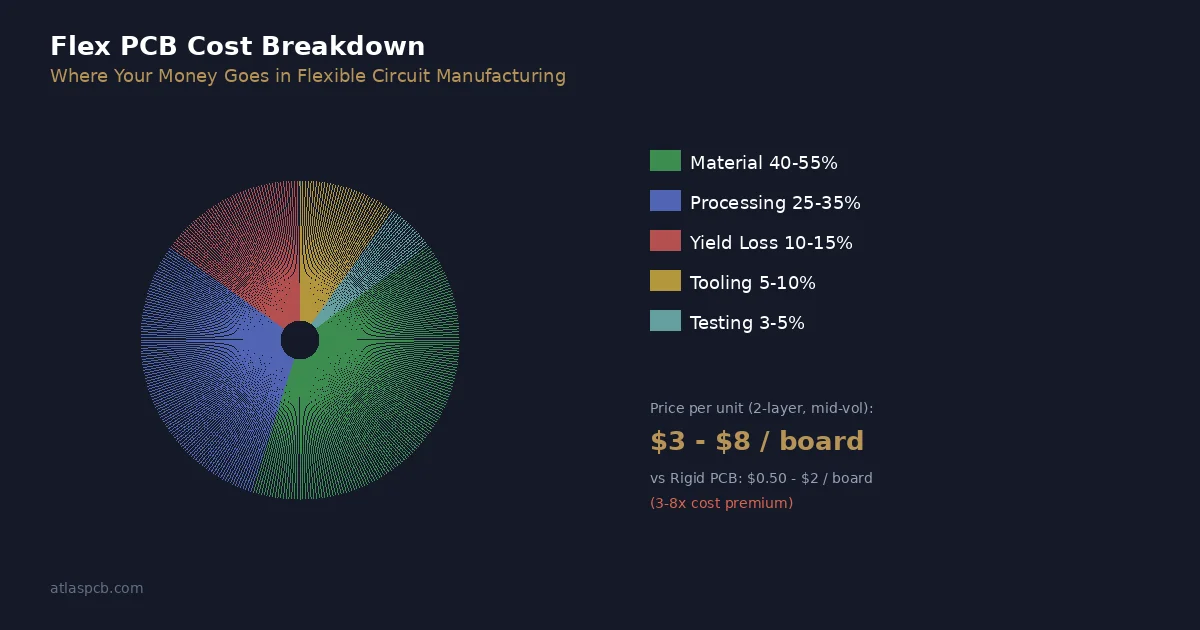
Understanding the internal cost structure of flex PCB manufacturing reveals where optimization efforts will have the greatest impact. Based on our production cost modeling across hundreds of flex orders, the typical cost distribution for a two-layer flex PCB at mid-volume production breaks down as follows.
Material costs consume 40 to 55 percent of the total fabrication cost. This includes polyimide base film, copper foil, adhesive layers, coverlay film, and stiffener materials. The material percentage is higher for flex than rigid boards because polyimide costs 3 to 30 times more than FR-4 per square foot depending on type and thickness, and coverlay film adds material cost that has no equivalent in rigid board solder mask (which costs pennies per board).
Processing labor and machine time account for 25 to 35 percent. Flex fabrication requires 40 to 50 process steps compared to 20 to 30 for rigid boards. Each step involves equipment time, operator attention, and yield risk. The additional steps unique to flex include coverlay lamination, laser cutting of coverlay openings, stiffener attachment, dimensional stability compensation during imaging, and special handling between every station.
Yield loss overhead adds 10 to 15 percent. Manufacturing yield for flex circuits runs 80 to 92 percent for standard two-layer designs versus 95 percent or higher for equivalent rigid boards. The yield cost is baked into the unit price — if a manufacturer needs to start 120 panels to ship 100 good ones, those 20 scrapped panels are distributed across the 100 good units as a cost adder.
Tooling and setup consume 5 to 10 percent at mid-volume. This includes laser stencils for coverlay, routing fixtures, test fixtures, and panelization tooling. At low volumes, tooling amortization per unit is much higher; at high volumes, it becomes negligible.
Quality and testing add 3 to 5 percent. Flex circuits require more extensive electrical testing than rigid boards because the dimensional instability during processing creates a higher risk of shorts and opens that would pass visual inspection.
FLEX PCB PRICING
Get an Accurate Flex PCB Quote in 24 Hours
Upload your Gerber files and our engineering team provides detailed pricing with cost optimization recommendations specific to your design.
Upload Design Files ›
The Eight Primary Cost Drivers
1. Base Material Selection
Polyimide substrate selection is the single largest cost lever in flex PCB design. The choice between adhesive-based and adhesiveless laminates alone creates a 30 to 50 percent material cost difference. Adhesive-based polyimide laminates (such as DuPont Pyralux LF series) cost approximately $6 to $15 per square foot and suit the vast majority of flex applications operating below 260 degrees Celsius with standard reliability requirements. Adhesiveless polyimide (such as DuPont Pyralux AP series) costs $10 to $25 per square foot but delivers better thermal performance, thinner profiles, and improved dimensional stability for fine-pitch designs.
Liquid crystal polymer (LCP) substrates represent the premium tier at $20 to $60 per square foot, justified only for high-frequency applications above 10 GHz where polyimide’s higher loss tangent becomes problematic. Polyester (PET) film offers a budget option at $3 to $8 per square foot for single-use or low-temperature applications, but its 120 degree Celsius maximum limits it to products that never see solder reflow.
The manufacturing insight many buyers miss: approximately 60 percent of flex PCB designs we review specify adhesiveless polyimide when adhesive-based would meet their actual performance requirements. This single material substitution — which requires no design changes — saves 30 to 50 percent on material cost, which translates to 12 to 25 percent savings on the total board price.
2. Layer Count
Each additional flex layer adds 35 to 40 percent to the total cost, a steeper escalation than rigid boards where additional layers add 20 to 30 percent. The reasons are compounding: more polyimide film, additional adhesive or bonding layers, extra imaging and etching cycles, and — critically — tighter registration requirements that reduce yield. Layer-to-layer alignment on polyimide is inherently more difficult than on rigid FR-4 because the material stretches and shrinks during thermal processing. Four-layer flex circuits typically run at 82 to 88 percent yield compared to 88 to 92 percent for two-layer, and six-layer flex drops to 75 to 85 percent depending on registration tolerances specified.
The practical implication: always question whether you truly need four layers in the flex section. Many rigid-flex designs route all flex signals on just one or two layers while keeping the complex routing in the rigid sections. This dramatically reduces flex processing cost while maintaining the interconnect benefit.
3. Panel Utilization
Panel utilization is the most overlooked cost factor in flex PCB manufacturing. Manufacturers charge based on the material consumed per panel, not per board outline. A flex circuit with an L-shaped or star-shaped outline that wastes 40 to 50 percent of its bounding rectangle costs 40 to 50 percent more in material than a rectangular design of the same circuit area.
Here is a real optimization example from our production. A customer had a flex circuit measuring 120mm long with a 90-degree bend that created a 120mm by 120mm bounding box. The useful circuit area was 3600 square millimeters, but the bounding box consumed 14,400 square millimeters — only 25 percent utilization. By rotating the panel array and interleaving boards (nesting one board’s tail into another’s open space), we achieved 68 percent utilization. On a 250-panel production run, this reduced material consumption by 43 percent, cutting the per-unit price by $2.80 on a board that previously quoted at $11.50 — a 24 percent cost reduction with zero design changes.
Working with your manufacturer on panelization before finalizing the outline geometry can save 15 to 30 percent on material-dominated flex boards. This is one area where the manufacturer’s process engineering team adds direct value that commodity quoting platforms cannot provide.
4. Coverlay versus Flexible Solder Mask
Every flex PCB needs a protective layer over its copper traces. The two options — coverlay film and flexible photoimageable solder mask — have dramatically different cost structures and capabilities.
Coverlay (adhesive-coated polyimide film) is the traditional and higher-performance option. It provides superior flex life (withstanding millions of bend cycles without cracking), better chemical resistance, and reliable insulation even in dynamic flex applications. However, it requires laser or mechanical cutting for pad openings, individual piece lamination, and manual alignment — making it labor-intensive and expensive. Coverlay adds approximately $0.50 to $2.00 per board depending on complexity.
Flexible photoimageable solder mask can be screen-printed or sprayed, exposed, and developed using the same processes as rigid board solder mask. It costs 50 to 70 percent less than coverlay processing but has significant limitations: it cracks after only thousands of bend cycles (unsuitable for dynamic flex), offers thinner coverage, and has poorer adhesion at elevated temperatures. Its appropriate use is limited to flex-to-install applications where the circuit bends once during assembly and then remains static throughout product life.
The decision framework: specify coverlay for any section that will flex during product operation, and consider flexible solder mask only for static flex sections where cost reduction outweighs the reliability premium.
5. Stiffener Type and Placement
Stiffeners reinforce areas of a flex circuit that need rigidity for component mounting or connector mating. The stiffener material and attachment method significantly impact cost.
FR-4 stiffeners cost the least — approximately $0.10 to $0.30 per board for simple rectangular shapes — because manufacturers can use standard rigid board material and processing. They add mechanical rigidity and provide a surface for SMT component placement in the stiffened zone.
Polyimide stiffeners cost 2 to 3 times more than FR-4 but provide better thermal compatibility with the flex substrate and thinner profiles. They are preferred when the stiffened area must pass through reflow soldering at temperatures that would degrade FR-4 adhesive systems.
Stainless steel stiffeners provide EMI shielding in addition to mechanical support at a cost premium of 3 to 5 times over FR-4. Aluminum stiffeners serve as both stiffeners and heatsinks for power components mounted on the flex region.
The attachment method matters too. Pressure-sensitive adhesive (PSA) is cheapest but limited to low-temperature applications. Thermally bonded stiffeners using acrylic or epoxy adhesive cost more but survive reflow. The difference is $0.05 to $0.15 per attachment point.
6. Surface Finish
Surface finish selection for flex PCBs follows the same options as rigid boards — ENIG, immersion tin, immersion silver, OSP, and HASL — but with different cost and compatibility implications. ENIG is the default choice for flex circuits, adding $0.15 to $0.40 per square inch of pad area. Its flat profile works well with fine-pitch components common on flex assemblies, and its excellent shelf life suits the longer production cycles typical of flex board inventory. OSP offers the lowest cost ($0.05 to $0.10 per square inch) but its limited shelf life of three to six months creates risk for flex boards that often sit in inventory longer than rigid boards due to smaller batch sizes and longer fabrication lead times.
7. Minimum Feature Size
Standard flex PCB manufacturing achieves 4 mil (100 micrometer) trace width and spacing at reasonable yield. Going finer triggers cost escalation: 3 mil trace and space adds 15 to 25 percent to processing cost due to tighter process windows and lower yield. Below 3 mil enters the realm of semi-additive processing (mSAP or SAP), which can double or triple the per-unit cost but achieves 25 to 50 micrometer features required for some high-density interconnect applications.
The yield impact is the primary cost mechanism. At 4 mil features, a typical two-layer flex runs at 90 percent yield. At 3 mil, yield drops to 82 to 87 percent. At 2 mil using additive processes, yield ranges from 70 to 80 percent depending on panel size and design complexity. Each percentage point of yield loss translates directly to higher per-unit cost.
8. Order Volume and Batch Economics
Flex PCB pricing exhibits steep volume discounts because of the high fixed-cost component in flex manufacturing. The NRE costs (tooling, CAM engineering, test fixture, coverlay laser program) are amortized across all units in a production run. At 100 units, NRE might contribute $2 to $5 per board. At 5000 units, that same NRE adds only $0.04 to $0.10 per board.
The steepest price breakpoints occur at 500 units (setup costs fully amortized), 2000 units (material volume discounts kick in), and 10,000 units (dedicated production line efficiency). Between 100 and 1000 units, per-unit cost typically drops 40 to 60 percent. Between 1000 and 10,000, an additional 30 to 50 percent reduction is typical.
COST OPTIMIZATION
Our Engineers Identify Cost Savings in Your Flex Design
Panel optimization, material substitution analysis, and feature review — we show you where your design costs more than it needs to.
Get Optimization Review ›Flex PCB versus Rigid-Flex versus Cables: The Cost Decision Framework
One of the most valuable engineering decisions you can make early in product development is choosing the right interconnect strategy. The choice between pure flex, rigid-flex, and traditional cables with connectors depends on more than just electrical requirements — the cost crossover points differ significantly by volume and complexity.
Pure flex PCBs are most economical when the circuit needs only one or two copper layers in the flexible section, the board replaces a wiring harness that costs more than $3 to $5 per unit to manufacture and assemble manually, dynamic flexing is required during product operation (hundreds to millions of cycles), or the form factor demands a thin, lightweight interconnect that conforms to the product enclosure.
Rigid-flex becomes more cost-effective than separate flex-plus-rigid when the design needs four or more layers in the rigid sections (combining them eliminates flex-to-rigid connectors costing $1 to $5 each), when reliability requirements mandate eliminating solder joint failure points at board-to-board connections, or when the total system cost including assembly labor exceeds the rigid-flex fabrication premium.
Traditional cables with connectors remain the lowest-cost option when the interconnect is a simple point-to-point link with fewer than 20 conductors, when the cable length exceeds 150 millimeters (beyond which flex PCB material costs escalate rapidly), or when the product requires field serviceability that would be impossible with a permanently bonded flex or rigid-flex circuit.
The volume crossover deserves attention. At 100 units, rigid-flex typically costs 3 to 5 times more than equivalent separate rigid boards plus cables. At 5000 units, the gap narrows to 1.5 to 2.5 times because cable assembly labor costs scale linearly while rigid-flex material costs benefit from volume pricing. At 50,000 units and above, rigid-flex often becomes cost-competitive or cheaper than cable assemblies because automated PCB manufacturing scales better than manual cable harness assembly.
Practical Cost Optimization Strategies
Based on reviewing hundreds of flex PCB designs and their resulting quotes, here are the optimizations that deliver the largest cost reductions with minimal design impact.
Maximize panel utilization through collaborative panelization. Work with your manufacturer to explore array configurations before freezing the board outline. Non-rectangular outlines, particularly those with narrow tails or branches, often have alternative array arrangements that improve utilization by 20 to 40 percent. This single optimization frequently delivers the largest absolute dollar savings.
Question your material specification. If your design does not require dynamic flexing (the flex bends only during installation), adhesive-based polyimide with flexible solder mask instead of coverlay can reduce material and processing cost by 25 to 40 percent. Verify with your manufacturer whether your actual thermal and mechanical requirements justify adhesiveless polyimide.
Minimize the flex layer count independently of the rigid sections. In rigid-flex designs, the flex section often needs only one or two signal layers for the routing that passes between rigid zones. Adding ground planes in the flex section for impedance control or shielding doubles the flex layer count and increases flex processing cost by 35 to 40 percent. Consider whether signal integrity requirements in the short flex section truly demand controlled impedance, or whether the rigid section can handle those requirements.
Standardize stiffener shapes and locations. Custom stiffener outlines with internal cutouts or complex geometries require laser or CNC routing, adding $0.20 to $0.50 per board. Simple rectangular stiffeners can be die-cut at much lower cost. If your mechanical design allows it, standardizing stiffener geometry saves on every unit produced.
Consolidate orders across product variants. If you have multiple flex PCB designs with similar material stacks, coordinating their production into the same manufacturing window allows the factory to batch material procurement and processing setup, typically earning a 5 to 10 percent discount on each design.
FLEX AND RIGID-FLEX CAPABILITIES
1-6 Layer Flex, Rigid-Flex up to 22 Layers
Standard and adhesiveless polyimide, dynamic flex certified, coverlay and flex mask options. Engineering support from design review through production.
2026 Supply Chain Impact on Flex Pricing
The current PCB material shortage affects flex pricing through polyimide film availability specifically. DuPont and other major polyimide suppliers have increased allocation priority toward high-volume customers, extending lead times for smaller orders. Standard 1-mil and 2-mil Kapton-equivalent films that previously shipped in two weeks now require four to six weeks of lead time. Specialty thin films (0.5 mil and below) can take eight to twelve weeks.
The pricing impact has been approximately 15 to 20 percent above early 2025 levels for standard polyimide materials. Adhesiveless laminates have seen larger increases of 20 to 30 percent due to their more complex manufacturing and higher demand from smartphone and wearable device manufacturers.
For hardware teams budgeting flex PCB programs in the current environment, we recommend adding 15 to 20 percent to historical pricing baselines, extending procurement lead times by two to four weeks beyond normal, and considering material pre-buy for production programs where polyimide thickness and type are already determined.
Conclusion
Flex PCB cost is driven primarily by material selection, layer count, and panel utilization — factors that are largely determined during the design phase rather than the procurement phase. The most effective cost optimization happens early, when design decisions are still flexible and collaboration with your manufacturing partner can identify savings opportunities before tooling commitments lock in the cost structure.
The engineers who achieve the lowest flex PCB costs are those who understand the cost structure well enough to make informed trade-offs: accepting adhesive-based polyimide where adhesiveless is not required, using flexible solder mask in static regions, optimizing outlines for panel nesting, and right-sizing layer counts in the flex sections independently of their rigid counterparts.
ATLASPCB
Ready to Quote Your Flex or Rigid-Flex Design?
Upload your Gerber files and receive a detailed quote with panel utilization analysis and material optimization recommendations within 24 hours.
Get Flex PCB Quote ›
Reviewed by AtlasPCB Engineering Team — 15+ years in advanced PCB fabrication for RF, HDI, and rigid-flex applications.
Related Reading:
About AtlasPCB — We specialize in complex PCB manufacturing for HDI, RF, and high-reliability applications. Explore our rigid-flex PCB manufacturing, instant online PCB quote, or get an full PCB manufacturing capabilities . Every order includes free engineering review. Get your quote.
Reviewed by AtlasPCB Engineering Team — IPC-certified manufacturing specialists with 15+ years of production experience in HDI, RF, and high-reliability PCB fabrication. Content based on factory floor data and real customer design reviews.
Frequently Asked Questions
How much does a flex PCB cost per unit?
Why are flex PCBs so much more expensive than rigid PCBs?
How can I reduce flex PCB cost without changing my design?
When should I choose flex PCB versus rigid-flex or cables?
- flex PCB
- PCB pricing
- flexible circuit
- cost optimization
- polyimide
- PCB manufacturing cost