· AtlasPCB Engineering Team · News · 6 min read
Unimicron Under Investigation for Relabeling China-Made PCBs as Taiwan-Origin, Shares Drop 10%
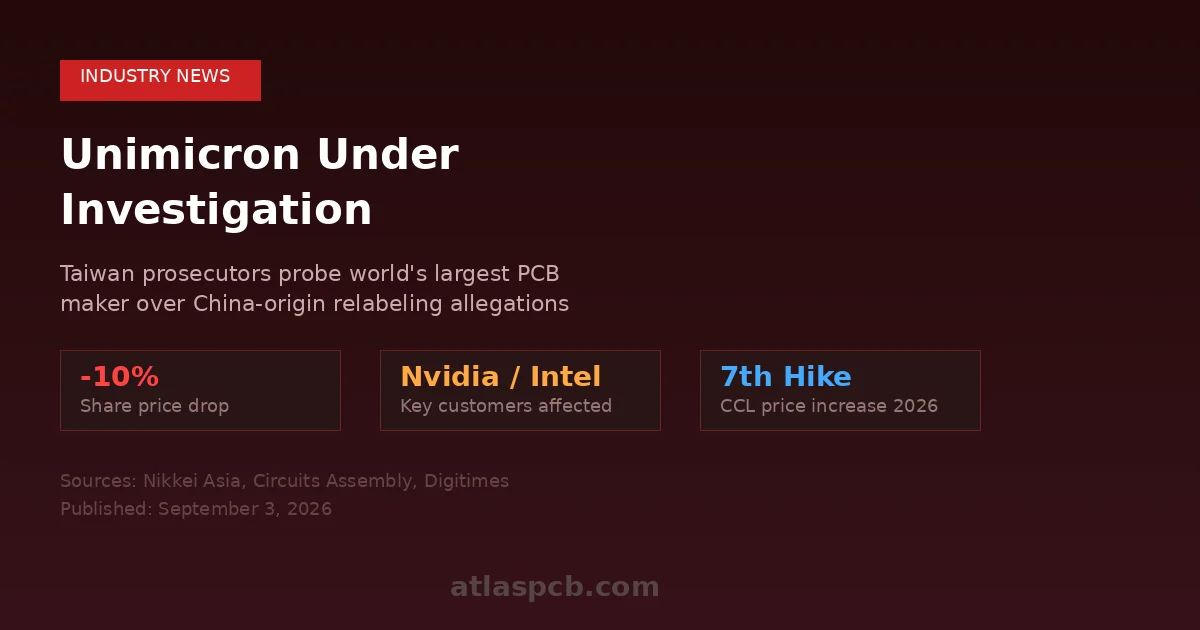
Taiwan prosecutors are investigating Unimicron, one of the world's largest PCB and IC substrate manufacturers and a key supplier to Nvidia, Intel, Google, and Amazon, over allegations of relabeling China-made parts as Taiwan-origin. The probe highlights growing supply chain transparency challenges as geopolitical tensions reshape electronics manufacturing.
Quick Answer
Taiwanese prosecutors announced an investigation into Unimicron Technology Corporation, one of the world's top PCB and IC substrate makers, over allegations that the company falsely relabeled China-manufactured parts as Taiwan-origin products. Unimicron shares fell approximately 10 percent following the news. The company is a key substrate and PCB supplier to major technology companies including Nvidia, Intel, Google, and Amazon. The probe underscores the escalating complexity of supply chain compliance as US-China technology restrictions and tariff regimes create strong financial incentives for origin misrepresentation.
Reviewed by AtlasPCB Engineering Team
Investigation Sends Shockwaves Through PCB Supply Chain
Taiwan prosecutors have launched an investigation into Unimicron Technology Corporation, the island’s largest printed circuit board and IC substrate manufacturer, over allegations that the company relabeled China-manufactured components as Taiwan-origin products. The news, first reported by Nikkei Asia on August 31, 2026, sent Unimicron shares tumbling approximately 10 percent in a single trading session and raised immediate questions about supply chain integrity across the global electronics industry.
Unimicron is not a minor player. The company ranks among the top three PCB manufacturers globally by revenue and is a critical supplier of advanced IC substrates to Nvidia, Intel, Google, and Amazon. Its substrates are used in some of the most advanced semiconductor packages currently in production, including those supporting AI accelerator chips and high-performance computing platforms. Any disruption to Unimicron’s operations or customer relationships has the potential to ripple through the entire AI hardware supply chain.
The investigation centers on allegations that products manufactured at Unimicron’s facilities in mainland China were shipped to Taiwan and relabeled with Taiwan-origin documentation before being sold to customers. If substantiated, the practice would constitute origin laundering under Taiwanese trade law and could trigger additional scrutiny under United States export control and tariff regulations that impose different requirements on China-origin versus Taiwan-origin electronics components.
Why Origin Labeling Has Become a Flashpoint
The financial incentive for origin misrepresentation in the PCB industry has grown substantially over the past several years as geopolitical tensions between the United States and China have produced an increasingly complex web of tariffs, export controls, and procurement restrictions.
United States tariffs on Chinese-manufactured printed circuit boards currently stand at 25 percent under Section 301 measures, a significant cost burden that makes China-origin PCBs substantially more expensive for US importers compared to equivalent products from Taiwan, South Korea, Japan, or Southeast Asian manufacturing hubs. For high-volume substrate and PCB shipments worth hundreds of millions of dollars annually, the tariff differential creates a powerful economic incentive to classify products as originating from lower-tariff jurisdictions.
Beyond tariffs, the US Department of Defense has implemented increasingly strict rules requiring non-China sourcing for circuit boards and substrates used in defense electronics. Several major defense contractors and their tier-one suppliers have adopted procurement policies that exclude China-origin PCBs entirely, regardless of tariff status. Similar policies are emerging among commercial aerospace companies and some automotive OEMs responding to customer or regulatory pressure to de-risk their supply chains from single-country dependencies.
These overlapping pressures have created a situation where the country of origin stamped on a PCB or substrate can affect its market value by 10 to 30 percent, accounting for tariff savings, access to restricted programs, and customer willingness to pay a premium for supply chain certainty. When margins are thin and volumes are large, the temptation to exploit ambiguities in origin determination rules becomes substantial.
Implications for the Broader PCB Industry
The Unimicron investigation is significant not just for the company itself but for the structural questions it raises about supply chain verification in an industry where manufacturing is distributed across multiple countries and substrates pass through several processing stages before reaching the end customer.
A modern IC substrate or advanced multilayer PCB may involve base materials sourced in Japan or China, inner-layer imaging performed at one facility, lamination and drilling at another, and final finishing and testing at a third location. Determining the “country of origin” for such a product requires applying complex rules of substantial transformation — the legal test for when enough value is added in a particular country to claim that country as the origin. These rules vary between jurisdictions and trade agreements, creating gray areas that can be exploited intentionally or misapplied unintentionally.
For PCB buyers, particularly those with exposure to US government contracts or tariff-sensitive supply chains, the Unimicron investigation underscores the importance of supply chain due diligence that goes beyond accepting country-of-origin declarations at face value. Verification practices that are becoming industry standard include requesting specific factory location documentation (not just corporate headquarters address), conducting periodic factory audits or using third-party audit services, requiring ISO/IEC 17065 product certification with origin verification, and including origin compliance clauses with financial penalties in supplier agreements.
What PCB Buyers Should Do Now
The immediate practical impact of this investigation for most PCB buyers will be limited, as Unimicron continues to operate and ship products while the investigation proceeds. However, the case serves as a useful prompt for companies to review their own supply chain practices.
Any organization procuring PCBs or substrates for products that will be imported into the United States should verify that their supplier can document the specific facility where manufacturing takes place, not just the country of the corporate entity. For products subject to ITAR restrictions or defense procurement rules, the documentation requirements are even more stringent and typically require facility-level certification.
Companies that have been sourcing PCBs from Taiwan-based manufacturers specifically to avoid China-origin tariffs should consider whether their due diligence processes would detect relabeling if it occurred in their supply chain. The cost of a tariff reassessment — where US Customs determines that previously imported goods were misclassified by country of origin — can include back duties, interest, and penalties that far exceed the tariff savings that motivated the original sourcing decision.
For companies working with AtlasPCB, our manufacturing takes place at documented, auditable facilities with full traceability from raw material receipt through finished product shipment. We provide factory location documentation and origin certificates as standard practice for customers requiring supply chain compliance documentation.
Broader Supply Chain Context: CCL Shortages and Factory Shifts
The Unimicron investigation comes during a period of significant turbulence in the global PCB supply chain. Several other developments in the past week highlight the pressures facing the industry.
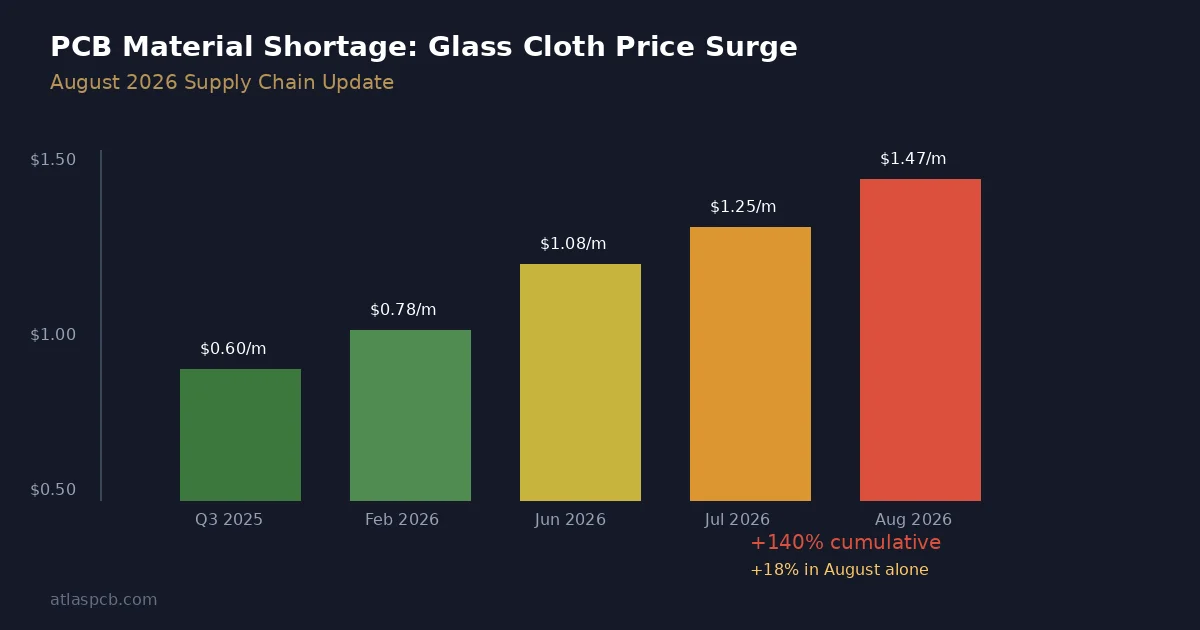
Kingboard Laminates, one of the world’s largest copper-clad laminate manufacturers, issued its seventh CCL price increase of 2026, driven by persistent shortages of fiberglass cloth and surging demand from AI data center buildouts. The CCL shortage that has been building throughout the year shows no signs of easing as AI infrastructure investment continues to accelerate.
Separately, Keytronic Corporation announced plans to cease all manufacturing operations in China and shift the majority of relocated demand to its expanded Vietnam facility. The Spokane Valley-based EMS provider expects to complete the China exit by the fourth quarter of fiscal 2026, incurring approximately $7.1 million in restructuring costs. Keytronic cited geopolitical risk reduction as the primary motivation, joining a growing list of electronics manufacturers rebalancing production away from China.
Meanwhile, Reuters reported that factory activity expanded across much of Asia in August, with strong demand for semiconductors, computers, and AI-related hardware boosting manufacturing output in China, Japan, and South Korea. The paradox of companies leaving China while overall manufacturing activity there grows reflects the bifurcation of the electronics supply chain — high-volume, cost-sensitive production remains concentrated in China even as geopolitically sensitive or tariff-exposed segments migrate to alternative locations.
These converging trends — origin compliance enforcement, material shortages, manufacturing migration, and sustained AI-driven demand — point toward a PCB supply chain that is simultaneously growing and fragmenting. For buyers, the message is clear: supply chain management has become as important as technical specification in determining whether your boards arrive on time, at the right price, and from the right place.
About AtlasPCB — We specialize in complex PCB manufacturing for HDI, RF, and high-reliability applications. Explore our impedance-controlled PCB manufacturing . Every order includes free engineering review. Get your quote.
Reviewed by AtlasPCB Engineering Team — IPC-certified manufacturing specialists with 15+ years of production experience in HDI, RF, and high-reliability PCB fabrication. Content based on factory floor data and real customer design reviews.
Frequently Asked Questions
What is Unimicron accused of doing?
How does this affect Nvidia and other customers?
Why does PCB country of origin matter?
What is origin laundering in electronics manufacturing?
- Unimicron
- PCB supply chain
- origin labeling
- Taiwan PCB
- semiconductor supply chain
- trade compliance
- PCB industry news
- Nvidia supplier