· Atlas PCB Engineering Team · News · 5 min read
TTM Technologies Reports Record $1 Billion Q2 Revenue as AI Infrastructure Drives PCB Demand
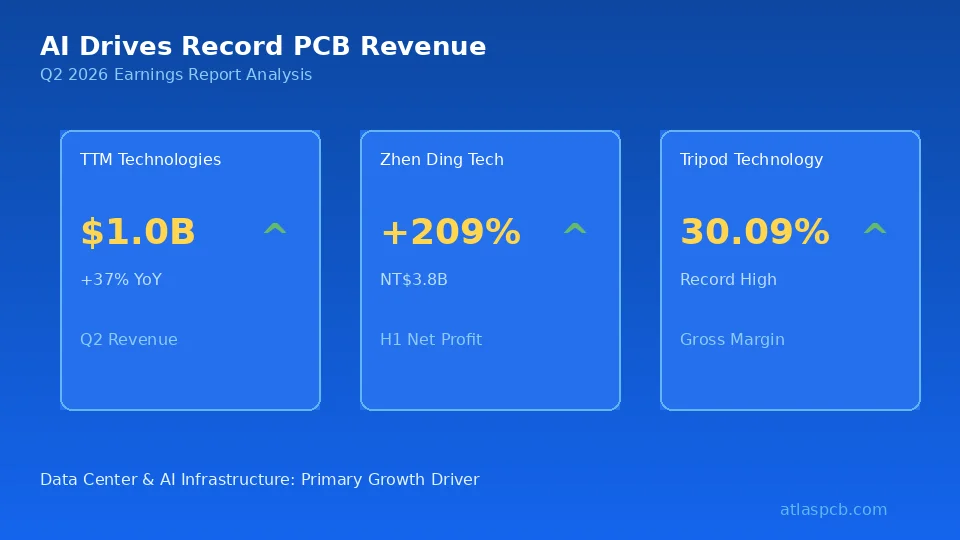
TTM Technologies posted record quarterly revenue of $1.0 billion in Q2 2026, a 37% year-on-year increase driven primarily by surging AI data center demand. The results signal continued capacity pressure in the advanced PCB segment.
TTM Technologies, one of the world’s largest printed circuit board manufacturers, reported record second-quarter 2026 financial results on August 5, with revenue reaching $1.0 billion — a 37% increase year on year that underscores the sustained intensity of AI-driven demand across the PCB supply chain.
Financial Highlights Signal Industry-Wide Momentum
The Q2 results exceeded analyst expectations across virtually every metric. GAAP net income reached $83.0 million ($0.77 per diluted share), while non-GAAP net income hit a record $106.9 million ($0.99 per diluted share). Adjusted EBITDA of $166.8 million represented a 16.6% margin, demonstrating that revenue growth is translating into genuine profitability rather than margin-dilutive volume chasing.
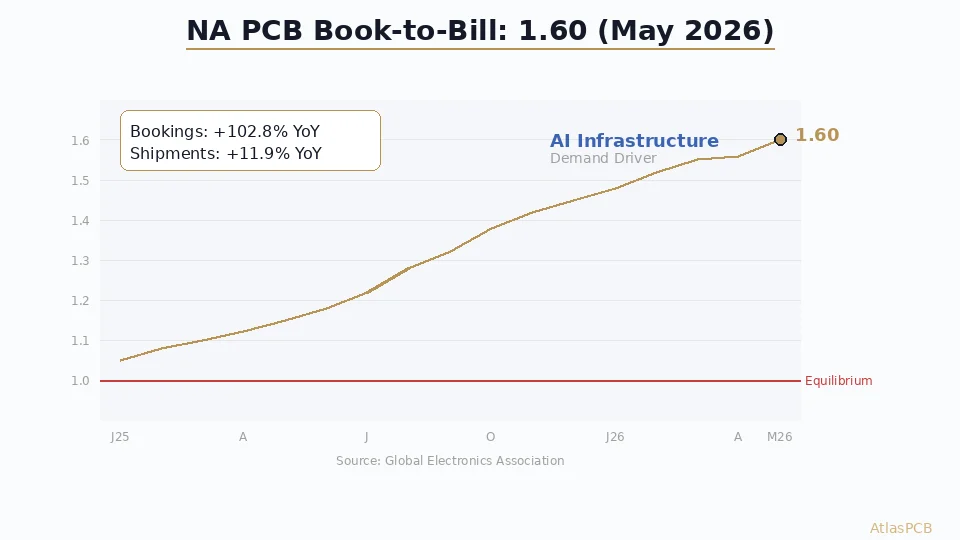
Perhaps the most telling indicator for downstream customers and competitors is TTM’s book-to-bill ratio of 1.49. A ratio this far above 1.0 indicates that incoming orders continue to substantially outpace the company’s ability to ship, suggesting ongoing capacity constraints in the advanced PCB segment. For hardware engineers waiting on prototype and production deliveries, this confirms what many have experienced firsthand: lead times for complex multilayer boards remain extended relative to pre-AI-boom levels.
Operating cash flow of $96.4 million further strengthens TTM’s position to invest in capacity expansion, advanced process technology, and strategic acquisitions — all of which will shape the supply landscape for the next several years.
AI Data Center: The 91% Growth Engine
The most dramatic segment performance came from TTM’s Data Center and Networking business, which accounted for 40% of total sales and surged 91% year on year. This growth reflects the massive infrastructure buildout by hyperscale cloud providers deploying next-generation AI training and inference clusters.
The boards feeding this demand are among the most complex in the industry — high-layer-count (30+ layers), ultra-low-loss material stackups, extremely tight impedance tolerances for 112G and 224G PAM4 SerDes channels, and advanced HDI constructions with stacked microvias. These are not commodity products, and the specialized manufacturing capability required to produce them at scale creates natural barriers to rapid capacity expansion.
Edwin Roks, President and CEO of TTM Technologies, attributed the growth directly to this trend: “Revenues grew 37% year on year, powered largely by ongoing robust demand in the Data Center and Networking end market,” noting that margin expansion initiatives and strong cash flow supported continued investment in advanced manufacturing technology.
Aerospace, Defense, and Medical Remain Strong
Beyond AI, TTM’s results highlight broad-based strength across high-reliability markets. Aerospace and Defense contributed 37% of total revenue, with backlog exceeding $1.7 billion — representing approximately six quarters of visibility at current run rates. The Medical, Industrial, and Instrumentation segment grew 33% year on year, reflecting continued demand for complex boards in diagnostic equipment, industrial automation, and precision instrumentation.
These segments share a common thread with AI infrastructure: they require advanced PCB technologies (controlled impedance, fine-pitch HDI, exotic materials, Class 3 reliability) that cannot be easily produced by commodity fabricators. The concentration of growth in high-complexity segments suggests that the bifurcation of the PCB market — between commodity boards facing price pressure and advanced boards commanding premium pricing — continues to widen.
European Expansion Through Acquisitions
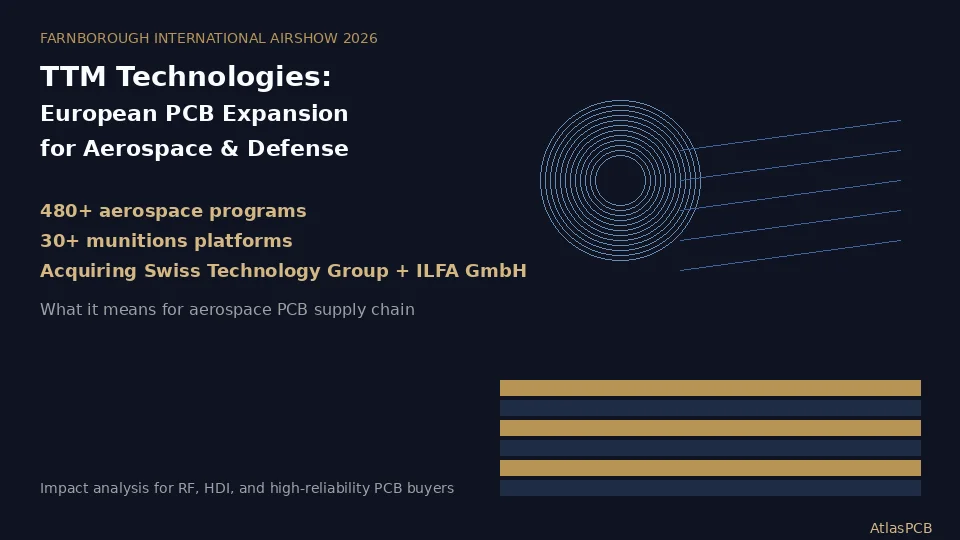
TTM announced that its planned acquisitions of Swiss Technology Group AG and ILFA GmbH are expected to close in Q3 2026. These acquisitions will establish TTM’s first significant European manufacturing presence, providing geographic diversification that serves both supply chain resilience requirements and growing European demand for locally sourced advanced PCBs.
The European PCB market has received significant attention as EU industrial policy increasingly prioritizes domestic electronics manufacturing capability. TTM’s entry through acquisition — rather than greenfield construction — allows immediate access to established customer relationships and qualified processes, accelerating time-to-revenue in a region where organic growth would take years.
Q3 Guidance and Full-Year Outlook
For Q3 2026, TTM expects revenue of $1.10–$1.14 billion, representing sequential growth that would mark another record quarter. Non-GAAP EPS guidance of $1.21–$1.27 per share suggests continued margin expansion as manufacturing efficiency improves with higher utilization rates.
The full-year 2026 revenue forecast of approximately $4.4 billion, with non-GAAP EPS approaching $5.00, would represent an extraordinary year for a company that generated $2.2 billion in revenue as recently as 2023. This trajectory reflects both the magnitude of AI infrastructure investment and TTM’s strategic positioning in the highest-complexity, highest-barrier segments of PCB manufacturing.
Implications for PCB Buyers
For engineers and procurement teams sourcing advanced PCBs, TTM’s results carry several practical implications. The sustained 1.49 book-to-bill ratio means lead times for complex boards are unlikely to compress significantly in the near term. AI-related orders continue to consume manufacturing capacity that might otherwise serve other markets, creating competition for fab time even in segments like aerospace and medical.
Diversifying supply chains across multiple qualified fabricators — including capable Chinese manufacturers for appropriate applications — remains a sound strategy for managing delivery risk. The complexity requirements driving TTM’s growth also apply to other advanced fabricators globally, suggesting that the capacity constraint is industry-wide rather than company-specific.
Source: TTM Technologies Q2 2026 earnings report (August 5, 2026). Reviewed by AtlasPCB Engineering Team.
About AtlasPCB — We specialize in complex PCB manufacturing for HDI, RF, and high-reliability applications. Explore our full PCB manufacturing capabilities, or get an instant online quote . Every order includes free engineering review. Get your quote.
Reviewed by AtlasPCB Engineering Team — IPC-certified manufacturing specialists with 15+ years of production experience in HDI, RF, and high-reliability PCB fabrication. Content based on factory floor data and real customer design reviews.
- TTM Technologies
- AI PCB demand
- data center
- PCB industry
- market growth