· AtlasPCB Engineering Team · News · 7 min read
TTM Technologies to Acquire Epiq Solutions for $1.1 Billion, Expanding Defense Electronics Reach
TTM Technologies has agreed to acquire Epiq Solutions from Veritas Capital for $1.1 billion, adding software-defined radios, embedded computing, and specialized RF technologies to its aerospace and defense portfolio.
Quick Answer
TTM Technologies has entered into a definitive agreement to acquire Epiq Solutions from Veritas Capital for $1.1 billion, adding software-defined radio, embedded computing, and specialized RF capabilities to TTM's existing aerospace and defense PCB manufacturing portfolio. The deal is expected to close by end of 2026.
TTM Technologies, one of the world’s largest printed circuit board manufacturers, has announced a definitive agreement to acquire Epiq Solutions from an affiliate of Veritas Capital in a deal valued at $1.1 billion. The transaction, expected to close by the end of 2026 pending regulatory approvals, represents TTM’s most aggressive move yet into integrated defense electronics — and a clear signal that the company’s ambitions extend well beyond bare PCB fabrication.
From Board Fabricator to Defense Systems Integrator
Santa Ana, California-based TTM has long been a dominant force in aerospace and defense PCB manufacturing. The company produces advanced multilayer boards, RF substrates, and high-density interconnect designs for some of the most demanding military programs in the world. But the Epiq acquisition marks a fundamental shift in strategy: TTM is no longer content to supply the boards. It wants to supply the systems that go on them.
Epiq Solutions brings a portfolio that reads like a wish list for any defense prime contractor. The company manufactures software-defined radios (SDRs), embedded computing platforms, and specialized radio technologies that serve signal intelligence, electronic warfare, unmanned systems, and space applications. These are not commodity products. SDRs in particular have become critical infrastructure for modern militaries, enabling flexible, reprogrammable communications that can adapt to evolving threats in real time.
The breadth of Epiq’s customer base — spanning commercial, government, and defense sectors — gives TTM immediate diversification within the RF and embedded computing space. This is not a niche bet. It is a calculated expansion into one of the fastest-growing segments of defense spending.
Veritas Capital’s Role in Building the Platform
To understand what TTM is actually buying, it helps to look at what Veritas Capital did with Epiq after acquiring the company in 2022. Under Veritas ownership, Epiq underwent a deliberate platform-building strategy, absorbing two targeted acquisitions that significantly expanded its capabilities.
The first was Xiphos Systems, a specialist in space-based computing. As satellite constellations and space-based sensing platforms proliferate — driven by both commercial operators and defense agencies — the need for radiation-hardened, high-reliability embedded computing has surged. Xiphos gave Epiq a foothold in a market that is growing at double-digit rates.
The second acquisition was Cyber Radio Solutions, which brought high-performance RF capabilities to the Epiq portfolio. In an era when electronic warfare and spectrum dominance are central to military doctrine, these RF technologies are not optional — they are mission-critical.
The combined entity that TTM is now acquiring is therefore not the same Epiq that Veritas bought four years ago. It is a significantly more capable, more diversified platform that spans software-defined radio, space computing, and high-performance RF. The $1.1 billion price tag reflects that expanded value.
A Pattern of Strategic Expansion
This deal does not exist in isolation. TTM has been executing a methodical expansion strategy throughout 2025 and 2026, and the Epiq acquisition is the latest — and largest — piece of that puzzle.
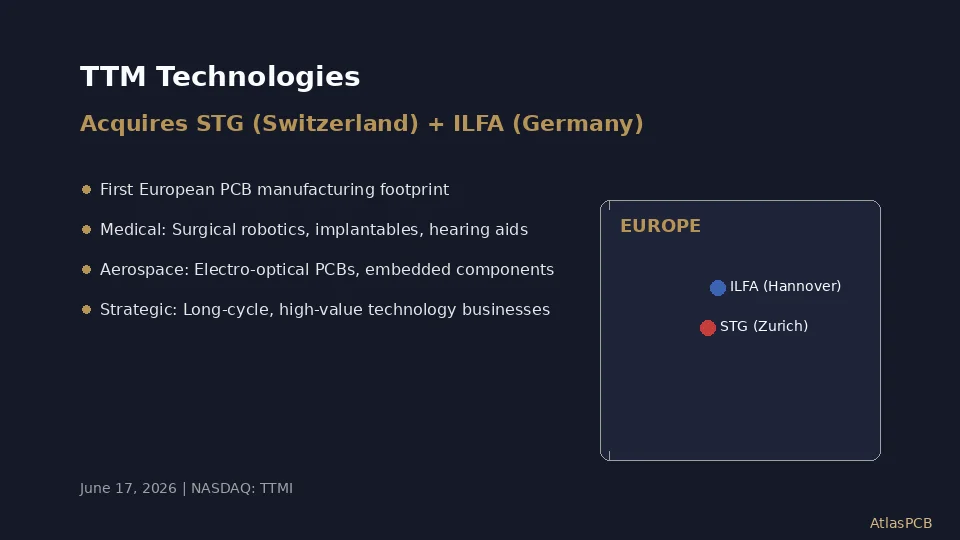
Earlier this year, TTM completed its acquisition of STG-ILFa in Europe, establishing a manufacturing footprint on the continent and gaining access to European defense programs that increasingly require domestic or allied-nation sourcing. That deal was about geography and market access. The Epiq deal is about capability and vertical integration.
TTM also reported record financial results in Q2 2026, driven in part by surging demand from AI infrastructure and aerospace programs. Those results gave TTM the financial confidence — and the balance sheet — to pursue a billion-dollar acquisition. The company’s expanded presence at Farnborough 2026 further underscored its ambitions in the aerospace sector.
Taken together, these moves paint a picture of a company that is systematically transforming itself from a PCB fabricator into a vertically integrated defense electronics supplier. TTM is not abandoning its core PCB business. Rather, it is building layers of capability on top of that foundation.
What This Means for the Defense Electronics Market
The defense electronics market is in a period of sustained growth, fueled by several converging trends. Electronic warfare has moved from a specialized niche to a central pillar of military strategy, with near-peer adversaries investing heavily in spectrum dominance and signal disruption. Unmanned systems — aerial, ground, and maritime — are consuming increasing shares of defense budgets, and each platform requires sophisticated embedded computing and communications. Space-based systems, once the domain of a handful of national programs, are now being deployed by an expanding roster of government and commercial operators.
All of these trends create demand for the exact capabilities that Epiq Solutions provides. Software-defined radios are the backbone of modern tactical communications. Embedded computing platforms process sensor data at the edge, enabling autonomous decision-making. High-performance RF systems enable everything from radar to electronic countermeasures.
By acquiring Epiq, TTM positions itself to capture value across a broader slice of the defense electronics supply chain. Instead of selling PCBs to a systems integrator who then builds an SDR, TTM can now sell the complete SDR — including the PCBs, the RF components, and the embedded computing architecture. That vertical integration translates to higher margins, deeper customer relationships, and greater strategic relevance to defense primes.
Implications for PCB Engineers and the Supply Chain
For engineers who work with TTM as a PCB fabricator, this acquisition raises important questions about the company’s long-term direction. Will TTM continue to prioritize merchant PCB fabrication, or will its internal programs increasingly absorb capacity? Will RF and high-frequency board production shift toward serving Epiq’s product lines rather than external customers?
These are not immediate concerns — TTM’s PCB business remains substantial and profitable — but they reflect a broader trend in the industry. As major fabricators consolidate and move up the value chain, the landscape for independent PCB sourcing evolves. Engineers and procurement teams should monitor how TTM’s capacity allocation shifts in the coming years, particularly for defense-grade RF substrates and high-reliability multilayer boards.
The consolidation trend itself is worth noting. TTM’s acquisition of Epiq follows a pattern seen across the electronics manufacturing sector, where scale and vertical integration are increasingly viewed as competitive advantages. For smaller and mid-sized PCB fabricators, this creates both challenges — in the form of larger, more integrated competitors — and opportunities, as engineers seek alternative suppliers who can offer dedicated attention and flexible capacity.
Industry Consolidation Shows No Signs of Slowing
The TTM-Epiq deal is unlikely to be the last major acquisition in defense electronics this year. Private equity firms like Veritas Capital have built substantial portfolios of defense technology companies, and many of those platforms are now reaching maturity and seeking strategic buyers. At the same time, defense primes are under pressure to modernize their supply chains and reduce dependence on fragmented vendor bases.
For PCB manufacturers specifically, the message is clear: the industry is moving beyond boards. The companies that will thrive in the next decade are those that can offer integrated solutions — not just bare substrates, but complete electronic assemblies, tested subsystems, and vertically integrated manufacturing. TTM’s acquisition of Epiq is a $1.1 billion bet that this is the future of defense electronics.
The deal is expected to close by the end of 2026, pending customary regulatory approvals. Until then, both companies will continue to operate independently, but the strategic direction is unmistakable. TTM Technologies is building something larger than a PCB company, and the rest of the industry is watching.
Reviewed by AtlasPCB Engineering Team — 15+ years in advanced PCB fabrication for RF, HDI, and rigid-flex applications.
Need RF or Defense-Grade PCBs?
AtlasPCB manufactures high-reliability PCBs for aerospace, defense, and RF applications with Rogers, PTFE, and controlled-impedance capabilities.
Request a Quote →About AtlasPCB — We specialize in complex PCB manufacturing for HDI, RF, and high-reliability applications. Explore our RF and high-frequency PCB services . Every order includes free engineering review. Get your quote.
Reviewed by AtlasPCB Engineering Team — IPC-certified manufacturing specialists with 15+ years of production experience in HDI, RF, and high-reliability PCB fabrication. Content based on factory floor data and real customer design reviews.
Frequently Asked Questions
Why is TTM Technologies acquiring Epiq Solutions?
What does Epiq Solutions do?
How does this acquisition affect the PCB industry?
When will the TTM-Epiq acquisition close?
- ttm technologies
- epiq solutions
- defense electronics
- aerospace pcb
- rf pcb
- acquisition
- electronic warfare
- software-defined radio