· Atlas PCB Engineering Team · News · 6 min read
Global Semiconductor Sales Hit $403 Billion in Q2 2026 as AI Demand Drives PCB Material Shortage
SIA reports record Q2 2026 semiconductor sales of $403.3 billion — up 35% quarter-over-quarter and 124% year-over-year — as AI server demand drives an unprecedented surge in PCB raw material costs, with glass cloth prices rising 18% in a single month and CCL prices up 15%. What PCB buyers need to know about the supply chain outlook.
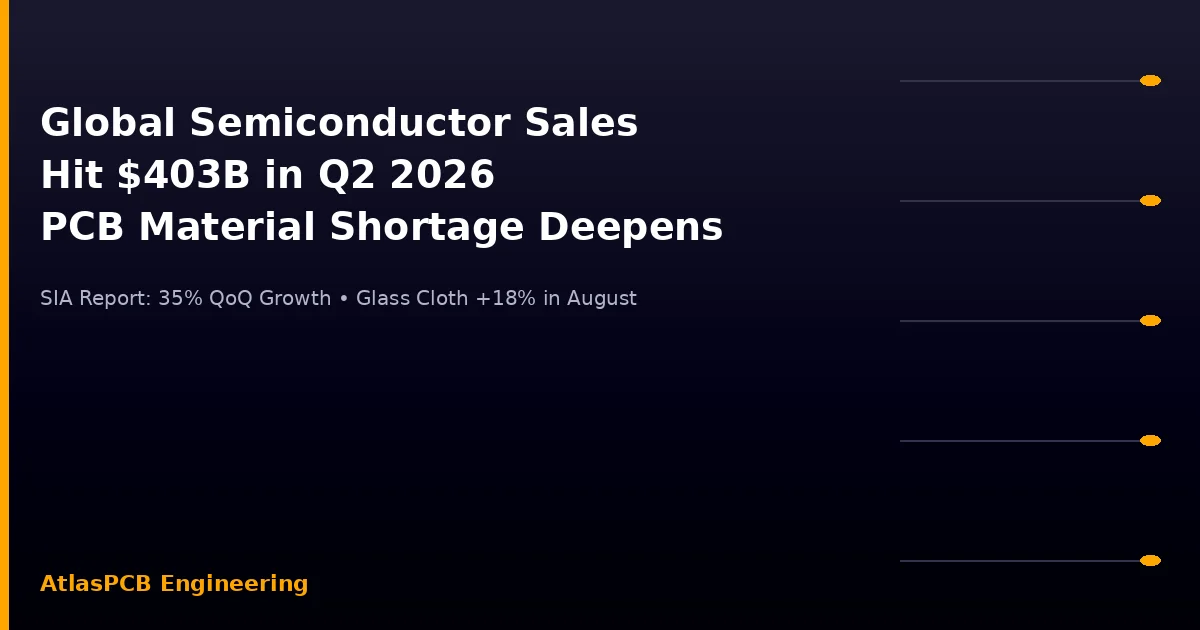
The Semiconductor Industry Association (SIA) announced on August 6, 2026 that global semiconductor sales reached $403.3 billion during the second quarter of 2026, representing a 35.1% increase over Q1 2026 and a staggering 123.6% year-over-year growth for the month of June alone. Monthly sales hit $134.5 billion in June 2026, setting a pace that puts the industry firmly on track to surpass $1.5 trillion in annual revenue for the first time in history. These figures confirm what PCB manufacturers and their supply chains have been experiencing firsthand for months: the AI infrastructure buildout is consuming electronic materials at a rate that the upstream supply chain was never designed to handle.
The AI Multiplier Effect on PCB Material Demand
The headline semiconductor numbers tell only part of the story for the PCB industry. What makes this growth cycle fundamentally different from previous semiconductor booms is the disproportionate impact on PCB complexity and material consumption per chip produced. Traditional server and networking equipment — the primary consumers of advanced PCBs — requires 8 to 14-layer boards consuming approximately 3 to 5 meters of glass cloth per unit. The AI-optimized servers and accelerator platforms driving this growth cycle use 16 to 30+ layer boards, with some specialized AI interconnect architectures requiring PCBs exceeding 70 layers. A single AI server platform consumes 30 to 50 meters of glass cloth — a 3x to 10x multiplication in material demand compared to the conventional servers it replaces.
This multiplier effect means that semiconductor revenue growing at 35% does not translate to 35% growth in PCB material demand — it translates to something considerably larger, because the semiconductor growth is concentrated precisely in the AI and high-performance computing segments that consume the most complex, material-intensive PCBs. The SIA data showing the strongest growth in logic and memory segments (the chip categories driving AI platforms) rather than in commodity semiconductors confirms that the PCB supply chain is experiencing demand growth that significantly exceeds the headline semiconductor figures.
Glass Cloth Crisis: Prices Up 140% From 2025 Baseline
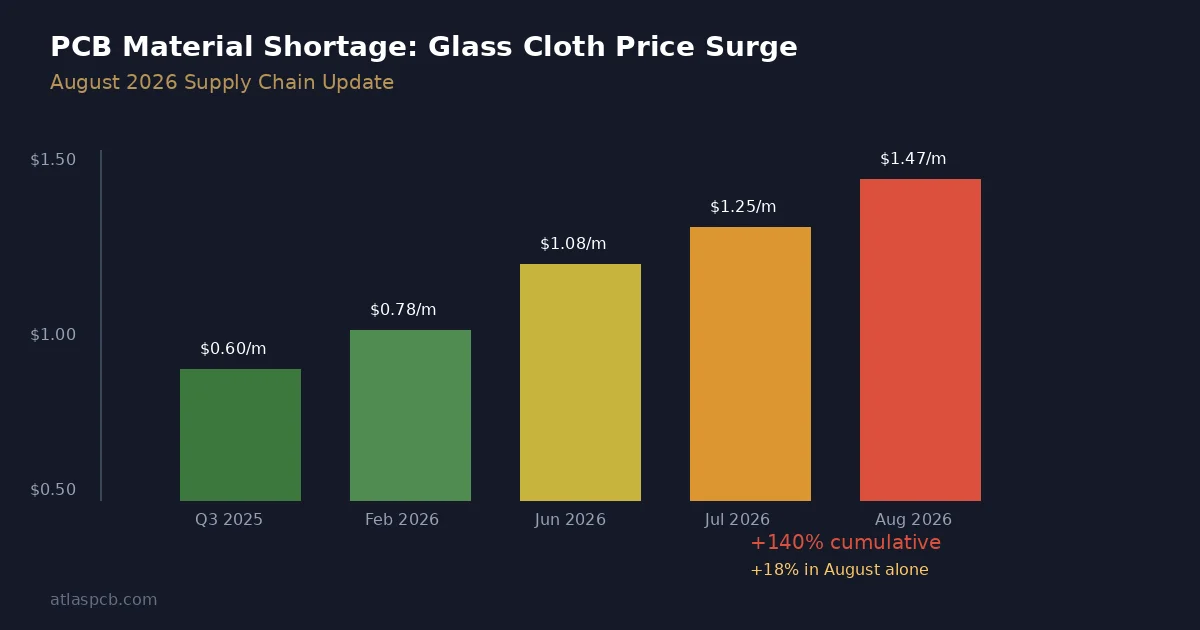
The most acute manifestation of this demand surge in the PCB supply chain is the ongoing glass cloth shortage that has pushed standard 7628 E-glass cloth prices from approximately $0.60-0.61 per meter in Q3 2025 to $1.47 per meter in August 2026 — a cumulative increase of 140% in less than twelve months. The August 2026 price jump alone was 17-18%, marking the steepest single-month increase since the current supply crisis began accelerating in February 2026.
The shortage is not simply a matter of total glass cloth production capacity, but rather a structural reallocation of that capacity toward high-margin specialty fabrics. AI server PCBs require Low-Dk and ultra-thin glass cloths for their signal integrity requirements at 112G SerDes and beyond. Weaving manufacturers have responded to premium pricing on these specialty fabrics (which command spot prices of $21.90-37.95 per meter) by shifting air-jet loom capacity away from standard specifications like 7628 and 2116 toward the high-value materials. This capacity reallocation has created artificial scarcity in standard glass cloth grades — the very materials used in the vast majority of conventional PCB production — even as specialty fabric supply struggles to keep pace with AI-driven demand.
Industry inventories have dropped to critically low levels of 3 to 10 days across major weaving mills, with many suppliers operating on advance-payment or allocation systems. Expanding production capacity requires specialized air-jet looms sourced primarily from Japanese equipment manufacturers currently quoting delivery lead times measured in years rather than months, suggesting that supply constraints will persist well into 2027 at minimum.
Downstream Cost Transmission: CCL and PCB Pricing
The glass cloth crisis is transmitting directly into copper clad laminate (CCL) pricing, where glass cloth represents 25-40% of manufacturing input costs depending on the laminate grade. Major CCL suppliers have implemented price increases exceeding 15% since the beginning of the year, with standard FR-4 sheet prices rising from approximately $16.05 to over $27.70 per sheet. High-speed laminate grades incorporating Low-Dk glass cloth have seen even steeper increases due to the extreme spot market premiums for specialty glass fabrics.
PCB fabricators, facing rising input costs for laminate, copper foil (which has its own supply pressures from EV and renewable energy demand), and chemistry consumables, have begun adjusting quotations upward by 20% or more across rigid, flex, and HDI product categories. The price increases are most severe for high-layer-count designs requiring specialty materials — precisely the product categories experiencing the strongest demand growth from AI customers — but standard FR-4 production is not immune given the shortage of basic glass cloth grades.
What This Means for PCB Buyers
For hardware engineering teams planning prototype runs or production orders in the current environment, several practical considerations emerge from these market conditions. Lead times for standard multilayer PCBs have extended by 5-10 working days compared to early 2026 levels, primarily driven by laminate procurement delays rather than fabrication capacity constraints. For designs requiring specialty materials (high-speed laminates, Low-Dk substrates, or ultra-thin prepregs used in HDI stackups), lead time extensions of 3-4 weeks above normal are common, and some specific material grades require 8-12 week advance procurement.
The cost environment favors design decisions that reduce material consumption without sacrificing performance. Working with fabrication engineers to optimize stackups — potentially using fewer prepreg plies of carefully selected construction rather than defaulting to thick buildup layers — can reduce material demand per board while maintaining impedance control accuracy. Similarly, copper balancing strategies that reduce resin consumption during lamination allow fabricators to use lower resin content prepregs that are currently more available than high-resin variants.
For programs with fixed budgets, locking in material pricing through advance purchase agreements or extended production forecasts provides protection against further increases that industry analysts project through Q4 2026, with some forecasts suggesting standard glass cloth could reach $1.75-2.19 per meter before supply-demand equilibrium is restored. The SIA’s projections of continued strong semiconductor demand through 2027, driven by ongoing AI infrastructure investment from hyperscale cloud providers and national AI initiatives, suggests that the material supply pressures affecting the PCB industry are structural rather than cyclical — requiring strategic rather than tactical procurement responses.
Industry Outlook
The convergence of record semiconductor demand with constrained PCB material supply creates a market environment that will reshape pricing, lead times, and design practices across the electronics industry for the foreseeable future. The SIA’s Q2 2026 data confirms that AI-driven demand is not a temporary surge but an accelerating trend, with quarterly growth rates suggesting the semiconductor industry will comfortably exceed $1.5 trillion in 2026 annual sales. For the PCB supply chain, this means that material cost pressures are likely to intensify before they moderate, and that engineering teams who adapt their design and procurement practices to the new cost reality will maintain competitive advantage over those waiting for prices to return to 2025 levels.
Sources: Semiconductor Industry Association (SIA) Q2 2026 Global Sales Report (August 6, 2026); PCEA August 2026 Digital Issue; industry glass cloth pricing data.
About AtlasPCB — We specialize in complex PCB manufacturing for HDI, RF, and high-reliability applications. Explore our impedance-controlled PCB manufacturing . Every order includes free engineering review. Get your quote.
Reviewed by AtlasPCB Engineering Team — IPC-certified manufacturing specialists with 15+ years of production experience in HDI, RF, and high-reliability PCB fabrication. Content based on factory floor data and real customer design reviews.
- semiconductor market
- PCB supply chain
- glass cloth shortage
- AI infrastructure
- raw material costs