· AtlasPCB Engineering Team · News · 9 min read
Global Semiconductor Market Hits $368 Billion in Q2 2026: What 104% YoY Growth Means for PCB Manufacturing Demand
The global semiconductor market reached a record $368 billion in Q2 2026 with 104% year-over-year growth driven by AI. Nvidia reported $96.2 billion quarterly revenue while memory companies grew 51-76% sequentially. Analysis of what unprecedented semiconductor expansion means for PCB manufacturing capacity, material demand, and board complexity requirements.
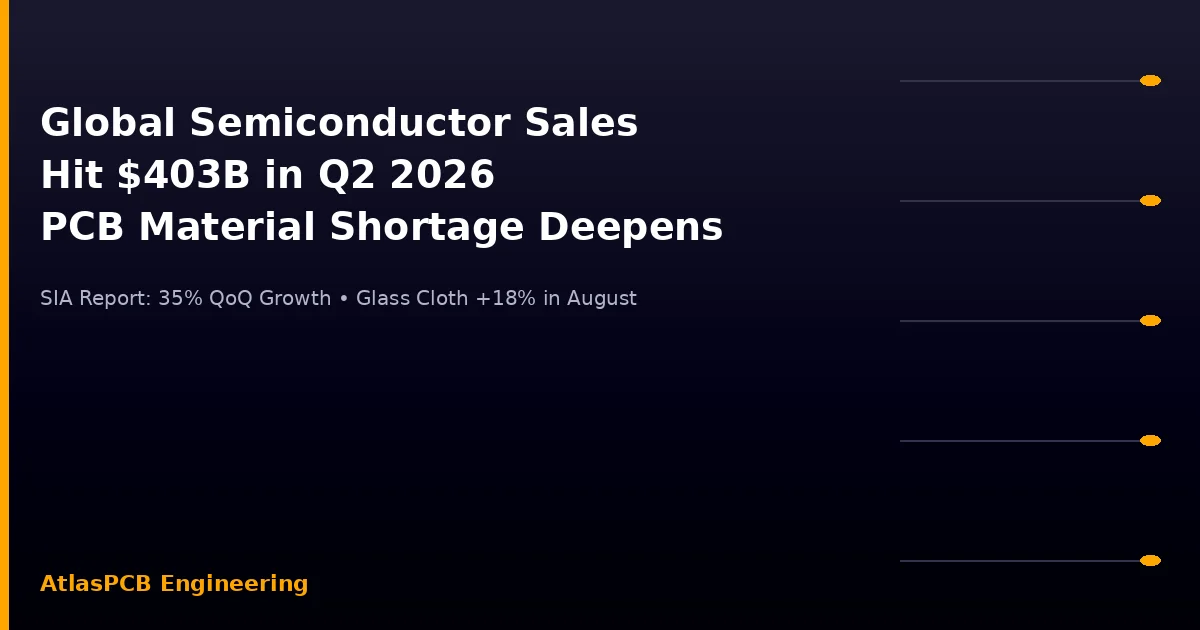
The global semiconductor market shattered all previous records in the second quarter of 2026, reaching $368 billion in total revenue according to data from the World Semiconductor Trade Statistics organization. That figure represents 104% year-over-year growth from Q2 2025 and a 35% sequential increase from Q1 2026, which itself had already set records with 79% annual growth. The numbers confirm what industry observers have been tracking for months: artificial intelligence infrastructure spending has entered a phase of expansion unprecedented in the history of computing, and the downstream pressure on PCB manufacturing is intensifying at every level of the supply chain.
Nvidia’s Record Quarter and What Vera Rubin Means for Board Demand
Nvidia reported Q2 2026 revenue of $96.2 billion, up 18% from the prior quarter and 106% year-over-year. The company’s Vera Rubin GPU architecture has entered full production, and management issued Q3 guidance of $108 billion — notably excluding any revenue assumptions from Chinese datacenter customers. Jensen Huang summarized the market dynamics bluntly: “AI has reached its inflection point. Compute is revenue. Demand is accelerating.”
For PCB manufacturers, those revenue figures translate directly into physical hardware. Each Nvidia GPU module requires a sophisticated multi-layer substrate. Each AI server board carrying those GPUs demands 20 to 40 or more PCB layers with controlled impedance, ultra-low-loss dielectrics, and microvias for breakout routing beneath BGA packages. A single hyperscale AI cluster rack can contain dozens of these boards, and global hyperscalers are building datacenters with tens of thousands of racks. The math is stark: Nvidia shipping $96 billion in GPU products in a single quarter means the PCB industry must supply the corresponding volume of high-complexity boards designed for AI accelerator workloads.
Vera Rubin’s architecture pushes board requirements further still. Higher power delivery demands thicker copper planes and more sophisticated power distribution networks. Faster SerDes interfaces operating at 224 Gbps require tighter impedance control and advanced materials such as Megtron 7 or Tachyon 100G. Every generation of GPU that ships in higher volume compounds the demand on PCB fabricators equipped to handle these specifications.
Memory Company Explosive Growth and HBM Substrate Implications
The memory segment posted the most dramatic sequential growth of any semiconductor category in Q2 2026. SK Hynix revenue grew 51% quarter-over-quarter. SanDisk matched that at 51%. Kioxia surged 76% sequentially. Full-year 2026 memory growth projections range from 249% (WSTS) to 280% (Gartner), numbers that would have seemed implausible just eighteen months ago.
High Bandwidth Memory is the critical link between this memory explosion and PCB manufacturing demand. HBM stacks require advanced silicon interposers and substrate packaging that pushes the boundaries between semiconductor packaging and PCB fabrication. The substrates used in HBM assembly demand line-and-space geometries below 10 micrometers, materials with ultra-low CTE mismatch, and drilling precision that rivals wafer-level processing. As HBM production scales to meet AI GPU demand, substrate manufacturers face capacity constraints that ripple outward to conventional PCB production — competing for the same advanced drilling equipment, laminate materials, and clean-room production capacity.
SK Hynix’s announcement of an Indiana manufacturing plant adds geographic diversification but also signals sustained long-term demand. The company is reportedly exploring closer strategic ties with Kioxia, a move that would consolidate memory manufacturing expertise and potentially create the world’s largest advanced packaging operation outside of Taiwan.
The $31.4 Billion NAND Investment and Downstream PCB Effects
Kioxia and SanDisk announced a joint $31.4 billion investment in NAND flash production over six years, centered on a new fabrication facility at Kitakami, Japan. While NAND flash itself is a semiconductor product, the infrastructure required to build and operate these fabs creates substantial downstream demand for PCB products. Fab equipment runs on complex control boards. Testing infrastructure requires high-speed measurement PCBs. The storage systems that house NAND products — enterprise SSDs, datacenter storage arrays — each require multi-layer PCBs with high-speed interfaces.
More importantly, the investment signals that memory manufacturers see sustained demand through at least 2032. For PCB manufacturers planning capacity investments and material procurement strategies, this provides a rare window of demand visibility. The material supply chain pressures already evident in 2026 are unlikely to ease if memory production is scaling at this pace for the next six years.
With AI demand consuming advanced board capacity, lead times are extending across the industry. AtlasPCB maintains dedicated capacity for high-complexity designs. Get a quote and lock in your slot
What This Means for PCB Manufacturers: Capacity, Materials, and Complexity
The semiconductor industry’s $368 billion quarter does not exist in isolation from PCB manufacturing — it depends on it. Every chip must be mounted on a board. Every board must be fabricated from laminate materials, drilled, plated, etched, and tested. The PCB industry is the physical foundation upon which semiconductor growth is built.
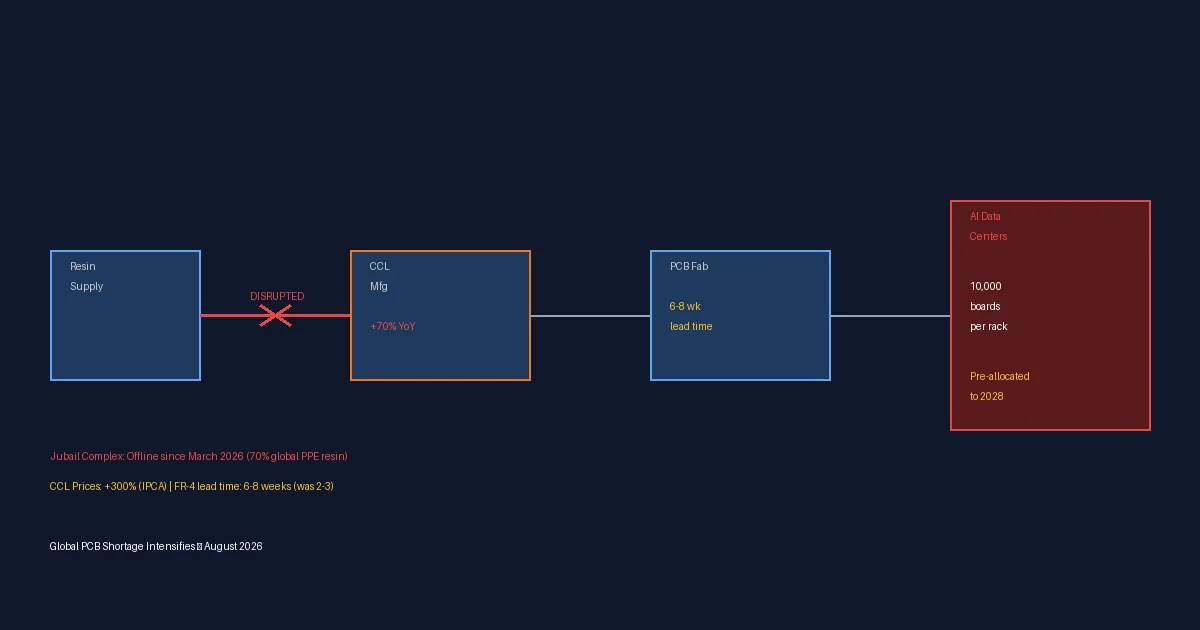
Three pressures are converging simultaneously. First, capacity: fabricators with advanced capabilities — sequential lamination for 20+ layer boards, laser drilling for microvias, and controlled-depth back-drilling — are running at or near full utilization. New capacity takes 18 to 24 months to bring online, and the demand surge is outpacing expansion plans. Second, materials: ultra-low-loss laminates from suppliers like Panasonic (Megtron series), Isola, and Rogers are experiencing extended lead times as AI server board production consumes available supply. Third, complexity: each new GPU generation demands finer geometries, tighter tolerances, and more sophisticated stackup designs, which reduces yield rates and effective throughput even at existing facilities.
The practical consequence is that lead times for high-layer-count, high-speed PCBs are extending. Projects that might have secured four-week delivery in 2024 now face six to eight weeks or longer at many fabricators. Engineers designing boards for AI-adjacent applications — networking switches, power delivery modules, optical transceivers, and server management controllers — are competing for the same manufacturing slots as the hyperscale GPU boards themselves.
The Divergence: AI Suppliers Versus the Rest of Semiconductor
Perhaps the most telling statistic from Q2 2026 is the growth divergence within the semiconductor industry itself. The five major AI-focused suppliers collectively grew 40% quarter-over-quarter, with Broadcom projecting 33% growth. Meanwhile, non-AI semiconductor companies grew a modest 9% sequentially. The semiconductor boom is not broad-based — it is concentrated in AI infrastructure.
This divergence matters for PCB procurement strategy. The fabrication capacity being consumed by AI boards is the same advanced capacity needed for other high-performance applications: aerospace avionics, medical imaging systems, telecommunications infrastructure, and automotive radar modules. Engineers in these sectors who are not directly building AI hardware are nonetheless affected by the capacity absorption happening in AI server production. The competition for manufacturing slots is asymmetric — hyperscalers can commit to large volumes with premium pricing, crowding out smaller orders that require the same technical capabilities.
2026-2027 Outlook and Sustainability of the Boom
Full-year 2026 semiconductor growth forecasts range from 90% to 112%, with Semiconductor Intelligence projecting 101% and RCD Advisors at 112%. Industry analysts have compared the current AI infrastructure buildout to previous transformative waves: consumer electronics in the 1970s, personal computers in the 1980s, the internet in the 1990s, and smartphones in the 2010s. Each of those cycles sustained growth for roughly a decade before maturing.
If the AI buildout follows a similar trajectory, PCB manufacturing demand for advanced boards will remain elevated through at least 2030. The investment patterns support this thesis — companies do not commit $31.4 billion to new fabs or open overseas manufacturing plants for a demand cycle they expect to end in eighteen months. For PCB manufacturers and their customers, planning horizons should extend accordingly.
The risk scenario is not demand collapse but rather supply-demand mismatch. If semiconductor growth sustains above 50% annually while PCB capacity grows at its historical 5-8% rate, the gap will widen. Material suppliers, equipment manufacturers, and fabricators that underinvest now will face acute shortages in 2027 and beyond.
Implications for Hardware Engineers Ordering PCBs Today
For engineers currently designing or about to prototype high-complexity boards, the Q2 2026 semiconductor data carries actionable implications. Lead times for advanced PCBs are not returning to pre-2025 levels in the near term. Material availability for ultra-low-loss laminates requires advance planning — specifying materials early and confirming supplier allocation before finalizing designs can prevent costly delays.
Design choices also matter more in a capacity-constrained environment. Boards that can achieve performance targets with fewer sequential lamination cycles, standard microvia structures rather than stacked or staggered configurations, and well-understood material systems will move through fabrication faster than designs pushing the absolute limits of manufacturing capability. This is not an argument against pushing boundaries — some applications demand it — but rather a call to be intentional about where complexity is necessary versus where it is inherited from legacy design habits.
Engineers should also consider qualifying multiple PCB suppliers for critical designs. Single-source dependency in a market where fabricators are selecting which orders to accept based on margin and complexity fit creates unacceptable project risk. Having a qualified alternative supplier with confirmed capability and material access provides schedule insurance that is worth the upfront qualification effort.
AtlasPCB specializes in advanced multilayer boards for AI, networking, and high-speed applications. Our engineering team reviews every design for manufacturability before production begins. Submit your design for a free DFM review
The $368 billion semiconductor quarter is not merely a financial milestone — it is a physical manufacturing challenge. Every dollar of that revenue eventually translates into silicon mounted on a PCB, routed through copper traces, and connected to a system. The PCB industry sits at the nexus of this demand surge, and the engineers who plan ahead will navigate it successfully. Those who treat PCB procurement as an afterthought will find themselves waiting in line behind the largest technology companies on earth.
Reviewed by AtlasPCB Engineering Team
Sources: WSTS Q2 2026 data, Nvidia Q2 FY2027 earnings report, Electronics Weekly, Semiconductor Intelligence, RCD Advisors market forecasts, Gartner memory market projections.
About AtlasPCB — We specialize in complex PCB manufacturing for HDI, RF, and high-reliability applications. Explore our full PCB manufacturing capabilities, or get an impedance-controlled PCB manufacturing . Every order includes free engineering review. Get your quote.
Reviewed by AtlasPCB Engineering Team — IPC-certified manufacturing specialists with 15+ years of production experience in HDI, RF, and high-reliability PCB fabrication. Content based on factory floor data and real customer design reviews.
- semiconductor market
- AI demand
- PCB manufacturing
- Nvidia
- memory growth
- supply chain
- market analysis