· AtlasPCB Engineering · News · 6 min read
North American PCB Book-to-Bill Reaches 1.49 in June 2026 as Shipments Grow 12% Year-Over-Year
The Global Electronics Association reports North American PCB shipments grew 12% year-over-year in June 2026 with bookings surging 31.5%, pushing the book-to-bill ratio to 1.49 for the eighth consecutive month at or above parity. What the sustained demand growth means for lead times and capacity planning.
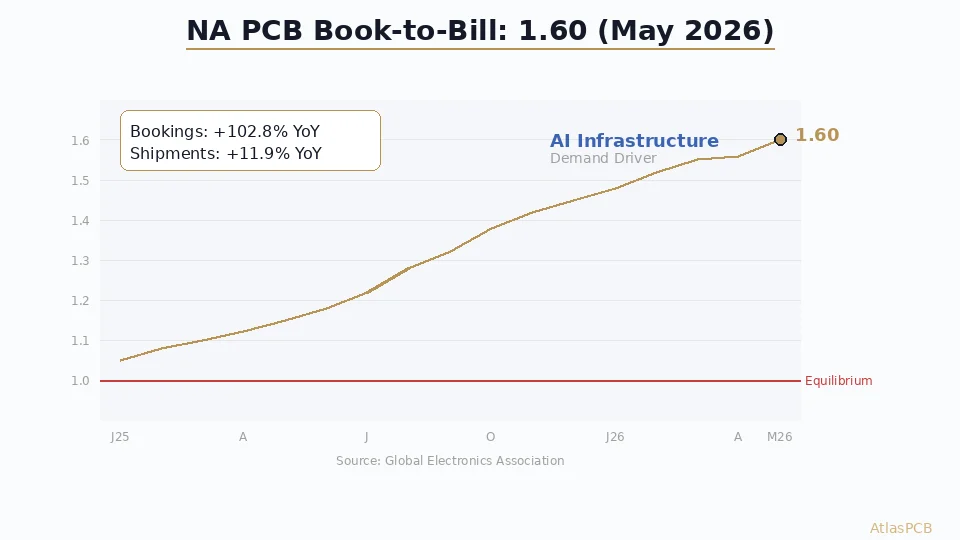
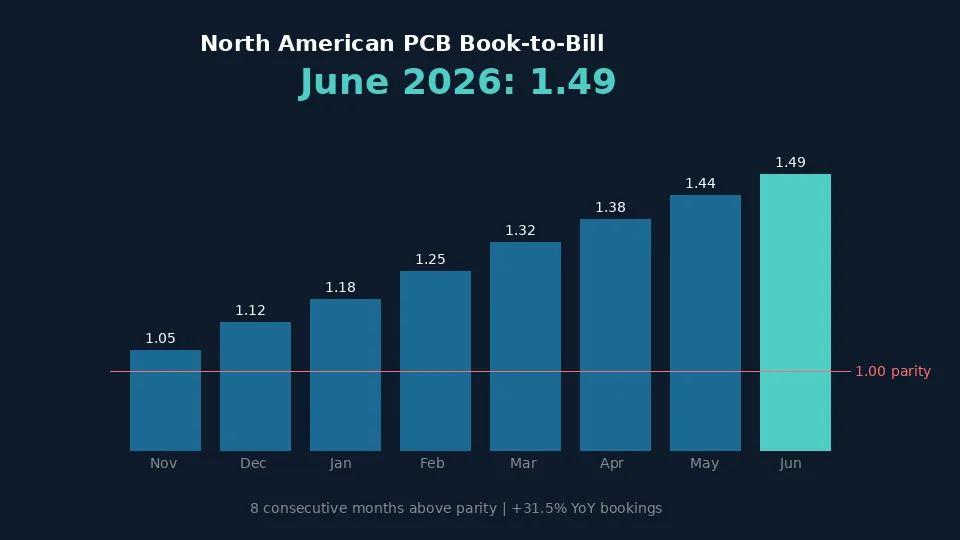
The Global Electronics Association released its June 2026 North American Printed Circuit Board Statistical Program findings on July 28, confirming that the PCB industry’s demand momentum remains firmly intact. Total North American PCB shipments in June 2026 grew 12.0 percent compared to the same month last year, while bookings surged 31.5 percent year-over-year, pushing the book-to-bill ratio to 1.49. This marks the eighth consecutive month the ratio has remained at or above parity, signaling sustained demand growth that shows no signs of deceleration.
The Numbers in Context
The headline shipment growth of 12 percent represents a continuation of the industry’s strong performance trajectory throughout the first half of 2026. Year-to-date shipments through June stand 12.7 percent above the same period in 2025, demonstrating that growth is broad-based and consistent rather than driven by isolated large orders in any single month. Year-to-date bookings paint an even more bullish picture, running 29.0 percent ahead of the same period last year — a level of order growth that virtually guarantees continued shipment expansion through the second half of the year and into early 2027.
The month-over-month comparisons show June shipments declining 18.5 percent from May and bookings falling 35.9 percent from the prior month. However, these sequential declines should not be interpreted as weakness. May 2026 was an exceptionally strong month with bookings driven by several large AI infrastructure programs placing multi-quarter commitments simultaneously. June’s numbers represent a normalization from that spike rather than a demand contraction, as confirmed by the still-elevated book-to-bill ratio well above 1.0.
Dr. Shawn DuBravac, the Global Electronics Association’s chief economist, noted that “the PCB industry’s book-to-bill ratio hit an eighth straight month at or above parity in June, as PCB demand remains firm and rigid board strength continues.” The sustained period above parity contrasts sharply with the sub-1.0 ratios seen throughout much of 2023 and early 2024, when inventory corrections following the post-pandemic boom created an industry-wide demand trough.
Drivers Behind Sustained Growth
The 29 percent year-to-date booking growth far outpacing 12.7 percent shipment growth reveals an important structural dynamic: the industry is accumulating backlog faster than it can convert orders to shipped product. This backlog accumulation reflects both genuine end-market demand growth and customers extending order horizons further into the future to secure capacity at preferred suppliers. Both factors contribute to lead time extension across the North American fabrication base.
The primary demand drivers remain concentrated in AI infrastructure buildout, data center expansion, and advanced telecommunications equipment. High-layer-count boards (20 or more layers), HDI constructions, and boards using advanced materials for high-speed serial links represent the fastest-growing segments within the overall market. These complex board types consume disproportionate factory capacity relative to their panel count because they require more processing steps, tighter tolerances, and longer cycle times than standard multilayer boards.
Automotive electronics continues as a secondary growth driver, with electric vehicle battery management systems, advanced driver assistance systems, and in-vehicle networking requiring increasing board area and complexity per vehicle. The ongoing transition from internal combustion to electric powertrains roughly doubles the PCB content per vehicle, creating sustained organic demand growth independent of overall vehicle production volumes.
Implications for Procurement and Lead Times
A book-to-bill ratio of 1.49 means that for every dollar of product shipped, customers are placing $1.49 in new orders. Sustained ratios above 1.3 historically correlate with lead time extension of 2 to 4 weeks beyond standard quotation periods within 3 to 6 months. Procurement teams managing PCB supply for production programs should interpret this data as a clear signal to extend order horizons and lock in production slots further in advance than typical practice allows.
For standard multilayer boards in the 4 to 8 layer range using commodity FR-4 materials, lead time impact remains moderate because capacity in this segment is broadly available across both North American and Asian fabricators. The constraint is more acute for high-complexity constructions — boards requiring sequential lamination, impedance-controlled high-speed materials, or very high layer counts — where fewer qualified manufacturers compete for growing demand. In these segments, lead times that were 3 to 4 weeks in early 2025 have already extended to 5 to 7 weeks, with further extension likely if booking growth continues at current rates.
Material availability adds another dimension to the lead time picture. The sustained demand growth has created upstream pressure on copper clad laminate suppliers, glass cloth producers, and specialty resin manufacturers. While material supply has not reached the acute shortage conditions of 2021, allocation-based supply for high-frequency laminates and ultra-low-loss materials has returned for some product grades, requiring fabricators to maintain larger raw material buffers and plan procurement further ahead.
What This Means for AtlasPCB Customers
Our production planning team monitors these industry indicators closely to maintain the lead times and service levels our customers expect. Current lead times for standard FR-4 multilayer boards remain stable at our published quotation periods. For high-frequency materials including Rogers and Megtron-series laminates, we recommend placing orders with at least one week additional buffer beyond standard lead times to accommodate potential material delivery variability from our upstream suppliers.
For customers with predictable quarterly demand patterns, locking in material reservations through blanket purchase agreements ensures continuity regardless of industry-level supply tightness. We encourage customers planning production ramps for Q4 2026 to engage our team now for material planning and capacity scheduling, particularly for designs requiring specialty materials or complex constructions that consume extended processing time.
The broader market signal from eight consecutive months of above-parity book-to-bill ratios is unambiguous: PCB demand is robust, supply chains are tightening, and the advantage belongs to buyers who plan ahead rather than relying on just-in-time procurement against shrinking available capacity. Early engagement in design review, material selection, and production scheduling will be the differentiating factor for teams who need predictable delivery through the second half of 2026.
Reviewed by AtlasPCB Engineering Team
SECURE YOUR PRODUCTION SLOTS
Lock In Lead Times Before Q4 Demand Peaks
Get a quote today and reserve production capacity. Blanket orders and scheduled releases available for repeat production programs.
Get Your Quote ›About AtlasPCB — We specialize in complex PCB manufacturing for HDI, RF, and high-reliability applications. Explore our full PCB manufacturing capabilities, or get an instant online quote . Every order includes free engineering review. Get your quote.
Reviewed by AtlasPCB Engineering Team — IPC-certified manufacturing specialists with 15+ years of production experience in HDI, RF, and high-reliability PCB fabrication. Content based on factory floor data and real customer design reviews.
- news
- PCB industry
- book-to-bill
- PCB shipments
- market data