· Atlas PCB Engineering Team · News · 6 min read
North American PCB Book-to-Bill Hits 1.49 in June 2026 as Industry Demand Extends Eight-Month Growth Streak
The Global Electronics Association reports North American PCB bookings surged 31.5% year-over-year in June 2026 with a book-to-bill ratio of 1.49, marking eight consecutive months at or above parity. What the sustained demand strength means for PCB buyers navigating capacity allocation and lead times.
June 2026 Data Confirms Sustained Industry Demand
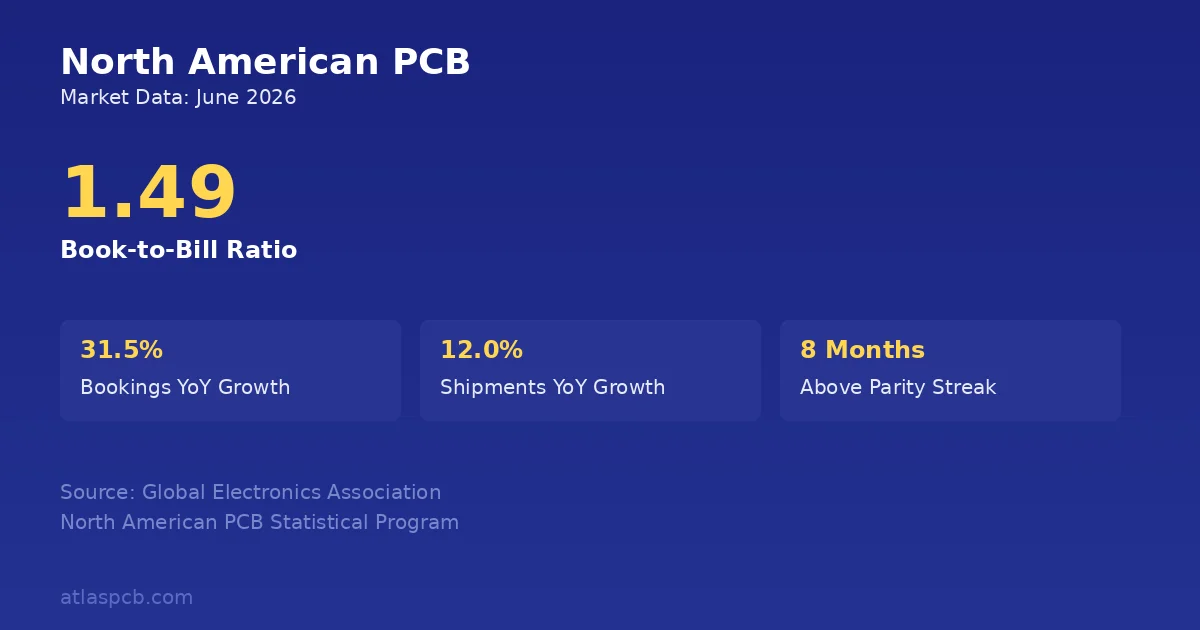
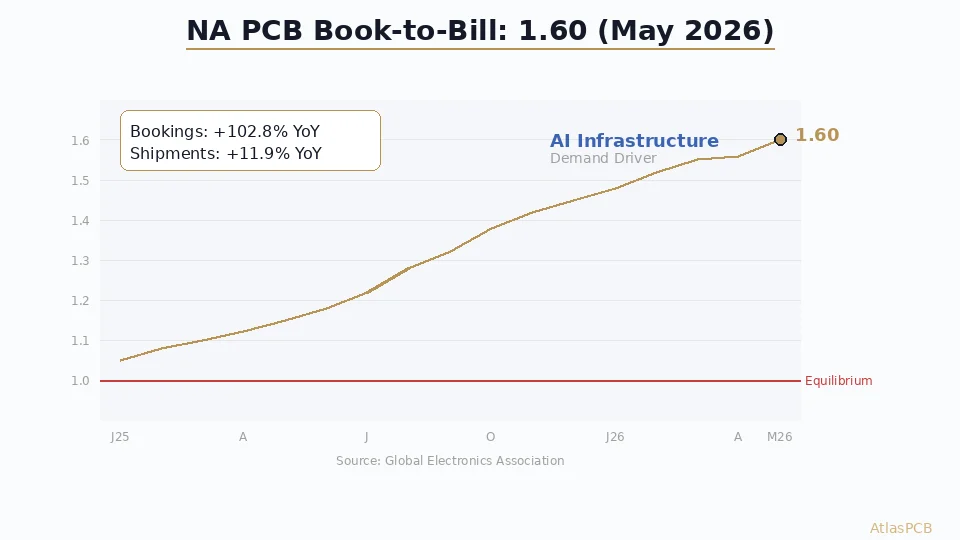
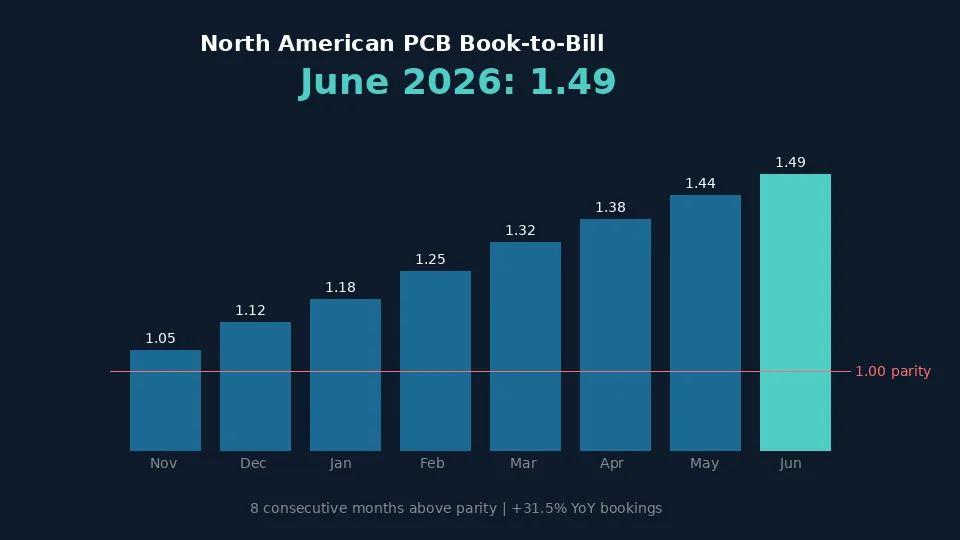
The Global Electronics Association (formerly IPC) released its latest North American Printed Circuit Board Statistical Program data in early August, revealing that the PCB book-to-bill ratio reached 1.49 in June 2026 — marking eight consecutive months at or above parity. The data confirms that the domestic PCB industry is experiencing a sustained demand cycle unlike anything seen since the post-pandemic recovery surge of 2021.
Total North American PCB shipments in June 2026 increased 12.0 percent compared to the same month last year, while year-to-date shipments through May had already risen 12.7 percent year-over-year. More significantly, PCB bookings in June jumped 31.5 percent year-over-year, with year-to-date bookings through May running 29.0 percent above the prior year’s levels.
“The PCB industry’s book-to-bill ratio hit an eighth straight month at or above parity in June, as PCB demand remains firm and rigid board strength continues,” said Dr. Shawn DuBravac, the Global Electronics Association’s chief economist. The sequential month-over-month decline — shipments fell 18.5 percent and bookings dropped 35.9 percent compared to May — reflects typical seasonal patterns rather than any structural softening, as May had been an exceptionally strong booking month driven by large program orders.
What a 1.49 Book-to-Bill Means for PCB Buyers
A book-to-bill ratio above 1.0 indicates that new orders exceed current shipments, signaling growing backlog and future production demand. At 1.49, the industry is booking nearly 50 percent more work than it is currently shipping — a level that historically precedes capacity tightening and lead time extensions within two to four months.
For hardware engineers and procurement teams planning new product introductions, this data carries immediate practical implications. Fabricators operating at high utilization rates become more selective about which orders they accept, prioritizing existing customer programs and higher-margin advanced technology work. Standard rigid PCB lead times, which had returned to three-to-four-week norms during the relatively balanced market of early 2025, have already begun extending into the five-to-seven-week range at many North American facilities.
The 31.5 percent year-over-year booking growth rate suggests that the demand acceleration has not yet peaked. Order placement today locks in capacity that may not be available at short notice in Q4 2026, particularly for complex multilayer designs requiring impedance control, HDI features, or exotic materials that consume more production capacity per panel.
Demand Drivers Behind the Numbers
Several converging factors explain the strength in North American PCB demand. The AI infrastructure buildout remains the dominant driver, with hyperscale data center operators placing substantial orders for high-layer-count server boards, advanced packaging substrates, and networking equipment PCBs. These designs typically require 16 to 30+ layers with tight impedance tolerances, sequential lamination, and heavy copper power planes — consuming disproportionate fabrication capacity relative to their panel count.
Defense and aerospace spending continues its upward trajectory as governments increase electronics content in next-generation platforms. The rigid board segment that Dr. DuBravac specifically highlighted benefits from military programs demanding domestic fabrication under ITAR and Buy American requirements, channeling work exclusively to North American facilities rather than allowing offshore alternatives.
The reshoring trend has also contributed incrementally to domestic booking growth. Companies implementing China Plus One sourcing strategies are qualifying North American and Southeast Asian fabricators for production that previously went exclusively to Chinese facilities. While the volume shift remains modest in absolute terms, it adds incremental demand to an already constrained domestic supply base.
Automotive electrification, though facing some demand moderation in the battery electric vehicle segment, continues generating steady PCB demand through ADAS sensor modules, battery management systems, and the growing electronics content per vehicle. The transition from internal combustion to electric powertrains roughly doubles the PCB content value per vehicle, supporting sustained growth even when unit vehicle sales fluctuate.
Capacity Response Lags Demand
The PCB industry’s capacity expansion cycle operates on fundamentally longer timelines than order intake. Building new fabrication capability requires 18 to 24 months from investment decision to qualified production, and even expanding existing facilities with additional production lines takes 12 to 18 months given equipment lead times and facility qualification requirements.
North American fabricators have announced several expansion projects in response to the demand environment. TTM Technologies reported record Q2 2026 revenue exceeding one billion dollars, driven by AI and networking demand, and has committed capital to capacity expansion at its Utah and New York facilities. Smaller domestic fabricators are similarly investing, though their expansion scale is necessarily more modest.
The challenge is that the current booking surge reflects demand arriving now, while capacity expansions deliver output quarters or years into the future. This temporal mismatch is the fundamental mechanism that produces allocation constraints and lead time extensions during up-cycles. Buyers who wait for capacity to “catch up” before placing orders often find themselves at the back of allocation queues.
Implications for International PCB Sourcing
The North American book-to-bill data exists within a global context. Asian fabricators — particularly in China, Taiwan, and Southeast Asia — serve the bulk of global PCB production volume. However, the same AI and advanced electronics demand driving North American bookings is also straining Asian capacity for advanced substrates and high-layer-count designs.
For hardware companies sourcing PCBs internationally, the strong North American data suggests that domestic capacity should not be treated as an unlimited overflow option when offshore suppliers become constrained. The era when North American fabricators maintained significant idle capacity available for rush orders has ended, at least for the current cycle.
Companies maintaining dual-source strategies between domestic and offshore fabricators should ensure their demand forecasts are communicated to both sources well ahead of production needs. The competitive advantage of pre-positioning capacity with multiple qualified suppliers becomes most valuable precisely when it requires the most advance planning — during periods of broad industry tightness like the current environment.
What PCB Buyers Should Do Now
The data supports several actionable recommendations for engineering teams planning production over the next two to four quarters. First, extend order horizons beyond minimum lead times wherever design schedules permit. Placing orders at four to six weeks of lead time when three weeks was previously sufficient provides a buffer against further lead time extension.
Second, engage fabricators in capacity planning discussions for upcoming programs, particularly those requiring advanced technology features. Sharing rolling forecasts — even preliminary estimates — helps fabricators plan capacity allocation and may secure preferential scheduling when production volumes materialize.
Third, consider material strategy as part of capacity planning. Many of the designs driving the current demand surge require specialty laminates such as high-speed low-loss materials, HVLP copper foil, and thin-core dielectrics that have their own supply constraints independent of fabrication capacity. Locking in material allocation through your fabricator or directly with laminate suppliers prevents material shortages from adding delays on top of fabrication lead times.
Finally, evaluate whether designs can be optimized for manufacturing efficiency. Boards designed with standard materials, conventional via structures, and relaxed tolerances where performance allows consume less fabrication capacity per panel, making them easier to schedule during periods of high utilization. Your fabricator’s DFM team can often identify small design modifications that dramatically improve manufacturability without compromising electrical performance.
Reviewed by AtlasPCB Engineering Team. We maintain capacity allocation for our contract customers through advance planning and strategic material inventory. Contact our team to discuss capacity reservation for your upcoming PCB programs.
About AtlasPCB — We specialize in complex PCB manufacturing for HDI, RF, and high-reliability applications. Explore our full PCB manufacturing capabilities, or get an instant online quote . Every order includes free engineering review. Get your quote.
Reviewed by AtlasPCB Engineering Team — IPC-certified manufacturing specialists with 15+ years of production experience in HDI, RF, and high-reliability PCB fabrication. Content based on factory floor data and real customer design reviews.
- PCB industry
- book-to-bill ratio
- North America
- PCB demand
- market data
- capacity planning