· AtlasPCB Engineering · News · 6 min read
AI Demand Drives Record PCB Revenue: TTM Hits $1B Quarterly, Zhen Ding Profit Surges 209%, Tripod Margins Exceed 30%
Q2 2026 earnings reveal unprecedented AI-driven growth across major PCB manufacturers. TTM Technologies posts first-ever billion-dollar quarter with 91% data center growth, Zhen Ding reports 209% profit increase fueled by optical module PCB demand, and Tripod Technology achieves record 30% gross margins. Analysis of what these results mean for PCB supply, pricing, and lead times.
The second quarter of 2026 has produced a remarkable set of earnings reports from major PCB manufacturers, confirming that artificial intelligence infrastructure demand has fundamentally reshaped the industry’s revenue and profitability landscape. Three of the world’s largest PCB companies — TTM Technologies, Zhen Ding Technology, and Tripod Technology — each posted record or near-record results in the same quarter, with AI-related products driving the majority of their growth.
These results are not merely financial milestones for individual companies. They represent structural shifts in PCB supply allocation, capacity investment priorities, and pricing dynamics that affect every hardware engineer and procurement team sourcing circuit boards in the current market. Understanding the scale of this demand concentration helps explain the lead time extensions and pricing pressure that mid-market customers have experienced throughout 2026.
TTM Technologies: First Billion-Dollar Quarter
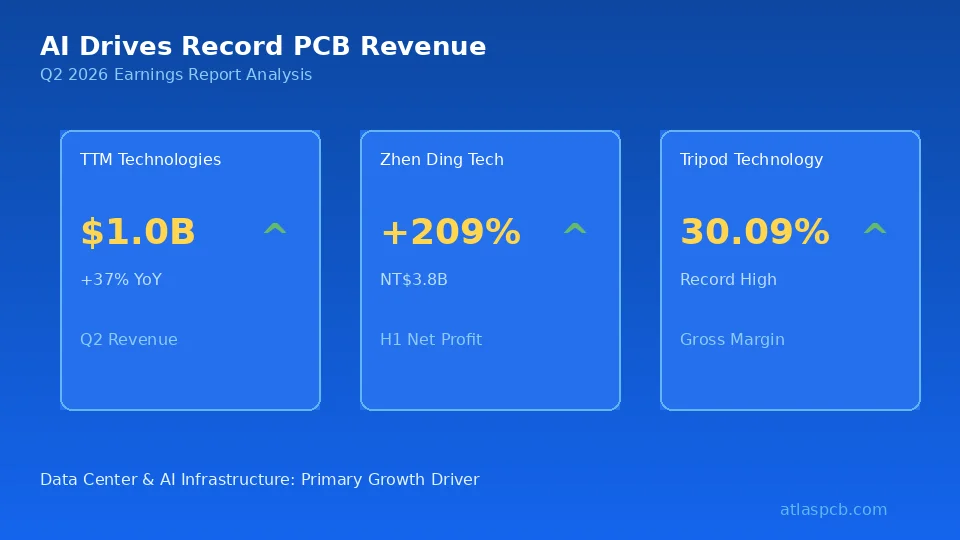
TTM Technologies (NASDAQ: TTMI), the largest PCB manufacturer headquartered in North America, reported quarterly revenue of $1.0 billion for Q2 2026 — an increase of 37% year over year and the first time the company has exceeded the billion-dollar threshold in a single quarter. Non-GAAP net income reached a record $106.9 million ($0.99 per diluted share), while adjusted EBITDA of $166.8 million represented a margin of 16.6%.
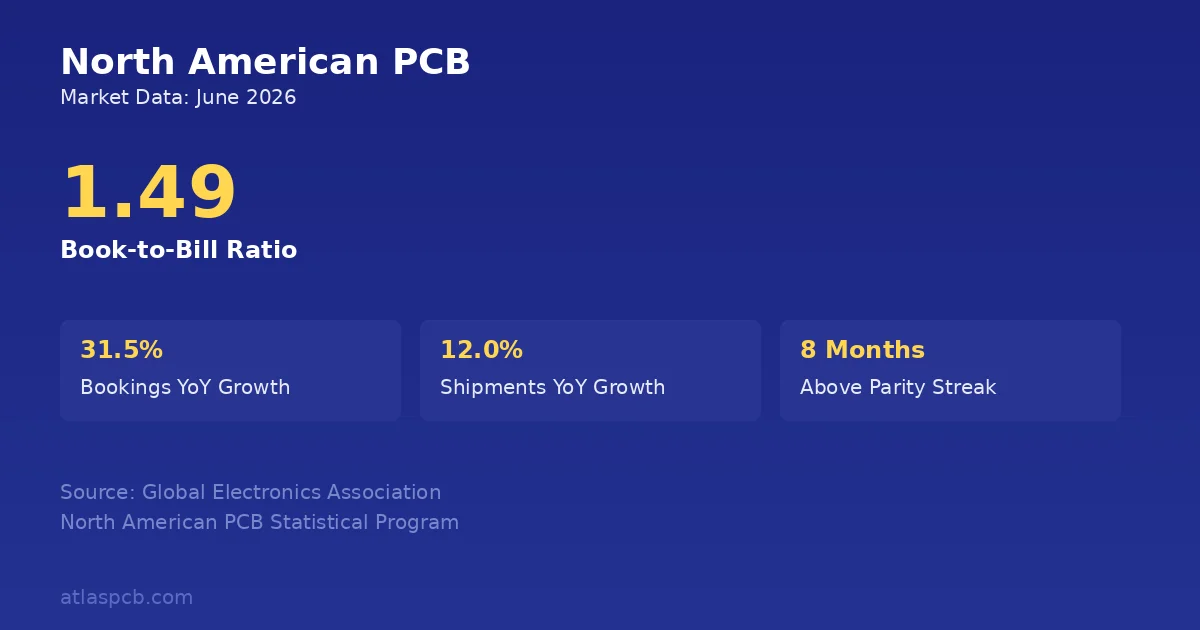
The growth was overwhelmingly concentrated in AI-related end markets. TTM’s Data Center and Networking segment accounted for 40% of total revenue and grew 91% year over year — nearly doubling in twelve months. This segment includes high-layer-count server backplanes, high-speed networking boards for AI training clusters, and advanced substrates for GPU/ASIC packages. The book-to-bill ratio of 1.49 indicates that incoming orders continue to exceed shipments, suggesting sustained demand growth through the second half of 2026.
TTM’s Aerospace and Defense segment contributed 37% of revenue with a backlog exceeding $1.7 billion, while Medical, Industrial and Instrumentation grew 33% year over year. CEO Edwin Roks attributed the broad-based strength to “ongoing robust demand in the Data Center and Networking end market” alongside steady defense spending and healthcare technology investment.
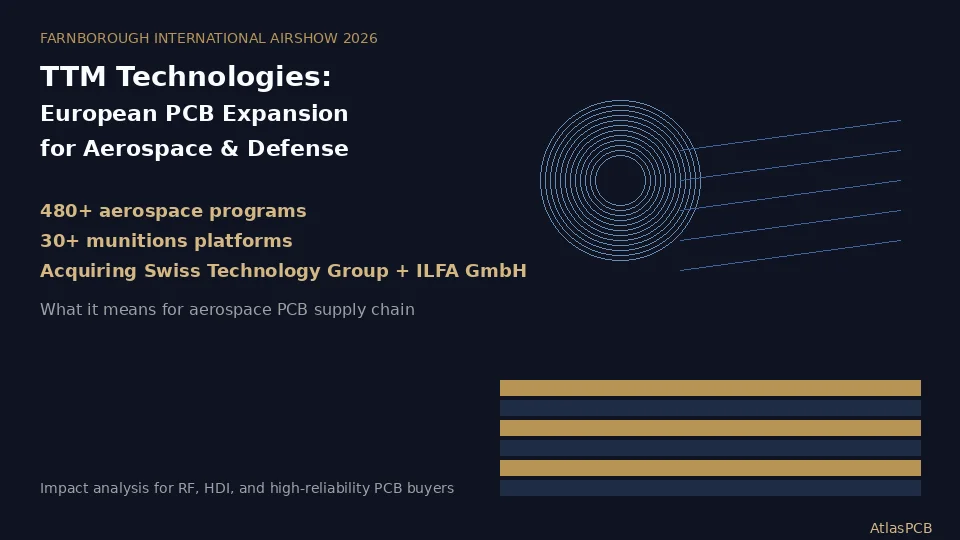
For Q3 2026, TTM guided revenue of $1.10 billion to $1.14 billion — implying continued sequential growth — with full-year 2026 revenue projected at approximately $4.4 billion. The company’s planned acquisitions of Swiss Technology Group AG and ILFA GmbH, expected to close in Q3, will further expand its European manufacturing footprint for advanced PCB and interconnect technologies.
Zhen Ding Technology: 209% Profit Increase on Optical Module PCB Demand
Zhen Ding Technology (4958.TW), the world’s largest flexible PCB manufacturer and a major rigid PCB producer, reported first-half 2026 net profit of NT$3.817 billion (approximately $119 million), representing a 209% increase year over year. Revenue reached a record NT$89.159 billion ($2.785 billion) for the first half, up 13.9% year over year.
The second quarter was particularly strong, with revenue rising 26.8% year over year to NT$48.431 billion ($1.513 billion) and net profit surging 295% year over year to NT$2.392 billion. The profit growth significantly outpaced revenue growth, indicating improving product mix as higher-margin AI-related products constitute a larger share of shipments.
Zhen Ding identified optical module PCBs as its primary growth catalyst. High-speed optical transceivers used in AI data center interconnects require specialized PCB substrates with ultra-low-loss materials and extremely tight manufacturing tolerances. The company reported that revenue from optical module-related products is growing significantly in 2026, with customers already reserving capacity allocations for 2027 delivery — a clear indication of sustained demand visibility.
The company disclosed that 1.6T optical module PCBs represent its current volume production sweet spot, while 3.2T optical module products have entered the prototype and qualification stage. Zhen Ding has stated its strategic objective of becoming the world’s largest high-end optical module PCB supplier by 2027, and is actively expanding advanced production capacity dedicated to AI applications.
Tripod Technology: Record 30% Gross Margin on Server and Memory PCB Demand
Tripod Technology (3044.TW), a major Taiwanese manufacturer specializing in server and automotive PCBs, achieved a record gross margin of 30.09% in Q2 2026 — the first time the company has exceeded the 30% threshold. Revenue for the quarter reached a record NT$24.857 billion ($776.7 million), up 38.8% year over year, while net profit of NT$3.896 billion produced record quarterly earnings per share of NT$7.41.
First-half 2026 results were equally impressive: revenue of NT$45.822 billion ($1.432 billion) grew 30.8% year over year, with net profit of NT$6.843 billion up 42.5% from the prior year period.
Tripod’s margin expansion reflects a favorable shift in product mix toward higher-value server and memory-related PCBs. As major competitors (including Zhen Ding and Unimicron) increasingly allocate capacity to ultra-high-end AI GPU server boards and optical substrates, some conventional server orders — still complex and high-margin compared to consumer products — have migrated to Tripod. The company has effectively positioned itself as the primary beneficiary of capacity reallocation within the Taiwanese PCB ecosystem.
An additional margin driver was pricing adjustment on memory module boards, where rising gold costs (gold wire bonding in DRAM packaging creates gold-content-proportional material costs in substrate PCBs) have been passed through to customers. Tripod noted that order growth has been “stronger than expected” due to this natural consolidation of conventional server demand onto its capacity.
Industry Implications for PCB Buyers
The concentration of manufacturing capacity and investment toward AI infrastructure has several practical consequences for hardware teams sourcing PCBs in 2026:
Lead time stratification has intensified. Advanced boards (high-layer-count, tight-tolerance, exotic materials) face lead times of 4-8 weeks at major manufacturers whose capacity is saturated with AI orders. Standard boards (4-6 layer, FR-4, relaxed tolerances) remain available at 2-3 week lead times from manufacturers not competing in the AI segment.
Pricing pressure on specialty materials continues. Ultra-low-loss laminates (Megtron 6, I-Tera MT40) and high-speed substrate materials face allocation constraints as AI optical module and GPU server demand absorbs available supply. Standard FR-4 materials remain adequately supplied with stable pricing.
Capacity investment is concentrated at the high end. The announced capital expenditure plans from TTM ($1.7B+ backlog investment), Zhen Ding (optical module capacity expansion), and Kinsus Interconnect (NT$19.6 billion ABF substrate expansion announced the same week) are overwhelmingly directed at AI-enabling technologies. Mid-market PCB capacity is not receiving proportional investment, creating potential future bottlenecks if demand growth broadens beyond AI.
The North American PCB market confirms this trajectory: June 2026 bookings rose 31.5% year over year according to the Global Electronics Association, with a book-to-bill ratio indicating continued demand growth ahead of shipment capacity.
What This Means for AtlasPCB Customers
For engineers and procurement teams working with AtlasPCB, the current market dynamics create both challenges and opportunities. We maintain dedicated capacity for standard and mid-complexity PCBs (4-16 layer, FR-4 through mid-loss materials) that is not subject to the same AI-driven allocation pressure affecting top-tier substrate manufacturers. Our standard lead times remain 5-7 working days for prototypes and 10-15 working days for production quantities.
However, specific material availability — particularly ultra-low-loss laminates and specialized prepregs for 25G+ applications — may face extended procurement times during periods of peak demand from the AI server supply chain. We recommend early engagement for designs requiring Megtron 6, I-Speed, or equivalent materials so we can confirm material allocation before production scheduling.
Reviewed by AtlasPCB Engineering Team. Financial data sourced from company earnings reports filed August 5-14, 2026. Currency conversions use rates current as of reporting date.
About AtlasPCB — We specialize in complex PCB manufacturing for HDI, RF, and high-reliability applications. Explore our full PCB manufacturing capabilities, or get an instant online quote . Every order includes free engineering review. Get your quote.
Reviewed by AtlasPCB Engineering Team — IPC-certified manufacturing specialists with 15+ years of production experience in HDI, RF, and high-reliability PCB fabrication. Content based on factory floor data and real customer design reviews.
- PCB industry
- AI demand
- TTM Technologies
- Zhen Ding
- Tripod Technology
- PCB market
- data center
- optical modules