· David Okafor · Engineering · 6 min read
Rigid-Flex PCB Cost Breakdown
Transparent breakdown of rigid-flex PCB pricing factors. Learn exactly what costs $X per panel, how bend zone design affects price, and practical optimization strategies that cut 20-40% without compromising reliability.
Quick Answer
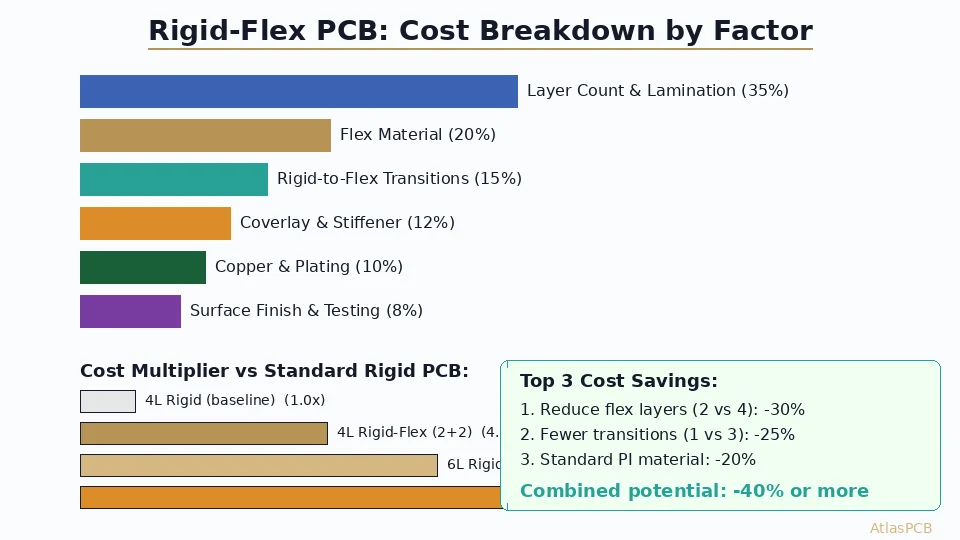
Rigid-flex PCBs cost 3-8x more than equivalent rigid boards, with the primary cost drivers being layer count (30-40% of cost), flex material type (15-25%), number of flex-to-rigid transitions (10-20%), and coverlay/stiffener processing (10-15%). Optimizing flex layer count, reducing transitions, and standardizing bend radius can cut costs 20-40%.
Quick Cost Reference: Rigid-Flex PCB Pricing Ranges (2026)
| Configuration | Prototype (5-10 pcs) | Small Batch (50-200 pcs) | Volume (1000+) |
|---|---|---|---|
| 4L (2 rigid + 2 flex) | $180-350/panel | $120-220/panel | $80-150/panel |
| 6L (4 rigid + 2 flex) | $280-500/panel | $180-350/panel | $130-250/panel |
| 8L (4 rigid + 4 flex) | $450-800/panel | $300-550/panel | $220-400/panel |
| 10L+ (6 rigid + 4 flex) | $600-1200/panel | $420-750/panel | $300-600/panel |
Note: Prices are per production panel (typically 18x24” or 18x21”). Unit cost depends on array count. These ranges assume standard polyimide flex material and ENIG finish.
For comparison: Standard 4-layer rigid FR-4: $40-80/panel prototype, $25-50/panel volume.
Cost Breakdown by Factor
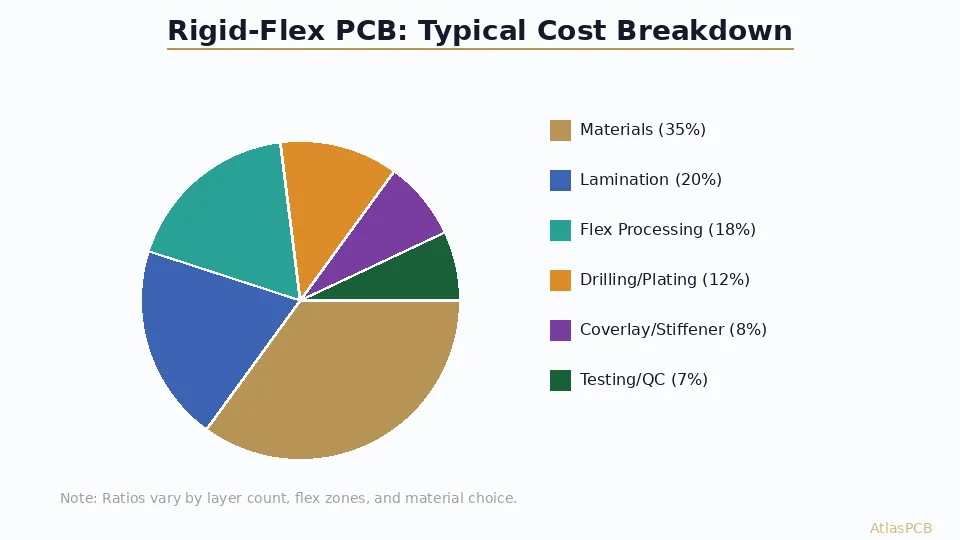
Here is where your money goes in a typical 6-layer rigid-flex board:
| Cost Factor | % of Total | What Drives It |
|---|---|---|
| Layer count & lamination | 30-40% | Number of sequential lamination cycles, flex layers |
| Flex material | 15-25% | Polyimide type, adhesiveless vs adhesive-based |
| Rigid-to-flex transitions | 10-20% | Number of transitions, bookbinder vs separate flex |
| Coverlay & stiffener | 10-15% | Precision laser cutting, adhesive processing |
| Copper & plating | 8-12% | Copper weight, through-via plating complexity |
| Surface finish | 5-8% | ENIG typical for flex pads |
| Testing & inspection | 5-8% | Flex bend testing, impedance verification |
| Material waste | 5-10% | Irregular panel utilization due to flex geometry |
RIGID-FLEX PRICING
Get a Rigid-Flex Quote in 24 Hours
Upload your design and we provide detailed cost breakdown with optimization suggestions. No obligation.
Compare Prices ›
Deep Dive: Each Cost Factor Explained
1. Layer Count and Lamination (30-40% of cost)
Rigid-flex boards require sequential lamination — you cannot press all layers at once like a standard multilayer. Each lamination cycle costs:
- Additional press time ($50-150/panel per cycle)
- Registration tooling and alignment
- Intermediate inspection between cycles
- Higher scrap risk (each cycle adds cumulative defect probability)
Cost math example:
- 4L rigid-flex (1 lamination cycle for flex core + 1 for rigid buildup) = 2 cycles
- 8L rigid-flex (2 flex cores + 2 rigid buildups) = 3-4 cycles
- Each additional cycle adds ~$100-200/panel at prototype quantities
2. Flex Material Selection (15-25% of cost)
| Material | Cost (relative) | When to Use |
|---|---|---|
| Standard PI (adhesive-based) | 1.0x | Static flex, 1-10 bend cycles |
| Adhesiveless PI | 1.3-1.5x | Dynamic flex, 100+ cycles |
| High-speed PI (low Dk/Df) | 1.8-2.5x | Impedance-controlled flex, >5 GHz |
| Modified epoxy flex | 0.7-0.8x | Cost-sensitive, minimal flex |
Optimization: If your flex zone bends once during assembly and stays fixed, standard adhesive-based polyimide is sufficient. You do not need adhesiveless material for static applications.
3. Number of Rigid-to-Flex Transitions (10-20% of cost)
Each transition between rigid and flex zones requires:
- Precise routing/scoring at the boundary
- Coverlay termination management
- Stress relief features
- Additional inspection
| Transitions | Cost Impact |
|---|---|
| 1 (simple L-shape) | Baseline |
| 2 (Z-shape or U-shape) | +15-25% |
| 3+ (complex multi-zone) | +30-50% |
Optimization: Consolidate flex zones where possible. Two separate flex ribbons cost more than one wider ribbon carrying the same signals.
4. Coverlay and Stiffener Processing (10-15% of cost)
Coverlay (flexible solder mask equivalent) requires:
- Precision laser cutting of pad openings
- High-temperature adhesive lamination
- Registration to flex circuit features
Stiffeners (FR-4 or polyimide backing in non-flex areas) add:
- Additional material and adhesive
- Separate lamination step
- Thickness tolerance management
RIGID-FLEX EXPERTISE
Up to 22-Layer Rigid-Flex Capability
AtlasPCB manufactures rigid-flex boards from simple 4-layer designs to complex 22-layer configurations with controlled impedance flex zones.
View Rigid-Flex Services ›7 Proven Strategies to Reduce Rigid-Flex Cost
Strategy 1: Minimize Flex Layer Count
- Route only essential signals through flex (power, ground, critical signals)
- Move non-critical I/O to connectors between rigid sections
- Savings: 25-35% by reducing from 4 flex layers to 2
Strategy 2: Increase Bend Radius
- Tighter bends require thinner copper (0.5 oz vs 1 oz)
- Tighter bends need adhesiveless PI (1.3-1.5x material cost)
- Design for minimum 6:1 bend ratio (bend radius = 6x total flex thickness)
- Savings: 10-20% on material costs
Strategy 3: Use Standard Panel Sizes
- Non-standard outlines waste panel material
- Design flex ribbons to nest efficiently in standard 18x24” panels
- Consult your fab for optimal panelization before finalizing dimensions
- Savings: 5-15% on material utilization
Strategy 4: Reduce Transition Count
- Combine adjacent flex zones into one longer ribbon where mechanical design allows
- Use flex-to-rigid transitions only where truly necessary for component mounting
- Savings: 15-25% per eliminated transition
Strategy 5: Specify Standard Materials
- Avoid exotic polyimide (Espanex, etc.) unless performance demands it
- Standard Dupont Pyralux AP with 1 mil PI + 0.5 mil adhesive handles most applications
- Savings: 20-40% on material component
Strategy 6: Relax Tolerances Where Possible
- Standard registration: +/- 3 mil (adequate for most signal routing)
- Standard coverlay opening: +/- 2 mil (fine for 0.5mm pitch connectors)
- Tight tolerances (+/- 1 mil) add 15-25% cost for additional process control
- Savings: 10-20% by using standard tolerances
Strategy 7: Volume Leverage
- Rigid-flex has steep volume pricing curves due to NRE amortization
- 50-piece run costs 40-50% less per piece than 10-piece prototype
- 500-piece run costs another 30-40% reduction
- Plan for production volume at design stage to optimize panel layout
COST OPTIMIZATION
We Suggest Cost Savings in Our DFM Review
Our engineers flag over-specified tolerances, unnecessary material choices, and panelization improvements that reduce your cost without compromising function.
Upload Design ›Cost Comparison: Rigid-Flex vs Alternatives
Before committing to rigid-flex, consider whether alternatives solve your problem cheaper:
| Solution | Cost | When It Works | When It Fails |
|---|---|---|---|
| Rigid-flex | 3-8x rigid | Space-critical, reliability-critical, high-vibration | Budget-constrained, simple interconnect |
| Flex + rigid (separate) | 1.5-3x rigid | Moderate flex, assembly handles mating | Tight space, EMI-sensitive |
| Board-to-board connectors | 1.2-1.5x rigid | Standard spacing, replaceable connection | Vibration, ultra-thin products |
| FPC cable (flat flex) | 0.3-0.5x rigid | Simple signal routing, standard pitches | High-speed, controlled impedance |
Decision rule: If your design requires controlled impedance through the flex zone, or the product experiences continuous vibration, rigid-flex is worth the premium. If it is simply connecting two rigid boards with a short ribbon, an FPC cable assembly is 5-10x cheaper.
ATLASPCB
Get Your Rigid-Flex Quote Today
Upload Gerber + IPC-2581 stackup. We quote within 24 hours and include cost optimization notes with every rigid-flex quotation.
Get Instant Quote ›
Related Reading:
About AtlasPCB — We specialize in complex PCB manufacturing for HDI, RF, and high-reliability applications. Explore our rigid-flex PCB manufacturing, or get an free engineering DFM review . Every order includes free engineering review. Get your quote.
Reviewed by AtlasPCB Engineering Team — IPC-certified manufacturing specialists with 15+ years of production experience in HDI, RF, and high-reliability PCB fabrication. Content based on factory floor data and real customer design reviews.
Frequently Asked Questions
How much more does rigid-flex cost compared to rigid PCB?
What is the biggest cost driver in rigid-flex PCB?
How can I reduce rigid-flex PCB cost?
What is the minimum order quantity for rigid-flex PCB?
- rigid-flex PCB
- PCB cost
- PCB pricing
- DFM optimization
- flex circuit