· David Okafor · Engineering · 8 min read
PCB Rush Pricing Explained
Understanding PCB rush pricing mechanics: how lead time affects fabrication cost, where the money actually goes in expedited orders, and strategies to minimize rush fees without delaying your project timeline.
Quick Answer
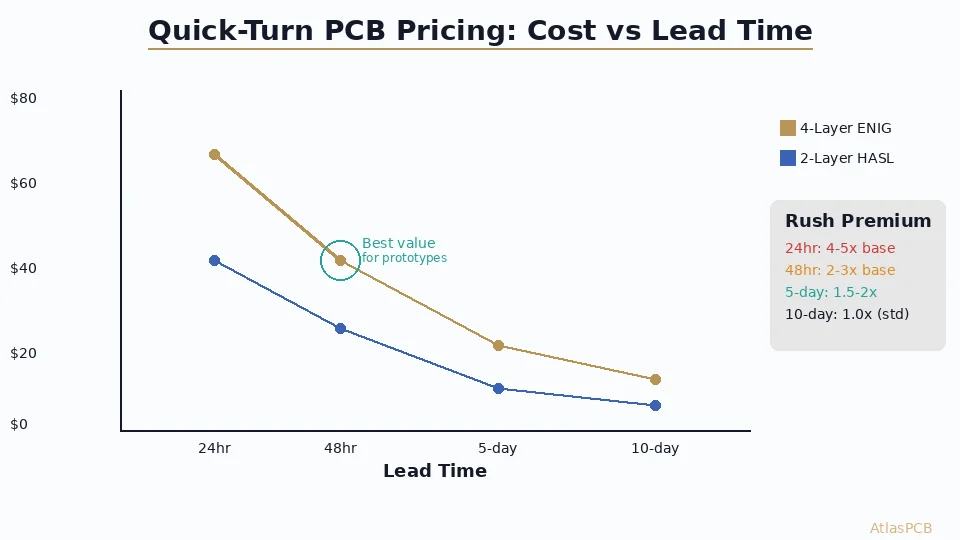
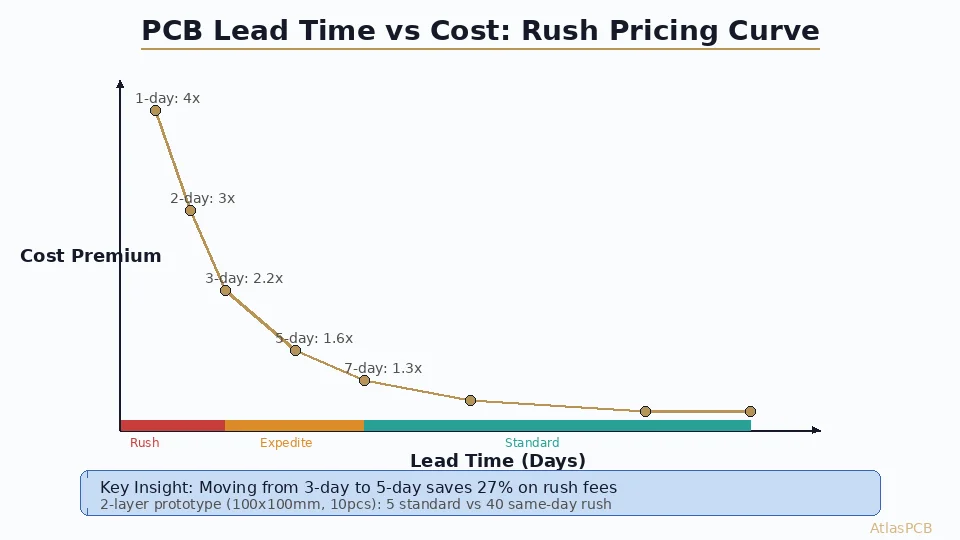
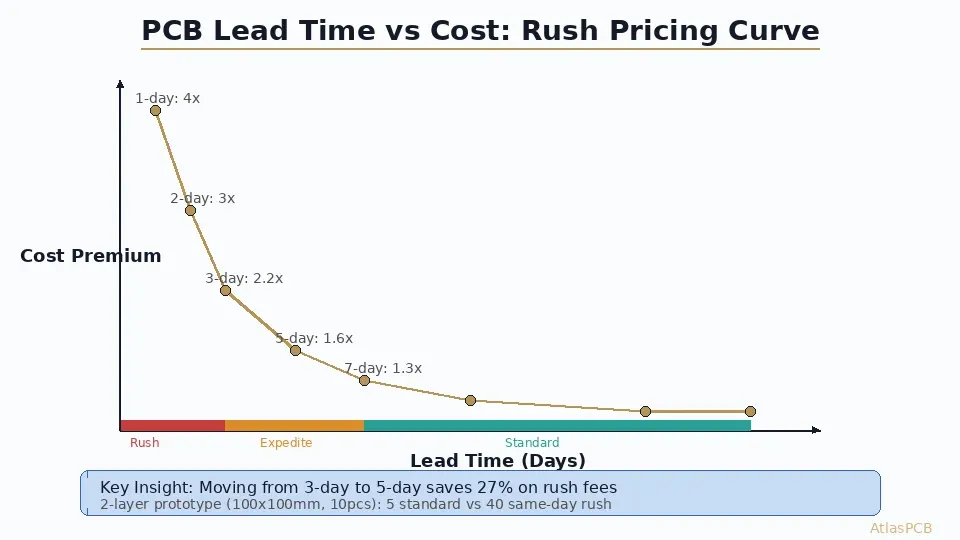
PCB rush pricing follows an exponential curve: same-day (24-hour) delivery costs 3-5x the standard price, 3-day costs 2-2.5x, 5-day costs 1.5-1.8x, and 7-day costs 1.2-1.3x. The inflection point for most 2-layer prototypes is the 5-day mark — moving from 3-day to 5-day saves 25-30% while adding only 48 hours. For multilayer boards (8+ layers), the minimum realistic rush is 5-7 days due to multiple lamination cycles.
Quick Reference: Rush Pricing Multipliers
| Lead Time | 2-Layer | 4-Layer | 6-Layer | 8-Layer | 10+ Layer |
|---|---|---|---|---|---|
| Same-day (24hr) | 4-5x | 5-8x | N/A | N/A | N/A |
| 2-day | 3-3.5x | 3.5-4x | N/A | N/A | N/A |
| 3-day | 2-2.5x | 2.5-3x | 3-4x | N/A | N/A |
| 5-day | 1.5-1.8x | 1.8-2.2x | 2-2.5x | 2.5-3x | N/A |
| 7-day | 1.2-1.3x | 1.3-1.5x | 1.5-1.8x | 1.8-2.2x | 2-2.5x |
| 10-day | 1.0-1.1x | 1.1-1.2x | 1.2-1.3x | 1.3-1.5x | 1.5-1.8x |
| 15-18 day | 1.0x | 1.0x | 1.0x | 1.0x | 1.0x |
N/A = physically impossible — multilayer boards require multiple lamination cycles that cannot be compressed below certain thresholds regardless of price.
Where the Money Goes in Rush Orders
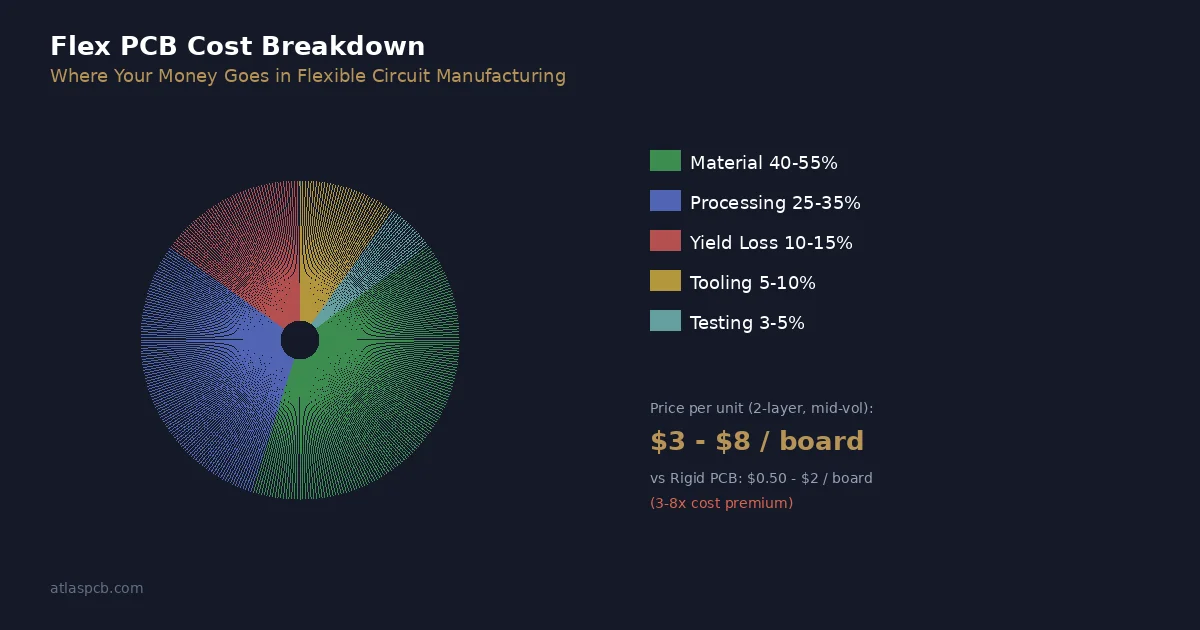
Understanding the cost structure behind rush pricing helps engineers make informed tradeoffs. PCB fabrication cost decomposes into three categories: material, labor/machine time, and queue priority — and rush pricing amplifies each differently.
Material cost stays relatively constant regardless of lead time. FR-4 laminates, copper foil, solder mask ink, and surface finish chemicals cost the same whether your board ships in 1 day or 15 days. This accounts for 20-35% of a standard-price board. It is the one component of your invoice that does not inflate during a rush.
Labor and machine time increase moderately because rush orders prevent batching. In normal production, a fabricator accumulates enough orders to fill a standard panel (typically 18x24 inches) before running each process step. Your 100x100mm prototype shares a panel with other similar-sized boards, splitting machine setup time, chemical bath usage, and operator attention across 8-12 jobs. A rush order often runs alone on a panel — all setup and processing costs fall on your single job. This alone accounts for a 1.3-1.5x multiplier on any rush below 7 days.
Queue priority is the largest rush cost component and the most variable. Every hour your rush job occupies a machine, another customer’s standard-lead-time order waits. The fabricator must either run overtime (1.5-2x labor rates), delay other orders (risking late-delivery penalties), or maintain dedicated rush capacity (equipment sitting idle during normal periods). This queue displacement cost follows an exponential curve: mild queue displacement at 7-day rush, moderate displacement at 5-day, and severe displacement at 2-3 day, where your single board takes priority over the entire production floor.
QUICK-TURN PRICING
Need Fast Boards Without Breaking the Budget?
AtlasPCB offers tiered lead times from 1-day rush to 18-day standard. Upload your Gerber files and instantly see pricing at every lead time option — pick the sweet spot for your project.
See All Lead Time Options ›
The Physics Floor: Minimum Lead Times by Complexity
No amount of money can accelerate chemical reactions or thermal curing. Understanding the physics constraints helps you set realistic expectations and avoid paying rush premiums for delivery dates the fabricator cannot actually hit.
A single lamination cycle — pressing core layers with prepreg under heat and pressure — requires 2-4 hours of press time at 180-200C, followed by 1-2 hours of controlled cooling. Post-lamination, the panel needs mechanical stress relief before drilling (minimum 4 hours to stabilize dimensional stability). A 4-layer board with one lamination cycle can theoretically compress all non-lamination steps (imaging, plating, routing) into the remaining hours and ship within 24-36 hours.
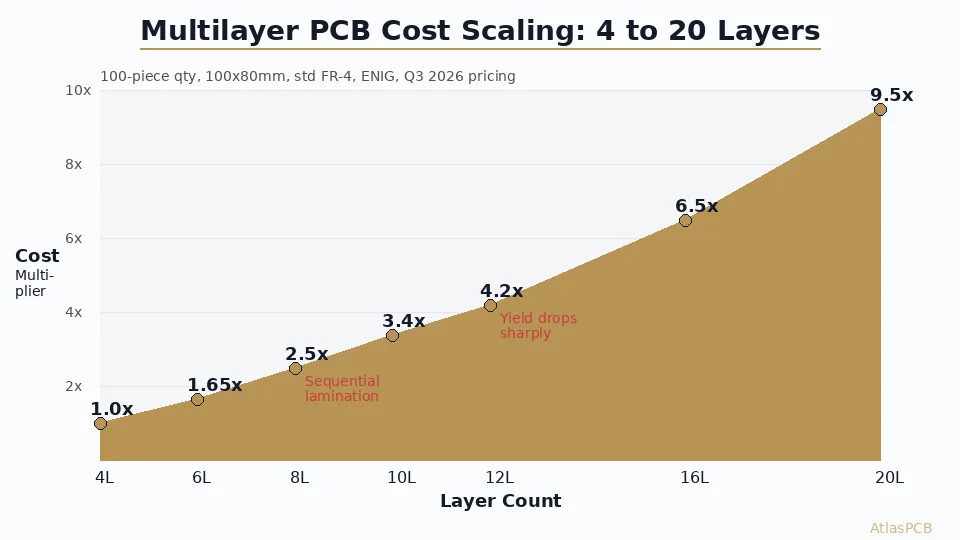
An 8-layer board requires two lamination cycles (inner core pair + full book), each with its own press cycle and cooling period. Minimum realistic processing time is 3-4 days even with zero queue wait. Add electroless copper deposition, pattern plating, and solder mask curing (each requiring chemistry and cure time), and the absolute floor for an 8-layer rush board is 4-5 days.
HDI boards compound this further. Each sequential buildup layer adds a full lamination cycle plus laser drilling and microvia plating. A 2+N+2 HDI board (10 layers total) requires four lamination cycles minimum: inner core, first buildup each side (may be simultaneous), second buildup each side. The physics floor for this construction sits at 6-8 days, and most fabricators quote 8-10 days as their fastest HDI delivery.
The practical implication: if a fabricator quotes you a 3-day 8-layer board, they either have pre-fabricated inner layers waiting in stock (common for repeat orders) or they are quoting delivery from a stage where partial fabrication is already complete. Ask explicitly what “day one” means in their lead time calculation.
Strategies to Minimize Rush Cost
Several engineering and procurement decisions can reduce rush premiums by 20-40% without changing your delivery date:
Design for standard process capabilities. Every non-standard feature adds processing time that cannot be compressed in a rush. Minimum trace/space of 5/5mil (125um) instead of 4/4mil (100um) eliminates the need for fine-line imaging processes with tighter exposure controls. Standard mechanical drill sizes (0.2mm minimum vs 0.15mm) allow higher drill speeds and fewer bit changes. OSP surface finish cures in 10 minutes; ENIG requires 30-45 minutes of sequential immersion chemistry. Each simplification buys back minutes that compound across a rush timeline.
Submit complete, error-free documentation. In rush production, there is no buffer time for engineering questions. A missing drill file, ambiguous impedance callout, or incorrect layer naming convention that takes 2 hours to resolve via email costs nearly nothing on a 15-day order but consumes 8% of your available production window on a 24-hour rush. Invest 30 minutes in documentation review before submission to save hours (and dollars) in production.
Choose your rush threshold strategically. The cost curve’s steepest region lies between 1-3 days, where each additional day of lead time saves 15-25% of the total cost. The curve flattens above 7 days, where adding time yields diminishing savings. For most projects, the optimal rush point is 5 days — fast enough to maintain design iteration cadence, but past the exponential pricing zone.
PROTOTYPE OPTIMIZATION
Running Multiple Design Iterations?
Batch your prototype revisions on a 5-day cycle instead of paying 3-day rush for each spin. Upload multiple variants per order to split NRE costs across designs.
Start Multi-Design Quote ›Real-World Pricing Examples
To make the abstract multipliers concrete, here are representative prices for a common prototype order (10 pieces, 100x100mm, 1.6mm FR-4, ENIG finish, +/-10% impedance tolerance):
| Configuration | Standard (15-day) | 7-day Rush | 5-day Rush | 3-day Rush |
|---|---|---|---|---|
| 2-layer, 5/5mil | $45-65 | $60-85 | $75-110 | $110-165 |
| 4-layer, 4/4mil | $95-140 | $130-190 | $175-260 | $250-380 |
| 6-layer, 4/4mil | $160-230 | $230-340 | $320-460 | N/A |
| 8-layer, 3.5/3.5mil | $280-400 | $420-600 | $560-800 | N/A |
These prices illustrate why the 5-day sweet spot is so compelling for prototype-stage work. A 4-layer board at 5-day costs roughly 1.8x the 15-day price — meaningful but manageable within most hardware startup budgets. Moving to 3-day adds another 45-50% on top of the 5-day price for just 48 hours of time savings.
For production volumes (100+ pieces), the rush premium percentage decreases but absolute cost remains significant. A 100-piece 4-layer production run might cost $800 at standard lead time (15-18 days) but $1,200 at 10-day expedite and $1,600 at 7-day rush. The per-board premium of $4-8 multiplied by 100 units makes the business case clear: only pay for production rush if the revenue timeline justifies it.
When Rush Pricing Is Worth It (And When It Isn’t)
Rush pricing makes financial sense in three scenarios. First, when your time-to-market revenue exceeds the rush premium — if shipping product one week earlier generates $10,000 in revenue, a $200 rush fee is irrelevant. Second, when you need boards to meet a fixed deadline (trade show demo, customer sample commitment, regulatory test slot) where delay has reputational cost beyond the dollar value. Third, when your engineering team sits idle waiting for boards — if three engineers billing $150/hour each are blocked for 5 days waiting for prototypes, the $4,500 in idle labor cost far exceeds any reasonable rush fee.
Rush pricing does not make sense for iterative prototype exploration where the next spin is not fully defined. If you are still making schematic changes while waiting for boards, paying for 3-day rush on a design that will need another revision is wasting money. In these situations, use standard 15-day lead time, order multiple design variants on the same panel, and maintain a steady pipeline of boards shipping weekly at standard pricing rather than sporadic rush orders.
ATLASPCB
See Rush Pricing Instantly for Your Design
Upload your Gerber files and get instant pricing across all lead time tiers. Compare 3-day, 5-day, 7-day, and standard options side by side to find your optimal cost-time balance.
Get Instant Quote ›
Related Reading:
About AtlasPCB — We specialize in complex PCB manufacturing for HDI, RF, and high-reliability applications. Explore our PCB prototype manufacturing from 1 piece, quick-turn PCB manufacturing from 24 hours, or get an instant online PCB quote . Every order includes free engineering review. Get your quote.
Reviewed by AtlasPCB Engineering Team — IPC-certified manufacturing specialists with 15+ years of production experience in HDI, RF, and high-reliability PCB fabrication. Content based on factory floor data and real customer design reviews.
Frequently Asked Questions
Why does 1-day PCB rush cost 4x more than standard?
What is the fastest possible lead time for a 4-layer PCB?
How can I reduce rush fees without extending lead time?
Does board complexity affect rush pricing differently?
Are production runs subject to the same rush pricing as prototypes?
- PCB pricing
- rush order
- lead time
- prototype cost
- PCB fabrication cost
- quick-turn