· AtlasPCB Engineering · Engineering · 10 min read
PCB Manufacturer for Aerospace: Class 3A Qualification Costs and Vendor Selection Guide
How to evaluate and select an aerospace PCB manufacturer with IPC-6012 Class 3A capability. Breaks down qualification costs, explains what drives the 3-5x price premium over commercial boards, and provides a vendor evaluation framework for program managers and procurement engineers.
Quick Answer
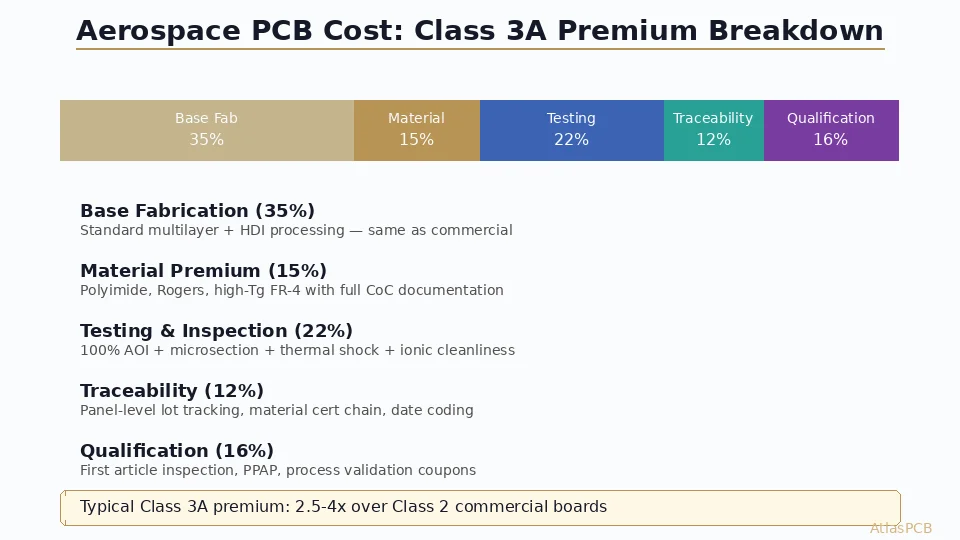
Selecting an aerospace PCB manufacturer requires evaluation across five dimensions: IPC-6012 Class 3A process certification, material qualification and traceability infrastructure, testing capability (microsection, thermal cycling, ionic cleanliness), documentation systems that support AS9102 First Article Inspection, and cost transparency that separates base fabrication from qualification overhead. The typical Class 3A premium is 3-5x over equivalent Class 2 commercial boards, with testing and documentation consuming over 50% of the markup.
Quick Answer: Aerospace PCB Cost Structure
| Cost Component | % of Aerospace Premium | Typical $/Panel Addition |
|---|---|---|
| Base Fabrication (Class 3 process) | 25-35% | $80-150 |
| Material (certified lots + CoC) | 10-15% | $40-80 |
| Testing and Inspection | 25-30% | $100-200 |
| Documentation/Traceability | 10-15% | $40-80 |
| Qualification Overhead | 15-20% | $60-120 |
| Total Premium over Class 2 | 100% | $320-630/panel |
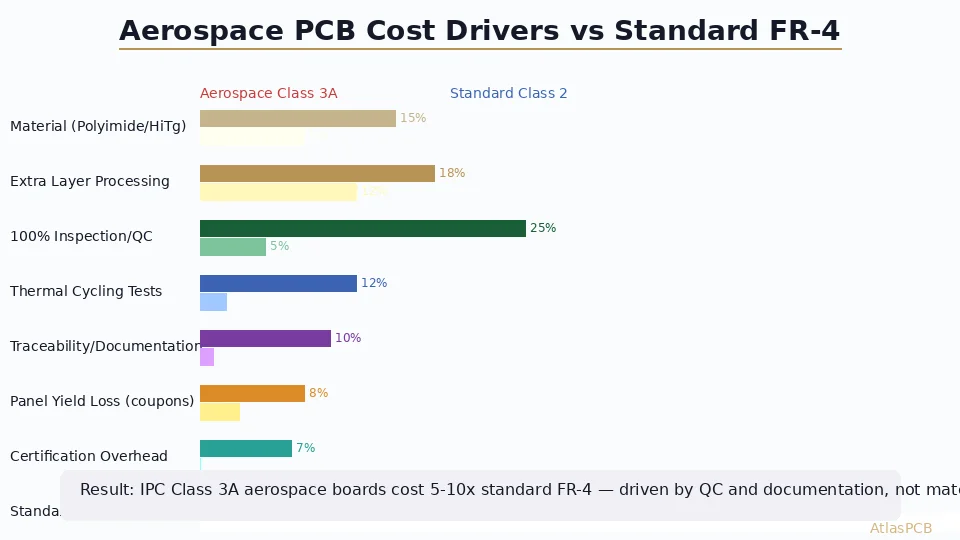
A standard 8-layer board that costs $120-180 per panel at commercial Class 2 pricing runs $450-800 per panel at aerospace Class 3A. The premium is NOT primarily from better materials or more complex processing — it comes from the testing, inspection, and documentation that proves the board meets specification.
What Makes an Aerospace PCB Manufacturer “Qualified”
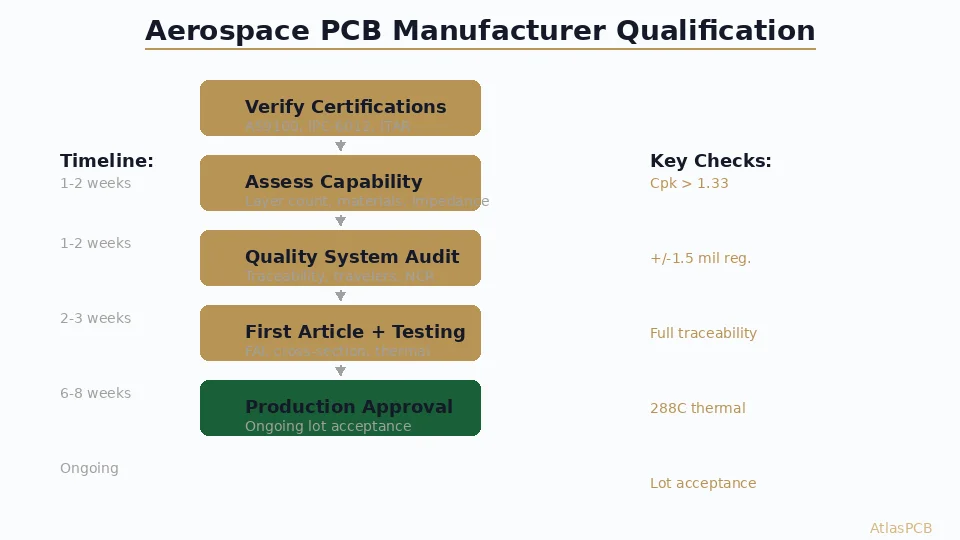
The aerospace and defense supply chain operates on a qualification-first model. You cannot simply find the cheapest manufacturer who claims to make “high-reliability boards” and submit those for a DO-254 or MIL-PRF-31032 program. The qualification process evaluates whether a manufacturer’s processes, equipment, personnel, and quality systems can consistently produce boards that meet the stringent acceptance criteria — not just whether they can make one good sample.
The minimum qualifications for a legitimate aerospace PCB manufacturer include IPC-6012 Class 3 certification (process audited by IPC or accredited third party), an in-house metallurgical lab capable of microsection analysis with SEM/EDS capability for failure analysis, thermal cycling equipment rated for 500+ cycles at the temperature extremes your program requires (typically -65C to +125C or +260C for solder float), calibrated impedance measurement (TDR or network analyzer for controlled-impedance boards), and a quality management system certified to AS9100D (the aerospace-specific extension of ISO 9001).
Beyond certifications, the practical indicators of genuine capability include: can they show you their microsection lab? Do they have thermal cycling chambers in-house or do they outsource (outsourcing adds lead time and reduces control)? Can they provide historical cpk data for your critical parameters (hole size, copper thickness, impedance)? Do they have experience with your specific material system (Rogers, polyimide, high-Tg FR-4 for aerospace has different press profiles than standard FR-4)?
AEROSPACE PCB MANUFACTURER
IPC Class 3 with 3A Process Capability
AtlasPCB supports aerospace programs with in-house microsection lab, thermal cycling, and full traceability systems. AS9102 FAI documentation included.
Request Aerospace Quote ›
The Real Cost Drivers (They Are Not What You Think)
Testing and Inspection: 25-30% of the Premium
The single largest cost addition for aerospace boards is inspection — not because the inspection is expensive per se, but because it is comprehensive. Commercial boards use statistical sampling: test one board from each panel, test 5% of vias in cross-section, test impedance on one coupon per lot. Aerospace Class 3A requires exhaustive verification:
100% electrical test at tightened thresholds: every net, every board, with isolation tested at higher voltage (250V versus 50V for commercial) to catch degraded insulation resistance. Flying probe testing at these thresholds takes 3-5 minutes per board versus 30 seconds for commercial — this directly adds operator time and machine occupancy cost.
Microsection analysis on every panel: not just one representative coupon but cross-sections of each unique via type (PTH, blind, buried, via-in-pad if present). Each cross-section requires mounting, polishing, etching, and SEM imaging with measurements of copper thickness, plating uniformity, and etch factor. At $50-100 per microsection with 4-6 sections per panel, this adds $200-600 per production panel.
Thermal cycling to 500 cycles: IPC-TM-650 Method 2.6.7.2 requires cycling between -65C and +125C (or +260C for solder float) with resistance monitoring on daisy-chain coupons. Five hundred cycles at 20-30 minutes per cycle means 7-10 days of dedicated chamber time per lot. This testing cost is amortized across the lot but still represents $1,000-2,000 per production run.
Documentation: The Hidden 10-15% Nobody Budgets For
Every aerospace PCB shipment includes a documentation package that takes 4-8 hours of quality engineer time to compile: material certificates traced to specific supplier lots, dimensional inspection results per AS9102 format, process traveler with step-by-step verification signatures, electrical test results, microsection photographs with annotated measurements, impedance test data with coupon identification, ionic cleanliness results, and the final Certificate of Compliance.
This documentation does not make the board better — it proves the board is good. And it creates the audit trail that allows your quality organization to answer an FAA auditor’s question three years later: “Show me that Board S/N 4127 was fabricated from qualified material on validated equipment with verified results.” Without that trail, you cannot ship hardware.
Yield Loss from Tighter Acceptance: A Silent 15-20% Adder
Commercial boards accept IPC Class 2 defect levels: 5% plating voids in PTH barrels, 25% reduction in annular ring, copper thickness variation of +/-20%. Boards that meet these loose criteria pass and ship. When you apply Class 3A acceptance criteria — zero plating voids, minimum 1 mil annular ring after worst-case registration, copper uniformity +/-10% — the same manufacturing process yields fewer passing boards.
A process with 95% yield at Class 2 typically delivers 75-85% yield at Class 3A. That 10-20% yield loss means 10-20% more panels must be started to deliver the required quantity, and the scrapped panels still consumed materials, labor, and machine time. This implicit cost is rarely visible on the quote but always present in the pricing.
FULL TRACEABILITY
Every Board Traceable to Material Lot
Panel-level traceability with material CoC chain, process traveler, and complete inspection documentation. AS9100D quality system.
Vendor Evaluation Framework: 8 Questions to Ask
Before selecting an aerospace PCB manufacturer, these questions separate genuine capability from marketing claims:
1. “Can I tour your microsection lab?” A qualified aerospace manufacturer has in-house metallurgical capability — not outsourced cross-section analysis. If they send microsections to a third-party lab, they add lead time and lose the ability to do real-time process adjustment based on microsection feedback.
2. “Show me cpk data for copper thickness on a recent production lot.” Process capability indices tell you whether their process is stable and centered. A cpk above 1.33 for copper thickness means they can consistently hit the +/-10% Class 3 requirement with margin. Below 1.0 means they are producing borderline boards that may or may not pass.
3. “What is your typical first-pass yield on Class 3A 8-layer boards?” Honest answers fall between 75-90%. If they claim 99%, they either do not run real Class 3A acceptance criteria or they are not being transparent. Our typical first-pass yield for aerospace Class 3A is 82-87% depending on board complexity, and we price accordingly.
4. “How do you handle material lot changes mid-production?” For aerospace continuity, the entire order should use one material lot if possible. A good manufacturer holds enough material at order start, or at minimum, re-qualifies (microsection + impedance verification) if a lot change occurs mid-run.
5. “What thermal cycling capability do you have in-house?” Minimum requirement: chamber rated for -65C to +260C (solder float requalification) with capacity for 500+ cycles. If they outsource thermal cycling, ask about turnaround time — it can add 2-3 weeks to your lead time.
6. “Can you provide AS9102 First Article Inspection reports?” This is the standard documentation format aerospace programs require. If the manufacturer is unfamiliar with AS9102, they have not served aerospace customers at a program level — only potentially supplying through distributors who repackage documentation.
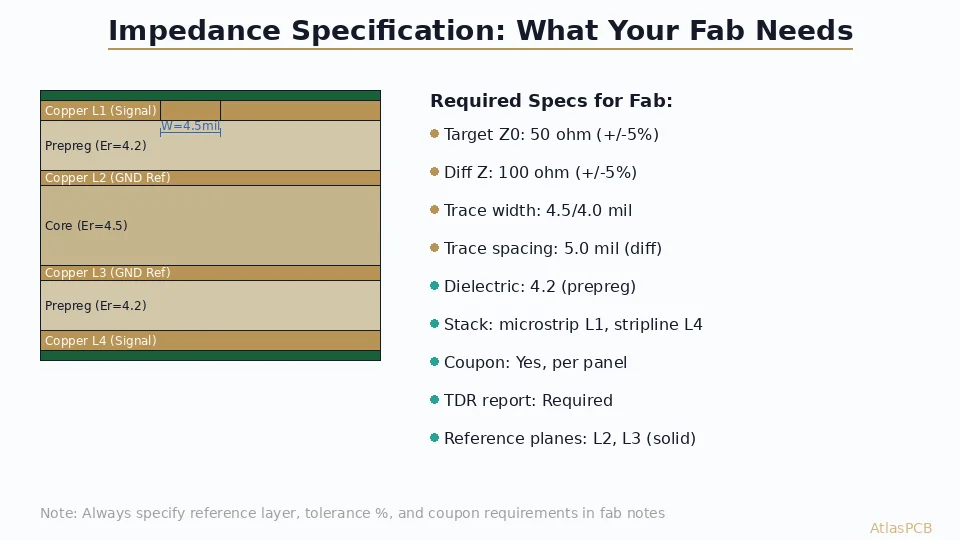
7. “What is your impedance control capability and what tolerance can you guarantee?” For aerospace RF applications, +/-5% impedance tolerance is often required. The manufacturer should be able to explain their process (LDI imaging, controlled pressing, etch compensation) and show TDR measurement data from recent production proving they achieve the claimed tolerance.
8. “How do you manage ITAR/EAR controlled designs?” If your program involves defense or export-controlled technology, the manufacturer must have procedures for controlled access to your design data, secure storage, and potentially ITAR registration. Chinese manufacturers can still support ITAR programs under certain conditions (non-restricted items, proper licensing), but they must demonstrate awareness and procedures.
Cost Optimization Without Compromising Compliance
While aerospace boards cost 3-5x commercial, there are legitimate ways to optimize spend:
Panel layout optimization: Work with your manufacturer to maximize the number of boards per panel while accommodating coupon placement. Proper panelization can improve utilization by 10-15%, directly reducing per-board cost. At AtlasPCB, we optimize panel layouts during DFM review specifically for aerospace orders where coupon requirements reduce available area.
Consolidate test coupon designs: If you have multiple aerospace board designs in production, share test coupon structures where the stackup and via types are identical. One coupon qualifies the process for all boards using that construction — reducing redundant testing costs.
Design to standard stackups: Every manufacturer has preferred stackup constructions they have already validated at Class 3A levels. Designing to these proven constructions eliminates first-article qualification costs ($3,000-8,000 per unique design) because the manufacturer can leverage existing process validation data. Ask for their standard aerospace stackup menu before starting your design.
Volume commitment pricing: Aerospace orders are typically low-volume (10-200 boards), but if you can commit to annual blanket orders with scheduled releases, the manufacturer amortizes NRE costs across the full commitment. We typically offer 15-25% lower per-board pricing on annual agreements versus individual purchase orders.
COST OPTIMIZATION
Aerospace PCB Without Overpaying
Our DFM engineers optimize panel utilization, recommend standard stackups, and identify cost savings while maintaining full Class 3A compliance.
Get Optimized Quote ›Timeline: From Vendor Selection to First Production Delivery
| Phase | Duration | Activities |
|---|---|---|
| Vendor Evaluation | 2-4 weeks | Capability assessment, facility audit (remote or on-site), sample order |
| First Article | 4-6 weeks | Process qualification, FAI documentation, thermal cycling |
| Design Approval | 1-2 weeks | Customer review of FAI report, acceptance |
| Production Order | 4-6 weeks | Material procurement, fabrication, testing, documentation |
| Total (first order) | 11-18 weeks | From RFQ to boards in hand |
| Repeat orders | 4-6 weeks | Leverages existing qualification |
The initial qualification investment pays back quickly — once your design is qualified at a manufacturer, repeat orders skip the 7-12 week qualification phase entirely. This is why aerospace programs maintain qualified vendor lists and avoid switching suppliers mid-program: re-qualification at a new manufacturer costs $5,000-15,000 in testing and 2-3 months in schedule.
ATLASPCB
Start Your Aerospace PCB Qualification
Upload your design for a detailed aerospace quote with Class 3A pricing breakdown. We provide standard stackup options, lead time estimates, and FAI documentation scope.
Request Aerospace RFQ ›
Reviewed by AtlasPCB Engineering Team — 15+ years in advanced PCB fabrication for RF, HDI, and rigid-flex applications.
Related Reading:
About AtlasPCB — We specialize in complex PCB manufacturing for HDI, RF, and high-reliability applications. Explore our impedance-controlled PCB manufacturing, instant online PCB quote, or get an full PCB manufacturing capabilities . Every order includes free engineering review. Get your quote.
Reviewed by AtlasPCB Engineering Team — IPC-certified manufacturing specialists with 15+ years of production experience in HDI, RF, and high-reliability PCB fabrication. Content based on factory floor data and real customer design reviews.
Frequently Asked Questions
What is the difference between IPC Class 3 and Class 3A for aerospace?
How much does aerospace PCB qualification cost?
Can a China-based manufacturer achieve IPC-6012 Class 3A?
What documentation does an aerospace PCB manufacturer provide?
How long does aerospace PCB fabrication take?
- PCB manufacturer for aerospace
- aerospace PCB cost
- IPC 6012 Class 3A
- impedance controlled PCB manufacturer