· David Okafor · Engineering · 10 min read
Multilayer PCB Cost Breakdown
Understand exactly what drives multilayer PCB pricing. We break down cost factors by layer count — material, drilling, lamination cycles, testing — and show optimization strategies that can reduce your bill by 20-40%.
Quick Answer
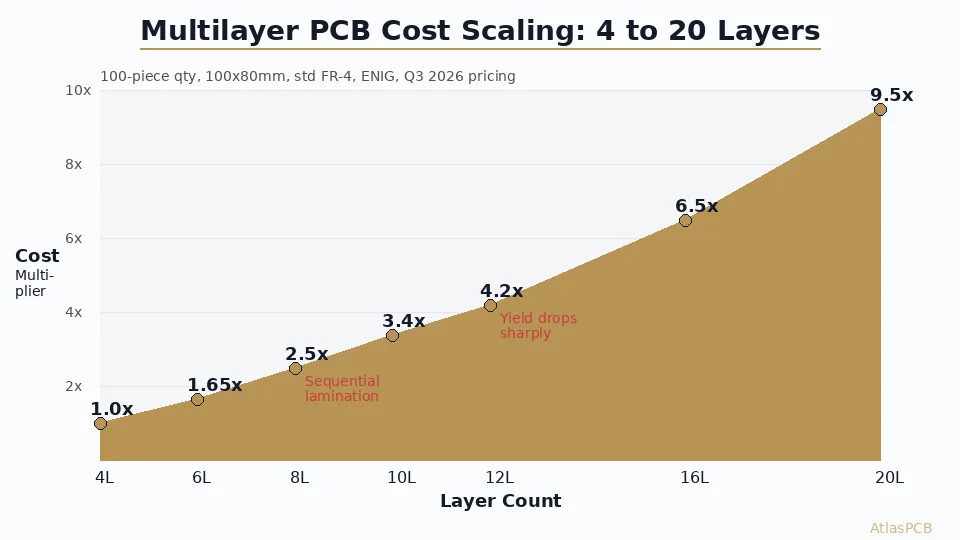
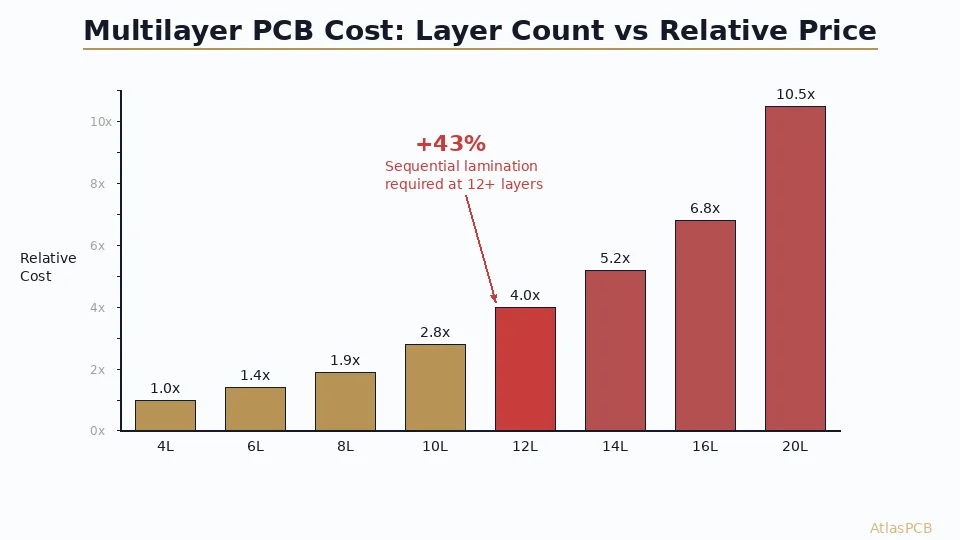
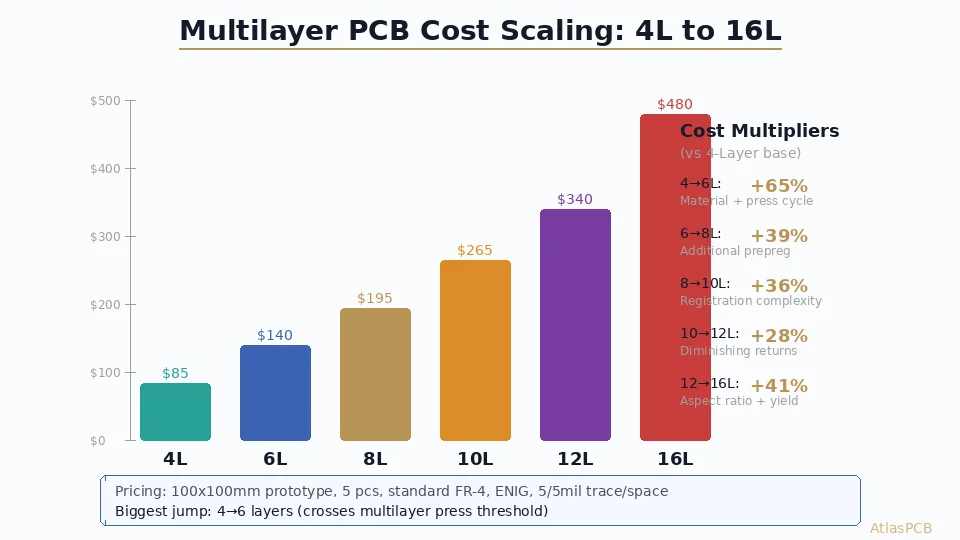
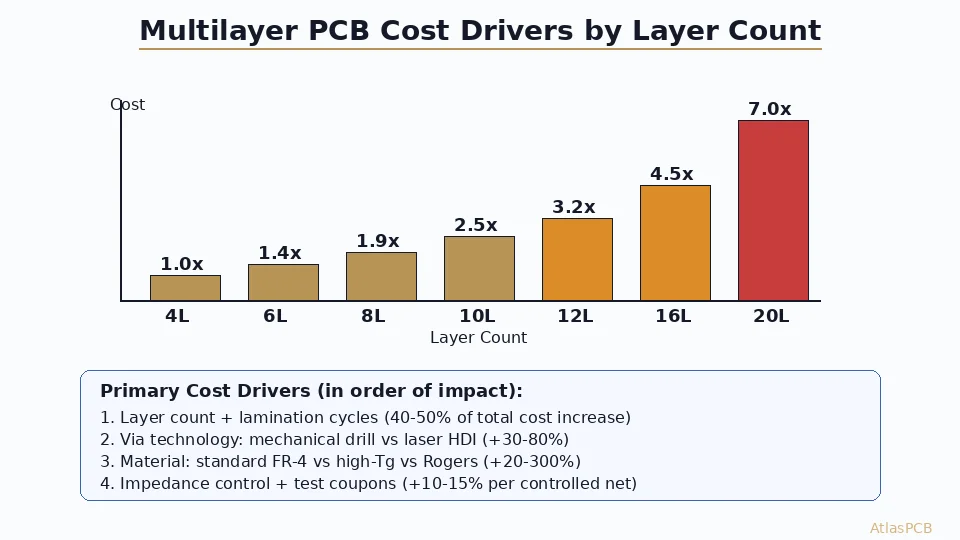
A 4-layer PCB costs roughly 1.8x a 2-layer board of the same dimensions. Each additional pair of layers adds approximately 40-60% to the previous cost tier: 6-layer is 2.5x, 8-layer is 3.5x, 12-layer is 4.5x, and 16-layer is 6.5x baseline. The primary cost drivers are material (30-45%), drilling (15-25%), and sequential lamination cycles (15-20%). The biggest cost jumps occur at the HDI threshold (requiring laser drilling) and at 12+ layers (requiring multiple lamination presses).
Quick Answer: Cost Multipliers by Layer Count
| Layers | Cost vs 2L | Typical Prototype (100x100mm, 5pcs) | Primary Cost Adder |
|---|---|---|---|
| 2 | 1.0x | $80-130 | Baseline |
| 4 | 1.8x | $140-230 | 1 lamination cycle |
| 6 | 2.5x | $200-320 | Material thickness |
| 8 | 3.5x | $280-450 | Registration complexity |
| 10 | 4.5x | $360-580 | Additional press cycle |
| 12 | 5.5x | $440-720 | Sequential lamination begins |
| 16 | 6.5-8x | $520-1040 | Multiple press cycles |
| 20 | 9-11x | $720-1430 | Premium material required |
| 24 | 12-15x | $960-1950 | Very few qualified fabs |
| 30 | 18-25x | $1440-3250 | Specialty process |
These multipliers assume standard FR-4, 1oz copper, ENIG surface finish, and standard tolerances. Factors that push cost higher: Rogers material (+200-400%), heavy copper 2oz+ (+30-50%), tight impedance tolerance +/-5% (+15-25%), and rush delivery (+50-100%).
The Four Primary Cost Drivers in Multilayer PCBs
1. Material Cost (30-45% of total)
Laminate material is the single largest cost component in multilayer boards, and its share increases with layer count. A 4-layer board uses one core and two prepreg sheets. A 16-layer board might use seven cores and eight prepregs — with each material layer adding both direct cost and yield risk.
The material cost story becomes more complex at higher layer counts because thinner cores become necessary to maintain reasonable total board thickness. A standard 62-mil (1.6mm) board at 16 layers requires 3-4 mil cores — thinner materials that cost 20-30% more per sheet than standard 8-mil cores and are more fragile to handle in production.
In our production, we maintain rolling stock of standard FR-4 thicknesses (3, 4, 5, 8, 10, 12, 20, 30 mil cores) from tier-1 suppliers (Shengyi, ITEQ, Isola). Non-standard thicknesses require special orders with 2-3 week lead times. Designing your stackup around available standard thicknesses can shave 15-20% off material cost and 1-2 weeks off lead time.
2. Drilling Cost (15-25% of total)
Drilling cost scales with three factors: total hole count, number of different drill sizes, and whether laser drilling is required. A typical 8-layer board with 3000 vias using 3 different drill sizes takes approximately 45 minutes of drill time. The same board with 8 different drill sizes takes 60+ minutes due to tool change overhead.
The cost jump to HDI (laser drilling) is substantial. Mechanical drilling costs approximately $0.001-0.003 per hole. Laser drilling costs $0.01-0.03 per hole — roughly 10x more per via. However, laser-drilled microvias are smaller, enabling denser routing in fewer layers, which often offsets the per-hole cost increase through layer reduction.
For cost-optimized designs, consolidate your via sizes. If you have vias at 0.25mm, 0.3mm, and 0.35mm, standardizing on 0.3mm eliminates two tool changes per panel without meaningful performance impact on most designs.
3. Lamination Cycles (15-20% of total)
Every lamination cycle involves: layup (manual alignment of copper and prepreg layers), pressing (2-4 hours at temperature and pressure), post-cure inspection, and registration verification. Standard multilayer boards through 8-10 layers can be built in a single lamination cycle. Beyond that, sequential lamination becomes necessary — and each additional press cycle adds 15-20% to the total board cost.
A 16-layer board built with buried vias might require three separate lamination cycles: the inner core pairs are drilled and plated first, then bonded together, then the outer layers are added in a final press. Each cycle introduces registration error that compounds through the stackup — which is why high-layer-count boards require tighter process control and achieve lower yields.
4. Electrical Testing (10-15% of total)
Testing cost is proportional to net count and board complexity. A flying probe tester checks continuity on every net and isolation between adjacent features. A 4-layer board with 500 nets takes 5-8 minutes of test time. A 20-layer board with 5000 nets might take 45-60 minutes — and any failure requires a full retest cycle after investigation.
At volume (>100 pieces), custom test fixtures become cost-effective despite the $500-2000 NRE, because fixture testing runs at 10-30 seconds per board versus 30-60 minutes on a flying probe. The crossover point is typically 50-100 boards for medium-complexity designs.
TRANSPARENT PRICING
Know Your Cost Before You Commit
Upload your Gerber files for an instant quote with line-item cost breakdown. See exactly what drives your price — no hidden fees, no surprises.
Get Instant Quote ›
Cost Optimization Strategies That Actually Work
Strategy 1: Layer Count Reduction Through Routing Optimization
The highest-impact cost reduction is eliminating a layer pair. Going from 8 to 6 layers saves 30-40% on a typical board. Before accepting your auto-router’s layer count suggestion, consider:
- Can differential pairs share layers with single-ended signals using proper spacing?
- Is a dedicated ground plane necessary on every other layer, or can shared reference planes serve multiple signal layers?
- Can power distribution work with fewer dedicated power planes if decoupling is optimized?
We’ve seen experienced layout engineers reduce layer count by 2 layers in 60% of designs we review, simply through better constraint management and reference plane sharing. The resulting cost savings typically exceed $100 per prototype run.
Strategy 2: Panel Utilization Optimization
PCB fabricators build boards on standardized panels (typically 18x24 inches or 18x21 inches). Your per-board cost is fundamentally: (panel cost) divided by (boards per panel). A 50x50mm board yields 48 boards per panel. A 55x55mm board yields only 36 — a 25% cost increase from a 10% dimension increase.
When possible, adjust non-critical board dimensions to maximize panel fit. Moving from 102mm to 98mm width might add 4 more boards per panel, saving 8-10% on unit cost at volume.
Strategy 3: Via Optimization
Three via-related optimizations with meaningful cost impact:
Consolidate drill sizes: Every unique drill requires a tool change (30-60 seconds each). Reducing from 8 drill sizes to 4 can save 5-10% of drilling cost.
Minimize blind/buried vias: Each blind or buried via type adds a sequential lamination step. If you can achieve your routing with only through-hole vias, you eliminate entire process steps. When blind vias are necessary, ensure they can be built in a single sequential step (1+N+1) rather than multiple (2+N+2 or 3+N+3).
Via-in-pad vs dogbone: Counterintuitively, via-in-pad (filled and capped) can be cheaper than dogbone vias in HDI designs because it eliminates the routing channel needed for dogbone escape, potentially allowing fewer routing layers.
Strategy 4: Surface Finish Selection
Surface finish adds $0.01-0.15 per square centimeter depending on type:
| Finish | Cost Adder | Best For |
|---|---|---|
| HASL (lead-free) | Baseline | General purpose, budget boards |
| OSP | -5% vs HASL | Short shelf life OK, fine pitch |
| ENIG | +15-25% vs HASL | Wire bonding, long shelf life, flat pads |
| Immersion Silver | +10-15% vs HASL | RF boards, cost-sensitive flatness |
| Hard Gold | +40-80% vs HASL | Edge connectors, wear surfaces |
If your design doesn’t require the flatness of ENIG (no fine-pitch BGA, no wire bonding), HASL saves meaningful cost at volume. For RF boards where surface roughness matters, immersion silver provides excellent performance at lower cost than ENIG.
HDI PCB MANUFACTURER
Reduce Layers with HDI — Often Cheaper Than More Standard Layers
A 6-layer HDI board can replace a 10-layer standard at lower cost and better performance. We'll recommend the most cost-effective approach for your design density.
Real-World Pricing Examples
To give concrete cost context, here are anonymized quotes from our recent production (Q2 2026 pricing, standard lead time):
Example 1: IoT Module (Simple)
- 4 layers, 40x30mm, FR-4 Tg150, 1oz, ENIG, 10 pieces
- Quote: $145 ($14.50/board)
- Key cost: Setup + material (small board, high panel utilization)
Example 2: Industrial Controller (Medium)
- 8 layers, 120x80mm, FR-4 Tg170, 1oz/0.5oz, ENIG, 20 pieces
- Quote: $680 ($34/board)
- Key cost: Material + 4 extra drill tool sizes + impedance control
Example 3: RF Transceiver (Complex)
- 6 layers, 80x60mm, Rogers RO4350B L1-2 + FR-4 L3-6, ENIG, 10 pieces
- Quote: $520 ($52/board)
- Key cost: Rogers material (+280% vs all-FR4) + hybrid lamination
Example 4: Server Board (High Layer Count)
- 16 layers, 300x250mm, Megtron 6, 1oz, ENIG, 5 pieces
- Quote: $2,850 ($570/board)
- Key cost: Large panel format + premium material + 3 lamination cycles + extensive testing
These examples illustrate that board area and material selection can outweigh layer count as cost drivers. The 6-layer Rogers board costs more per unit than the 8-layer FR-4 board due to material premium.
JLCPCB vs Custom PCB Manufacturer: Cost and Capability Comparison
Budget PCB services offer compelling pricing for simple multilayer boards, but the cost advantage narrows and eventually reverses as complexity increases:
| Spec | Budget Service (JLCPCB-type) | Custom Manufacturer (AtlasPCB-type) |
|---|---|---|
| 4-layer prototype, 5pcs | $25-60 | $80-150 |
| 8-layer, standard | $100-200 | $180-350 |
| 8-layer, impedance controlled | $180-300 | $200-400 |
| 12+ layers | Limited/unavailable | $400-800 |
| HDI (any-layer) | Not offered | $500-1200 |
| Rogers/hybrid | Basic options only | Full material library |
| Rigid-flex | Not offered | Available |
The budget services optimize for volume and standardization — their pricing excels on boards within their standard process window. Once you need tight tolerances, specialty materials, or high layer counts, a specialized manufacturer provides both capability and competitive pricing because those complex boards are their core business, not edge cases handled with upcharges.
COST OPTIMIZATION
Get Your Multilayer Board Quoted — With Cost Reduction Tips
Our quoting engineers flag opportunities to reduce cost: layer elimination, material substitution, panelization optimization. Many customers save 15-30% from our recommendations.
Get Optimized Quote ›Volume Pricing Curves: When Do Costs Drop?
PCB pricing has strong economies of scale, but the curve shape varies by complexity:
Simple 4-6 layer boards:
- 5 pcs → 100 pcs: 60-70% cost reduction per unit
- 100 pcs → 1000 pcs: additional 30-40% reduction
- Above 1000 pcs: 10-15% additional per 10x volume increment
Complex 12+ layer boards:
- 5 pcs → 50 pcs: 40-50% cost reduction per unit
- 50 pcs → 500 pcs: additional 20-30% reduction
- Above 500 pcs: 5-10% additional per 10x volume increment
The flatter curve on complex boards reflects the higher proportion of fixed costs (material, testing) versus setup costs. Simple boards benefit enormously from amortizing panel setup across more units. Complex boards have per-unit costs that are more intrinsically tied to process steps that don’t simplify at volume.
ATLASPCB
Ready to Quote Your Multilayer PCB?
Upload Gerber files for instant pricing on 4 to 30-layer boards. We stock standard materials for same-day quoting and offer volume pricing for production runs.
Get Instant Quote ›
Reviewed by AtlasPCB Engineering Team — 15+ years in advanced PCB fabrication for RF, HDI, and rigid-flex applications.
Related Reading:
- 4-Layer PCB Manufacturing
- 6-Layer PCB Manufacturing
- 8-Layer PCB Manufacturing
- How Many Layers Does My PCB Need? A Decision Framework
- Advanced HDI PCB Stackup Design: Sequential Lamination and ELIC
- High Layer Count PCB Challenges: 20 to 68 Layer Boards
- 16-Layer PCB Stackup Design: Rules and Material Selection
About AtlasPCB — We specialize in complex PCB manufacturing for HDI, RF, and high-reliability applications. Explore our HDI PCB manufacturing capabilities, multilayer PCB fabrication up to 30 layers, or get an instant online PCB quote . Every order includes free engineering review. Get your quote.
Reviewed by AtlasPCB Engineering Team — IPC-certified manufacturing specialists with 15+ years of production experience in HDI, RF, and high-reliability PCB fabrication. Content based on factory floor data and real customer design reviews.
Frequently Asked Questions
How much does a 4-layer PCB cost compared to a 2-layer?
What makes HDI PCBs more expensive than standard multilayer?
How can I reduce multilayer PCB cost without sacrificing performance?
Why do 12+ layer boards have a disproportionate cost jump?
Is it cheaper to go 10-layer standard or 6-layer HDI?
- multilayer PCB cost
- PCB pricing
- HDI PCB manufacturer
- PCB layer count
- cost optimization