· David Okafor · Engineering · 7 min read
IPC-2581 for Smart Factory PCB Manufacturing
How IPC-2581 intelligent manufacturing data standard enables AI-driven automation, digital twins, and predictive quality control in modern PCB fabrication and assembly.
Quick Answer
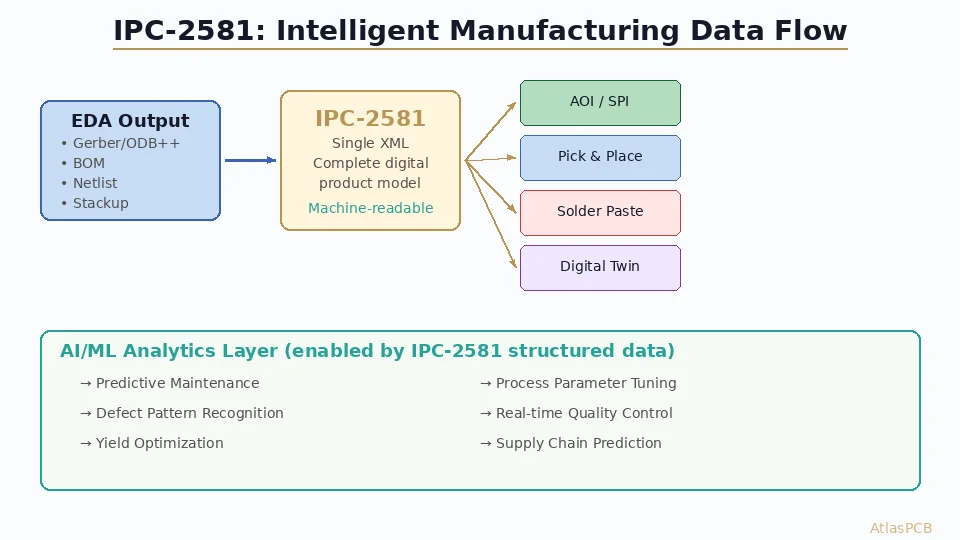
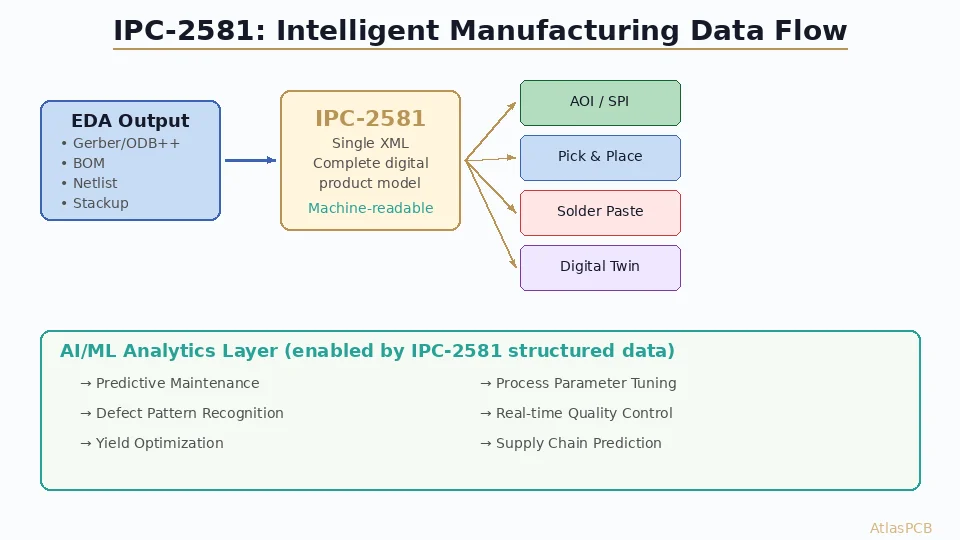
IPC-2581 is an open XML-based standard that encapsulates the complete PCB design, fabrication, and assembly data in a single machine-readable file — replacing the fragmented Gerber/drill/BOM/netlist file set. This unified digital product model enables AI-driven smart factory automation including automated DFM checking, predictive maintenance, real-time quality analytics, and digital twin simulations without manual data translation or file interpretation errors.
Why PCB Manufacturing Needs a Data Revolution
The PCB industry has operated with fundamentally the same data exchange format for over 40 years. Gerber files — originally developed by Gerber Scientific in the 1980s for photoplotter control — remain the dominant format for communicating design intent to fabricators. But as manufacturing complexity increases, the limitations of image-based data exchange become acute.
A typical 12-layer HDI PCB design requires 30-50 individual files for manufacturing: Gerber layers, drill files (multiple formats), netlist, BOM, assembly drawings, impedance specifications, stackup documents, special instructions, and engineering notes. Each file format is different, many require manual interpretation, and errors in cross-referencing between files account for an estimated 15-25% of NPI (New Product Introduction) engineering time at fabrication shops.
At PCB East 2026, Hemant Shah and Dana Korf presented on “IPC-2581 and the Future of Intelligent Manufacturing Data,” demonstrating how structured, machine-readable design data forms the essential foundation for AI-driven automation. Their central argument: you cannot build an AI-powered smart factory on top of image files designed for photoplotters. The data infrastructure must change first.
Understanding IPC-2581
What It Contains
IPC-2581 (formally “Generic Requirements for Printed Board Assembly Products Manufacturing Description Data and Transfer Methodology”) defines a single XML file that encompasses:
Design Data:
- Complete layer stackup with material properties (Dk, Df, thickness, copper weight)
- All copper features with net assignments (every trace, pad, and fill knows which net it belongs to)
- Via definitions with drill sizes, plating specifications, and connectivity
- Component placement with reference designators, package types, and 3D positions
Manufacturing Data:
- Fabrication notes and special requirements
- Impedance control specifications tied to specific nets/layers
- Surface finish requirements by area
- Panel layout and tooling requirements
Assembly Data:
- Complete BOM with approved vendor/part number lists
- Solder paste stencil definitions
- Component placement coordinates and rotation
- Test point locations and access requirements
The Structural Advantage
The key innovation isn’t just bundling files together — it’s net-aware data structure. In a Gerber file, a copper feature is just a shape. In IPC-2581, that same feature is a conductor segment belonging to a specific net, with impedance requirements, clearance rules, and connectivity to specific component pins.
This structural intelligence enables:
<Net name="DDR_DQ0">
  <Route layer="L3" width="0.090mm" impedance_target="50ohm">
    <Segment start="U1.A3" end="U5.B7" length="42.3mm"/>
  </Route>
  <Constraints>
    <LengthMatch group="DDR_DQ" tolerance="0.5mm"/>
    <Spacing min="0.100mm" to_net_class="DDR"/>
  </Constraints>
</Net>
An AI system can directly parse this to understand that DDR_DQ0 is a length-matched signal requiring 50Ω impedance on Layer 3 — without needing to reverse-engineer this information from image data.
Enabling AI-Driven Smart Factory Operations
Automated DFM Analysis
Traditional DFM checking requires an engineer to interpret Gerber data, identify potential manufacturing issues, and manually verify compliance. With IPC-2581:
- Automated net-aware checks: The system knows which features are signal traces vs power planes, enabling intelligent spacing analysis based on voltage class
- Material-aware verification: Stackup data includes material properties, allowing the system to calculate achievable impedance tolerances and flag unrealizable specifications
- Process capability matching: AI compares design requirements against the specific factory’s measured process capabilities, predicting yield before fabrication starts
Predictive Quality Control
IPC-2581 data, combined with in-process measurements, enables predictive analytics:
- AOI correlation: When AOI detects a defect pattern, the system cross-references IPC-2581 net data to identify which functional circuits are affected — enabling intelligent dispositions (scrap vs repair vs accept)
- SPI prediction: Solder paste inspection data correlated with component placement coordinates from IPC-2581 predicts which joints will have marginal volume before reflow
- Process trending: Manufacturing parameters (etch time, plating current density, drilling speeds) are mapped to specific design features through IPC-2581 data, enabling process engineers to see which design characteristics drive variation
Digital Twin Manufacturing
The complete digital product model in IPC-2581 enables true digital twin operations:
- Virtual build simulation: Run the entire manufacturing sequence virtually before committing material, identifying tooling conflicts, process bottlenecks, and yield risks
- Real-time process matching: During production, compare measured results against the digital model to detect drift immediately
- Lot genealogy: Every manufactured board links to its exact design specification version, enabling root cause analysis across production history
Seamless Design-to-Manufacturing Data Transfer
AtlasPCB accepts IPC-2581, ODB++, and Gerber formats with automated DFM analysis on every order.
View Our Capabilities →Industry Adoption Status (2026)
EDA Tool Support
| EDA Platform | IPC-2581 Version | Export Quality |
|---|---|---|
| Cadence Allegro/OrCAD | Rev C | Full (native) |
| Siemens Xpedition | Rev C | Full (native) |
| Zuken CR-8000 | Rev C | Full (native) |
| Altium Designer | Rev B/C | Good (improving) |
| KiCad | Rev B | Basic (community) |
| Quilter.ai | Rev C | Full (native) |
Fabricator Readiness
At PCB East 2026, a survey of attending fabricators revealed:
- 62% can accept IPC-2581 files for fabrication
- 38% use IPC-2581 data to drive internal automation
- 85% plan to expand IPC-2581 utilization within 12 months
- Only 12% use IPC-2581 data for AI/ML applications (the emerging frontier)
The gap between acceptance (62%) and AI utilization (12%) represents the current industry position: most fabs can receive the data, but few have built the analytics infrastructure to exploit its machine-readable structure.
Key Implementation Barriers
1. Legacy system integration: Existing CAM systems are built around Gerber workflows. Retrofitting IPC-2581 parsing into legacy toolchains requires significant development effort.
2. Specification completeness: Many designers export IPC-2581 with incomplete data — particularly material specifications, impedance targets, and manufacturing notes that don’t translate from their informal communication methods.
3. Change management: Engineers and CAM operators who have decades of Gerber workflow experience must learn new tools and processes. The efficiency gains only materialize after the learning curve.
4. Customer adoption: Even if a fabricator is IPC-2581-ready, they can’t force customers to export in the format. Both sides of the handoff must participate.
Practical Implementation Guide
For PCB Designers
Verify your EDA export settings: Ensure IPC-2581 export includes:
- Net connectivity (not just geometry)
- Material properties (Dk, Df, thickness for each dielectric layer)
- Impedance control specifications per net class
- Component data with package 3D models
Include manufacturing intent: Add notes, specifications, and requirements within the IPC-2581 structure rather than in separate documents
Validate before sending: Use IPC-2581 viewers/validators (freely available from IPC consortium members) to confirm data integrity
For Fabricators
Start with automated DFM: The quickest ROI comes from using IPC-2581 structured data for automated design rule checking — eliminating hours of manual Gerber review per job
Build net-aware AOI programs: When AOI program generation consumes IPC-2581 data, inspection programs automatically know which features are critical (signal traces vs thermal relief, for example)
Instrument processes for data collection: IPC-2581 benefits multiply when combined with in-process measurement data. Equip drilling, plating, and etching stations with automated data logging tied to panel/job identity
For Assembly/EMS Providers
Automate stencil design: IPC-2581 pad geometry and component data directly generates optimized stencil apertures without manual CAD work
Machine program generation: Pick-and-place programs generated directly from IPC-2581 placement data, eliminating file format conversion errors
Traceability integration: Link each assembled unit to its exact IPC-2581 version for complete manufacturing genealogy
The Path Forward: IPC-2581 + AI
The PCB industry is at an inflection point where two technologies converge:
- IPC-2581 provides the structured, machine-readable data foundation
- AI/ML provides the analytical capability to extract manufacturing intelligence from that data
The combination enables capabilities that were impossible with fragmented Gerber-based workflows:
- Generative DFM: AI suggests design modifications that improve manufacturability while maintaining electrical performance
- Predictive yield modeling: Before a single panel enters production, ML models estimate yield based on the design’s characteristics and the factory’s historical performance
- Autonomous process optimization: Fabrication parameters (etch time, drill speeds, plating currents) are continuously optimized by AI based on measured outcomes linked back to design features through IPC-2581 data
- Cross-factory learning: When multiple factories use the same IPC-2581 data structure, learnings from one facility transfer to another — enabling enterprise-wide quality improvement
Further Reading
- AI-Powered DFM Checking for PCB Design
- PCB Test Coupon Design and IPC Standards
- PCB Testing Methods Guide
- HDI PCB Design Guide
Ready to streamline your design-to-manufacturing handoff? Submit your design files — we accept IPC-2581, ODB++, and standard Gerber/drill packages with 12-hour engineering review.
About AtlasPCB — We specialize in complex PCB manufacturing for HDI, RF, and high-reliability applications. Explore our free engineering DFM review, or get an full PCB manufacturing capabilities . Every order includes free engineering review. Get your quote.
Reviewed by AtlasPCB Engineering Team — IPC-certified manufacturing specialists with 15+ years of production experience in HDI, RF, and high-reliability PCB fabrication. Content based on factory floor data and real customer design reviews.
Frequently Asked Questions
What is the difference between IPC-2581 and Gerber/ODB++?
How does IPC-2581 enable AI in PCB manufacturing?
Do all EDA tools support IPC-2581 export?
- IPC-2581
- smart factory
- PCB manufacturing
- digital twin
- machine-readable data
- Industry 4.0
- AI manufacturing
- DFM