· Marcus Lin · Engineering · 11 min read
Immersion Silver vs ENIG: Solderability, Shelf Life, and Cost Trade-offs
A detailed fabrication-level comparison of Immersion Silver and ENIG surface finishes covering solderability performance, shelf life limitations, cost structure differences, and practical selection guidance for volume production.
Selecting a surface finish is one of the most consequential decisions in PCB fabrication, yet many designers default to ENIG without fully understanding what they gain and what they sacrifice. Immersion silver has quietly become one of the most technically capable alternatives, offering performance characteristics that exceed ENIG in several measurable dimensions while introducing constraints that demand disciplined supply chain management. This article examines both finishes from the perspective of a fabrication facility that processes thousands of panels monthly in both chemistries, drawing on process data, failure analysis results, and customer feedback to provide an honest comparison.
Chemistry and Deposition Fundamentals
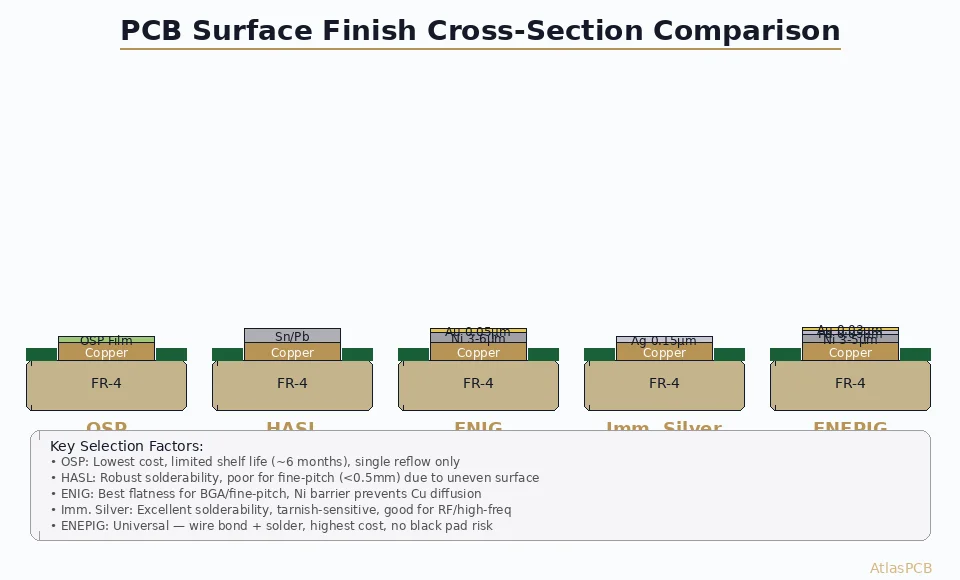
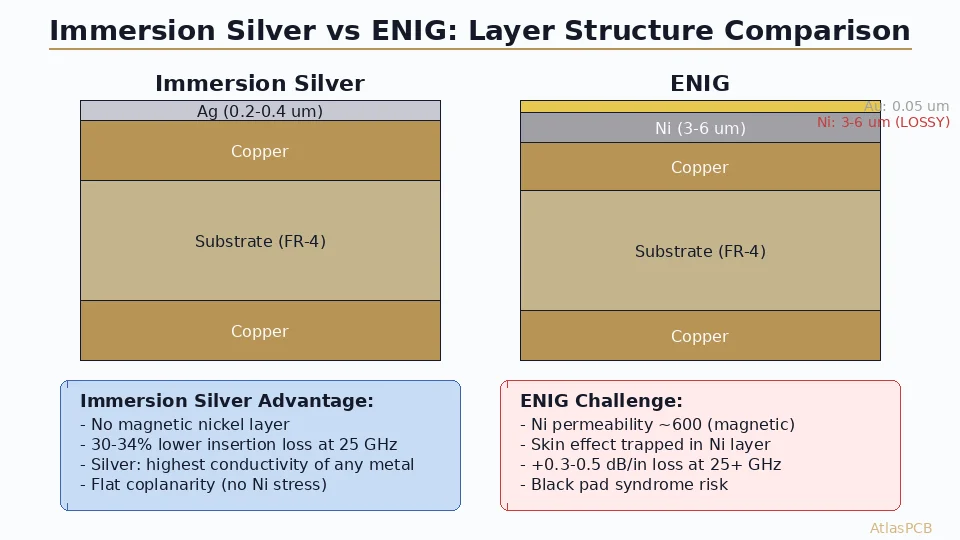
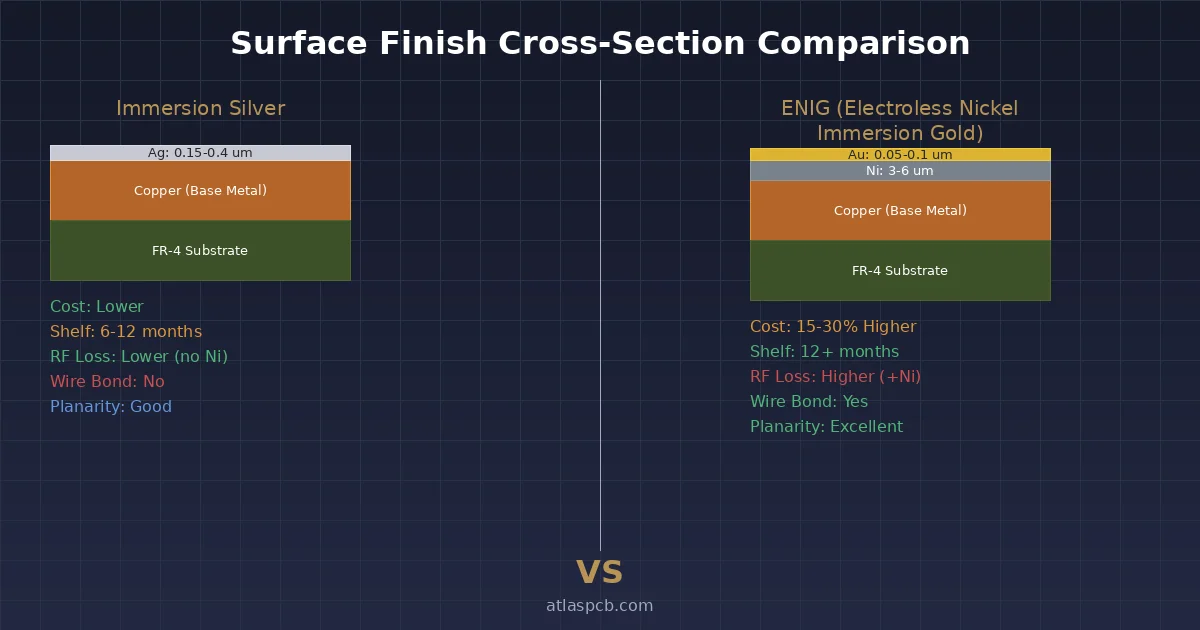
Understanding the metallurgical differences between these two finishes explains most of their behavioral differences in assembly and service life. ENIG deposits a nickel barrier layer of 3 to 6 micrometers followed by a thin immersion gold layer of 0.05 to 0.1 micrometers. The gold serves primarily as an oxidation barrier for the underlying nickel, which forms the actual soldering surface once the gold dissolves into the molten solder during reflow. The nickel layer provides a robust diffusion barrier between the copper pad and the solder joint, preventing copper dissolution and providing excellent planarity for fine-pitch component placement.
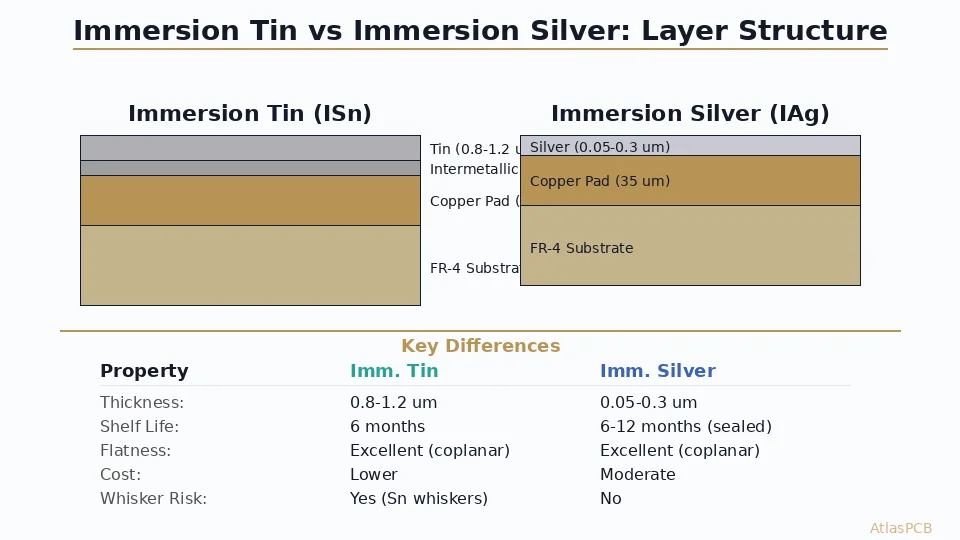
Immersion silver, by contrast, deposits a pure silver layer of 0.15 to 0.40 micrometers directly onto the copper pad through a displacement reaction. There is no intermediate barrier layer. The silver coating is significantly thinner than the combined ENIG deposit, yet it provides outstanding solderability because silver has inherent affinity for tin-based solders. The absence of an intermetallic barrier means the metallurgical system is simpler, with fewer potential failure modes related to layer interactions.
From our fabrication experience, the ENIG process requires substantially more chemical baths — typically seven to nine stages including activation, nickel plating, and gold displacement — compared to the four to five stages required for immersion silver. Each additional bath represents a potential source of contamination and process variation. The nickel bath in particular demands rigorous monitoring of phosphorus content, bath loading, and metal turnover rates to prevent the formation of hyper-corrosion defects known as black pad.
Solderability Performance in Production
In controlled wetting balance testing, fresh immersion silver consistently outperforms fresh ENIG. The silver surface presents a highly wettable substrate because the solder directly contacts silver, which dissolves readily into tin-based alloys and creates a clean copper-tin intermetallic at the joint interface. Contact angles measured on fresh immersion silver boards routinely fall below 15 degrees with SAC305 solder paste, compared to 20 to 30 degrees for fresh ENIG.
The practical significance becomes apparent during assembly. Our assembly partners report that immersion silver boards require less aggressive reflow profiles to achieve complete wetting, particularly on thermal relief pads connected to large copper planes. The lower thermal mass of the silver deposit compared to the nickel-gold stack means heat transfer to the solder joint interface occurs more efficiently. For designers working with large ground pads on power supplies or motor controllers, this translates to fewer solder defects related to insufficient wetting on thermally challenging pads.
However, the solderability advantage of immersion silver degrades more rapidly with storage time than ENIG. Silver tarnishes when exposed to sulfur-containing compounds in the atmosphere, forming silver sulfide that impairs wetting. In a well-controlled storage environment with anti-tarnish packaging and humidity indicators, immersion silver maintains excellent solderability for six to nine months. ENIG, protected by its gold layer, maintains consistent solderability for twelve months or longer under similar conditions. This difference becomes decisive when boards must sit in warehouse inventory for extended periods or when production schedules experience unexpected delays.
Our production data from over two thousand lots processed in the past twelve months shows the defect rate differential clearly. Immersion silver boards assembled within three months of fabrication exhibit solder defect rates below 50 parts per million. Boards assembled between six and nine months show defect rates rising to 150 to 300 parts per million, still within acceptable limits for most applications but representing a threefold increase. ENIG boards maintain relatively stable defect rates below 80 parts per million regardless of whether they are assembled at three months or twelve months post-fabrication.
Shelf Life Management in Practice
The shelf life limitation of immersion silver is not an inherent deficiency but rather a constraint that demands process discipline. In our experience, the majority of tarnish-related failures trace back to improper handling rather than fundamental material limitations. Exposure to sulfur-containing cardboard packaging, storage in uncontrolled environments near rubber bands or elastic materials that outgas sulfur compounds, or simply leaving boards exposed to ambient air during incoming inspection — these handling errors account for the vast majority of field complaints we see with immersion silver.
Proper storage protocol requires vacuum-sealed anti-tarnish bags with nitrogen backfill, humidity indicator cards inside the package showing below 30 percent relative humidity, and storage temperatures between 15 and 30 degrees Celsius. When these conditions are maintained, we have verified acceptable solderability at twelve months post-fabrication for immersion silver boards, approaching ENIG performance. The challenge is that maintaining this discipline across a global supply chain with multiple warehousing stages and handlers is considerably more difficult than simply specifying ENIG and gaining inherent tolerance to storage variability.
For companies operating just-in-time manufacturing with predictable consumption schedules, immersion silver presents minimal shelf life risk. The boards move from our factory to the customer’s assembly line within weeks, well within the comfort zone for silver’s solderability window. Conversely, companies building to stock for uncertain demand, maintaining safety inventory across multiple distribution centers, or shipping boards to contract manufacturers in tropical climates with limited environmental controls will find ENIG’s forgiving storage characteristics worth the premium.
Cost Structure Analysis
The cost difference between immersion silver and ENIG reflects fundamental differences in material consumption and process complexity. Gold, even at the thin deposition thicknesses used in ENIG, represents a significant material cost component. Nickel anodes, bath chemistry maintenance, and the additional rinse and treatment stages compound the processing cost. In our current pricing structure, ENIG adds approximately 15 to 25 percent to the surface finish cost compared to immersion silver, with the exact differential depending on panel size, pad density, and order volume.
For a standard four-layer FR-4 board measuring 100 by 160 millimeters with moderate component density, the ENIG premium translates to roughly two to four dollars per panel above immersion silver. At prototype quantities of ten to fifty panels, this differential is negligible relative to total order cost. At production volumes of five thousand panels or more, the cumulative savings from specifying immersion silver can reach tens of thousands of dollars per order — enough to justify the additional supply chain discipline required for shelf life management.
The cost calculation must also factor in yield considerations. Black pad failures in ENIG, while rare with modern process controls, create catastrophic assembly defects that require complete board replacement. A single black pad event on a high-value assembly can negate months of accumulated finish cost savings. Our incoming quality monitoring includes coupon testing and cross-sectional analysis of every ENIG lot to verify phosphorus content and deposit uniformity, adding analytical cost that does not apply to immersion silver production.
Immersion silver’s simpler chemistry also translates to faster processing throughput. Panels move through the silver line approximately 30 percent faster than through the ENIG line, improving factory utilization and enabling shorter lead times. For customers requiring expedited delivery, this processing speed advantage can be as valuable as the direct cost savings.
Electrical Performance Considerations
At frequencies below 1 GHz, both finishes perform equivalently in terms of signal integrity. The differences emerge above 3 GHz, where skin effect causes current to flow in the outermost layers of the conductor surface. Silver has the highest electrical conductivity of any metal, and the immersion silver surface presents a low-loss path for high-frequency signals. ENIG’s nickel underlayer, being ferromagnetic with significantly lower conductivity than either copper or silver, introduces measurable insertion loss at millimeter-wave frequencies.
Our characterization data on test coupons fabricated with both finishes on identical stackups shows insertion loss differences of 0.02 to 0.05 dB per centimeter at 10 GHz. While this appears small, it accumulates across long traces and becomes significant in antenna feed networks, phase-matched routing, and high-speed serial links operating above 28 Gbps. For these applications, immersion silver provides a measurable performance advantage that directly impacts system margin.
Contact resistance measurements also favor immersion silver for press-fit connector applications and certain switch contact designs where gold over nickel is not specified. The low and consistent contact resistance of silver surfaces makes immersion silver popular in automotive connector applications and backplane designs where signal integrity at the connector interface is critical.
Black Pad Risk and Failure Modes
The most serious failure mode unique to ENIG is black pad, also known as nickel corrosion defect. This condition occurs when the electroless nickel deposit develops excessive phosphorus enrichment at the surface during gold deposition, creating a passive layer that prevents proper intermetallic formation during soldering. Black pad joints appear visually normal after reflow but exhibit dramatically reduced mechanical strength, failing under thermal cycling or mechanical stress.
In our facility, we have reduced black pad incidence to below 0.01 percent of pads through rigorous bath monitoring, controlled immersion times, and regular cross-sectional verification. However, the failure mode cannot be completely eliminated because it relates to fundamental electrochemistry at the nickel-gold interface. When it does occur, it typically affects an entire panel or lot, creating a concentrated quality event rather than randomly distributed defects.
Immersion silver does not have an equivalent catastrophic failure mode. Its primary defect mechanisms — tarnishing, micro-voiding, and creep corrosion — are progressive rather than sudden, providing warning signs during incoming inspection that allow preventive action before assembly. This predictability makes immersion silver attractive for applications where the consequences of a latent defect reaching the field are unacceptable.
Assembly Compatibility
Both finishes are compatible with standard lead-free reflow processes using SAC305 and similar alloys. However, they differ in their tolerance for multiple reflow cycles. ENIG maintains consistent solderability through three or more reflow cycles because the nickel barrier prevents copper dissolution regardless of how many times the surface is exposed to molten solder. Immersion silver boards begin to show copper diffusion effects after two reflow cycles, as the thin silver layer is consumed during the first reflow and subsequent cycles expose copper directly to thermal oxidation.
For double-sided SMT assemblies requiring two reflow passes, immersion silver performs adequately provided the process engineer maintains protective nitrogen atmosphere during reflow to minimize oxidation of the top-side pads during the second-side reflow cycle. Boards requiring three or more reflow cycles — such as those with through-hole components reflowed after two SMT passes — benefit significantly from ENIG’s thermal endurance.
Wave soldering compatibility is excellent for both finishes. Selective soldering processes also work well with either finish, though immersion silver’s superior wetting characteristics provide slightly larger process windows for selective soldering of through-hole connectors on mixed-technology assemblies.
Decision Framework for Engineers
The selection between immersion silver and ENIG ultimately depends on the intersection of technical requirements and supply chain realities. Choose immersion silver when the design operates above 5 GHz and signal loss matters, when cost pressure at volume demands the most economical finish, when assembly will occur within three months of fabrication, and when the supply chain can maintain controlled storage conditions. Choose ENIG when boards require extended shelf life beyond six months, when wire bonding is specified anywhere on the assembly, when ultra-fine-pitch components below 0.4 millimeter pitch demand maximum planarity, or when multiple reflow cycles are unavoidable.
Many of our customers maintain qualification for both finishes across their product lines, selecting the appropriate finish at the project level based on these criteria. This dual-qualification approach maximizes cost optimization while maintaining reliability margins appropriate to each product’s risk profile.
Reviewed by AtlasPCB Engineering Team
ATLASPCB SURFACE FINISH SERVICES
Both Finishes Available — No Minimum Order
We process Immersion Silver, ENIG, OSP, HASL, Immersion Tin, and Hard Gold with full IPC-4552/4553 compliance. Get a quote with surface finish options compared.
Get Your Quote ›About AtlasPCB — We specialize in complex PCB manufacturing for HDI, RF, and high-reliability applications. Explore our RF and high-frequency PCB services, free engineering DFM review, or get an full PCB manufacturing capabilities . Every order includes free engineering review. Get your quote.
Reviewed by AtlasPCB Engineering Team — IPC-certified manufacturing specialists with 15+ years of production experience in HDI, RF, and high-reliability PCB fabrication. Content based on factory floor data and real customer design reviews.
- surface finish
- immersion silver
- ENIG
- solderability
- PCB cost
- DFM