· Marcus Lin · News · 5 min read
AGC Launches Advanced RF PCB Materials for 77 GHz
AGC introduces fastRise low-loss prepreg for automotive radar applications, expanding North American sourcing options for high-frequency PCB materials.
AGC Expands High-Frequency PCB Material Portfolio for Automotive Radar
Japanese materials giant AGC (formerly Asahi Glass Company) is making significant moves in the high-frequency PCB substrate market, introducing advanced materials specifically engineered for automotive radar and millimeter-wave applications. As detailed in coverage from iConnect007 at APEX EXPO 2026, AGC’s lineup includes the fastRise low-loss non-reinforced prepreg, designed to meet the exacting requirements of 77 GHz automotive radar systems used in Advanced Driver Assistance Systems (ADAS) and autonomous driving platforms.
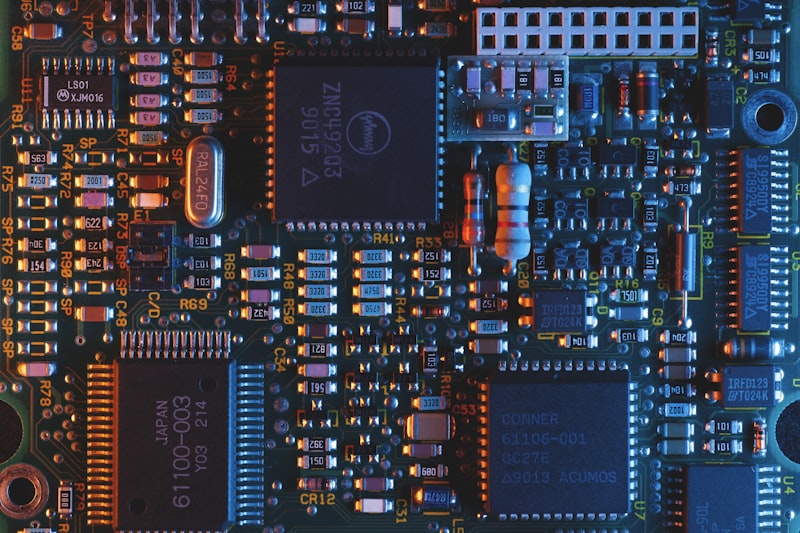
Photo by Spencer Davis on Unsplash — Free to use under Unsplash License
Why 77 GHz Radar Demands Specialized PCB Materials
Modern automotive radar operates primarily at 77 GHz (76–81 GHz band), a frequency range where conventional PCB materials like standard FR-4 become virtually unusable. At millimeter-wave frequencies, the electrical properties of the substrate dominate signal performance:
Dielectric constant (Dk): At 77 GHz, even small variations in Dk across the board area cause impedance mismatches that degrade radar beam forming. Materials must provide Dk stability within ±0.05 across the entire panel, with low Dk values (typically 3.0–3.6) to minimize signal delay and wavelength compression.
Dissipation factor (Df): The Df — or loss tangent — determines how much signal energy is absorbed by the substrate as heat. At 77 GHz, a Df difference of just 0.002 can translate to 2–3 dB of additional insertion loss per inch of trace length. High-performance radar substrates target Df values below 0.004 at 77 GHz, compared to >0.020 for standard FR-4.
Moisture absorption: Water molecules absorb microwave energy strongly. PCB materials for automotive radar must have moisture absorption below 0.1% to maintain consistent Dk/Df values across the vehicle’s operating lifetime and environmental exposure.
Thermal stability: Automotive under-hood temperatures can range from -40°C to +125°C (or higher near engine components). The substrate’s Dk and Df must remain stable across this temperature range — a challenging requirement that eliminates many otherwise suitable materials.
AGC’s fastRise: Bridging the Gap
AGC’s fastRise is positioned as a non-reinforced prepreg that offers several advantages for 77 GHz applications:
- Low and stable Dk: Consistent dielectric properties at millimeter-wave frequencies, enabling accurate impedance matching for patch antennas and transmission lines
- Low Df: Minimized signal loss for improved radar range and sensitivity
- Non-reinforced construction: Eliminating glass weave removes the “fiber weave effect” — a significant source of Dk variation at millimeter-wave frequencies where the wavelength approaches the weave pitch
- Processing compatibility: Designed to work within standard multilayer PCB lamination processes, reducing the need for specialized equipment
The elimination of glass reinforcement is particularly significant. At 77 GHz, the signal wavelength in the substrate is approximately 1.5–2.0 mm — close enough to typical E-glass weave patterns (1.0–1.8 mm pitch) to cause measurable Dk modulation as traces cross over glass bundles. This phenomenon, well-documented in [high-frequency PCB design literature]/blog/high-frequency-pcb-design-best-practices/), creates impedance discontinuities that degrade radar performance. Non-reinforced prepregs like fastRise provide a homogeneous dielectric that eliminates this effect.
North American Sourcing: A Strategic Advantage
AGC has emphasized its commitment to North American sourcing, a strategy that addresses several market pressures simultaneously:
- Supply chain resilience: With geopolitical tensions affecting trade routes and tariff structures, domestic or near-shore material sourcing provides predictability that offshore-only supply chains cannot match
- Lead time reduction: North American material availability shortens the procurement cycle from weeks to days for standard thicknesses and configurations
- Technical support: Local application engineers who understand the specific requirements of North American automotive OEMs and Tier 1 suppliers
This sourcing strategy aligns with broader industry trends. According to iConnect007’s APEX EXPO coverage, PCB manufacturers across North America are investing heavily in capabilities for automotive and aerospace applications — sectors where supply chain security is becoming as important as technical performance.
The Competitive Landscape: Rogers, Taconic, and Beyond
AGC’s automotive RF materials enter a market traditionally dominated by Rogers Corporation and Taconic Advanced Dielectrics:
| Material | Manufacturer | Dk (77 GHz) | Df (77 GHz) | Type |
|---|---|---|---|---|
| RO3003 | Rogers | 3.00 | 0.0013 | PTFE ceramic |
| RO4835 | Rogers | 3.48 | 0.0037 | Thermoset |
| TLY-5 | Taconic | 2.20 | 0.0009 | PTFE woven |
| fastRise | AGC | ~3.2 | <0.004 | Non-reinforced |
| IS680 | Isola | 3.45 | 0.0035 | Low-loss thermoset |
Each material family represents different engineering trade-offs between electrical performance, processability, cost, and mechanical properties. PTFE-based materials (Rogers RO3003, Taconic TLY-5) offer the lowest losses but require specialized processing — [PTFE PCB fabrication]/blog/rf-microwave-pcb-design/) demands higher lamination temperatures and modified drilling parameters. Thermoset materials like Rogers RO4835 and AGC’s fastRise process more like conventional epoxy systems, making them attractive for high-volume automotive production where process simplicity reduces defect rates.
Implications for Automotive PCB Design
The availability of new materials like fastRise expands the design engineer’s toolkit for automotive radar applications. Key design considerations include:
Antenna integration: 77 GHz patch antennas are typically fabricated directly on the PCB surface, requiring extremely tight Dk control for resonant frequency accuracy. A 1% Dk shift moves the antenna resonant frequency by approximately 0.5%, or ~385 MHz at 77 GHz — enough to shift the antenna out of the regulatory band.
Mixed-material stackups: Many automotive radar modules combine a [high-frequency substrate]/blog/high-frequency-pcb-substrate-selection-dk-df/) (for the antenna and RF front end) with conventional FR-4 (for digital processing, power management, and connectors) in a single PCB. This requires careful material compatibility analysis for lamination, thermal expansion matching, and via reliability across the material boundary.
Manufacturing volume: Automotive volumes — millions of units per year for popular vehicle platforms — demand materials and processes that can scale. The ability to process fastRise on standard lamination equipment without exotic process steps is a significant advantage for high-volume automotive PCB fabricators.
Atlas PCB: Your Partner for Automotive RF PCBs
Atlas PCB fabricates on a comprehensive range of high-frequency substrates including Rogers, Taconic, AGC, and Isola materials. Our RF specialists understand the unique requirements of [automotive radar PCB design]/blog/rf-microwave-pcb-design/), from Dk tolerance control to mixed-material stackup optimization. We support prototype through production volumes for automotive Tier 1 suppliers and radar module manufacturers.
Designing an automotive radar PCB? Upload your Gerbers for a quote with free RF material recommendation, or talk to our RF specialists about material selection for your 77 GHz application.
About AtlasPCB — We specialize in complex PCB manufacturing for HDI, RF, and high-reliability applications. Explore our RF and high-frequency PCB services, or get an Rogers RO4350B PCB manufacturing . Every order includes free engineering review. Get your quote.
Reviewed by AtlasPCB Engineering Team — IPC-certified manufacturing specialists with 15+ years of production experience in HDI, RF, and high-reliability PCB fabrication. Content based on factory floor data and real customer design reviews.
- news
- rf-materials
- automotive
- radar
- 77ghz
- adas