· Priya Nair · Engineering · 10 min read
PCB Surface Finish Comparison
In-depth comparison of PCB surface finishes—OSP, HASL, Immersion Silver, and ENIG—covering solderability, shelf life, wire bonding capability, fine-pitch compatibility, and total cost of ownership for different assembly requirements.
Quick Answer
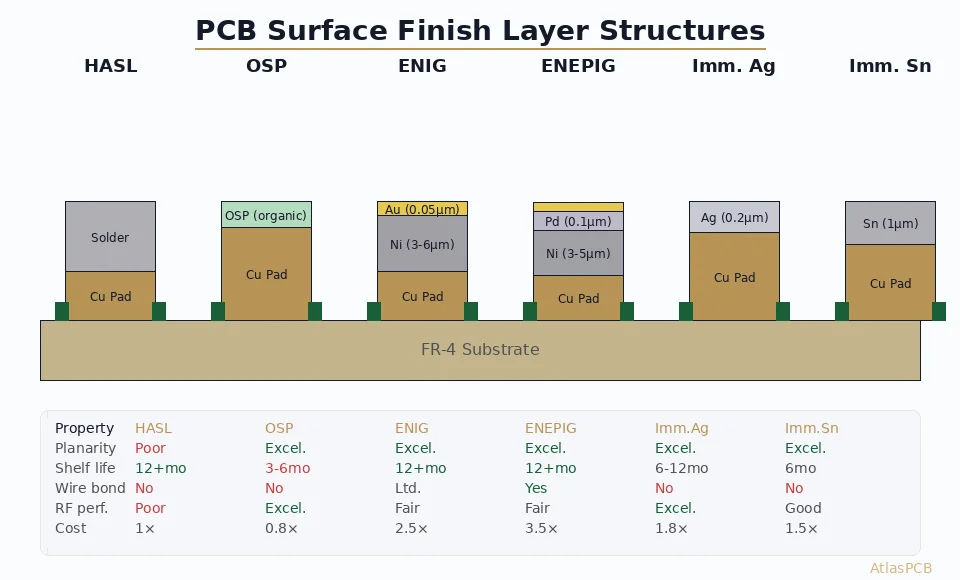
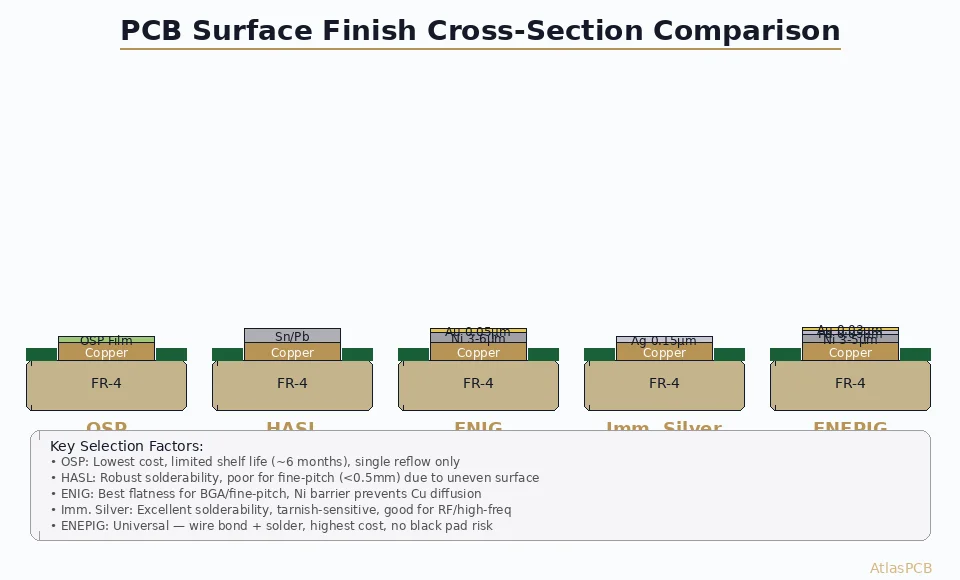
ENIG (Electroless Nickel/Immersion Gold) provides the best all-around performance for fine-pitch BGA, wire bonding, and long shelf life (12+ months), but costs 3-5× more than OSP. HASL offers excellent solderability at low cost but cannot support fine-pitch components below 0.5mm due to uneven surface topology. OSP is the lowest cost and flattest option but limited to 6-month shelf life and single-reflow reliability. Immersion Silver balances cost and performance for most SMT applications with flat topology and good solderability, though tarnish sensitivity requires controlled storage.
Introduction: Why Surface Finish Matters More Than You Think
The PCB surface finish is the last barrier between your copper traces and the outside world. Choose wrong, and you face soldering defects, corrosion, shelf life limitations, or assembly incompatibility. Choose right, and you get reliable solder joints, long inventory life, and compatibility with your entire component mix.
Yet surface finish selection is frequently an afterthought—checked off on a fabrication drawing without considering the full implications for assembly yield, storage requirements, and long-term reliability. This is a costly mistake. The $0.50-3.00 per board cost difference between finishes pales compared to assembly rework costs when the wrong finish meets a challenging component.
This guide provides a rigorous, data-driven comparison of the four most common PCB surface finishes: OSP, HASL, Immersion Silver, and ENIG. We cover the chemistry, performance characteristics, application limits, and total cost implications so you can make the right decision for your specific design.
Understanding Surface Finish Functions
A PCB surface finish serves three critical purposes:
- Oxidation protection: Prevents copper from forming non-solderable Cu₂O/CuO layers
- Solderability maintenance: Ensures reliable solder wetting during assembly
- Contact interface: Provides appropriate surface for electrical connections (test probes, connectors, wire bonds)
Key Performance Parameters
When evaluating finishes, these parameters determine suitability:
- Planarity (flatness): Critical for fine-pitch components
- Shelf life: How long solderability is maintained
- Multi-reflow capability: Survives multiple thermal cycles during assembly
- Solderability: Initial wetting force and spread characteristics
- Wire bond compatibility: Supports gold or aluminum wire bonding
- Cost: Raw material + process complexity
- Environmental impact: Lead content, waste stream management
OSP (Organic Solderability Preservative)
Process Overview
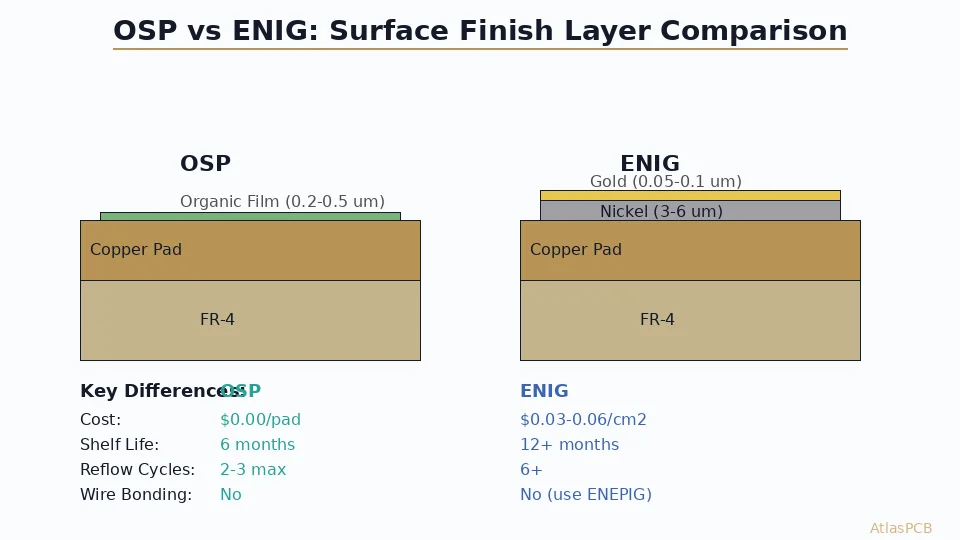
OSP applies a thin (0.2-0.5μm) organic coating—typically alkyl benzimidazole—to bare copper through a simple immersion process:
- Cleaning: Acid cleaner removes oxides and organics
- Micro-etch: Light copper etch (0.5-1μm) for surface activation
- OSP coating: Immersion in benzimidazole solution (30-50°C, 1-2 min)
- DI rinse and dry: Controlled drying prevents water spots
Performance Characteristics
Strengths:
- Flattest surface: <1μm variation—excellent for ultra-fine-pitch
- Lowest cost: $0.05-0.15/dm² processing cost
- Lead-free: No heavy metals in chemistry
- Simple process: Minimal equipment and chemistry management
- Re-workable: Can strip and re-coat if shelf life expires
Limitations:
- Short shelf life: 6 months maximum (3 months practical)
- Limited reflow cycles: Degrades with each thermal excursion
- ICT probe issues: Coating can interfere with test probe contact
- Humidity sensitive: Performance degrades rapidly above 60% RH
- No wire bonding: Copper surface not suitable for gold wire
- Visual inspection: Difficult to verify coating presence/integrity
Best Applications
- High-volume consumer electronics with rapid inventory turnover
- Single-sided reflow assemblies
- Cost-sensitive designs without fine-pitch BGAs requiring wire bonding
- Products assembled within 3 months of PCB fabrication
HASL (Hot Air Solder Leveling)
Process Overview
HASL immerses the PCB in molten solder (typically SAC305 for lead-free or Sn63Pb37 for SnPb):
- Flux application: Liquid flux coating protects copper during immersion
- Solder immersion: Board dipped in molten solder bath (250-260°C for SAC)
- Air knife leveling: High-pressure hot air blows excess solder, controlling thickness
- Cooling: Controlled cool-down prevents thermal shock
Performance Characteristics
Strengths:
- Excellent solderability: Metal-to-metal solder interface—best possible wetting
- Long shelf life: 12+ months with solder protection
- Self-healing: Minor surface damage re-flows during assembly
- Multiple reflow capable: Maintains solderability through 3-5 reflows
- Visual clarity: Bright, easily inspected surface
- Proven reliability: Decades of field history
Limitations:
- Uneven surface topology: Air knives create 10-30μm solder mounds
- Fine-pitch incompatible: >0.5mm pitch only due to bridging risk
- Thermal stress: 250°C+ immersion stresses thin boards and HDI structures
- Lead-free challenges: Higher melting point solder increases warpage risk
- Via fill interference: Solder can plug vias, affecting assembly
- Board size limitation: Large panels may warp during processing
Surface Planarity Data
| Pad Size | Average Solder Height | Variation |
|---|---|---|
| 2.0 × 2.0 mm | 15-25 μm | ±10 μm |
| 1.0 × 1.0 mm | 10-20 μm | ±8 μm |
| 0.5 × 0.5 mm | 8-15 μm | ±6 μm |
| 0.3 × 0.3 mm | Not recommended | N/A |
Best Applications
- Through-hole heavy designs (power supplies, industrial controls)
- Designs with components ≥0.5mm pitch only
- Products requiring long warehouse storage
- Legacy designs maintaining SnPb compatibility
- Budget-sensitive projects prioritizing solderability
Immersion Silver (ImAg)
Process Overview
Immersion silver deposits a thin (0.1-0.4μm) pure silver layer through galvanic displacement:
- Cleaning: Acid clean + micro-etch surface preparation
- Pre-dip: Prevents drag-in contamination to silver bath
- Immersion silver: Chemical displacement (Cu → Ag²⁺), 40-55°C, 1-3 min
- Anti-tarnish: Organic co-deposit or post-treatment for oxidation protection
- DI rinse and controlled drying
Performance Characteristics
Strengths:
- Excellent planarity: <3μm variation—suitable for fine-pitch
- Good solderability: Silver wets readily with standard fluxes
- Moderate shelf life: 6-12 months with proper storage
- Multi-reflow capable: Survives 2-3 reflows reliably
- Cost-effective: Mid-range pricing between OSP and ENIG
- Press-fit compatible: Good contact surface for press-fit connectors
- Aluminum wire bond capable: Supports Al wedge bonding
Limitations:
- Tarnish sensitivity: Sulfur compounds cause darkening and reduced solderability
- Creep corrosion risk: In sulfur-rich environments (industrial, automotive)
- Micro-void risk: Silver dissolution into solder can create Kirkendall voids
- Storage requirements: Anti-tarnish packaging recommended
- Planar micro-void (PMV): Possible champagne void formation under BGA joints
- Not suitable for Au wire bonding: Gold wire requires ENIG or electrolytic gold
Tarnish Prevention
Silver tarnishes when exposed to sulfur-containing gases (H₂S, SO₂, COS). Prevention requires:
- Vacuum packaging: Sealed bags with desiccant and anti-tarnish strips
- Controlled storage: <30°C, <60% RH, sulfur-free environment
- Limited exposure: Once unsealed, assemble within 8-24 hours
- Anti-tarnish chemistry: Modern ImAg processes include organic co-deposits that extend air exposure tolerance to 5-7 days
Best Applications
- Automotive electronics with moderate environmental requirements
- Fine-pitch SMT assemblies (0.3-0.4mm pitch BGAs)
- Mid-volume production with controlled inventory systems
- Designs requiring aluminum wire bonding
- Press-fit connector applications
ENIG (Electroless Nickel/Immersion Gold)
Process Overview
ENIG deposits a dual-layer coating: 3-6μm electroless nickel barrier followed by 0.05-0.12μm immersion gold for protection:
- Cleaning and micro-etch: Standard surface preparation
- Palladium activation: Catalyzes electroless nickel deposition
- Electroless nickel: Chemical reduction deposits Ni-P alloy (3-6μm, 7-9% P)
- Immersion gold: Galvanic displacement deposits Au (0.05-0.12μm)
- Rinse and dry: Controlled process to prevent gold contamination
Performance Characteristics
Strengths:
- Exceptional planarity: ±2μm—best for ultra-fine-pitch
- Longest shelf life: 12+ months with minimal precautions
- Excellent solderability: Gold protects nickel from oxidation indefinitely
- Multi-reflow capable: 5+ reflows without degradation
- Wire bond compatible: Supports both gold and aluminum wire bonding
- Contact surface: Suitable for membrane switches, test points
- Corrosion resistant: Nickel barrier protects copper in harsh environments
- Visual inspection: Gold surface easily verified
Limitations:
- Cost: 3-5× more expensive than OSP (nickel + gold chemistry + longer process)
- Black pad risk: Hyper-corrosion during gold deposition creates brittle Ni-P layer
- Phosphorus content sensitivity: Must maintain 7-9% P in Ni for optimal performance
- Solder joint reliability concern: Nickel-tin intermetallic (Ni₃Sn₄) can be brittle
- Signal loss at high frequency: Nickel is ferromagnetic—affects RF performance above 1 GHz
- Process complexity: Multi-step process with tighter controls than alternatives
Black Pad Defect
The most significant ENIG risk—black pad (also called black nickel)—occurs when:
- Gold deposition rate is too aggressive (high Au³⁺ concentration)
- Nickel surface is attacked during gold displacement reaction
- Creates porous, phosphorus-enriched nickel surface
- Results in brittle solder joints that fracture at the Ni-Sn interface
Prevention:
- Maintain immersion gold bath within specification (low Au concentration)
- Control nickel phosphorus content (7-9% target)
- Monitor gold deposition time (<12 minutes typical)
- Regular cross-section verification of Ni/Au interface
- [ENEPIG alternative]/blog/enepig-vs-enig-surface-finish-wire-bonding-en/) adds palladium barrier
Best Applications
- Fine-pitch BGA assembly (0.3-0.4mm pitch)
- Gold wire bonding for chip-on-board (COB) or die attach
- High-reliability aerospace, medical, and military applications
- Membrane switch and keypad contacts
- Long-term storage inventory (12+ months)
- Multi-reflow assemblies (double-sided SMT + wave solder + rework)
Not Sure Which Surface Finish to Specify?
AtlasPCB's DFM engineers review your BOM, assembly process, and reliability requirements to recommend the optimal surface finish. We support all major finishes including ENEPIG for combined wire bonding and soldering.
Get DFM Review →Head-to-Head Performance Comparison
Comprehensive Comparison Table
| Parameter | OSP | HASL (LF) | Immersion Ag | ENIG |
|---|---|---|---|---|
| Planarity | Excellent (<1μm) | Poor (10-30μm) | Very Good (<3μm) | Excellent (±2μm) |
| Shelf life | 6 months | 12+ months | 6-12 months | 12+ months |
| Reflow cycles | 1-2 | 3-5 | 2-3 | 5+ |
| Min pitch | 0.3mm | 0.5mm | 0.3mm | 0.3mm |
| Au wire bond | No | No | No | Yes |
| Al wire bond | No | No | Yes | Yes |
| ICT probing | Fair | Excellent | Good | Excellent |
| RF performance | Good | Fair | Good | Poor (>1GHz) |
| Cost (relative) | 1× | 1.5× | 2× | 3-5× |
| Lead-free ready | Yes | Yes (SAC) | Yes | Yes |
| Press-fit | Poor | Good | Good | Fair |
Solderability Retention Over Time
Based on J-STD-003 wetting balance testing:
Fresh (0 months):
- All finishes: >95% wetting within 2 seconds
After 6 months (controlled storage):
- OSP: 85-92% wetting (degrading)
- HASL: 98%+ wetting (stable)
- Immersion Ag: 90-95% wetting (minor degradation)
- ENIG: 98%+ wetting (stable)
After 12 months:
- OSP: Often fails J-STD-003 (not recommended)
- HASL: 95%+ wetting
- Immersion Ag: 85-92% wetting (depends on storage)
- ENIG: 97%+ wetting
Thermal Reliability (Accelerated Aging)
After 1000 thermal cycles (-40°C to +125°C):
- OSP + SAC305: 0.1-0.5% solder joint failure rate
- HASL + SAC305: 0.3-0.8% failure rate (IMC growth concern)
- ImAg + SAC305: 0.1-0.3% failure rate
- ENIG + SAC305: 0.2-0.5% failure rate (Ni₃Sn₄ brittleness at extremes)
Surface Finish Selection Decision Framework
Decision by Application Type
Consumer electronics (smartphones, tablets): → OSP for high-volume, fast-turn inventory → Immersion Silver if multiple reflows needed
Automotive electronics: → ENIG for under-hood (harsh environment, long storage) → Immersion Silver for body electronics (moderate environment) → Avoid OSP (unpredictable storage at dealerships)
Medical devices: → ENIG for implantable and Class III devices → Immersion Silver for Class I/II with wire bonding alternatives
Aerospace/Military: → ENIG or [ENEPIG]/blog/enepig-vs-enig-surface-finish-wire-bonding-en/) for maximum reliability → Tin whisker mitigation required (avoid pure tin finishes)
RF/Microwave designs: → Immersion Silver for best RF performance (no ferromagnetic nickel) → OSP acceptable for controlled environment applications → Avoid ENIG at frequencies >1 GHz (nickel loss)
LED lighting: → HASL for large pads and low-cost requirements → OSP for aluminum-substrate MCPCBs with quick assembly
Decision by Component Mix
| If your BOM includes… | Recommended Finish |
|---|---|
| BGAs ≤0.4mm pitch | ENIG or Immersion Silver |
| Wire bonding (Au) | ENIG (or ENEPIG) |
| Wire bonding (Al) | ENIG or Immersion Silver |
| Press-fit connectors | Immersion Silver |
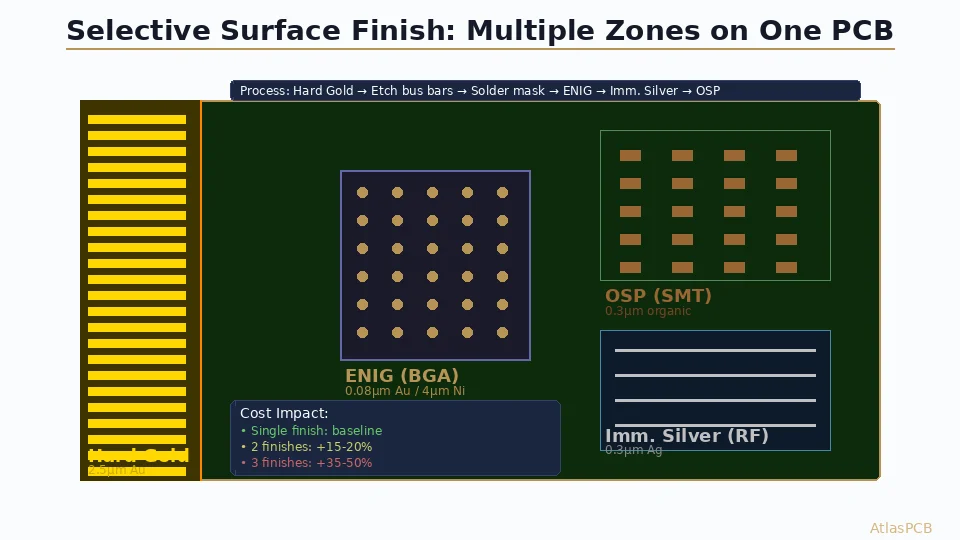
| Edge connectors | Selective gold plating (separate process) |
| RF components >1 GHz | Immersion Silver (avoid ENIG) |
| Through-hole only | HASL (cost optimal) |
| Mixed pitch (fine + coarse) | ENIG (universal compatibility) |
Cost Analysis and Total Cost of Ownership
Direct Process Cost
Per dm² PCB area:
- OSP: $0.05-0.15
- HASL (lead-free): $0.10-0.25
- Immersion Silver: $0.15-0.35
- ENIG: $0.30-0.75
Hidden Cost Factors
Storage-related costs:
- OSP requires climate-controlled storage + vacuum packaging
- Expired OSP boards need stripping and re-coating ($5-15/panel)
- ENIG and HASL require minimal storage investment
Assembly yield impact:
- OSP: 0.5-2% higher defect rate if boards exceed 3-month storage
- HASL: 1-3% additional defect rate on fine-pitch components (bridging)
- Immersion Silver: 0.3-1% additional defects if tarnished
- ENIG: 0.1-0.5% additional defects (black pad, if process not controlled)
Rework cost impact:
- HASL boards are easiest to rework (self-tinning during hot air)
- ENIG surfaces maintain solderability through multiple rework cycles
- OSP degrades with each thermal cycle, limiting rework options
Total Cost of Ownership Model
For a typical 4-layer, 100×100mm PCB in production volume (10,000 units):
| Cost Element | OSP | HASL | ImAg | ENIG |
|---|---|---|---|---|
| Surface finish | $0.50 | $1.00 | $1.50 | $3.50 |
| Storage/packaging | $0.30 | $0.05 | $0.15 | $0.05 |
| Yield loss (assembly) | $0.80 | $0.60 | $0.30 | $0.20 |
| Rework allowance | $0.40 | $0.20 | $0.25 | $0.15 |
| Total/board | $2.00 | $1.85 | $2.20 | $3.90 |
Note: HASL may be cheapest total cost for coarse-pitch designs; ENIG premium justified for reliability-critical applications.
Emerging Surface Finish Technologies
ENEPIG (Electroless Nickel/Electroless Palladium/Immersion Gold)
[ENEPIG]/blog/enepig-vs-enig-surface-finish-wire-bonding-en/) adds a palladium layer (0.05-0.3μm) between nickel and gold:
- Eliminates black pad risk
- Supports both gold and aluminum wire bonding
- Compatible with soldering and press-fit
- 20-30% cost premium over ENIG
Immersion Tin (ImSn)
Immersion tin provides excellent solderability at moderate cost:
- Good planarity and multi-reflow capability
- Risk: Tin whisker growth—not recommended for aerospace/military
- Shorter shelf life than ENIG (6-9 months)
- Copper diffusion into tin limits long-term storage
Direct Immersion Gold (DIG)
Newer process deposits gold directly on copper without nickel barrier:
- Eliminates nickel RF losses—ideal for high-frequency
- Thicker gold required (0.1-0.3μm) for adequate protection
- Higher gold cost but simpler process
- Limited adoption—still maturing
Conclusion: Making the Right Choice
Surface finish selection is not a one-size-fits-all decision. The right choice depends on your specific combination of:
- Component requirements (pitch, wire bonding, connectors)
- Storage timeline (weeks vs. months vs. years)
- Assembly process (single reflow vs. multi-reflow vs. selective solder)
- Operating environment (consumer, automotive, military, RF)
- Budget constraints (direct cost vs. total cost of ownership)
The pragmatic approach:
- If fine-pitch BGA + wire bonding + long storage → ENIG
- If fine-pitch BGA + moderate storage + cost-conscious → Immersion Silver
- If coarse-pitch + fast inventory turn + maximum cost savings → OSP
- If through-hole dominant + long storage + proven reliability → HASL
Don’t compromise surface finish to save $1-2 per board when assembly rework costs $15-50 per incident. Match the finish to your actual manufacturing and supply chain reality.
Need help selecting the right surface finish? AtlasPCB offers free DFM analysis for new projects, including surface finish recommendations based on your component mix, assembly process, and reliability requirements. Request a quote with our engineering team.
Further Reading
- [ENEPIG vs ENIG Surface Finish: Complete Comparison for Wire Bonding, Solderability, and Long-Term Reliability]/blog/enepig-vs-enig-surface-finish-wire-bonding/)
- [ENEPIG vs ENIG: Which PCB Surface Finish for Your Design?]/blog/enepig-vs-enig/)
- [PCB Surface Finish Selection — ENIG vs HASL vs OSP vs Hard Gold vs ENEPIG]/blog/pcb-surface-finish-enig-hasl-osp-hard-gold-enepig/)
- [mmWave PCB Material Selection: Rogers vs Megtron vs LCP for 5G and 6G Applications]/blog/mmwave-pcb-material-selection-rogers-megtron-lcp-5g-6g/)
- [Rogers PCB Fabrication: Material Sourcing, Lead Times & Quality Control]/blog/rogers-pcb-fabrication/)
- Rigid PCB Manufacturing
About AtlasPCB — We specialize in complex PCB manufacturing for HDI, RF, and high-reliability applications. Explore our HDI PCB manufacturing capabilities, RF and high-frequency PCB services, or get an PCB assembly services . Every order includes free engineering review. Get your quote.
Reviewed by AtlasPCB Engineering Team — IPC-certified manufacturing specialists with 15+ years of production experience in HDI, RF, and high-reliability PCB fabrication. Content based on factory floor data and real customer design reviews.
Frequently Asked Questions
Which surface finish is best for BGA packages with 0.4mm pitch?
How does surface finish affect PCB contact resistance in edge connectors?
Can OSP boards be reliably assembled after 3 months of storage?
- surface finish
- OSP
- HASL
- ENIG
- immersion silver
- PCB assembly
- solderability
- fine pitch