· Dr. Chen Wei · Engineering · 4 min read
Medical Device PCB Standards
Navigate medical device PCB requirements — IEC 60601 safety standards, FDA regulations, biocompatibility, creepage/clearance rules, and reliability considerations for medical electronics.

Quick Answer
Medical device PCBs must comply with IPC-6012 Class 3, IEC 60601 electrical safety, ISO 13485 quality management, and FDA 21 CFR Part 820 design controls. Material traceability, UL 94V-0 flammability, and biocompatibility (ISO 10993) may also be required for implantable devices.
Medical device PCBs carry a unique burden: patient safety. A failure in a medical PCB can directly harm or kill a patient. This demands the highest quality standards, rigorous testing, and complete traceability throughout the product lifecycle.
Regulatory Framework
FDA (United States)
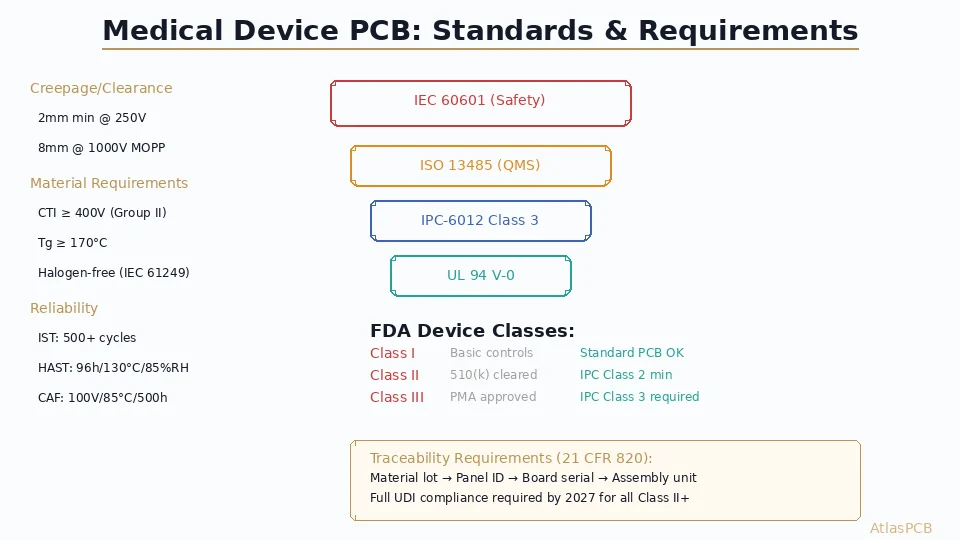
- Medical devices classified into Class I (lowest risk), Class II, Class III (highest risk)
- 510(k) premarket notification or PMA (Premarket Approval) required
- Quality System Regulation (QSR) 21 CFR Part 820 governs manufacturing
- Design History File (DHF) must document all design decisions including PCB specifications
EU MDR (European Union)
- Medical Device Regulation 2017/745 replaced the MDD
- CE marking required for EU market
- Technical documentation including PCB specifications
- Notified Body audit for Class IIa and above
IEC 60601-1 (Safety Standard)
The primary safety standard for medical electrical equipment. Key PCB-relevant requirements:
Creepage and Clearance:
| Insulation Type | Clearance (min) | Creepage (min) |
|---|---|---|
| Basic insulation | 2.5mm | 5.0mm |
| Supplementary | 2.5mm | 5.0mm |
| Double/Reinforced | 5.0mm | 8.0mm |
| 2x MOPP (patient contact) | 4.0mm | 8.0mm |
Design implications:
- Wide PCB traces or slots between mains circuits and patient circuits
- Conformal coating can reduce creepage requirements
- Board edge spacing for safety-critical circuits
PCB Quality Requirements
IPC Class 3 (Minimum)
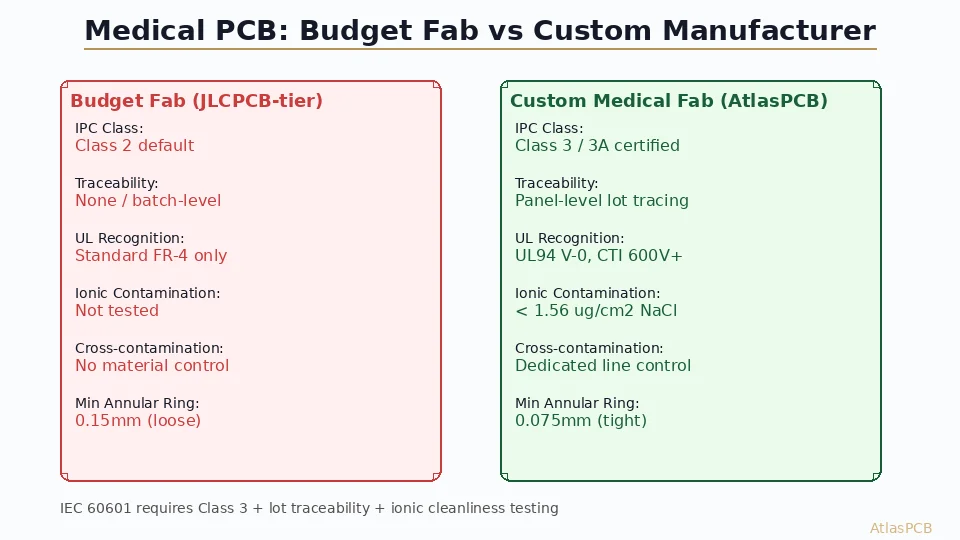
- Medical PCBs should be fabricated to IPC-6012 Class 3
- Life-support devices may require IPC-6012DM (medical addendum)
- Zero defect tolerance on critical features
Material Requirements
- Tg: >=170°C for lead-free assembly compatibility
- CTI: >=600V for safety creepage calculations
- Flammability: UL 94 V-0 rated
- Biocompatibility: ISO 10993 for implantable or patient-contact devices
- Moisture resistance: Low moisture absorption for sterilization compatibility
Traceability
- Full lot traceability from raw materials to finished PCBs
- Unique board identification (2D barcode or serial number)
- Retained samples from each production lot
- Records retained for product lifetime + 10 years (minimum)
Design Considerations
Safety Isolation
- Physical separation between patient-connected circuits and mains power
- Slots, cutouts, or board splits for reinforced insulation barriers
- Optocouplers or isolated DC-DC converters across isolation barriers
- Guard traces around high-impedance measurement circuits
ESD Protection
- Medical devices are frequently handled by staff
- IEC 61000-4-2 Level 4: +/-8kV contact, +/-15kV air discharge
- TVS diodes on all patient-facing I/O
- ESD-rated connectors for frequently plugged interfaces
Sterilization Compatibility
- Implantable PCBs must withstand sterilization methods:
- Autoclave: 134°C, 2 atm pressure, 18 minutes
- Ethylene oxide (EtO): low temperature but chemical exposure
- Gamma radiation: up to 50 kGy cumulative dose
- Conformal coating (parylene preferred for implantables) provides chemical and moisture barrier
Reliability
- MTBF (Mean Time Between Failures) calculations required
- FMEA (Failure Mode and Effects Analysis) for PCB-level failures
- Accelerated life testing (HALT/HASS) for critical devices
- Burn-in testing for life-support equipment
Specific Medical Applications
Patient Monitors
- Multi-channel analog acquisition (ECG, SpO2, EEG)
- Low-noise PCB design (analog/digital separation, low-noise power)
- IPC Class 3, IEC 60601 compliance
Implantable Devices (Pacemakers, Neurostimulators)
- Hermetic packaging (ceramic or titanium)
- Flex or rigid-flex PCBs (miniaturization)
- Biocompatible materials (ISO 10993)
- Extreme reliability requirements (10+ year implant life)
Diagnostic Imaging (MRI, CT, Ultrasound)
- High-speed data acquisition and processing
- EMI shielding critical (MRI magnetic field interference)
- Large, complex multi-layer boards
Surgical Robots
- Real-time control with ultra-low latency
- Redundant circuits for safety-critical functions
- Vibration and shock resistant design
Conclusion
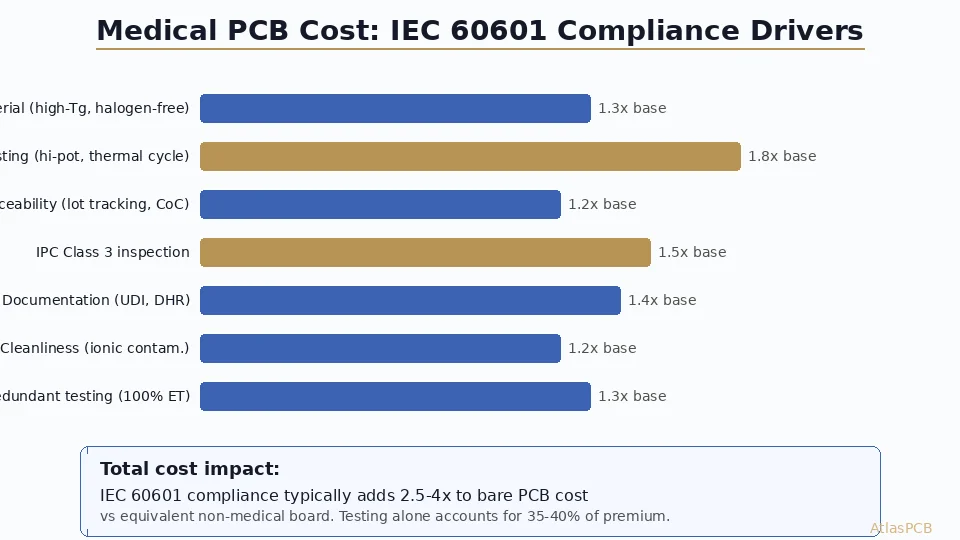
Medical PCB design requires a systems-level understanding of safety standards, regulatory requirements, and patient risk. Start with IPC Class 3 fabrication, follow IEC 60601 creepage/clearance rules, and implement complete traceability. Work with manufacturers who hold ISO 13485 (medical quality management) and have experience navigating FDA and EU MDR requirements. The cost of compliance is significant but far less than the cost of a product recall or patient harm.
Further Reading
[IPC Class 3 Requirements: The Complete Guide for Designers]/blog/ipc-class-3-requirements/)
[Rigid-Flex PCB Design: Stackup, Bend Rules, and Manufacturing Guidelines]/blog/rigid-flex-pcb-design/)
[EMC/EMI Design for PCBs: Passing Compliance on the First Try]/blog/emc-emi-pcb-design/)
[HDI PCB Design Guide: Stackup Rules, Via Structures & DFM Checklist]/blog/hdi-pcb-design-guide/)
[PCB Manufacturer with Engineering Review: Why Human DFM Audit Matters]/blog/pcb-manufacturer-engineering-review/)
About AtlasPCB — We specialize in complex PCB manufacturing for HDI, RF, and high-reliability applications. Explore our full PCB manufacturing capabilities, or get an instant online quote . Every order includes free engineering review. Get your quote.
Reviewed by AtlasPCB Engineering Team — IPC-certified manufacturing specialists with 15+ years of production experience in HDI, RF, and high-reliability PCB fabrication. Content based on factory floor data and real customer design reviews.
Frequently Asked Questions
What PCB class is required for medical devices?
What certifications does a medical PCB manufacturer need?
- medical PCB
- IEC 60601
- FDA
- safety standards